EACC & Member News

Taylor Wessing: The potential acquisition of Solvinity by a U.S. entity: risks to national security?

On November 7 2025, the proposed acquisition of Solvinity Group B.V. (“Solvinity”) by Kyndryl Nederland B.V. (“Kyndryl”) was announced, causing quite a stir in the Netherlands. Kyndryl is an American company that, through this acquisition, will become the owner of the company that manages the digital infrastructure behind DigiD. DigiD is used by millions of Dutch citizens to log in to websites of the government and organizations with a public mandate. The completion of the acquisition is subject to the completion of various approval procedures, including a review by the Investment Assessment Bureau (“BTI”).

Read more

EACC

European Commission | Commission consults Member States on proposal for a Temporary Crisis Framework

The European Commission is gathering the views of Member States on a draft proposal for a State aid Temporary Crisis Framework to support the EU economy in the context of the Middle East crisis, as announced on 13 April 2026 by President Ursula von der Leyen. The draft proposal is based on Article 107(3)(c) of the Treaty on the Functioning of the EU, which allows aid to develop specific economic sectors also in view of specific unexpected economic risks.
The Commission is consulting Member States to seek their views on a targeted and temporary framework to address the effects of the crisis on some of the most exposed sectors of the economy, such as agriculture, fishery, road transport and intra-EU short sea shipping. The draft proposal also includes a temporary adjustment to the Clean Industrial Deal State aid Framework (CISAF) allowing for higher aid intensities to address electricity price spikes.
The draft proposal under consultation proposes to allow Member States to grant:

Calibrated temporary support for the most exposed sectors:

covering part of the price increases for fuel or fertilisers, as compared to before 28 February 2026, based on beneficiaries’ consumption, and
a simplified measure allowing a limited amount of aid per company (except for EU short sea shipping). On this basis, Member States may rely on relevant statistics to avoid individual tracking of actual consumption.

An increased maximum aid intensity for the electricity costs for energy-intensive industries under Section 4.5 of the CISAF, above the existing maximum of 50%.

In addition, the Commission stands ready to assess, on a case-by-case basis and subject to several requirements, temporary measures that may include subsidising the fuel cost of gas-fired electricity generation to reduce overall electricity costs.
The Commission is also asking additional questions to Member States about the measures in the draft framework and on whether any further measures are required to address the effects of the crisis. Member States now have the possibility to comment on the Commission’s draft proposal and answer these questions. The Commission will quickly assess the responses, with the aim of adopting a Temporary Framework by the end of April.
Background
State aid rules enable Member States to take swift and effective action to support citizens and companies, in particular SMEs, facing economic difficulties due to current situation in energy markets.
The proposed Temporary Energy Crisis Framework would complement the ample possibilities for Member States to design measures in line with existing EU State aid rules, in particular those under the CISAF.
Member States also continue to be able to implement State aid measures under the General Block Exemption Regulation, without the need to notify them to the Commission.


Compliments of the European CommissionThe post European Commission | Commission consults Member States on proposal for a Temporary Crisis Framework first appeared on European American Chamber of Commerce New York [EACCNY] | Your Partner for Transatlantic Business Resources.

Read More
EACC

IMF | Cushioning the Middle East War Shock

Speech by IMF Managing Director Kristalina Georgieva at the 2026 Spring Meetings in Washington, DC
Good morning.
A resilient world economy is being tested again by the now-paused war in the Middle East. The conflict has caused considerable hardship around the globe. My heart goes out to all people affected by this war and all wars.
When we welcome ministers and central bank governors to our Spring Meetings next week, our focus will be on how best to weather this latest shock and ease the pain on economies and people.
This requires understanding the nature of the shock, the channels through which it affects the economy, the size of the impact, and the policies that can mitigate it.
So what hit us? A supply shock that is:

Large, with the world’s daily oil flow cut by some 13 percent, and its LNG flow by some 20 percent;
Global, with all of us now paying more for energy and with supply chains disrupted across the world;
And asymmetric, with its impact depending on proximity to the conflict, whether you are an energy exporter or importer, and your policy space.

As always, a negative supply shock pushes prices up. As a point of reference, Brent jumped from $72 per barrel on the eve of hostilities to a peak of $120. Thankfully, oil prices have fallen, but they remain much higher than before the war—and many countries are paying high premiums for access to precious supplies.
Spare a thought for the Pacific Island nations at the end of a long supply chain, wondering if fuel will still reach themin the wake of such a severe disruption.
The supply interruptions have had—and will for some time continue to have—ripple effects, such as:

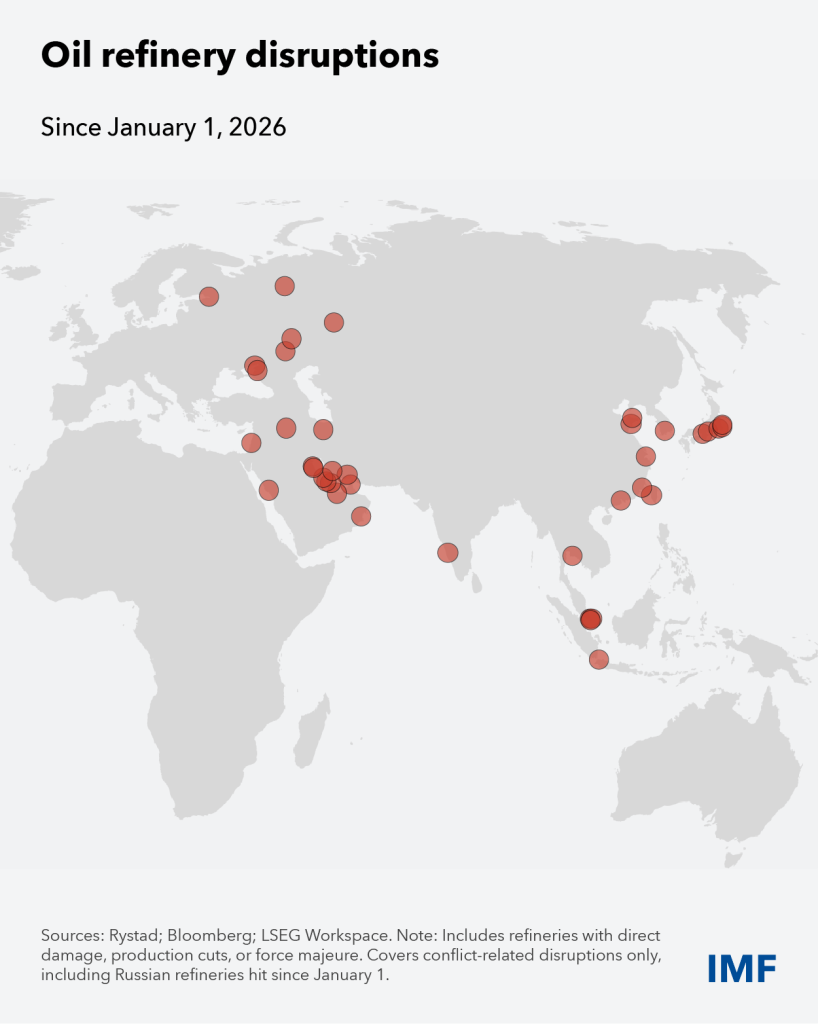
Oil refinery disruptions given the need to maintain minimum flow rates, with warning lights flashing red in many far-flung places;

Shortages of refined products including diesel and jet fuel, which have disrupted transportation, trade, and tourism in a world more interconnected than ever;

Food insecurity for another 45 million people given the transport issues—taking the total number of people in hunger to over 360 million—with the problem potentially worsening over time because of higher fertilizer prices;
And supply chain disruptions given industrial dependencies such as on sulfur, helium for silicon chipmaking and MRI imaging, and naphtha for plastics.

The second question is: how can this shock play out? Through three main channels:

First: the price impact and supply shortages. Higher prices for key inputs feed into many consumer goods, lifting inflation. This, coupled with shortages, reduces demand by brute force.
Second channel: inflation expectations. These can break anchor and ignite a costly inflation process. Here is the distribution of near-term inflation forecasts for the U.S.; notice how the curve has moved to the right, indicating higher short-run inflation expectations. And here is the curve for the euro area; it also moves right, and it widens, indicating higher uncertainty. Fortunately, longer-run expectations have not budged—this is very good and very important.

Third channel: financial conditions. From a highly supportive starting point, these tightened, in an orderly manner. Emerging market bond spreads widened substantially; equity prices adjusted; and the dollar appreciated. And now we see some easing.

We have been here before in the 1970s and earlier this decade. We know eventually a significant part of the shock will dissipate, leaving us in a new equilibrium. Supply recovers and demand adjusts. New capacity comes on stream. Energy efficiency rises.
As proof, please appreciate how the world has become progressively less energy intensive since the 1980s, which cushions the shock. Renewable energy increased its share, yet oil remains our number one fuel.

As the world responds, it is important that we maintain our collective quest for energy efficiency and energy diversification. Different countries have different paths to energy security, but all must strive for it.
Let me move to the third question: how large is the growth impact?
The answer very much depends on whether the ceasefire holds and leads to lasting peace and how much damage the war leaves in its wake.
Given the uncertainties, our World Economic Outlook, to be published next week, will include a range of scenarios, going from a relatively swift normalization, to a middle scenario, to one where oil and gas prices stay much higher for much longer and second-round effects take hold.
All these scenarios start from a situation where strong AI and tech investment, supportive financial conditions, and other factors were driving considerable momentum in the world economy.
In fact, had it not been for this shock, we would have been upgrading global growth.
But now, even our most hopeful scenario involves a growth downgrade. Why? Because of significant infrastructure damage, supply disruptions, losses of confidence, and other scarring effects.
Take Qatar’s Ras Laffan complex—a tremendously important example of strategic investment done right; producer of 93 percent of the Gulf’s LNG, some 80 percent of it going to Asia-Pacific, a region that now endures serious fuel shortages. Ras Laffan has essentially been shut since March 2, took direct hits on March 19, and could take 3‒5 years to restore to full capacity.

Even in the best case, there will be no neat and clean return to the status quo ante.
Another relevant fact: see how ship passages through Bab-el-Mandeb on the Red Sea have never quite recovered  from the devastating disruptions there—they remain stuck at about half their 2023 level.

So the reality is, we don’t truly know what the future holds for transits through the Strait of Hormuz or, for that matter, for the recovery of regional air traffic.
What we do know is that growth will be slower—even if the new peace is durable.
And we also know there are significant variations across the world. Countries able toexport oil and gas undisturbed are the least affected. In contrast, countries directly disrupted by the war—including oil and gas exporters who suffered the blockade—and countries relying on imported oil and gas, still bear the brunt of the impact.
How bad this impact will be will depend, in no small measure, on how much policy space countries have, including oil and gas reserves, given the five-week gap we have seen in tanker traffic from the Gulf.
Let me walk you through a few key charts to illustrate three points of differentiation:

First, let’s separate the world into oil importers on the left and oil exporters on the right. As the pile-up of dots on the left shows, over 80 percent of countries are net oil importers.

Second, let’s highlight countries directly hit by this war. Note how the hits have disproportionately fallen on major oil exporters—although the red dots on the left remind us of the war’s toll on regional non-oil economies as well.
Third, let us add a vertical scale for countries’ sovereign credit ratings, as a proxy for policy space. The bottom left is where we find vulnerable oil importers. Let’s color Sub-Saharan Africa in yellow, and small-island nations in orange. Notice how these two sets of countries largely fill that quadrant of vulnerability—they will very much be in our focus next week.

And yet, with oil being a global commodity, even oil exporters far from the affected region and enjoying terms-of-trade gains have felt the effects of costlier oil.
Let me move to the last question: what should countries do?
A word of caution upfront: this being a classic negative supply shock, demand adjustment is unavoidable.
Policymakers can help in multiple ways, and—certainly—they must be careful not to make things worse. So here I appeal to all countries to reject go-it-alone actions—export controls, price controls, and so on—that can further upset global conditions: don’t pour gasoline on the fire.
Beyond that, as in past shocks, alertness and agility are key. The challenge will be to detect if and when changing conditions take us from one state of the world to another:

For now, there is value inwaiting and watching, with central banks stressing their commitment to price stability but otherwise staying on hold—with a stronger bias to action if credibility is in question. Fiscal authorities should provide targeted and temporary support to the vulnerable, aligned with their medium-term fiscal frameworks.
Next, if inflation expectations threaten to break anchor and ignite a costly inflation spiral, then central banks shouldstep in firmly with rate hikes. Fiscal support should remain targeted and temporary. Rate hikes, of course, would further dampen growth—that’s how they work.
Finally, if a severe tightening of financial conditions adds a negative demand shock to the supply shock, then monetary policy returns to a delicate balancing act while fiscal policy—if and only if there is fiscal space—switches to well-calibrated demand support.

Let us have a quick look at what hasactually been happening out there.
In monetary policy, markets have been expecting major central banks to tighten their policy stance. Here we see four key market-implied policy rate paths, each showing an upward shift.

In energy policy, we see many countries putting in place emergency conservation measures—from general campaigns, to limits on private vehicle use, to remote work. These and other steps are well-documented in the International Energy Agency’s energy policy tracker, which is summarized here.

Such information-sharing, let me add, underscores why we have joined forces with the IEA and the World Bank to form a coordination group within which the IMF will lead on the macroeconomics.
And finally, coming back to fiscal policy, we see that most countries have appropriately held the line, avoiding untargeted tax cuts, energy subsidies, and price-based measures, although a few have chosen to deliver broad-based support. Again we see the IEA summary here.
We will point out that measures that mute the price signal also mute the necessary demand response, resulting in higher global energy prices. And we will work with countries to help them target their fiscal support and craft effective sunset clauses for temporary measures.
As we do so, we will also stress that it is important for fiscal and monetary policies to not pull in opposite directions.
Already, the world has seen benchmark yield curves rising, driving up the cost of debt. Adding deficit-financed stimulus to this mix at this moment would increase the burden on monetary policy and amplify such shifts. It would be like driving with one foot on the accelerator and one on the brake—not good.

As we will flag in our forthcoming Fiscal Monitor, the world has a fiscal space problem. Public debt is generally much higher than 20 years ago—including in most G20 countries—reflecting widespread neglect of fiscal consolidation in the periods when conditions permitted it.

As a result, interest payments are rising as a share of revenue at all income levels. The implication is clear: all countries must deploy their limited fiscal resources responsibly, and most must move decisively to rebuild fiscal space after this shock. I cannot emphasize this enough.

Let me move to financial sector policies. As our Global Financial Stability Report will insist, it is essential that financial regulators and supervisors be alert, nimble, and responsive to a fluid situation.
Financial conditions have been highly accommodative for some time, spurred by tech optimism and new financial intermediaries, many of them nonbanks. While this has lifted growth, it also creates risks of reversal. If investors were to start worrying about energy insecurity holding back the growth of AI, for example, given AI’s huge energy needs, then we could find ourselves in a spot of trouble.
Micro- and macro-prudential policies must work to reduce financial stability risks and ensure a resilient system.
With that, I want to stress the most important lesson of all: good policies make a difference. There are forces countries can’t control, but they do have authority over their own policies and institutions.
Take heed: the strength and agility of your fundamentals is your best defense when shocks come—and come they will.
And, as you deal with the long tail of the current shock, do not forget to steer the great global transformations in technology, demographics, geopolitics, trade, and climate and build a better future. Your structural and regulatory policy choices underpin productivity and long-run growth—and growth potential matters enormously for stability.
For us at the IMF, supporting you to build strong policies and institutions, this is our raison d’être. And, as the firefighter, we are here for you when crisis hits.
Once more, let’s take into our lens the vulnerable oil importers of the world, those rated in the speculative grade, and let’s color in blue all countries with IMF-supported programs. We can scale these programs up if needed and—be sure—there are more programs to come.

Given the spillovers of the Middle East war, we expect near-term demand for IMF balance-of-payments support to rise by somewhere between $20 billion and $50 billion, with the lower bound prevailing if the ceasefire holds.
Two points worth noting here. One, this range would be much higher were it not for the sound policymaking of many emerging market economies—including some of the largest ones—over the decades. And two, we are well resourced to meet this shock.
So, yes, our 191 member countries can count on us to support them with financing if needed. And they can count on us to bring them together to find a path forward through the fog of uncertainty. This is what next week will be about.
Thank you, and let us hope for lasting peace in the Middle East and everywhere—because war takes away everything that we work for.
 
 
Compliments of the International Monetary FundThe post IMF | Cushioning the Middle East War Shock first appeared on European American Chamber of Commerce New York [EACCNY] | Your Partner for Transatlantic Business Resources.

EACC

ECB | Europe’s Fossil Fuel Dependence Poses Risks to Price Stability

Blog | Europe’s energy dependence increasingly complicates the task of maintaining price stability. Meeting the continent’s clean‑energy targets would weaken the link between volatile global markets and domestic prices. Crucially, the tools to make this transition are already within reach.
Europe’s energy dependence has become one of the critical vulnerabilities of our economy. Recent energy price shocks have transferred vast resources out of Europe, prompted emergency interventions and strained public finances. These costs are real, recurring and largely wasted.
Energy policy is the responsibility of elected governments, and rightly so. But Europe’s energy dependence also has profound implications for the ECB. Our primary mandate is price stability. Yet repeated energy price shocks make achieving this objective increasingly difficult.
Why do central banks care?
Europe remains among the advanced economies most reliant on imported fossil fuels. This vulnerability was starkly exposed following Russia’s unjustified invasion of Ukraine, when energy prices surged, pushing euro area inflation up to 10.6% in October 2022 and giving rise to what some aptly described as “fossilflation”.
Recent geopolitical tensions have highlighted how little this dependence has changed, with the conflict in the Middle East triggering another surge in European energy costs. The March 2026 ECB staff macroeconomic projections outline how this external shock could increase inflation and decrease growth.
This is a complex scenario for us to manage. Tightening monetary policy to contain inflation can deepen an economic slowdown, while loosening policy to support growth can entrench inflation.
In theory, central banks can look through temporary supply shocks, provided they do not spill over into broader and more persistent price pressures, inflation expectations remain anchored and wage-price spirals do not emerge. But repeated and persistent energy shocks test all these conditions, as ECB President Christine Lagarde highlighted in her recent speech.
Transition now – or pay more later
Europe cannot eliminate geopolitical risk, but it can significantly reduce its exposure to it. The most effective way to do that is by cutting reliance on imported fossil fuels and accelerating an orderly shift to home‑grown clean energy. If Europe were to meet its sustainable energy targets, the link between domestic energy prices and volatile global energy markets would weaken substantially.
Spain’s transition to renewable energy demonstrates the benefits of clean energy investment: estimates from the Banco de España indicate that wholesale electricity prices in early 2024 were approximately 40% lower than they would have been had wind and solar generation remained at 2019 levels.
Broader implementation of these strategies would mean fewer shocks to households, firms, public finances and financial markets – and ultimately greater macroeconomic and price stability.
Some argue that such a transition is prohibitively expensive. It is true that according to the European Commission, investment will need to reach around €660 billion per year between 2026 and 2030. But focusing only on these costs is profoundly misleading.
Investing in clean, sustainable energy replaces substantial spending on fossil fuels. Today, Europe spends nearly €400 billion each year on fossil fuel imports. By contrast, the marginal cost of producing home‑grown renewable energy is structurally lower. Once the infrastructure is in place, the energy itself is virtually free.
As a result, the adoption of domestically produced, clean and sustainable energy delivers far more than just climate benefits. It strengthens macroeconomic stability, lowers long‑term costs, supports economic growth, delivers health benefits and enhances Europe’s strategic autonomy – as recently highlighted in a speech by President Lagarde.
New analysis from the UK Climate Change Committee shows that for every pound invested in sustainable energy, the benefits outweigh the costs by a factor of 2.2 to 4.1. So it is no surprise that recent reports, including Mario Draghi’s “The future of European competitiveness”, identify decarbonisation as a core pillar of Europe’s long‑term economic strategy.
The choice is clear, if not easy
Fortunately, the tools needed to make this transition are within reach. It requires large upfront investments, deep and well‑functioning capital markets, and a predictable policy environment. Progress on the savings and investments union will be essential to mobilise capital at the necessary scale.
Policy certainty, combined with the right incentives, is essential to ensure that long-term perspectives are prioritised over short-term gains, and public and private objectives reinforce rather than undermine one another. This starts with delivering on existing decarbonisation targets and preserving the Emissions Trading System as a credible, market‑based instrument for carbon pricing.
None of this is easy. But the real question is no longer whether Europe can afford to make the energy transition. It is whether it can afford not to. From a central banking perspective, the answer is clear.
 
 
Compliments of the European Central Bank The post ECB | Europe’s Fossil Fuel Dependence Poses Risks to Price Stability first appeared on European American Chamber of Commerce New York [EACCNY] | Your Partner for Transatlantic Business Resources.
EACC

World Bank | Joint Statement by the Heads of the International Energy Agency, International Monetary Fund, and World Bank Group

 The Heads of the International Energy Agency, International Monetary Fund, and World Bank Group have agreed to form a coordination group to maximize their institutions’ response to the energy and economic impacts of the war in the Middle East. They issued the following joint statement:
The Middle East war has caused major disruptions to lives and livelihoods in the region and triggered one of the largest supply shortages in global energy market history. The impact is substantial, global, and highly asymmetric, disproportionately affecting energy importers, in particular low-income countries. It is already transmitted through higher oil, gas and fertilizers prices, and is triggering concerns about food prices as well. Global supply chains—including of helium, phosphate, aluminum, and other commodities—are affected, as is tourism due to flight disruptions at key Gulf hubs. The resulting market volatility, weakening of currencies in emerging economies, and concerns about inflation expectations raise the prospect of tighter monetary stances and weaker growth.
At these times of high uncertainty, it is paramount that our institutions join forces to monitor developments, align analysis, and coordinate support to policymakers to navigate this crisis. This is especially the case for countries that are most exposed to the downstream impacts from the war and those confronting more limited policy space and higher levels of debt. To ensure a coordinated response, we have jointly agreed to form a group that will:
(i)  Assess the severity of impacts across countries and regions through coordinated data sharing on energy markets and prices, trade flows, fiscal and balance of payments pressures, inflation trends, export restrictions of key commodities, and supply chain disruptions.
(ii)  Coordinate a response mechanism that may include: targeted policy advice, assessment of potential financing needs and related provision of financial support (including through concessional financing), and use of risk mitigation tools as appropriate.
(iii)  Mobilize relevant stakeholders, including other multilateral, regional, and bilateral partners, to deliver a coordinated and efficient support to countries in need.
The group will work with, and draw on, other international organizations’ expertise as needed.
We are committed to working together to safeguard global economic and financial stability, strengthen energy security, and support affected countries and people on their path to sustained recovery, growth, and job creation through reforms.

About the International Energy Agency
The International Energy Agency, the global energy authority, was founded in 1974 to help its Member countries coordinate collective responses to major oil supply disruptions. Its mission has expanded and evolved since, and rests today on three main pillars: working to ensure global energy security; expanding energy cooperation and dialogue around the world; and supporting a secure, affordable and sustainable energy future. For more information, visit https://www.iea.org/.
About the International Monetary Fund
The IMF is a global organization that works to support economic growth and prosperity for all of its 191 member countries. It does so by supporting economic policies that promote financial stability and monetary cooperation, which are essential to increase productivity, job creation, and economic well-being. The IMF is governed by and accountable to its member countries. For more information, visit  https://www.imf.org
About the World Bank Group
The World Bank Group works to create a world free of poverty on a livable planet through a combination of financing, knowledge, and expertise. It consists of the World Bank, including the International Bank for Reconstruction and Development (IBRD) and the International Development Association (IDA); the International Finance Corporation (IFC); the Multilateral Investment Guarantee Agency (MIGA); and the International Centre for Settlement of Investment Disputes (ICSID). For more information, please visit www.worldbank.org, ida.worldbank.org/en/home, www.miga.org, www.ifc.org, and www.icsid.worldbank.org.The post World Bank | Joint Statement by the Heads of the International Energy Agency, International Monetary Fund, and World Bank Group first appeared on European American Chamber of Commerce New York [EACCNY] | Your Partner for Transatlantic Business Resources.

Read More
EACC

IMF | Global Imbalance: Old Questions, New Answers?

Blog | Widening global current account imbalances are best addressed by simultaneous domestic policy adjustments. Industrial policy and tariffs offer a costly fix with unreliable effects on imbalances.
Global current account imbalances are widening again, reversing a decade of steady decline following the global financial crisis. History suggests a clear risk: widening imbalances have often been accompanied by concentrated and lower-quality growth, triggered sectoral dislocations across trading partners, and preceded financial crises or abrupt reversals of capital flows. With the global economy already absorbing multiple shocks, such a disorderly adjustment could be exceptionally costly.
This renewed widening has revived questions about which policy tools can meaningfully impact external positions. In particular, the recent expansion of industrial policies and the proliferation of trade restrictions have diverse economic and non-economic motives, but are often justified by the objective of reducing current account imbalances. Yet there is limited analytical and empirical clarity on how these policies affect external balances.

Saving and investment
For any economy, the current account reflects the difference between what its people, businesses, and government save and invest. This concept anchors the IMF’s long-standing analytical framework for external sector assessments.
Policies affect the current account to the extent that they alter saving or investment. This depends not just how policies affect activity today, but also how they shift expectations. Personal saving rises when people expect income to decline, and it falls when they expect increased income. Companies invest based on their outlook for returns, not just today’s profitability. This insight is central to understanding why many trade and industrial policies often have limited or counterintuitive impacts on the current account.
We can see how standard macroeconomic policies have driven some of the recent increase in global imbalances: bigger budget deficits and robust consumer spending have lowered saving in the United States, while weaker demand and higher saving in China have followed its real estate slowdown.
Of course, positive or negative current account balances are not inherently undesirable, as they can reflect structural factors such as countries saving more as their population ages. It is also important to bear in mind that the relevant metric for assessing imbalances is the overall current account position of a country against the rest of the world, not bilateral or sectoral balances. Nor are imbalances simply about misaligned exchange rates and price competitiveness. A meaningful diagnosis requires a full macroeconomic assessment of influences on saving and investment, including policy drivers and structural forces.
Policy details matter 
Tariffs have been justified as a way to narrow trade deficits. However, our analysis finds that they have only small and unreliable effects on the current account because they are often perceived as permanent or are frequently retaliated against. In such cases, people do not adjust saving in anticipation of future price changes. The result is a nearly unchanged current account.
There is one important exception: temporary tariffs can raise saving by encouraging people to postpone consumption. In theory, this can increase the current account balance, though such episodes are rare, and empirical evidence suggests the effects are modest and short-lived.
Industrial policies are more diverse—and so are their effects. We distinguish two types of industrial policies: micro, which target specific companies or sectors, and macro, which are economy-wide policies that are often combined with financial or capital account restrictions.
Micro industrial policies—such as subsidies for a specific industry or targeted tax incentives—generally have ambiguous and limited effects on the current account. When they succeed in raising aggregate productivity, they tend to boost investment and consumption, often lowering the current account balance. When they fail, for example by misallocating resources and depressing productivity, they can increase the current account balance, but at the cost of lost output. Either way, large and systematic effects on external balances are uncommon.
Macro industrial policies, by contrast, can have larger effects. These strategies, often associated with export-led growth models, combine foreign asset accumulation, capital flow restrictions, financial repression, or other mechanisms that boost national saving. These policies work not by improving efficiency but by forcing saving, often at the expense of economic welfare. The current account balance increases, but mainly because domestic demand is restrained and resources are redirected toward external surpluses.
The conclusion is clear: industrial policies and tariffs are not shortcuts to external rebalancing. When they affect the current account, they often do so by suppressing consumption or investment—hardly a recipe for sustainable growth. Durable rebalancing still depends on sound domestic policies, not trade barriers.
Future imbalances and output
Applying our findings to the current economic picture, scenario analysis shows that global imbalances could widen further if trends persist. This would reflect continued large fiscal deficits and strong domestic demand in the United States, additional government support to exporters in China alongside weaker safety net provision and consumption, and subdued investment and weak productivity growth in Europe. In this setting, an escalation of tariffs does little to change current account positions, largely because these measures are reciprocated or perceived as permanent, but it does lower output across regions.
By contrast, an alternative scenario anchored in domestic rebalancing—fiscal consolidation in deficit countries, more consumption‑led growth in surplus economies, and productivity‑enhancing investment elsewhere—would narrow global imbalances and raise global output.
This synchronized adjustment would lead to the best outcome for the global economy. The economic drag from US fiscal tightening would be offset by stronger demand from China and Europe. But even if such coordination proves difficult, the best course of action for each country is clear: start addressing domestic imbalances now, regardless of what others do. Delaying adjustment poses a threat to domestic and global economic stability. Unilateral adjustment will also add pressure for other economies to adjust. Stronger domestic demand in China, by lifting global demand, would increase global interest rates and make fiscal adjustment more likely in other regions such as the United States. Fiscal consolidation in the United States could further stoke deflationary forces in China and incentivize efforts to boost consumption.
What is clear is that global imbalances will be shaped by domestic macroeconomic trajectories and policies rather than by tariffs or narrowly targeted industrial policies. It’s also evident that reducing global imbalances works best when countries move together. The IMF, though its analysis, policy advice, and convening power, can help its members move toward this better outcome.
 
 
Compliments of the International Monetary FundThe post IMF | Global Imbalance: Old Questions, New Answers? first appeared on European American Chamber of Commerce New York [EACCNY] | Your Partner for Transatlantic Business Resources.

EACC & Member News

Bird & Bird: European Blockchain Sandbox – supporting FinTech innovation and compliance

The European Blockchain Sandbox (‘Sandbox’), a European Commission initiative, concluded its work with the publication of the 3rd cohort best practices report in February 2026. The Sandbox provided a pan-European framework enabling cross-border regulatory discussions between blockchain/DLT innovators from both the private and public sectors with regulators and authorities on national and EU level.

Read more