


Department of Homeland Security Released a proposed rule which would eliminate the 60-day grace period after U.S. employment ends.
17
Sep
Department of Homeland Security Released a proposed rule which would eliminate the 60-day grace period after U.S. employment ends.
The probability of AI extinguishing humanity in the upcoming decade amounts to 10 % – according to an AI researcher at Anthropic. Consequently, Anthropic’s CEO Dario Amodei called for slowing down the pace of development. His three-step approach includes external audits of security practices, cooperation amongst AI developers and global regulation through international cooperation. Sam Altman, CEO of Open AI, and Elon Musk agreed with the proposal. But Amodei’s recommendations have also set off antitrust alarms in the US Federal Trade Commission.
The State of the Union (SOTEU) address is an annual speech by the President of the European Commission to the European Parliament, setting the priorities for the Union for the year ahead.
President Metsola, Prime Minister Carney, Honourable Members,
‘It was the best of times, it was the worst of times.‘ This is how Charles Dickens describes Europe in the days of the French Revolution. And it is also a fair description of the world we live in. The speed of change is incredible. The challenges exceptional. So if I look at Europe today, my take is this: the state of our Union is the strongest it has ever been. The state of our Union can also feel as precarious as it has ever been.
These two statements may seem incompatible. But they are both true. And they reflect these exceptional times. This complex age of great possibilities and great perils, which all countries are seeking to navigate.
In this world, Europe has chosen to forge its own path. And a stronger, independent Europe is now emerging.
This is a Europe that is securing its prosperity. One that is breaking free from its toxic dependency on Russian fossil fuels. That has become the greatest trading power on the planet. That is transforming its industrial policy while upholding our unique social model.
This is a Europe better able to defend itself than ever before. One that has radically overhauled its approach to securing our homelands. That has increased defence spending by almost 80 % in the last five years alone.
This is a Europe that stands up for each other. As we are doing by standing with Ukraine as it fights for its future and for our freedom. Or when we stood up for Greenland when it was threatened. Or when drones, hybrid attacks or disinformation target our democracies.
All of this proves one thing. That Europe is there for Europeans. And that in the cold fragility of today’s world, only Europe can provide true sovereignty to Europeans.
And therefore, Honourable Members, this is a Europe we can be so proud of.
At the same time, we all know the threats that we are facing. As old assumptions and relationships have frayed, we are now dealing with an openly hostile world. A territorial war of aggression is raging on our continent; others have erupted nearby. A fight for industrial capacities is shaping global competition. And a battle of narratives is seeking to weaken confidence in Europe; to paralyse our democracies.
But people’s worries are not only linked to these big, global threats. The effects of the many crises are present for many European families, not least on the cost of living or housing. The dizzying speed of change and technology is impacting our jobs, our livelihoods and our society. And it is also having a profound effect on our democracy and our discourse.
We see this in the rise of the extreme, the decline of nuance – even in the way that we relate to each other.
These real concerns are being weaponised to drive a wedge between us. Sometimes from the outside – and too often from the inside. But our path is clear. Building an independent Europe that has the power to act. Nothing can divert us from this. Because in this world, the fate of Europe must remain in the hands of Europeans.
So our choice is clear. Do we want a strong and independent Europe that stands up for its values in this world? Or do we let divisions and dependencies hold us back? Do we want to rally around our European idea that together we can decide our own destiny? Or do we let our democracies be undermined by the proxies and puppets of authoritarians?
Whether it is the ultranationalists or the anti-Europeans, whether it is Russian interference or disinformation, the names may be different, but their goal is the same. They despise our values, and they want to shatter our European unity. So let’s not only fight back against that, let’s fight together for our European idea.
Honourable Members,
Our economy has withstood the impact of the Middle East wars better than expected. And unemployment is at near-record lows. But the pressures from higher energy prices and borrowing costs are biting for people and for businesses.
Clear fiscal choices will have to be made to ensure fiscal sustainability, while protecting investment. So, kickstarting Europe’s economy is our number one priority.
We have a huge market, world-class industry and services, a rich pool of savings and one of the world’s leading currencies. And yet, we still fragment our capital, networks and purchasing power.
This is why, when we took office, we put in place a bold plan. To build an economy where innovation and energy flow across borders. Where companies compete and grow across Europe, and savings finance our future. This is the logic of the Draghi and Letta reports. And together we are delivering. But we have to be faster – all institutions.
We now have the political agreement on the One Europe, One Market Roadmap. And together, by the end of next year, we can and must complete this historic overhaul of the Single Market.
In today’s economy, speed is of the essence. A permit or a form, a grid connection or a financing decision. All of this can determine where an investment is made. Where jobs are created. We need to move much faster. This is why we will put forward proposals to further speed up permitting.
Where projects are in Europe’s strategic interests, we need to massively accelerate. And where the administrative burden is slowing down business and SMEs, we need to slash that too.
You know that our 12 omnibus proposals are reducing the administrative burden by around €17 billion a year. But simplification cannot be a one-way street. All levels have to have skin in the game. We have long spoken about the harms of gold-plating.
Honourable Members,
Yes, we are doing our best at the European level to cut red tape. But now I think it is time for the Member States to step up. If we are serious about simplification, we also need a pact against gold-plating.
Europe cannot remain an industrial powerhouse if its energy prices are structurally too high.
When Russia cut off the gas we fought back. Our supplies are now more diversified. And we have invested in our homegrown clean energies – renewables and nuclear.
But then came the closure of the Strait of Hormuz. And again we bitterly felt the cost of our general dependence on imported fossil fuels. Since the start of the conflict, imported fossil fuels have cost us an additional €90 billion, without a single molecule of energy added.
So, we need to double down on our affordable, homegrown, clean energy. Be it renewables and nuclear, or biomethane and others. Technologically neutral. But they must give us independence and drive down energy prices.
For this independence, we need to electrify Europe. Our goal is to double the share of electricity by 2040. With this, Europe could cut its fossil-fuel import bill by €260 billion a year. But we also need to ensure that the electricity we generate is available.
Last year, we installed more than 80 gigawatts renewable capacity. But six times more capacity is still waiting to be connected. This is why we need the grids package so urgently.
We must invest faster. Speed up grid connections. Develop storage. In short, let’s make Europe’s future electric. This is a must.
Honourable Members,
We can bring down energy prices, invest and innovate more, reform our economies. But all this is undermined if our companies do not compete on a level playing field.
Our trade deficit with China is now €1 billion – a day. It has reached a tipping point. Some say the second China shock is looming. But it’s already here. It shows in our communities and in factories across our Union. It leads to deindustrialisation in the industrial heartlands of Europe. This is unsustainable.
And this is why we are engaged in a dialogue with China to rebalance our trade. But this dialogue must now lead to results. China’s weaker domestic demand means it also needs our European market. So, it is in both our interests to work together to find solutions.
Let me be clear: we will use all the tools at our disposal to rebalance our relationship. Words are good. But deeds are better.
And there is another point. We still have too many dangerous dependencies. We are more than 80 % dependent on China for many critical raw materials. 90 % for some rare earths. We have done a lot. But we are not the only ones trying to diversify. We need to urgently procure and build up our reserves.
No country can do this alone. So we need to think differently. This is why we will establish a new European Corporation on Critical Raw Materials. It will help us obtain and stockpile what we need. For electric cars, chips and batteries, clean tech and defence. And so much more.
Not only our industry depends on this, but also our independence and security.
This brings me to my next point, on financing. To be very clear, our budget is about our future. And any modern budget needs new own resources.
We must create the conditions for our companies to attract investment and grow. This is why our work on the Savings and Investments Union is so critical. But developing capital markets takes time. And the needs of our companies are urgent. We need a banking system that is built for growth – not just stability.
This is why we will put forward a new Banking Package focusing on simplification and tackling fragmentation. We know the demand for capital is out there. But we need a greater capacity and appetite for risk.
Our deep-tech start-ups are on track to attract record venture capital investment in 2026. This is why I announced a new Scaleup Europe Fund last year.
A year on, the first investments have been made in companies such as ICEYE. ICEYE was set up by two young Europeans: Rafał from Poland and Pekka from Finland. They initially met through Erasmus some 15 years ago. Together they founded a tech start-up. They developed their idea around satellite imagery. They got Horizon funding. They proved their technology. They grew with private investment. And today they are one of the world’s leading space technology companies. With offices in Finland, Poland, Spain and Greece.
ICEYE’s story shows that Europe is the home of innovation. And that we can reignite Europe’s entrepreneurial spirit.
I am delighted that the founders are with us today. Please join me in welcoming Rafał and Pekka. You are a true European success story.
Honourable Members,
These are Europe’s economic fundamentals. But our future prosperity and security will greatly depend on how we manage the tipping points of our time: climate change and AI.
On climate change, this summer was the summer of truth. Almost no part of our continent was spared. In Belgium’s High Fens, a peatland formed over centuries burned into a wasteland of ash.
Flames roared from the mountains of Ireland to the islands of Greece and Croatia. In the Alps, ancient glaciers retreat further every day. The impact of all of this is simply devastating: 660 000 hectares burnt to the ground. Some 12 million tonnes of crops lost.
Key rivers like the Danube, der Rhein and La Garonne are disappearing before our eyes.
More than 35 000 additional deaths during the heatwaves. Care homes and hospitals dangerously overheated. And all of this is a mere preview.
These were the hottest summer months ever – but probably the coolest of the years to come.
Science is clear. Europe is warming at double the global rate. Of course, the transition is complex. And we will need to adjust and learn along the way.
But there is no doubt: Europe can, must and will stay the course on its climate targets.
Honourable Members,
This is not about mitigation or adaptation. We need both. And they need to strengthen each other. This is the only way to reach climate resilience. But we need to step up dramatically on preparedness.
We will present a new framework for climate resilience next month. We will identify 100 of the most vulnerable territories in Europe. And we will assess the risks – and at which level they should be managed.
This will give us a whole of society approach – all the way through to the local level where adaptation matters most. And it will aim to make Europe the champion in adaptation technologies – a huge emerging market.
Whether drought-resistant crops, flood prevention or energy-efficient cooling, Europe is already a leader. And we must capture this market.
Today, only around 25 % of catastrophe losses in Europe are covered by private insurance. This means that, far too often, national budgets become the insurer of last resort.
We need to take action to close this gap. This is why the Commission will set up a Climate Insurance Alliance.
Honourable members,
There can be no repeat of this summer. This is why we will also soon present a European Heatwave Plan. We need better early warning systems and better health preparedness. We need urban adaptation and cooling. And we need to support the most vulnerable.
The second point is on water and food security.
We know the risks of water scarcity for our farmers, energy and supply chains. Yet, European pipes lose almost one in every four litres Mostly through leakage. What a waste. So we will put forward a new European Water initiative. Because water is precious. For our industry – and for our food security.
Crops need water to grow, while livestock need it to survive. Entire harvests depend on it. This is why we will make proposals to improve risk management and address the insurance gap.
Once again, Europe’s farmers have risen to the challenge of this never-ending summer.
Honourable Members,
Europe’s farmers are the best in the world. And we will support them every step of the way.
The next point is about wildfires. They are getting more intense, more frequent and more spread out.
I am so proud of Europe’s response. Of our European assets flying across the continent. But clearly, we need to think bigger. And learn faster.
This is why we have asked some of Europe’s most senior firefighters and emergency responders to lead the work. They will look at all aspects of preparedness and prevention. From civil–military coordination to needs for new capabilities. And I have asked them to make proposals, including for a future European Firefighting Fleet.
Our emergency crews have saved countless lives and homes this year alone. And there is one story I would like to tell. It is the story of a Danish pilot, Rune Kyndal.
His passion for flying took him all around the world. He settled down in a small Canadian city called Terrace. He became one of the country’s most experienced civilian pilots. But Rune wanted to put his talent at the service of a bigger mission. So he came back to Europe to help tame wildfires across our continent.
In July, he carried out many successful missions across Greece. He was then supposed to get a well-deserved break. But the emergency was at its peak. So Rune decided to stay.
A few days later he was involved in a tragic accident, with his fire liaison officer.
Both Rune and the officer were killed. They died as heroes.
I have asked Rune’s mother and brothers to join us today as special guests. Dear Margit, dear Tue, dear Kaare, We are honoured to have you. Rune gave his life to save others. Today, all of Europe owes him.
Honourable Members,
The second tipping point of our times is artificial intelligence.
AI is fast becoming a foundational layer for our economy and security. Europe’s stance is clear. We want to make the most of AI to improve our society, our quality of life and our productivity.
I am an optimist that AI has the potential to benefit humanity – if we get it right. But, as with any powerful new technology, AI comes with a balance of possibilities and risks. Without addressing these risks, we will never be able to unlock AI’s possibilities.
As the frontier models become more capable, these risks have come more sharply into focus.
Models being developed will allow hacking on a level we never thought possible. And they will soon be in the hands of adversaries who see the world very differently from us.
At the same time, the dangers of self-improving models are becoming ever more apparent.
Incidents of AI agents escaping their environment or inserting malicious code are a mere glimpse. After the HuggingFace incident, developers are ringing the alarm. And CEOs of the most advanced companies tell us that it is time to slow down on the self-recursive models. To pace the frontier.
If the people developing the technology are clear, then we should be too. The AI Act is of course a crucial piece to putting guardrails in place. And it puts Europe in the position to shape global efforts on how to tackle this.
So, we will step up together with our like-minded partners like Canada, the United Kingdom and others. We want to team up on model evaluation, verification, early warning, AI security and much more.
And I will invite the main frontier labs for a discussion on how we can support ongoing industry efforts to pace the frontier.
Honourable Members,
It is also true that Europe will need its own capabilities – in particular to protect our national security.
We need to stay in the race. Because this is crucial for our independence. So we need to massively boost our computing capacity. And we will set out our ideas for how to achieve this in a clean and efficient way.
We will also develop new ways to use public and private funds to invest in the most promising European start-ups and companies.
Honourable Members,
By limiting the risks of AI, we can maximise the benefits. We have already done a lot. On gigafactories and tech sovereignty, for example. But the next leg of this race is not only about frontier models. Just as was the case with the printing press in times gone by. It was invented by a German inventor, but was mastered and applied across Western Europe.
We do not need to be the ones who develop the frontier technology to be the ones who draw the greatest value from it. The key is creating the value that AI has not yet delivered. Moving AI from the screen to the real economy and society. On the factory floor. On the hospital ward. In precision agriculture. In our energy grids. Smart grids. For autonomous driving. For defence.
This is where the real value is hidden. And it is where Europe has big advantages. We have world-class industries that sit on the highest-quality data. These data are a precious European treasure. They are what can power tailor-made industrial AI models.
Let me give you one societal example. On breast cancer screening – an issue many of you have campaigned tirelessly on. Mammography screening reduces mortality by around 30–40 % among women who attend the screenings. Early detection is of the essence. This is where AI can step in.
AI-supported mammography can identify earlier and more cancers during screening. And as a result, more women can survive. So we need AI for health. But, here again, we must do it in a European way.
Do I want my doctor to have instant AI access to all the data needed to make the best diagnostic or treatment choice? Yes, of course. But do I want my doctor to be a robot, AI assisted? No, of course not. I do not want a robot to tell me whether I have cancer or not.
The point is that AI needs to empower our doctors. Not to replace them.
This is just one example. We are now focusing on five of the highest-value sectors in which industrial AI has the biggest potential and we have the data: health, transport, agri-food, advanced manufacturing, and defence and space.
In November, we will announce game-changing initiatives across these sectors.
We will invite Member States, MEPs, industry and entrepreneurs to join us in this ambitious European project.
Our approach is clear. We want AI. We want AI to create more value, more responsibly. And at a lower cost and with less energy consumption. But above all, we want AI with human agency. This is the essence of the European way.
Honourable Members,
Many of the risks of AI also spill over into our social market economy. For some, AI allows them to speed up repetitive tasks, to make better use of their skills. But clearly, these benefits are unevenly spread between skill sets, generations and regions.
Look at young people and the barriers they are facing, just to get on the first rung of employment.
Our response must keep pace. From education to employment, AI must help develop skills, improve the quality of jobs and give workers a fair chance.
This is why we need our Quality Jobs Act. And we will deliver before the end of the year.
Honourable Members,
Next year, we will celebrate the 10th anniversary of our European Pillar of Social Rights. And we will keep delivering on its promise.
We will invest in our regions, so everyone has the “right to stay”. We will launch a European Care Deal to address the challenges linked to our demographic changes.
We have just proposed the first-ever Housing Act to tackle short-term rentals and housing speculation.
Because, Honourable Members, staying in the region is not a privilege. Care is not a privilege. Housing is not a privilege. They are rights. And we have to give them to our Europeans.
When we proclaimed this Pillar of Social Rights 10 years ago, the world was different. Our society has changed. In many ways for the better, in others not.
Today, our fundamental values are being challenged. Some people even want to backslide on women’s rights. To send us back to an age in which women were second-class citizens.
We have fought so hard for equal treatment, equal opportunities, equal pay.
Look around this room. Finally, there are many of us here: Presidents, Vice-Presidents, Group Leaders, Commissioners, MEPs, staffers and ushers.
So let me send a very clear message: women are here to stay. We will defend our rights. And we will continue to stand up for our values every single day.
This is why, together with my dear friend António Costa, we will host a summit to uphold the enduring principles of our Social Pillar.
Times may change, technologies may change, but our values do not. In Europe, people will always come first.
Honourable Members,
In this age of tipping points, our prosperity and security will not only be built at home.
This year, we have signed free trade agreements with India, Mercosur, Mexico, Australia and Indonesia.
We now have trade deals in place with more than 80 countries – more than anyone else in the world. And business is asking us for more.
I can announce today a new international connectivity project. It will link the South Caucasus and Central Asia directly to the European market – what we call the Middle Corridor.
Through Global Gateway, we will aim to crowd in up to €12 billion in public and private investment. Our goal is to diversify routes, triple trade flows and slash freight transit times by 2030.
To make this a reality, we will organise a Regional Connectivity Summit with the Prime Minister of Bulgaria.
These partnerships are a strategic choice for Europe. But they also respond to the fracture in the international rules-based system.
For some, the answer is to go it alone. But this is not an option for us. Europe will always lead when it comes to defending the rules-based system. But we can no longer rely on it as the only way to secure our interests. Or assume that its rules will shelter us from the complex threats that we face.
In this new world, we must urgently reimagine our partnerships. And build global coalitions for our resilience and democracies.
And here too only Europe – with its size and power – can take the lead.
And this is why I have invited Prime Minister Mark Carney of Canada to be here today.
Mark, your presence here is a symbol of the enduring friendship between our people. Our cultural, historical and personal links run deep within the fabric of our societies.
And thanks to CETA, our trade in goods has grown by 75 % in less than a decade.
This shows the power of our trade agreements. We see the world with the same eyes: from AI to climate change, from the Arctic to geopolitics. And we have stood together: on Ukraine, on defence, on raw materials and on supply chains.
But above all, dear Mark, Europe and Canada believe in democracy.
We believe that power does not belong to the strongest, the richest or the loudest – but to all of us. That democracies have the freedom to choose with whom to work.
So, we are joining forces voluntarily. We will move from CETA to an Alliance for the Future to create a common prosperity and economic security space. We will work on intelligent manufacturing. We will create a tech alliance. We will integrate defence industrial bases. We will make the Arctic a flagship joint project. We will work on energy, critical minerals and batteries. On AI, quantum, cyber and economic security.
This is a partnership not against anyone else, but for our common strength.
In short, we want to bring the relationship with Canada to the highest level possible.
Dear Mark,
I said we must urgently reimagine our partnerships. So, I would like to work with you on opening the door for Canada to be the first associate member of the EU.
We share one ocean, one set of values, one way of seeing the world. And we will now build our shared future as well – thank you for being here.
Honourable Members,
Europe’s belief in cooperation has always been driven by peace. It is our raison d’être.
Today, that peace is threatened. Russia’s war of aggression on Ukraine rages on. And threats are mounting on our soil. In the last week we have seen it in Denmark, Lithuania and Poland. The attempted drone attack in Leipzig is further proof. We need to be clear about what this was. An attack using military-grade material, carried out by Russian operatives on European soil.
An attack not only on one Member State – but against all of our Union.
And, Honourable Members, we will not allow it.
We should be under no illusions about what is happening here: hybrid threats facing Europe are less and less hybrid and less and less threats.
Cyberattacks and sabotage, arson and drone incursions. They are ramping up every day. So, as the threat level climbs, so must Europe’s preparedness.
This is why I will propose, together with the HR/VP, a new European security strategy.
We already have many tools. And we are strengthening our work with NATO. But our doctrine, our institutions and our decision-making have not kept pace with the new reality.
Our systems were made for a different world. They are driven by well-intentioned attempts at consensus and compromise. But we need to consider whether they are still fit for purpose.
For instance, Europe needs its own counter-hybrid playbook. We urgently need a consensus on how to respond to certain incidents. Those which fall below armed aggression but clearly threaten our national security. In other words, a mechanism to flank NATO’s ‘Article 4′.
I believe it is time for Europe’s own Article 4 – or an Emergency Security Protocol. When triggered by one Member State, all Member States would convene. To coordinate a European response. To deter further escalation. And to mitigate the impact.
And I believe we must go further still.
For a long time, we have discussed a leaders’ format focused on the security of our continent. With partners like Canada, Norway, Ukraine, the United Kingdom and others involved.
This is even more urgent now, given the nature and scale of the risks at play. This is why we will set out our ideas to make a European Security Council a reality.
The urgency is clear.
This united front also drives our work on European defence.
The surge in defence spending has led to record levels of investment in our capabilities and forces.
New joint projects are getting off the ground. And we are spending more European than ever before. That is good.
Bigger orders for our industry, more interoperability and more economies of scale. Now we need to take that approach to the next level.
The war in Ukraine has shown us the importance of strategic enablers. These are the critical support assets and force multipliers that any credible defence relies on. From air and missile defence to strategic transport and air-to-air refuelling. From space to cyber.
These systems are essential, and we need more of them. Only together does Europe have the scale to deliver them.
That is why I can announce a new European Instrument for Strategic Enablers – fully aligned with NATO. Because only a strong and credible European defence posture will guarantee our security.
And that there is no room for any kind of doubt: Europe will defend each and every single square metre of its territory.
Honorable Members of Parliament,
The men and women in Ukraine show us every day what this means. We know that the coming winter will be harsh for Ukraine.
But we also know that North Korean missiles and Russian drones cannot break the Ukrainian spirit of resistance. For the Ukrainians are fighting for something. They are fighting for the survival of their state, their identity, and their freedom. And they are also fighting for our freedom and our self-determination.
Our task remains to support Ukraine in this endeavor to the best of our ability. In concrete terms, this means: First, we will support Ukraine more strongly than ever during this harshest winter of the war. Together with partners, we will provide humanitarian aid and reinforce Ukraine’s energy and heating infrastructure. Second, we will strengthen Ukraine’s air defense. Last week, for the first time, we approved the purchase of American Patriot interceptor missiles.
These must now be delivered urgently. But we must also work together to reduce our reliance on a single supplier. That is why we intend to develop a cost-effective, modular missile defense system with Ukraine. At the heart of this cooperation is “Freyja.”
Here, we are combining Ukrainian combat experience and innovative drive with Europe’s technological leadership—and, of course, our substantial production capacity. And Freyja is just the beginning. More is needed. Using the remaining funds from SAFE, we will launch a new program for joint projects with Ukrainian companies.
Third, we will tighten our sanctions against Russia. Pressure on Russia must continue to mount. What is needed is not necessarily a constant stream of new sanctions, but above all the enforcement of existing ones. Our sanctions are painful. They place enormous pressure on the Russian economy.
Russia is doing everything it can to circumvent them. Therefore, we must close all loopholes.
Because, Honourable Members,
Every day this summer, strike after strike hit Ukrainian cities.
In Odessa, Russian drones struck a crowded shopping mall in broad daylight. Then they struck a second time – deliberately targeting the rescue workers who rushed in to help.
This is not just war. This is a deliberate strategy of terror.
But Ukrainians have proved countless times that their spirit cannot be broken. And this summer, a little girl showed the whole world the true essence of this.
When the war began, Sasha was a six-year-old girl with a great passion. She loved gymnastics more than anything. But on a sunny day in May, a Russian missile struck her home. Sasha was rescued from under the rubble. She spent two weeks in a coma. And when she woke up, she discovered that her left leg was gone forever. It seemed her dream had collapsed with her house.
But Sasha refused to give up. Just seven months after the attack, she was back in the gym with her new prosthetic leg. She trained harder than ever. And started winning gold after gold.
This summer she travelled the world with her Dance of Freedom tour. Her aim is to tell the world about Ukrainian resilience in the fight for freedom. She has inspired people at the Tour Eiffel and in Times Square, in Rio and in Tokyo.
And today, she wants to bring her message right here to the heart of Europe.
Honourable Members, please join me in welcoming Sasha.
You are a great inspiration to all of us. Slava Ukraini!
Honourable Members,
The longing for peace is universal. The deep suffering in Gaza and unchecked settler violence in the West Bank have deeply affected Europeans.
The Israeli government’s decision to advance the illegal E1 settlement project is unacceptable.
Last year, I called for Europe to act, proposing a number of measures.
It is painful for many Europeans that Member States have been unable to build the necessary majorities for a unified response. Some Member States have moved ahead. Others are considering doing so.
When Europe is divided, it cannot change the course of events.
The months ahead in the region will be critical. Despite these challenges, Europe is leading the way in supporting Palestinians.
We have delivered more aid than anyone else. Through the Palestine Donor Group and the Team Gaza Initiative, we have brought together 65 delegations. Together we have pledged nearly €1 billion to rebuild Gaza and support a modern Palestinian Authority.
Europe supports the right to self-defence for Israel. And the Palestinian people have an equal right to live in safety and with dignity.
It is Europe’s role to keep the flame of a two-state solution alive.
Honourable Members,
Throughout this speech, I have spoken about the need for Europe to act together. Or risk being pulled apart.
Once again, this summer, this reality was tested at our borders.
From our eastern borders to the shores of Crete and right across the Mediterranean. And of course, with the crisis in Ceuta. These events are different in nature. But they have two things in common. The first is that vulnerable people are being exploited. By callous traffickers and smugglers. By our adversaries. This is why we have proposed a sanction regime to hit criminals where it hurts most.
This brings me to my second point.
All of our external borders are European borders. So, I want to address the people of Spain directly.
Ceuta’s border is a European border. Because Ceuta is Spain. Ceuta is Europe. And Europe will be there for you.
The point is that the only solution is a European solution. And that is the Pact on Migration and Asylum.
After years of work, we finally have a common European framework. One that gives responsibilities to all – and that demands solidarity from all. And it now needs to be fully implemented.
We are on the right path. We have seen a 55 % reduction in illegal arrivals over the past two years. And a further 35 % drop this year. That is real progress.
But the events of this summer show that our tools need to evolve – especially for emergency situations. Europe needs the means to protect its borders at all times. Especially in scenarios when mass movements are engineered and weaponised. This is why we will propose a new European Emergency Response Framework.
It will only be triggered under a strictly defined set of criteria. And in those cases, it will allow for time-limited and strictly defined flexibility in standard procedures.
The message from Europe is clear: we will always comply with our values and fundamental rights. But we will never compromise on protecting our borders. It is we, Europeans, who decide who comes to our Union and under what circumstances. And not the smugglers and the traffickers.
This is why we will also step up our work to strengthen Frontex – especially to speed up returns. We will improve our early warning systems – including in partnership with third countries. We will ensure that we can detect and anticipate online. And finally, we will keep tackling the root causes of illegal migration.
We need to work together with our neighbours to boost investment. To offer young people meaningful prospects – so they are not compelled to gamble with their lives. They need jobs, skills, training, apprenticeships.
This is why I am announcing today a new Mediterranean Youth Skills and Jobs initiative.
Honourable Members,
This is how we can reduce illegal migration. Uphold the rights of individuals seeking protection. Facilitate safe, legal migration with new Gateway Offices in partner countries. And defend the freedoms of our Schengen area.
This need for collective European solutions is more important than ever. Because it is also our European democracy that is being threatened.
Time and again, we have seen disinformation and foreign interference seeking to divide us. Seeking to erode trust in our democratic fabric and free media. Election campaigns poisoned by foreign propaganda. Conspiracy theories built on viral deepfake videos.
This is cognitive warfare. In Europe, we form our own opinions based on access to reliable, independent information. This is how we debate, compromise and find solutions – even on controversial issues. This openness is our biggest strength. But it is being weaponised by our opponents to distort debate and truth.
So we need a collective capacity to anticipate, detect and respond. This is why, last year, I announced the Centre for Democratic Resilience. It is already delivering with all the Member States and this House. Many thanks for that. We will step up our work, pooling our resources with Member States and stakeholders.
But we should be under no illusions. The threats to our democracies do not only come from the outside. We see the rise of anti-democratic, anti-European forces. And we know the risks.
But nothing is inevitable. Just look at Hungary.
The date of 12 April will stay in our memory for a very long time. The day the Hungarian people took their future into their hands. They chose democracy. They chose Europe. They brought Hungary back to where it belongs: at the heart of our Union.
Years of backsliding have started to be reversed. The fight against corruption and state capture is speeding up. There is real progress on fundamental rights. On academic freedom. And now, billions of euro of investment in Hungary have been unlocked.
There is of course much more work ahead. But this shows that hard work pays off.
Thanks to our Rule of Law Reports, any issues are now detected early and addressed through dialogue.
And thanks to this House, we have strengthened the link between funds and respect for the rule of law.
With the next long-term budget we must go even further. Respecting the rule of law and fundamental rights is a must for EU funds. It has to be front and centre in the budget. Now and in the future.
Honourable Members,
At its heart, democracy is about giving people the power to choose the society they want to live in.
Today, much of this power has been taken out of the hands of parents. Young Europeans now spend four to six hours per day on screens. Children are pulled ever deeper into feeds designed to keep them scrolling.
What we are witnessing is a great capture of our children. A capture of their attention, their focus, their minds. This is depriving children of their childhood.
What our children need is time to grow into themselves. To grow up with others. To be confronted with all of the emotions and choices that come with real life. They even need time to get bored. Because this is when they have to use their imagination. When they have to talk, agree, disagree, form an opinion, change an opinion.
But when a child has a smartphone, all of this is taken away.
Day and night, parents see the cost: loss of sleep, anxiety, even self-harm.
And in a growing number of cases even fatal tragedies. Like that of Oléa, a 14-year-old girl living in Belgium.
Oléa took her life exactly one month ago – a victim of online bullying.
The story is so tragic and full of sorrow, I was not sure whether to include it.
But Oléa’s mum has spoken so movingly about her daughter. And so passionately about stopping this from happening to others.
I want to do her words justice so I will speak in French, as she did.
‘Je suis persuadée que sans ces réseaux omniprésents, ma fille serait toujours là. C’est trop.’
Honourable Members,
She is right. C’est trop. Enough is enough.
I convened a Special Panel of experts. We spoke to young people. We looked at Australia and others who have moved ahead. And now it is time for Europe to act.
Tomorrow, the Commission is proposing the EU KIDS ACT. We will take a gradual and differentiated approach. Each age has its own sensitivities. And therefore, each will have its own tailored protection level.
No social media under the age of 13. No personal account under the age of 15.
That means, from 13 until a child turns 15, only mini accounts set up and supervised by parents or guardians, with limited features and time restriction of one hour a day. And between 15 and 18, safe design will be an obligation for the platforms.
I am aware that many perceive the power of big tech as overwhelming. And impossible to roll back.
I disagree.
We do not have to accept addictive features. We do not have to accept children being drawn into ever more extreme content. We do not have to accept that girls have their photos used for AI-generated sexualised images.
So we are reversing the burden of proof.
Platforms will have to prove to us that they are safe. Because it is not about our minors accessing social media. It is about when and how do we allow social media to access minors.
Europe has the power to act. It is we who decide our rules, not big tech.
But it is not only minors who are at risk. Addictive design, for example, is harming everyone. This is why we need a wider framework, the Digital Fairness Act. We will propose it in autumn.
Honourable Members, All of this shows us what Europe can achieve when it comes to what really matters.
But we must also win back the hearts of Europeans. We must foster a sense of belonging to something greater than ourselves. A sense of belonging to a common home. The certainty that, as Europeans, we will always be there for one another.
For one need only look beyond our borders to understand just how alive this European idea remains. One need only look to Ukraine and Moldova. To the Western Balkans. One need only look to all those countries close to our Union. And because their future lies within our Union, we will soon propose roadmaps for the most advanced candidate countries.
This process will remain merit-based. And, Honourable Members, I repeat: respect for our values is non-negotiable. I was horrified by the images from Ratko Mladić’s funeral in Belgrade last week. He committed some of the most atrocious crimes against humanity.
The glorification of war criminals simply has no place in the European Union. All the victims of the wars in the former Yugoslavia deserve to be remembered, and all their families deserve our compassion.
For this is what we stand for as a Union: truth, justice, and respect for our values. Honourable Members, Europe will always remain true to its values. Our Union was born as a peace project. It was created so that our tragic past might give way to a shared future for Europeans.
Decades later, millions of people still see Europe as a promise—even as far away as Canada.
And yet, we often forget just how powerful that promise remains. In the wake of the war, a Congress of Europe was held in 1948. It brought together the greatest minds of our continent to reflect on the future of European cooperation—to nurture the European idea that we share. As a society, we must rediscover the ability to think about Europe.
Next year, we will celebrate the historic 70th anniversary of the Treaty of Rome.
To mark this occasion, I announce today that we will launch a new Congress of Europe. We need our brightest minds—from across our Union and our entire great continent.
Together, they will craft a vision capable of inspiring the new generation of Europeans.
A vision capable of recapturing the European imagination, so that the next generation can write its own history. Let us never forget the birth of our Union. Peoples who had been at war for so long united to build a common destiny—a destiny of peace and prosperity, of democracy and freedom.
They never wrote down exactly where that destiny would ultimately lead us. But each generation has built upon the legacy of the last.
Step by step. Stone by stone. Of course, our imperfections, our diversity, and our differences remain.
But that is precisely what makes Europe *our* Europe. Our common home. So, Honourable Members, Let us once again take our future into our own hands.
Long live Europe. Es lebe Europa.The post EU Commission | State of the Union 2026 first appeared on European American Chamber of Commerce New York [EACCNY] | Your Partner for Transatlantic Business Resources.
On the third Tuesday of September, known as Budget Day or Prinsjesdag, the Dutch Ministry of Finance traditionally presents the Budget, which includes the Ministry’s tax plans for the upcoming year. The draft bills presented on Budget Day will be discussed by the Dutch Parliament. During this legislative process, these bills may be amended. We have outlined the main proposals below. Unless otherwise noted, these proposals are expected to come into effect on 1 January 2027.
On 15 September 2026, Budget Day, the Dutch government presented the Tax Plans 2027. The proposals are broadly in line with the measures previously announced and contain no notable changes. However, as the government does not hold a parliamentary majority, additional tax measures could emerge during the legislative process as part of broader political negotiations. Subject to parliamentary approval, the proposals will enter into force as of 1 January 2027, unless indicated otherwise.
GDP (Gross Domestic Product) in the G20 area grew by 0.7% in the second quarter of 2026, slightly down from 0.8% in the previous quarter, according to provisional estimates (Figure 1). This reflected a mixed picture across G20 countries for which data were available, with most recording a slowdown.
Among G20 economies with available data, the contraction in Saudi Arabia deepened, with GDP falling by 4.8% in Q2 2026, following a 1.4% decline in Q1. This mainly reflected a sharp decrease in oil activities.1 GDP also contracted in South Africa, by 0.2% in Q2, after growing by 0.4% in Q1. In Korea, GDP growth slowed markedly, from 1.8% in Q1 to 0.6% in Q2, primarily reflecting weaker growth in exports and private consumption. Growth also slowed in Brazil, from 1.1% to 0.5%, China, from 1.3% to 0.9%, and India, from 2.1% to 1.8%. More moderate slowdowns were recorded in Japan, the United Kingdom and the United States, to 0.4% in each country, and in Germany and Italy, to 0.3% and 0.2%, respectively.
By contrast, growth rebounded strongly in Mexico, with GDP increasing by 1.4% in Q2 after contracting by 0.3% in Q1, and remained strong in Indonesia, at 1.3% (similar to Q1). Growth also strengthened in Türkiye, from 0.3% to 1.1%, and in Canada, from 0.1% to 0.8%, while it picked up slightly in Australia, from 0.3% to 0.4%. In France, GDP was unchanged in Q2, following a contraction of 0.2% in Q1.
Compared with the same quarter of the previous year, GDP in the G20 area was 3.1% higher in Q2 2026 (Table 2). Among G20 economies with available data, India recorded the highest year-on-year growth, at 8.1%, followed by Indonesia at 5.3% and China at 4.3%. By contrast, GDP contracted by 4.3% in Saudi Arabia.
Click here to access the interactive chart.
Compliments of the Organisation for Economic Co-operation and Development
The post OECD | G20 GDP Growth Slows Slightly to 0.7% in the Second Quarter of 2026 first appeared on European American Chamber of Commerce New York [EACCNY] | Your Partner for Transatlantic Business Resources.
August inflation data out of the US did nothing to allay fears that the Fed’s inflation target is still out of reach, triggering investors to price in a near certainty of a hike this week.
There is still significant uncertainty, of course, as Fed officials cannot make pronouncements on monetary policy this close to the meeting, while Chair Warsh has severely cut back the Fed’s guidance to markets. We now expect a hike, however, and with futures pricing in a 90% chance of a 25 basis point move, failure to follow through would send shockwaves through markets and probably add fuel to the sell-off in long-term rates. Whether the FOMC validates aggressive markets bets for rate increases beyond then remains an open question.
The House and Senate return to Washington this week after their August and Labor Day week recesses – although this will be the House’s final working week before the midterm elections.
Speech by Christine Lagarde, President of the ECB, at “Hofburg im Dialog – Economy, Europe, Resilience” in Vienna, Austria
Vienna, 14 September 2026
Let me begin with a story that starts in this city.
In this country, the years before 1873 have a name: the “Gründerzeit”, or “founders’ era”.
The old city walls had come down and the Ringstrasse was rising where they had stood. Railways were pushing out across the empire. New banks and joint stock companies were being founded by the hundred.
But money did not stop at borders. On a scale never before seen, savers in Vienna, Berlin, Paris and London could lend abroad. Their money went into the transformative technologies of the day. French savers financed the Suez Canal. Larger sums still went from British and German savers into the American railways.[1]
The historian Eric Hobsbawm called these decades the age of capital.[2]
In 1873 that age came to an end. Eight days after the Emperor opened the World Exhibition in the Prater, the Vienna stock exchange collapsed, and four months later Wall Street followed.
The crash hit both continents. But what the money had built stayed in the United States, and so did the growth. By the end of the century, the US economy was the largest in the world, while Europe went through two decades of slow growth.
Today, European savers are again financing the transformative technology of the age: artificial intelligence. Again, most of the money is flowing to the United States. Euro area households hold about €440 billion in US technology firms.[3]
The question I want to ask today is whether, this time, Europe will get its share of the benefits. I believe it can. But only if we are clear about why we need this technology, why we cannot simply buy it, and why part of it must be built here.
Why Europe must adopt fast
Let me start with some good news.
Europe is often criticised when it comes to technology: good at running and regulating an advanced industrial society, but weaker at putting new digital tools to work. With AI, the picture is already different. Things are moving.
Firms are investing significantly. Euro area firms will devote around 10% of total investment to AI in 2026, and ECB staff estimate that AI-related borrowing accounted for about a quarter of the growth in credit to firms in the first quarter of this year.
Workers are adopting too. The share of euro area workers using AI on the job has doubled in two years and now exceeds 50%,[4] a level it took the internet about a decade to reach.[5]
Yet progress is not as fast as it could be, as the gap with the United States shows. Over the last two years, US digital investment has grown twice as fast as in the euro area. US workers spend two to three times as much of the working week using AI as workers in the largest euro area economies.[6]
The reason this matters comes down to growth.
An ageing society is straining our social model, and new strategic investment needs are adding to the bill: our analysis finds that existing budgets and EU instruments leave more than €100 billion a year of the public share of those investment needs uncovered.[7] With a workforce that will shrink by more than a million people a year over the next 25 years, there is no way to pay for all this without faster productivity growth.[8]
AI is therefore arriving at the right moment. After years of stalling productivity, it is the best chance we have to make the arithmetic work.
ECB estimates suggest that, if adopted quickly, AI could lift the level of productivity by up to 4% over a decade, which would be transformative for public finances.[9] To put that in context, the Draghi report estimated that a 2% rise in productivity over a similar horizon would cover up to one-third of the fiscal cost of Europe’s strategic investments.[10]
But the case for speed may be even stronger than these estimates suggest, because Europe will pay for this boom whether or not it shares in the growth.
AI investment is now growing so fast, above all in the United States, that the tech companies’ own cash flows no longer cover it. The big US hyperscalers issued more than USD 100 billion in bonds last year, most of it long-dated,[11] and they now account for close to a tenth of new euro bond issuance by non-financial companies.[12]
Measured against the economy, the buildout is not unprecedented, at about half the size of the IT surge of the late 1990s.[13] But it is arriving at a time when government deficits and debt are high, and market participants already attribute part of the rise in US long-term real yields to AI-related borrowing.[14]
Since euro area long-term rates move with US yields, Europe will bear part of the price of this boom in its own borrowing costs. The question is whether it will also get the growth that goes with it.
Why importing is not enough
Adopting, for Europe, means importing.
Here, there is an important difference compared with the world of 1873. The railways were a European invention, and it was the United States that was catching up. The Gründerzeit earned its name because Europe turned the inventions of that age into companies.
Today, the companies are being built elsewhere. Last year the United States produced 59 notable AI models and China produced 35. France and the United Kingdom produced one each.[15] Along the rest of the AI value chain, the picture is the same: the United States hosts three-quarters of the world’s AI computing capacity; Europe hosts 5%.[16]
There is nothing inherently bad about importing rather than producing new technologies. Historically, the gains from great technologies have mostly gone to those who adopted them, and Europe benefits from US investment in AI.
But there are three reasons why AI is special.
The first concerns data.
Much of what a firm knows now lies in its data. That knowledge is what sets it apart from its competitors, and economists have started to value it as an asset in its own right.[17]
Adopting AI means running that data through a system that belongs to someone else and sits under someone else’s law. Cloud computing already did this, but a cloud only stores data, whereas a model reads it. That puts the supplier of a model in a position to learn what an industry knows and to compete with it.
European firms understand this, and without domestic alternatives many will hold back. Eurostat asked firms that had considered AI and decided against it why they had done so. Almost half cited data protection concerns.[18]
The second reason is access.
Past technologies, once adopted, stayed with those who used them. The railway tracks that savers financed in the 1870s could not be taken up again from London or Berlin.
Where Europe has remained reliant on others for inputs or services, the damage a cut-off could cause has been painful but bounded. Halving imports of critical inputs from China would cost us 2-3% of manufacturing value added, for example.[19]
With AI, the loss would be of a different kind. Within a few years it will be screening goods at the border, deciding which tax returns are audited, dispatching trains, watching patients on wards and clearing payments at banks. A withdrawal of access, or a change in its terms, would then reach every sector at once.
That is leverage of a kind no trade partner has ever held over Europe, and it could be used in any negotiation, on tariffs or on digital taxes, for example.
The third reason concerns the frontier.
If we move to a world of many models, including open ones, the threat of a cut-off will diminish. For most of the economy, a model a year behind the best will do the job. But even then the frontier will matter in the most innovative sectors.
Where competition is cut-throat, a small edge in capability can produce outsized gains. Pharma, finance and defence, for instance, all work this way. And this can produce winner-takes-all dynamics: the firm with the best model earns the most from it and can spend the most on the next one, which can entrench its lead for good.
Faced with these properties of AI, Europe has an awkward choice.
Either it holds back on adopting, because it cannot protect its data, and forgoes the growth. Or it adopts AI quickly, becomes highly dependent, and risks losing the freedom to organise its economy according to its own values.
Financing sovereign AI
So what can we do to unite growth with sovereignty?
The foundation is building more European computing capacity. Companies should be deciding whether to adopt AI on its merits, without worrying about where their data ends up.
There is much debate about whether the AI buildout in the United States is a bubble. ECB staff have looked at past technological revolutions, and corrections have been part of the pattern. No one knows whether this one will follow a similar route, but if it does, we will feel the effects here in Europe.[20]
Most European savers’ exposure to US tech giants runs through investment funds, which would have to sell into a falling market to meet redemptions. Making sure our financial system can absorb that is a pressing task for supervisors and regulators. Banks, which the ECB is responsible for supervising, are well capitalised.
None of this is a reason to delay building on this side of the Atlantic. Europe already has too little data centre capacity to meet its own demand, and on current trends, that gap is projected to grow more than sixfold within a decade.[21]
The EU’s new gigafactories are a start, but they will fill only a fraction of it. Europe needs to build at a different pace altogether.
Next, Europe needs models that are “good enough” for most tasks and that run on European infrastructure, so that the threat of being cut off loses its force.
Today such models are mostly released with open weights, and the best of them are currently Chinese, such as DeepSeek and Kimi. But they offer no guarantee: a lab can stop releasing new versions openly whenever it chooses, and the licence terms can change with each one.
Europe has something to build on: Mistral in France has released its latest generation of models with open weights, and a firm in San Sebastián has compressed a Chinese open model into a version that now scores higher on independent benchmarks than any other European model. We need to grow that potential to give Europe a range of open models of its own.
The final step is securing access to the frontier, so that Europe stays competitive in the innovative sectors that will drive the fastest productivity growth.[22]
No country controls the whole AI supply chain today. It runs through China for rare earths, Taiwan for chips, Europe for lithography and the United States for models. What countries can do is protect their access by being indispensable to the frontier.
Some call this holding a chokepoint. I prefer to see it as being a link in the chain that no one can afford to remove.
Europe holds one of the most important links of all in ASML. But indispensability does not last on its own; others will try to build ways around it. When China restricted rare earth exports in 2010, Japan cut its dependence sharply within a few years. China is now spending heavily to replicate what ASML does.
So Europe must keep innovating, to find the links in the chain where it can become indispensable next.
Each step calls for many policies, and I will not list them all. But all of them come back to capital. Europe needs more of it, and it needs a different kind.
More of it, because data centres are expensive. The cost of closing Europe’s data centre gap over the next decade could be as high as €600 billion, chips included.[23]
In the United States the whole of the capital market has been drawn in to make the buildout possible: bonds, private credit and securitisation alongside traditional lending. Europe is still relying largely on its banks.
A different kind of capital, because new models and the links in the chain that keep us indispensable cannot be financed with debt alone. They take equity, and equity willing to carry a firm through years of losses before it earns anything.
The news is better than it was. Mistral’s funding round last week was the largest equity raise ever by a European technology company. But that is one round, and Europe needs many more.
In each case the money is there: European households save around €1.4 trillion a year.[24] What is missing are the markets that channel it to our own uses.
We hear a great deal about the savings and investments union. This, fundamentally, is what it is for. Savings will always go abroad in search of returns, as they have done since the age of capital. But Europe must first be able to deploy its savings at home.
Conclusion
Let me conclude by stressing the opportunity in front of us.
Three years ago I argued that capital markets do not spring up because policymakers call for them. They emerge to finance transformative projects that are beyond the reach of banks.[25]
That is what happened in the 1860s and 1870s, when US railways needed financing on a scale no bank could provide, and capital markets sprung up to channel savings, many of them European, to where they were needed.
I said then that Europe needed a project of its own to drive its capital markets forward. I believe AI is that project. It needs capital on a scale that only markets can provide, and the stakes for Europe could hardly be higher.
Governments across Europe have understood this. The Commission has put its proposals on the table. What remains is to act on them, so that this time Europe’s savings can build Europe’s future.
Thank you.
Wilkins, M. (1989), The History of Foreign Investment in the United States to 1914, Harvard University Press; Bonin, H. (2010), History of the Suez Canal Company, 1858-2008: Between Controversy and Utility, Droz.
Hobsbawm, E. (1975), The Age of Capital, 1848-1875, Weidenfeld & Nicolson.
Chart 3 in Andersson, M., Breckenfelder, J., Corradin, S., Nikolov, K. and Viola, M.A. (2026), “The AI boom: rational enthusiasm or the next dot-com bubble?”, The ECB Blog, ECB, 17 August.
Dias da Silva, A., Lebastard, L. and Sondermann, D. (2026), “AI adoption and the productivity promise: what workers report”, The ECB Blog, ECB, 26 August.
Lane, P.R. (2026), “AI and the euro area economy”, keynote speech at the ECB-SAFE-RCEA International Conference on the Climate-Macro-Finance Interface (3CMFI), Frankfurt, 23 March.
Bick, A., Blandin, A., Deming, D.J., Fuchs-Schündeln, N. and Jessen, J. (2026), “Mind the Gap: AI Adoption in Europe and the U.S.”, NBER Working Paper Series, No 34995, National Bureau of Economic Research, March.
Bouabdallah, O., Dorrucci, E., Nerlich, C., Nickel, C. and Vlad, A. (2025), “Time to be strategic: how public money could power Europe’s green, digital and defence transitions”, The ECB Blog, ECB, 25 July.
European Commission (2026), Demographic transformation in the EU: understanding change and adapting to its consequences, Publications Office of the European Union.
Lane, P.R. (2026), op. cit. The ECB scenarios refer to total factor productivity.
Draghi, M. (2024), The Future of European Competitiveness, European Commission, September, as cited in Bouabdallah, O. et al. (2025), op. cit.
Bank for International Settlements (2026), “Financing the AI infrastructure boom: on- and off-balance sheet borrowing”, BIS Quarterly Review, March.
Duquerroy, A., Furtuna, O., Rahmouni-Rousseau, I. and Vaz Cruz, L. (2026), “Big tech, big debt: when US tech giants tap the euro area bond market”, The ECB Blog, ECB, 31 August.
Aldasoro, I., Doerr, S. and Rees, D. (2026), “Financing the AI boom: from cash flows to debt”, BIS Bulletin, No 120, Bank for International Settlements, 7 January.
Duquerroy, A. et al. (2026), op. cit.
Stanford Institute for Human-Centered AI (2026), The 2026 AI Index Report.
Pilz, K.F., Rahman, R., Sanders, J., Emberson, L. and Heim, L. (2025), “The US hosts the majority of GPU cluster performance, followed by China”, Data Insights, Epoch AI, 5 June.
Jones, C.I. and Tonetti, C. (2020), “Nonrivalry and the Economics of Data”, American Economic Review, Vol. 110, No 9, September, pp. 2819-2858; Veldkamp, L. (2023), “Valuing Data as an Asset”, Review of Finance, Vol. 27, No 5, pp. 1545-1562; Baley, I. and Veldkamp, L. (2025), The Data Economy: Tools and Applications, Princeton University Press.
Eurostat (2026), Use of artificial intelligence in enterprises, survey year 2025. The concern has an economic basis independent of privacy law. Handing proprietary data to a model provider creates two risks that a cloud contract did not. First, a provider that sees the workflows of a whole industry is in a position to acquire the knowledge on which its customers’ margins rest and to launch a rival product. Second, once that knowledge is inside the system it can reach other subscribers, through models updated on customer data or through agents and shared features that carry information across firms.
Essers, D., Lebastard, L., Mancini, M., Panon, L. and Timini, J. (2025), “Critical input disruptions – mapping out the road to EU resilience”, Research Bulletin, No 128, ECB, 24 February.
Andersson, M., Breckenfelder, J., Corradin, S., Nikolov, K. and Viola, M.A. (2026), “The AI boom: rational enthusiasm or the next dot-com bubble?”, The ECB Blog, ECB, 17 August.
According to a study commissioned by the European Commission’s Directorate-General for Communications Networks, Content and Technology, a capacity gap of 3 gigawatts in 2025 rises to around 20 gigawatts by 2036 under the baseline scenario. See Bergamaschi, R. et al. (2026), “Cloud & AI Study: Executive Summary”, European Commission DG CNECT, July.
See “A Transformative AI Strategy for Europe”, 14 September 2026.
The Commission’s impact assessment report for the Cloud and AI Development Act (SWD(2026) 502) projects a gap of 19 gigawatts between EU data centre demand and installed capacity by 2036. Epoch AI estimates the up-front capital cost of a one-gigawatt AI data centre, including servers, at around USD 38 billion (Michael, A. and Cottier, B. (2026), “Servers account for 60% of the total cost of ownership of a one-gigawatt AI data center”, Epoch AI, 14 May). 19 gigawatts multiplied by USD 38 billion equals around USD 720 billion, or roughly €600 billion at current exchange rates. This should be treated as an upper bound, since the gap covers data centre capacity of all types, while the cost estimate is for GPU-dense AI facilities.
European Commission (2025), Savings and Investments Union: A Strategy to Foster Citizens’ Wealth and Economic Competitiveness in the EU, 19 March.
Lagarde, C. (2023), “A Kantian shift for the capital markets union”, speech at the European Banking Congress, Frankfurt am Main, 17 November.
Compliments of the European Central Bank The post ECB | A New Age of Capital: Growth, Sovereignty and AI first appeared on European American Chamber of Commerce New York [EACCNY] | Your Partner for Transatlantic Business Resources.
Remarks by Kristalina Georgieva, IMF Managing Director at the Bank for International Settlement
Dear Fabio, dear Pablo, dear governors—thank you for inviting me here to share a few thoughts on the challenges faced by central banks as our stewards of monetary policy.
Over the past 20 years, we have seen the Great Moderation give way to the global financial crisis, followed by a long spell at the effective lower bound, followed by a succession of large shocks, from the pandemic to the war in the Middle East.
And we have seen the unstoppable march of technology, not at an even tempo but, as ever, in discrete jumps—from robotics to stablecoins to AI bots trading 24/7.
Each recent shock has had profound implications for fiscal and monetary policy, making policymaking harder, touching all three core central banking tasks: price stability, financial stability, and payment systems.
Today I will focus on what in many jurisdictions is top of mind for businesses and the general public—price stability—addressing three points: first, demand management in the face of the energy shock; second, what AI means for monetary policy; and third, the pressure on long-term interest rates arising from market concerns about the mix of stubborn inflation and high public debt.
Let me start with the Strait of Hormuz, noting upfront that—rather unusually for me—I am less optimistic than consensus on the size and duration of the supply shock its effective closure has caused.
It is true that six months into the war the global economy has not fallen off a cliff. Oil did not reach $150 per barrel and, despite inflated fuel prices and hardships in several Gulf countries, we remain on track for world growth of about 3 percent this year.
To explain this resilience, let me recognize a few of the countries represented in this forum, without trying to be comprehensive: Saudi Arabia and the UAE for rerouting oil around Hormuz; the U.S. and Norway for ramping up oil and gas exports; China for curtailing its oil imports; Nigeria and India for their refining; and all International Energy Agency members for their coordinated reserve releases.
These steps and others, including gas-to-coal switching in some countries, diversification away from hydrocarbons in many, and demand reduction in all, have helped us get through this shock—so far.
But, to quote the Game of Thrones, winter is coming. Oil, gas, and petroleum product prices remain high—just last Friday, U.S. diesel prices broke a new record. Shipping through Hormuz is at about one-tenth of its pre-war level. Reserve drawdowns will hit their limits. Depleted reserves will need restocking. And now we have AI as the thousand-pound gorilla in the room, with its voracious appetite for energy.
As central bankers, you are in the business of demand management. One key question you confront is how restrictive should policy be if the energy outlook were to worsen? The answer depends on your assessment of the risk that a price-level shift could trigger second-round effects and a broader inflation process.
To make that assessment, you look to the data: output and capacity utilization; job market indicators; financial conditions; underlying inflation and inflation expectations; and much more. And, despite all the data, we know that reading the tea leaves remains as much art as science.
At the IMF, our reading is not only that the price-level shift is less extreme than in the gas supply shock experienced by Europe in 2022, but also that there may have been more slack going in, which would limit the risk of the shock propagating.
But again, let me share my worry that this global ordeal may be far from over.
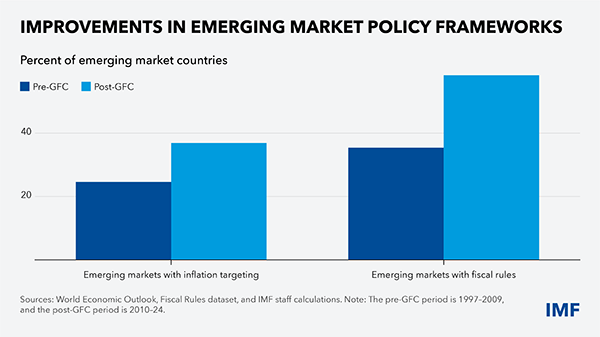
With that in mind, it is comforting to have watched many emerging markets come of age in recent years in terms of central bank independence and the sophistication of their policy frameworks. Here, in my first slide of two, we see this progress.
Next, let me turn to AI and what it means for monetary policy—as a positive demand shock today and a positive supply shock tomorrow, rolled into one.
So, here is my hypothesis: that AI is likely to add to inflation pressures in the short run while its longer-run effects are unclear—views are split on whether it may be deflationary or not.
With large upfront investment in AI infrastructure—reversing a decades-long progression toward lower capital and energy intensity—and with rising equity prices boosting household wealth, a positive demand effect likely dominates in the short run—although this could go into reverse if there were to be a major market correction.
But there is also a positive supply effect, with productivity expected to increase over time. As our new chief economist Silvana Tenreyro argues in a recent Bank of England paper titled “Productivity and Inflation Dynamics,” higher productivity boosts both supply and demand, the latter through its effects on real income.
Whether the outcome is inflationary or deflationary depends on the magnitudes of the two effects and their timing. With AI expected to deliver a lasting uplift to productivity growth, Silvana’s logic suggests it will also raise expected permanent real income, which could lift demand in advance of expanding supply, pushing up the neutral interest rate, r*, and inflation—the leads and lags are crucial.
Ken Rogoff goes a step further, injecting into the argument the demand effects of a changing income distribution. His logic is that if AI hollows out the middle of the job market—which our own research also flags as a risk—and if AI retains its winner-takes-all dynamic, the boost to demand could be muted, possibly to a point where the positive supply effect dominates.
For now, we can safely conclude that the question of whether the recent bout of high inflation would be followed by a return to ultra-low inflation and interest rates has been answered. In the short run, no.
And as for the longer run, yes, there is a possibility that—through the expected uplift in productivity—AI could reduce costs and be deflationary. But in how long is this long run? And how confident are we that we will get the right combination of productivity gains and demand responses?
And one last thought on AI, more for the fiscal authorities than for central bankers: if AI is going to hollow out the middle of the job market, we had better start considering the future of personal income taxation.
That last concern takes me from the gorilla to the elephant in the room: public debt.
The recent years have been defined by vast shocks—with the pandemic in particular necessitating unprecedentedly large fiscal support to households and firms, notably in advanced economies, followed by further rounds of fiscal support during the cost-of-living crisis, especially in Europe.
Regrettably, in far too many countries, post-crisis recovery has not been paired with consolidation. The result is what I call the “stairway-not-to-heaven”: big upward jumps in debt when shocks strike, little or no reduction afterward. Rinse and repeat.
Even after the recent inflation surprise helped lower some debt ratios, the crisis legacy remains a global public debt burden that is at its heaviest since World War II—and on track to exceed 100 percent of GDP within the decade—with many of the highest ratios seen in advanced economies.
At the same time, inflation remains stubborn. In U.S. for instance, inflation has been above target for 5½ years—and we at the IMF have pushed back in our projections the date when we expect it to return to target by no less than two years. In the U.S. and elsewhere, markets judge the recent rate-cutting cycles to be over.
Today, most major advanced economies have public debt paths that call for fiscal policy attention. All of us are aware that U.S., French, and Japanese 10‑year sovereign yields, to highlight just three, are currently at their highest levels since 2007, 2008, and 1996, respectively.
And as these benchmark borrowing costs rise, they lift most of the world’s yield curves up with them—in some emerging markets this more than fully offsets hard-won spread compression.
Core yields are climbing despite central bank bondholdings that keep material amounts of debt and duration off market. Today, even after significant shrinkage, the Bank of Japan still owns 34 percent of own-government debt, the Eurosystem 20 percent, and the Fed 11 percent—as shown here, in my second slide.
Many governments now face high and rising debt-service burdens. Heavy reliance on short-term bills increases gross financing needs—to close to 40 percent of GDP in the U.S. Treasury’s case. This amplifies sensitivity to policy rates and raises the cost of falling behind the curve, failing to control inflation, and then having to double down with higher rates.
It is worrisome that fiscal consolidation seems not to have received the attention it deserves. In Japan, the government has ambitious budget plans to lift potential growth and ease the pain of rising prices. In Europe, significant spending is being accommodated by escape clauses in the fiscal rules. In the U.S., the debt path draws insufficient Congressional attention.
With rising bond yields, the difference between real interest rates and real growth, r – g, is now less supportive than before. For growth to painlessly solve the fiscal problem, large and sustained increases would be needed.
These are the reasons why I chose to use my recent remarks at Jackson Hole to warn about the risk of fiscal dominance. When public debt is high, history has taught us that fears of lower-than-optimal policy rates or future monetization may lurk in the background, pushing bond yields and inflation expectations upward. And, with many central banks now making losses from a mix of low yields on legacy assets and high interest expenses on bank reserves, the challenge for central banks is even greater.
With high debt and fears of fiscal dominance conspiring to increase the risk of inflation expectations moving upward, central banks will need to respond forcefully to future shocks to protect independence, preserve credibility, and deliver on their price stability mandate.
At the Fund, we take very seriously our duty to call out the fiscal risks and create traction for consolidation—this is the underlying problem that needs to be solved. Our annual Article IV consultations with the systemic economies have consistently flagged the fiscal issue and will continue to do so.
But until such time as credible medium-term fiscal plans are put in place, it is important to stand firm with a rock-solid commitment to that most critical purpose of central banking: to ensure inflation is low and stable.
Let me close by proposing for discussion five core features for monetary policy success in these unsettled times:
First, vigilance. When shocks interact, our models may lose some predictive power, calling for especially thorough scrutiny of the data.
Second, agility. Conditions change, and what works in one state of the world may not work in another, so policies must stand ready to pivot and adapt.
Third, communication. Markets need basic guidance on how central banks think, but equally central banks must take care to guard their policy optionality.
Fourth, credibility. The framework that underpins credibility—central bank independence and a clear nominal anchor—must be protected, and keeping inflation anchored when public debt is high may dictate a hawkish bias.
Fifth, humility. This, last but by no means least, is a key ingredient given the speed and magnitude of the changes that central banks confront today, requiring the ability to correct course with no remorse.
Having these five points in mind may come in handy, especially in tough times—times like, for instance, when you are called upon to distinguish between market discipline from orderly increases in bond yields and sudden spikes indicative of vigilantes and malfunction—situations that can necessitate decisive liquidity provision.
Thank you.
Compliments of the International Monetary Fund The post IMF | Monetary Policy with Supply Shocks and High Debt first appeared on European American Chamber of Commerce New York [EACCNY] | Your Partner for Transatlantic Business Resources.