

EACC

European Semester Spring Package: Sustaining a green and sustainable recovery in the face of increased uncertainty

The European Commission’s 2022 European Semester Spring Package provides Member States with support and guidance two years on from the first impact of the COVID-19 pandemic and in the midst of Russia’s ongoing invasion of Ukraine.
The Spring 2022 Economic Forecast projects the EU economy to continue growing in 2022 and 2023. However, while the EU economy continues to show resilience, Russia’s war of aggression against Ukraine has created a new environment, exacerbating pre-existing headwinds to growth, which were previously expected to subside. It also poses additional challenges to the EU economies related to security of energy supply and fossil fuel dependency on Russia.
Linking the European Semester, the Recovery and Resilience Facility and REPowerEU
The case for reducing our dependency on fossil fuels from Russia has never been clearer. REPowerEU is about rapidly reducing our dependence on Russian fossil fuels by fast-forwarding the clean transition and joining forces to achieve a more resilient energy system and a true Energy Union.
The European Semester and the Recovery and Resilience Facility (RRF) – at the heart of NextGenerationEU – provide for robust frameworks to ensure effective policy coordination and to address the current challenges. The RRF will continue to drive Member States’ reform and investment agendas for years to come. It is the main tool to speed up the twin green and digital transition and strengthen Member States’ resilience, including through the implementation of national and cross-border measures in line with REPowerEU.
The country-specific recommendations adopted in the context of the European Semester provide guidance to Member States to adequately respond to persisting and new challenges and deliver on shared key policy objectives. This year, they include recommendations for reducing the dependency on fossil fuels through reforms and investments, in line with the REPowerEU priorities and the European Green Deal.
Fiscal policy guidance
The activation of the general escape clause of the Stability and Growth Pact in March 2020 allowed Member States to react swiftly and adopt emergency measures to mitigate the economic and social impact of the pandemic. Coordinated policy action cushioned the economic blow and paved the way for a robust recovery in 2021.
Policies to mitigate the impact of higher energy prices and support those fleeing Russia’s military aggression against Ukraine will contribute to an expansionary fiscal stance in 2022 for the EU as a whole.
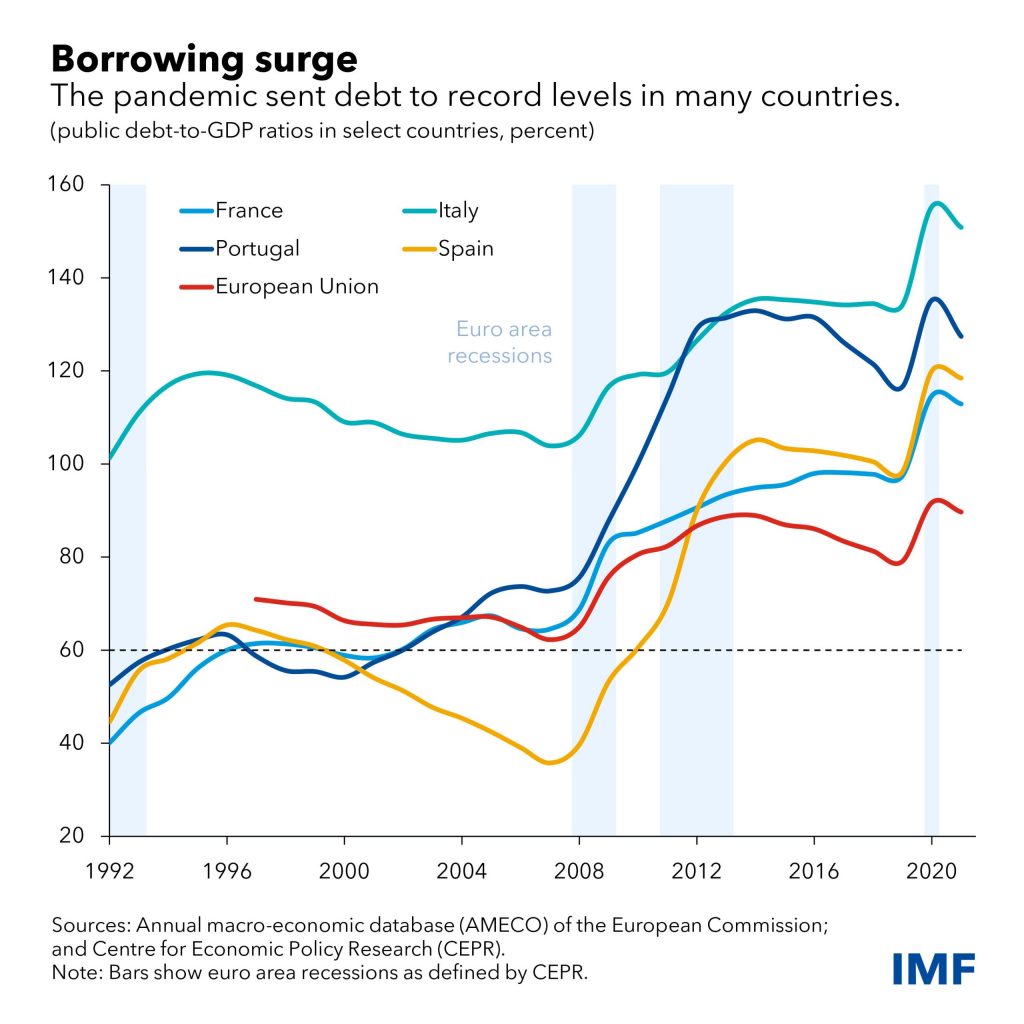
The specific nature of the macroeconomic shock imparted by Russia’s invasion of Ukraine, as well as its long-term implications for the EU’s energy security needs, call for a careful design of fiscal policy in 2023. Fiscal policy should expand public investment for the green and digital transition and energy security. Full and timely implementation of the RRPs is key to achieving higher levels of investment. Fiscal policy should be prudent in 2023, by controlling the growth in nationally financed primary current expenditure, while allowing automatic stabilisers to operate and providing temporary and targeted measures to mitigate the impact of the energy crisis and to provide humanitarian assistance to people fleeing from Russia’s invasion of Ukraine. Moreover, Member States’ fiscal plans for next year should be anchored by prudent medium-term adjustment paths reflecting fiscal sustainability challenges associated with high debt-to GDP levels that have increased further due to the pandemic. Finally, fiscal policy should stand ready to adjust current spending to the evolving situation.
The Commission considers that the conditions to maintain the general escape clause of the Stability and Growth Pact in 2023 and to deactivate it as of 2024 are met. Heightened uncertainty and strong downside risks to the economic outlook in the context of war in Ukraine, unprecedented energy price hikes and continued supply chain disturbances warrant the extension of the general escape clause through 2023. The continued activation of the general escape clause in 2023 will provide the space for national fiscal policy to react promptly when needed, while ensuring a smooth transition from the broad-based support to the economy during the pandemic times towards an increasing focus on temporary and targeted measures and fiscal prudence required to ensure medium-term sustainability.
The Commission will provide orientations on possible changes to the economic governance framework after the summer break and well in time for 2023.
Article 126(3) report on compliance with the deficit and debt criteria of the Treaty
The Commission has adopted a report under Article 126(3) of the Treaty on the Functioning of the EU (TFEU) for 18 Member States (Belgium, Bulgaria, Czechia, Germany, Greece, Spain, France, Italy, Latvia, Lithuania, Hungary, Malta, Estonia, Austria, Poland, Slovenia, Slovakia and Finland). The purpose of this report is to assess Member States’ compliance with the deficit and debt criteria of the Treaty. For all these Member States except Finland, the report assesses their compliance with the deficit criterion. In the case of Lithuania, Estonia and Poland, the report was prepared due to a planned deficit in 2022 exceeding the 3% of GDP Treaty reference value, whereas the other Member States had a general government deficit in 2021 exceeding 3% of GDP.
The pandemic continues to have an extraordinary macroeconomic and fiscal impact that, together with the current geopolitical situation, creates exceptional uncertainty, including for designing a detailed path for fiscal policy. The Commission therefore does not propose to open new excessive deficit procedures.
The Commission will reassess Member States’ budgetary situation in the autumn of 2022. In spring 2023, the Commission will assess the relevance of proposing to open excessive deficit procedures based on the outturn data for 2022, in particular taking into account compliance with the fiscal country-specific recommendations.
Addressing macroeconomic imbalances
The Commission has assessed the existence of macroeconomic imbalances for the 12 Member States selected for in-depth reviews in the 2022 Alert Mechanism Report.
Ireland and Croatia are no longer experiencing imbalances. In both Ireland and Croatia, debt ratios have declined significantly over the years and continue to display strong downward dynamics.
Seven Member States (Germany, Spain, France, the Netherlands, Portugal, Romania, and Sweden) continue to experience imbalances. Three Member States (Greece, Italy, and Cyprus) continue to experience excessive imbalances.
Overall, vulnerabilities are receding and are falling below their pre-pandemic levels in various Member States, justifying a revision of the classification of imbalances in two cases, where also notable policy progress has been made.
Opinions on the draft budgetary plans of Germany and Portugal
On 19 May, the Commission adopted its opinions on the 2022 draft budgetary plans of Germany and Portugal.
Germany submitted an updated draft budgetary plan for 2022 in April, after a new government took office in December 2021. Also Portugal submitted a new draft budgetary plan for 2022 in April. The Commission did not assess the draft budgetary plan submitted by Portugal in the autumn of 2021, given that the State Budget for 2022 had been rejected in the Portuguese Parliament.
Germany’s fiscal stance in 2022 is projected to be supportive. Germany plans to provide continued support to the recovery by making use of the RRF to finance additional investment. Germany also plans to preserve nationally financed investment.
Portugal’s fiscal stance in 2022 is projected to be supportive. Portugal plans to provide continued support to the recovery by making use of the RRF to finance additional investment. Portugal also plans to preserve nationally financed investment. Portugal is expected to broadly limit the growth of nationally financed current expenditure in 2022.
Enhanced surveillance report and post-programme surveillance reports
The fourteenth enhanced surveillance report for Greece finds that the country has taken the necessary actions to achieve the agreed commitments, despite the challenging circumstances triggered by the economic implications of new waves of the pandemic as well as of Russia’s invasion of Ukraine. The report could serve as a basis for the Eurogroup to decide on the release of the next set of policy-contingent debt measures.
The Commission has also adopted the post-programme surveillance reports for Ireland, Spain, Cyprus, and Portugal. The reports conclude that the repayment capacities of each of the Member States concerned remain sound.
Employment guidelines
The Commission is also proposing guidelines – in the form of a Council decision – for Member States’ employment policies in 2022. Every year, these guidelines set common priorities for national employment and social policies to make them fairer and more inclusive. Member States will now be called to approve them.
Member States’ continued reforms and investments will be crucial to supporting high-quality job creation, the development of skills, smooth labour market transitions, and to address the ongoing labour shortages and skills mismatches in the EU. The guidelines provide steering on how to continue modernising labour market institutions, education and training, as well as social protection and health systems, in order to make them fairer and more inclusive.
This year, the Commission proposes to update the guidelines for Member States’ employment policies with a strong focus on the post-COVID 19 environment, on making the green and digital transitions socially fair, as well as on reflecting recent policy initiatives, including in response to Russia’s invasion of Ukraine, such as measures to enable access to the labour market for people fleeing the war in Ukraine.
Progress towards the UN Sustainable Development Goals
The Commission remains committed to integrating the United Nations Sustainable Development Goals (SDGs) into the European Semester. The 2022 European Semester cycle provides updated and consistent reporting on progress towards the achievement of the SDGs across Member States. Specifically, the country reports summarise the progress of each Member State towards implementation of the SDGs, and include a detailed annex, based on the monitoring carried out by Eurostat.
The country reports also make reference to the recovery and resilience plans of the 24 Member States which have been adopted by the Council. The support provided under the RRF underpins a significant number of reforms and investments that are expected to help Member States make further progress toward the SDGs.
In parallel to the Spring Package, Eurostat has today released the “Monitoring report on progress towards the SDGs in an EU context”. The EU has made progress towards most of the SDGs over the last five years of available data. Most progress has been achieved towards fostering peace and personal security within the EU territory and improving access to justice and trust in institutions (SDG 16), followed by the goals of reducing poverty and social exclusion (SDG 1) as well as the economy and the labour market (SDG 8). In general, further efforts will be necessary to achieve the Goals, in particular in the environmental area like clean water and sanitation (SDG 6) and life on land (SDG 15).
Members of the College said:
Valdis Dombrovskis, Executive Vice-President for an Economy that Works for People, said: “Russia’s invasion of Ukraine has undoubtedly put Europe into extraordinary economic uncertainty. This has resulted in significantly higher prices for energy, raw materials, commodities and food, and is hurting consumers and businesses. With this European Semester Spring package, we are looking to sustain Europe’s economic recovery from the pandemic, and simultaneously phase out our strategic dependence on Russian energy before 2030.”
Paolo Gentiloni, Commissioner for Economy, said: “Ever since the first weeks of the pandemic more than two years ago, the EU and national governments have delivered strong and coherent policy support to our economies, helping to sustain a swift recovery. Today, our common priorities are investment and reform. This is reflected in the recommendations presented today, with their clear focus on the implementation of national recovery and resilience plans and on the energy transition. Fiscal policies should continue to transition from the universal support provided during the pandemic to more targeted measures. As we navigate the new period of turbulence caused by Russia’s invasion of Ukraine, governments must also have the flexibility to adapt their policies to unpredictable developments. The extension of the general escape clause to 2023 recognises the high uncertainty and strong downside risks in a situation where the state of the European economy has not normalised.”
Nicolas Schmit, Commissioner for Jobs and Social Rights said: “The Commission’s Employment Guidelines are a vital aspect of Member States’ priority-setting and policy coordination for employment and social policies. In the wake of the pandemic, it is crucial that the Union and its Member States ensure that the green and digital transitions are socially just. The Commission’s 2022 Guidelines pave the way towards creating more and better jobs and promoting social fairness, which includes supporting the integration of people fleeing the war in Ukraine into labour markets.”
Next steps
The Commission invites the Eurogroup and Council to discuss the package and endorse the guidance offered today. It looks forward to engaging in a constructive dialogue with the European Parliament on the contents of this package and each subsequent step in the European Semester cycle.
Compliments of the European Commission.
The post European Semester Spring Package: Sustaining a green and sustainable recovery in the face of increased uncertainty first appeared on European American Chamber of Commerce New York [EACCNY] | Your Partner for Transatlantic Business Resources.
EACC

ESMA study looks at reasons for lower costs in ESG funds

The European Securities and Markets Authority (ESMA), the EU’s securities markets regulator, has published a study looking at the potential reasons behind the relatively lower ongoing costs, and better performance, of environmental, social and governance (ESG) funds compared to other funds, between April 2019 and September 2021.
ESMA recently determined that ESG equity undertakings for collective investment in transferable securities (UCITS), excluding exchange-traded funds, were cheaper and better performers in 2019 and 2020 compared to non-ESG peers.
Understanding the cost and performance dynamics of ESG funds is of particular interest as it may bring insights for the overall fund industry on how to make funds more affordable and profitable for retail investors.
ESMA, in today’s article, is looking at some of the potential drivers behind this relative cheapness, and outperformance, of ESG funds, and finds several differences between the two categories of funds:

ESG funds are more oriented towards large cap stocks;
ESG funds are more oriented towards developed economies; and
The sectoral exposures also differ between ESG and non-ESG funds.

Even after controlling for these differences, ESG funds remain statistically cheaper and better performing than non-ESG peers. Further research is thus needed to identify the other factors driving these cost and performance differences.
Contact:

Solveig Kleiveland, Senior Communications Officer | press@esma.europa.eu

Compliments of the European Securities and Market Authority.
The post ESMA study looks at reasons for lower costs in ESG funds first appeared on European American Chamber of Commerce New York [EACCNY] | Your Partner for Transatlantic Business Resources.

EACC

Ukraine: EU Commission presents plans for the Union’s immediate response to address Ukraine’s financing gap and the longer-term reconstruction

Today, the Commission has set out plans in a Communication for the EU’s immediate response to address Ukraine’s financing gap, as well as the longer-term reconstruction framework. This Communication follows from the European Council call to address the consequences of the war in Ukraine via a dedicated Europe-led effort.
Immediate response and short terms needs
Since the Russian aggression started, the EU has significantly stepped up its support, mobilising around €4.1 billion to support Ukraine’s overall economic, social and financial resilience in the form of macro-financial assistance, budget support, emergency assistance, crisis response and humanitarian aid. Military assistance measures have also been provided under the European Peace Facility, amounting to €1.5 billion, that will be used to reimburse Member States for their in-kind military support to Ukraine and the mobilisation of an additional €500 million is under way.
The war resulted in a collapse of tax, export and other revenues, compounded by large scale illegal appropriation of assets and export goods including in the agricultural sector, while essential expenditure skyrocketed. The International Monetary Fund has estimated Ukraine’s balance of payments gap until June at roughly €14.3 billion ($15 billion).
Addressing Ukraine’s significant short-term financial support to sustain basic services, address humanitarian needs and fix the most essential destroyed infrastructure will require a joint international effort, in which the Union will be ready to play its part.
The Commission therefore envisages to propose granting Ukraine in 2022 additional macro-financial assistance in the form of loans of up to €9 billion, to be complemented by support from other bilateral and multilateral international partners, including the G7. This would be paid in tranches with long maturities and concessional interest rates thanks to the guarantee from the Union budget. To make this possible, Member States should agree on making available additional guarantees. Together with grant support from the EU budget for subsidising the related interest payments, this will ensure well-coordinated and highly concessionary support to Ukraine.
Reconstruction of Ukraine
A major global financial effort will be required to rebuild the country after the war damage, to create the foundations of a free and prosperous country, anchored in European values, well integrated into the European and global economy, and to support it on its European path. While Russia’s aggression continues, the overall needs for the reconstruction of Ukraine are not yet known. Nevertheless, it is important to design the main building blocks of this international effort already now. Support will have to have a medium to long-term horizon.
The reconstruction effort should be led by the Ukrainian authorities in close partnership with the European Union and other key partners, such as G7 and G20 partners, and other third countries, as well as international financial institutions and international organisations. Partnerships between cities and regions in the European Union and those in Ukraine will enrich and accelerate reconstruction.
An international coordination platform, the ‘Ukraine reconstruction platform’, co-led by the Commission representing the European Union and by the Ukrainian government, would work as an overarching strategic governance body, responsible for endorsing a reconstruction plan, drawn up and implemented by Ukraine, with administrative capacity support and technical assistance by the EU. It would bring together the supporting partners and organisations, including EU Member States, other bilateral and multilateral partners and international financial institutions. The Ukrainian Parliament and the European Parliament would participate as observers.
The ‘RebuildUkraine’ reconstruction plan endorsed by the platform, based on a needs assessment, would become the basis for the European Union and the other partners to determine the priority areas selected for financing and the specific projects. The platform would coordinate the financing sources and their destination to optimise their use, as well as monitor progress in the implementation of the plan.
To support the reconstruction plan, the Commission proposes to set up the ‘RebuildUkraine’ Facility as the main legal instrument for the European Union’s support, through a mix of grants and loans. It would be embedded in the EU budget, thereby ensuring the transparency, accountability and sound financial management of this initiative, with a clear link to investments and reforms. It would build on the EU’s experience under the Recovery and Resilience Facility, but adapted to the unprecedented challenges of reconstructing Ukraine and accompanying it on its European path. The Facility itself would have a specific governance structure ensuring full ownership by Ukraine.
A significant emphasis will be put on the rule of law reforms and fight against corruption, whilst investments, brought in line with climate, environmental and digital EU policies and standards, will help Ukraine emerge stronger and more resilient from the devastation of the Russian invasion.
The unforeseen needs created by war in Europe are well beyond the means available in the current multiannual financial framework. Therefore, new financing sources will have to be identified.
The architecture suggested is sufficiently flexible to accommodate such new financing sources. The additional grants to be made available to Ukraine could be financed either by additional contributions from Member States (and third countries should they wish to do so) to the Facility and existing Union programmes, thus benefitting from the Union’s financial mechanisms and safeguards for the proper use of funds, or through a targeted revision of the multiannual financial framework. These sources could also finance the loans to be granted to Ukraine under the Facility. However, given the scale of the loans that are likely to be required, options include raising the funds for the loans on behalf of the EU or with Member States national guarantees.
Members of the College said:
Ursula von der Leyen, President of the European Commission, said: “The unprovoked and unjustified Russian invasion of Ukraine has caused terrible human suffering and massive destruction across the country, forcing millions of innocent Ukrainians to flee their homes. Ukraine can count on the EU’s full support. The EU will continue to provide short-term financial support to Ukraine to meet its needs and keep basic services running. And we stand ready to take a leading role in the international reconstruction efforts to help rebuild a democratic and prosperous Ukraine. This means, investments will go hand in hand with reforms that will support Ukraine in pursuing its European path.”
Executive Vice-President for an Economy that works for people, Valdis Dombrovskis, said: “The EU’s support for Ukraine is unwavering. We will continue using all available means to help our friend and neighbour to resist Russia’s unprovoked and brutal aggression. We need to address both keeping the country running on a daily basis, and working to rebuild the country. To address Ukraine’s most urgent needs, we envisage to provide emergency loans under a new macro-financial assistance programme. In the longer term the EU will lead a major international financial effort to rebuild a free and democratic Ukraine – working with partners such as the G7, international financial institutions and in close coordination with Ukraine itself. We will stand with Ukraine at every step of the way, to repair the destruction caused by Russia’s war and to create a brighter future and new opportunities for its people”.
High Representative/Vice-President for a Stronger Europe in the World, Josep Borrell said: “The EU will remain steadfast in its solidarity with and support for Ukraine as it defends itself against Russia’s unjustifiable, and illegal war of aggression. We continue to provide Ukraine with military assistance measures.”
Commissioner for Budget and Administration, Johannes Hahn, said: “The European Union will continue to stand by Ukraine and its people and to play a key role in all political, humanitarian, resilience and economic efforts to address the short-term and long-term needs that will bring Ukraine back to peace and socio-economic recovery. I am convinced that the new “Ukraine reconstruction platform” led jointly by Ukraine and the Commission, as well as our proposed ‘RebuildUkraine’ Facility, will help offer Ukraine a better future. This will be done in close coordination with all donors”.
Commissioner for the Economy, Paolo Gentiloni said: “The destruction Russia has unleashed on Ukraine has no precedent in postwar Europe; nor does its disregard for the international order so painstakingly constructed over decades. Today the European Commission is setting out a path to help a new Ukraine rise from the ashes of war, just as our Union emerged from the rubble of 1945. Together with the Ukrainian authorities and in cooperation with our international partners, we will mobilise the funding Ukraine needs to ride out this storm – and to ‘build back better’ its economic and social infrastructure.”
Commissioner for Neighbourhood and Enlargement, Olivér Várhelyi said: “In the last weeks we have witnessed the terrible loss of lives and the devastation this war caused in the infrastructure in Ukraine. We have swiftly mobilised assistance and are committed to support rebuilding Ukraine. The reconstruction should fully reflect the needs identified by Ukraine and be firmly anchored in the country’s reform agenda”.
Background
The EU’s commitment to supporting Ukraine is long-standing and has delivered results. The EU has provided significant financial assistance to Ukraine, which over the years from 2014 to 2021 amounted to €1.7 billion in grants under the European Neighbourhood Instrument, €5.6 billion under five macro-financial assistance programmes in the form of loans, €194 million in humanitarian aid and €355 million from foreign policy instruments. The EU provides its support to Ukraine for policy development and comprehensive reforms, with strong involvement from Member States in a Team Europe approach. Among the flagship programmes are those on decentralisation, public administration reform and anti-corruption.
Before and during the war, the EU has worked closely with European financial institutions to support Ukraine. Since 2014, the European Investment Bank and the European Bank for Reconstruction and Development have mobilised over €10 billion in loans to Ukraine. In recent weeks, the European Investment Bank has disbursed €668 million to the Ukrainian budget. The EU is also working in close cooperation with the World Bank and the International Monetary Fund, which have been key partners in the Ukrainian efforts since 2014.
Compliments of the European Commission.
The post Ukraine: EU Commission presents plans for the Union’s immediate response to address Ukraine’s financing gap and the longer-term reconstruction first appeared on European American Chamber of Commerce New York [EACCNY] | Your Partner for Transatlantic Business Resources.

Read More
EACC

IMF | Why Countries Must Cooperate on Carbon Prices

‘An international floor price for carbon could speed the world’s transition to green energy without compromising countries’ competitiveness.’
Recent surges in food and fuel costs are hurting households everywhere. The global spike in energy prices since Russia’s invasion of Ukraine underscores the need to transition away from dependence on energy sources that are subject to recurrent disruptions. The war has also impacted food security, which is already under pressure from crop failures and extreme weather events due to higher temperatures. These developments make clear the importance of accelerating a green transition that would limit further temperature rises, while protecting vulnerable groups who are most dependent on high-carbon fuels and jobs.
While carbon pricing is among the most effective policy tools to direct spending and investment out of dirty energy and into green alternatives, many countries are reluctant to use this policy lever. They fear a loss of international competitiveness, especially in high-emission sectors such as steel or chemicals.
One way to square this circle is through an international carbon price floor (ICPF) agreement. This was proposed by IMF staff in a paper last year that called for the world’s largest emitters to pay a floor price of $25-$75 per ton of carbon depending on their level of economic development. The proposal recognizes that some countries may use alternative policies to carbon pricing—regulations, for example—but these alternatives should achieve at least the same emissions reductions as the carbon price floor.
We develop this proposal in a recent staff paper which shows that an ICPF introduced by all countries simultaneously—and with the same tiered price floors based on income level—would combine several important advantages over alternative schemes. First, it would reduce emissions sufficiently to accomplish the 2-degree target. In fact, it is the only feasible option out of all those we considered in the paper to prevent the planet from heating to dangerously high temperatures.
A price worth paying
Second, it would have only a small impact on global economic growth—provided countries also invest in low-carbon energy. According to our estimates, the ICPF would reduce global gross domestic product by 1.5 percent by 2030 relative to what it would have been in the absence of the price floor, with the world’s poorest countries seeing a much smaller slowdown (just 0.6 percent). This is a price worth paying to prevent the far larger costs of failing to curb carbon emissions—many trillions of dollars—as spelled out in a recent report by the United Nations Intergovernmental Panel on Climate Change.
And third, it would ensure that the costs of transition are allocated according to differentiated responsibilities between countries of different income levels through differentiated carbon price floors. The ICPF proposal sets price floors per ton of carbon at $25 for low-income countries, $50 for middle-income countries, and $75 for high-income countries. This would be fairer than a uniform global carbon price and there would be less need for additional transfer payments between countries which have proven politically problematic in the past.
These are only floor prices. Many countries (especially high-income ones) have committed to ambitious climate policy in their nationally determined contributions (NDCs). These countries might have to set a higher price to achieve these goals. For many middle- and low-income countries, meanwhile, our analysis shows that the floors are higher than those implied by their NDCs which do not go far enough to limit the increase in temperature. Strengthening the contributions of middle- and low-income countries—which account for a fast-growing share of global emissions—is indeed key to keep global temperatures in check.
Competitiveness preserved
In the absence of a global agreement, high-income countries that have proposed ambitious climate policy have considered imposing a tariff on carbon emissions of imported products (a so-called border carbon adjustment or BCA). The intention is to protect domestic industry from foreign competitors that face less stringent climate policies. Our study confirms previous work showing that while BCAs can protect energy-intensive and trade-exposed industries they do not incentivize enough emissions reductions to achieve global temperature goals. This is because they only tax exported goods from countries that do not have a domestic carbon tax.
A fourth advantage of a simultaneous and differentiated ICPF is that there would be no need for high-income countries to impose a BCA tariff. All country groups would be acting together, and high-income countries would suffer no major losses to competitiveness. This would hold true even with differentiated carbon price floors: goods from middle- and low-income countries are typically more carbon-intensive, so the lower carbon price and the higher carbon intensity offset one another. A given good would thus require similar carbon payments in all income groups.
Geopolitical tensions have increased since Russia’s invasion and the prospects for international cooperation may seem slim as countries signal retreat into rival camps. Yet climate change is a global challenge that can—and must—concentrate minds as more frequent floods, droughts and weather disasters exacerbate the food crisis and impose other economic and human costs. Our proposal for an international carbon price floor phased in by 2030 would be a big step towards limiting global warming to below 2 degrees Celsius.
Compliments of the IMF.
The post IMF | Why Countries Must Cooperate on Carbon Prices first appeared on European American Chamber of Commerce New York [EACCNY] | Your Partner for Transatlantic Business Resources.

EACC

ECB Speech | Luis de Guindos: Building the Financial System of the 21st Century

Speech by Luis de Guindos, Vice-President of the ECB, at the 20th annual symposium on “Building the financial system of the 21st century: an agenda for Europe and the United States” organised by the Program on International Financial Systems and Harvard Law School (by videoconference) |
It is with great pleasure that I am taking part in this symposium once again. It is hard to believe how much has happened since we last met two years ago.
In my remarks back then, I touched upon the enhanced resilience of the banking sector following the design and implementation of the Basel III regulatory framework – a long process that was set in motion in the aftermath of the global financial crisis.
Since that crisis, and the ensuing sovereign debt crisis, the euro area has been hit by two unrelated but sequential global shocks: first, the pandemic and then the massive surge in energy prices exacerbated by the Russian invasion of Ukraine, which has so far affected Europe more than other parts of the world. To use some jargon, these were “low probability” events. But they materialised in rapid succession with a large impact on inflation at global level.
So it is not easy to be a central banker right now. In the euro area, we moved from having to deal with stubbornly low inflation levels for almost a decade to the highest inflation figures since the creation of the euro, while also having to contend with extraordinary uncertainty surrounding inflation dynamics.
Today, I will give a brief overview of the current economic situation in the euro area, and then share our assessment of the current risks to the overall stability of the financial system.
Economic outlook
Just as we were getting the pandemic and its economic implications under control, geo-political tensions in Europe erupted. Russia’s war against Ukraine has cast a dark shadow over our continent and is likely to trigger a slowdown in growth and higher inflation in the near-term.
After the largest contraction on record in 2020, the euro area economy transitioned to a firm path of recovery in 2021. However, rising inflationary pressures that had been building up since the latter half of last year and renewed pandemic-related restrictions look likely to have slowed the momentum of the recovery in 2022. The Russian invasion of Ukraine exacerbated these pressures on account of large rises in commodity and energy prices. The war has also created new bottlenecks on top of the supply chain disruptions resulting from recent restrictions in Asia.
Following a steady rise in the course of 2021, inflation reached a record high of 7.4% in March 2022, remaining at this level in April. Price increases will most likely remain high over the coming months, mainly because of the rise in energy costs but also due to higher food prices and renewed supply chain disruptions.
Medium-term inflation expectations remain anchored, close to our 2% target. That said, we are closely monitoring for second-round effects, notably wage-setting behaviour. We need to prevent the scenario where the high inflation that we currently see becomes entrenched in expectations.
We are faced with an exceptional degree of uncertainty regarding the outlook for economic activity and inflation. So we need to move gradually and cautiously as we normalise our monetary policy. At our April meeting, the ECB’s Governing Council judged that the incoming data reinforced our expectation that net asset purchases under the asset purchase programme should be concluded in the third quarter. I would expect this to happen earlier in the third quarter rather than later. A first interest rate hike could take place some time after that, depending on our evolving assessment of the outlook. Our June staff projections will put us in a better position to appraise where the euro area economy is heading. We need to observe the impact that shifts in financing conditions and the erosion of purchasing power are having on activity and inflation dynamics.
For the past two years, the combination of fiscal and monetary policy has been crucial in helping the euro area to navigate the pandemic. This combination remains critical today. Monetary policy has to ensure that inflation stabilises at 2% over the medium-term while fiscal measures need to be very selective, targeted and temporary – also in part because fiscal space is now more limited than it was in 2020 and 2021.
Despite the current uncertainty, financial markets have, so far, remained relatively calm. If stress conditions arise, we will deploy flexibility to ensure that monetary policy is transmitted smoothly across the euro area, as we did to good effect during the height of the pandemic.
Financial stability
The macroeconomic forces I have just discussed, amplified by the economic fallout from the Russia-Ukraine war, also have implications for the financial stability outlook. The improved economic conditions throughout 2021 helped to reduce near-term risks to financial stability. But medium-term vulnerabilities continued to build up in the latter half of last year. The pandemic left a legacy of significantly higher levels of indebtedness across sectors, signs of overvaluation in some financial and property markets, and increased risk-taking by non-bank financial institutions.
Since the Russian invasion, financial stability concerns have centred on the economic and inflationary impacts of the current macro-financial environment through higher commodity and energy prices, trade disruptions and weaker confidence. Let me touch upon some components of the euro area financial system in turn.
The banking sector is facing new headwinds from the war. Higher energy and commodity prices, combined with potential energy supply disruptions, could lead to rising credit risks in the corporate sector, especially in energy intensive sectors. This has already led analysts to cut bank profitability forecasts for 2022, due to increased provisioning expectations.
An upward shift in interest rate expectations may affect banks’ financial positions in two different ways. On the one hand, bank earnings are expected to benefit from higher rates in the short-term; on the other, their net worth is vulnerable to rate increases in the medium-term. The economic value of banks with a high share of fixed-rate assets may drop as assets lose more value than liabilities. That said, overall interest rate risk exposures are moderate, on aggregate, and banks have actively managed them to prepare for increasing interest rates.
The slowdown in growth and tightening financing conditions could also lead to renewed challenges for sovereign debt sustainability, particularly in more highly indebted countries. These risks appear manageable in the short-term. But a sustained rise in interest rates, or more subdued growth, could contribute to a reassessment of sovereign risk by market participants and to higher fragmentation risks in sovereign bond markets.
To the extent that increased sovereign vulnerabilities coincide with fragilities in the corporate and banking sectors, risks materialising in any of these sectors may lead to the re-emergence of adverse feedback loops between sovereigns, banks and corporates.
The uncertain outlook could also have an adverse impact on the euro area non-bank financial sector. Duration risk has recently started to materialise, and valuation losses may further increase in an environment of rising interest rates. Some non-bank financial institutions have large exposures to firms with higher credit risk, or firms in energy-intensive industries that are more vulnerable to risks from rising commodity prices.
Turning to financial markets, corrections we saw after the Russian invasion of Ukraine have remained largely orderly. But high volatility in some commodity prices has triggered liquidity stress in related derivatives markets. An increase in initial margin requirements has greatly increased firms’ liquidity needs, making it more difficult for some firms to hedge. This recent episode raises the question of whether margining practices, including those between the clearing member and their clients, may be too procyclical. Financial markets remain vulnerable to further corrections that could potentially be triggered by an escalation of the war, or a faster-than-expected pace of monetary policy normalisation.
Conclusion
Let me conclude.
Sound financial regulation and greater resilience have helped the European financial system navigate both the pandemic and the economic fallout stemming from the Russia-Ukraine war.
Yet sizeable challenges remain. To address financial stability risks, we need to implement targeted macroprudential policy instruments. At the same time, amid global inflationary pressures and risks to growth, we are walking on a narrow path as we strive to deliver on our price stability mandate. But rest assured, we remain fully committed to stabilising inflation at our 2% target over the medium-term.
Compliments of the European Central Bank.
The post ECB Speech | Luis de Guindos: Building the Financial System of the 21st Century first appeared on European American Chamber of Commerce New York [EACCNY] | Your Partner for Transatlantic Business Resources.

EACC

REPowerEU: A plan to rapidly reduce dependence on Russian fossil fuels and fast forward the green transition

The European Commission has today presented the REPowerEU Plan, its response to the hardships and global energy market disruption caused by Russia’s invasion of Ukraine. There is a double urgency to transform Europe’s energy system: ending the EU’s dependence on Russian fossil fuels, which are used as an economic and political weapon and cost European taxpayers nearly €100 billion per year, and tackling the climate crisis. By acting as a Union, Europe can phase out its dependency on Russian fossil fuels faster. 85% of Europeans believe that the EU should reduce its dependency on Russian gas and oil as soon as possible to support Ukraine. The measures in the REPowerEU Plan can respond to this ambition, through energy savings, diversification of energy supplies, and accelerated roll-out of renewable energy to replace fossil fuels in homes, industry and power generation.
The green transformation will strengthen economic growth, security, and climate action for Europe and our partners. The Recovery and Resilience Facility (RRF) is at the heart of the REPowerEU Plan, supporting coordinated planning and financing of cross-border and national infrastructure as well as energy projects and reforms. The Commission proposes to make targeted amendments to the RRF Regulation to integrate dedicated REPowerEU chapters in Member States’ existing recovery and resilience plans (RRPs), in addition to the large number of relevant reforms and investments which are already in the RRPs. The country-specific recommendations in the 2022 European Semester cycle will feed into this process.
Saving energy
Energy savings are the quickest and cheapest way to address the current energy crisis, and reduce bills. The Commission proposes to enhance long-term energy efficiency measures, including an increase from 9% to 13% of the binding Energy Efficiency Target under the ‘Fit for 55′ package of European Green Deal legislation. Saving energy now will help us to prepare for the potential challenges of next winter. Therefore the Commission also published today an ‘EU Save Energy Communication‘ detailing short-term behavioural changes which could cut gas and oil demand by 5% and encouraging Member States to start specific communication campaigns targeting households and industry. Member States are also encouraged to use fiscal measures to encourage energy savings, such as reduced VAT rates on energy efficient heating systems, building insulation and appliances and products. The Commission also sets out contingency measures in case of severe supply disruption, and will issue guidance on prioritisation criteria for customers and facilitate a coordinated EU demand reduction plan.
Diversifying supplies and supporting our international partners
The EU has been working with international partners to diversify supplies for several months, and has secured record levels of LNG imports and higher pipeline gas deliveries. The newly created EU Energy Platform, supported by regional task forces, will enable voluntary common purchases of gas, LNG and hydrogen by pooling demand, optimising infrastructure use and coordinating outreach to suppliers. As a next step, and replicating the ambition of the common vaccine purchasing programme, the Commission will consider the development of a ‘joint purchasing mechanism‘ which will negotiate and contract gas purchases on behalf of participating Member States. The Commission will also consider legislative measures to require diversification of gas supply over time by Member States. The Platform will also enable joint purchasing of renewable hydrogen.
The EU External Energy Strategy adopted today will facilitate energy diversification and building long-term partnerships with suppliers, including cooperation on hydrogen or other green technologies. In line with the Global Gateway, the Strategy prioritises the EU’s commitment to the global green and just energy transition, increasing energy savings and efficiency to reduce the pressure on prices, boosting the development of renewables and hydrogen, and stepping up energy diplomacy. In the Mediterranean and North Sea, major hydrogen corridors will be developed. In the face of Russia’s aggression, the EU will support Ukraine, Moldova, the Western Balkans and Eastern Partnership countries, as well as our most vulnerable partners. With Ukraine we will continue to work together to ensure security of supply and a functioning energy sector, while paving the way for future electricity and renewable hydrogen trade, as well as rebuilding the energy system under the REPowerUkraine initiative.
Accelerating the rollout of renewables
A massive scaling-up and speeding-up of renewable energy in power generation, industry, buildings and transport will accelerate our independence, give a boost to the green transition, and reduce prices over time. The Commission proposes to increase the headline 2030 target for renewables from 40% to 45% under the Fit for 55 package. Setting this overall increased ambition will create the framework for other initiatives, including:

A dedicated EU Solar Strategy to double solar photovoltaic capacity by 2025 and install 600GW by 2030.
A Solar Rooftop Initiative with a phased-in legal obligation to install solar panels on new public and commercial buildings and new residential buildings.

Doubling of the rate of deployment of heat pumps, and measures to integrate geothermal and solar thermal energy in modernised district and communal heating systems.
A Commission Recommendation to tackle slow and complex permitting for major renewable projects, and a targeted amendment to the Renewable Energy Directive to recognise renewable energy as an overriding public interest. Dedicated ‘go-to’ areas for renewables should be put in place by Member States with shortened and simplified permitting processes in areas with lower environmental risks. To help quickly identify such ‘go-to’ areas, the Commission is making available datasets on environmentally sensitive areas as part of its digital mapping tool for geographic data related to energy, industry and infrastructure.

Setting a target of 10 million tonnes of domestic renewable hydrogen production and 10 million tonnes of imports by 2030, to replace natural gas, coal and oil in hard-to-decarbonise industries and transport sectors. To accelerate the hydrogen market increased sub-targets for specific sectors would need to be agreed by the co-legislators. The Commission is also publishing two Delegated Acts on the definition and production of renewable hydrogen to ensure that production leads to net decarbonisation. To accelerate hydrogen projects, additional funding of €200 million is set aside for research, and the Commission commits to complete the assessment of the first Important Projects of Common European Interest by the summer.
A Biomethane Action Plan sets out tools including a new biomethane industrial partnership and financial incentives to increase production to 35bcm by 2030, including through the Common Agricultural Policy.

Reducing fossil fuel consumption in industry and transport
Replacing coal, oil and natural gas in industrial processes will reduce greenhouse gas emissions and strengthen security and competitiveness. Energy savings, efficiency, fuel substitution, electrification, and an enhanced uptake of renewable hydrogen, biogas and biomethane by industry could save up to 35 bcm of natural gas by 2030 on top of what is foreseen under the Fit for 55 proposals.
The Commission will roll out carbon contracts for difference to support the uptake of green hydrogen by industry and specific financing for REPowerEU under the Innovation Fund, using emission trading revenues to further support the switch away from Russian fossil fuel dependencies. The Commission is also giving guidance on renewable energy and power purchase agreements and will provide a technical advisory facility with the European Investment Bank. To maintain and regain technological and industrial leadership in areas such as solar and hydrogen, and to support the workforce, the Commission proposes to establish an EU Solar Industry Alliance and a large-scale skills partnership. The Commission will also intensify work on the supply of critical raw materials and prepare a legislative proposal.
To enhance energy savings and efficiencies in the transport sector and accelerate the transition towards zero-emission vehicles, the Commission will present a Greening of Freight Package, aiming to significantly increase energy efficiency in the sector, and consider a legislative initiative to increase the share of zero emission vehicles in public and corporate car fleets above a certain size. The EU Save Energy Communication also includes many recommendations to cities, regions and national authorities that can effectively contribute to the substitution of fossil fuels in the transport sector.
Smart Investment
Delivering the REPowerEU objectives requires an additional investment of €210 billion between now and 2027. This is a down-payment on our independence and security. Cutting Russian fossil fuel imports can also save us almost €100 billion per year. These investments must be met by the private and public sector, and at the national, cross-border and EU level.
To support REPowerEU, €225 billion is already available in loans under the RRF. The Commission adopted legislation and guidance to Member States today on how to modify and complement their RRPs in the context of REPowerEU. In addition, the Commission proposes to increase the RRF financial envelope with €20 billion in grants from the sale of EU Emission Trading System allowances currently held in the Market Stability Reserve, to be auctioned in a way that does not disrupt the market. As such, the ETS not only reduces emissions and the use of fossil fuels, it also raises the necessary funds to achieve energy independence.
Under the current MFF, cohesion policy will already support decarbonisation and green transition projects with up to €100 billion by investing in renewable energy, hydrogen and infrastructure. An additional €26.9 billion from cohesion funds could be made available in voluntary transfers to the RRF. A further €7.5 billion from the Common Agricultural Policy is also made available through voluntary transfers to the RRF. The Commission will double the funding available for the 2022 Large Scale Call of the Innovation Fund this autumn to around €3 billion.
The Trans-European Energy Networks (TEN-E) have helped to create a resilient and interconnected EU gas infrastructure. Limited additional gas infrastructure, estimated at around €10 billion of investment, is needed to complement the existing Projects of Common Interest (PCI) List and fully compensate for the future loss of Russian gas imports. The substitution needs of the coming decade can be met without locking in fossil fuels, creating stranded assets or hampering our climate ambitions. Accelerating electricity PCIs will also be essential to adapt the power grid to our future needs. The Connecting Europe Facility will support this, and the Commission is launching today a new call for proposals with a budget of €800 million, with another one to follow in early 2023.
Background
On 8 March 2022, the Commission proposed the outline of a plan to make Europe independent from Russian fossil fuels well before 2030, in light of Russia’s invasion of Ukraine. At the European Council on 24-25 March, EU leaders agreed on this objective and asked the Commission to present the detailed REPowerEU Plan which has been adopted today. The recent gas supply interruptions to Bulgaria and Poland demonstrate the urgency to address the lack of reliability of Russian energy supplies.
The Commission has adopted 5 wide-ranging and unprecedented packages of sanctions in response to Russia’s acts of aggression against Ukraine’s territorial integrity and mounting atrocities against Ukrainian civilians and cities. Coal imports are already covered by the sanctions regime and the Commission has tabled proposals to phase out oil by the end of the year, which are now being discussed by Member States.
The European Green Deal is the EU’s long-term growth plan to make Europe climate neutral by 2050. This target is enshrined in the European Climate Law, as well as the legally binding commitment to reduce net greenhouse gas emissions by at least 55% by 2030, compared to 1990 levels. The Commission presented its ‘Fit for 55′ package of legislation in July 2021 to implement these targets; these proposals would already lower our gas consumption by 30% by 2030, with more than a third of such savings coming from meeting the EU energy efficiency target.
On 25 January 2021, the European Council invited the Commission and the High Representative to prepare a new External Energy Strategy. The Strategy interlinks energy security with the global clean energy transition via external energy policy and diplomacy, responding to the energy crisis created by Russia’s invasion of Ukraine and the existential threat of climate change. The EU will continue to support the energy security and green transition of Ukraine, Moldova and the partner countries in its immediate neighbourhood. The Strategy acknowledges that Russia’s invasion of Ukraine has a global impact on energy markets, affecting in particular developing partner countries. The EU will continue to provide support for a secure, sustainable and affordable energy worldwide.
Compliments of the European Commission.
The post REPowerEU: A plan to rapidly reduce dependence on Russian fossil fuels and fast forward the green transition first appeared on European American Chamber of Commerce New York [EACCNY] | Your Partner for Transatlantic Business Resources.

EACC

REPowerEU: time to address our energy dependencies

With the REPowerEU package adopted today, we are helping to provide a common, supportive, and coordinated response to the energy implications of Russia’s invasion of Ukraine.
There are three main messages that I would like to share with you in my condition as EU Commissioner for internal market and industry.
1. The industrial dimension of unplugging Europe from Russian gas
Industry consumes more than a quarter of gas demand, sometimes with limited substitution options. That is why accelerating our independence from Russian gas requires working with industry to identify alternatives.
It also means understanding that Europe must mobilize an unprecedented industrial capacity to produce and deploy alternatives to Russian fossil fuels. More than 210 billion euros will have to be invested over 5 years to achieve our objectives. This is 10% on top of the annual investment needed to achieve the “Fit for 55” objectives.
These investments involve deep transformation of industrial processes, by investing in electrification, hydrogen, or carbon storage. They require access to more and more decarbonised electricity, more and better performing networks. All of this to be able to put on the market the clean technologies needed for our energy transition.
At each stage of the process, a new industry needs to emerge, an industrial ecosystem must be transformed, and workers reskilled.
Let’s take our electricity needs as an example. We need decarbonised and abundant electricity, which will allow us to electrify industrial processes wherever possible, and to produce hydrogen where it is needed, particularly as energy storage.
Today we have 165 Gigawatts (GW) of solar energy capacity installed. We will need more then 600 GW by 2030. And today, more than 70% of these needs are imported from a single country, China.
To ensure that Europe has the industrial capacity to meet its ambitions, and that regulatory targets also lead to job creation in Europe, we are launching an industrial alliance for solar energy. The alliance will aim to foster an innovative and value-creating industry in Europe.
We are also stepping up efforts on hydrogen. Most recently, I signed a declaration with industry to work to increase our electrolyser capacity tenfold by 2025.
In the coming months, we will have to continue our efforts in the wind energy or heat pump sectors, as these technologies are equally needed.
And, of course, we should optimise the potential of nuclear power. In the short term, by extending power plants wherever possible and safe should reduce our dependence. We can also use them to produce hydrogen. And in the longer term, by supporting an innovative and flexible nuclear sector, in particular small modular reactors.
2. Preparing for all scenarios
REPowerEU presents options to reduce Russian gas consumption by two-thirds in the short term. While we have identified ways to be even faster, provided we consider the broadest possible basket of measures, we must continue to prepare ourselves.
Because we are not immune to unilateral decisions from the Russians. I will continue my dialogue with industry to help us to work, in a coordinated and united way, on all the alternatives.
Some of these alternatives, like using coal or heavy fuel oils instead of gas for certain industrial processes, will not be very popular in the short term. But I believe we should consider all options without taboos.
3. Reducing our dependence on imported raw materials
Today’s package aims to end our dependence on Russian gas. Whether it is solar, wind, hydrogen, batteries or any other technology or component, their manufacture requires raw materials. Almost all of which come from distant, concentrated, non-European sources.
With Maroš Šefčovič and my other colleagues in the College, we are working on a legislative initiative that is up to the challenge. Because what’s the point of ending one dependency if you’re going to be locked into another one even more dramatically? 
The demand for raw materials is exploding, due to the green and digital transition, but also in light of our growing defence and security needs highlighted in a separate Commission communication today. And we depend almost exclusively on imports, often from a single country. So if one of those countries is at war, bans exports, its industry is in lockdown, or there is an earthquake, we have a problem.
That is why you can expect raw materials to become a focal point of our attention and actions.
This does not mean producing everything in Europe, of course. But we must be present on all value chains, so that we can take our industrial destiny and our geopolitical choices in hand.
Compliments of the European Commission.
The post REPowerEU: time to address our energy dependencies first appeared on European American Chamber of Commerce New York [EACCNY] | Your Partner for Transatlantic Business Resources.

EACC

ESMA consults on notifications for cross-border marketing and management of funds

The European Securities and Markets Authority (ESMA), the EU’s securities markets regulator, is consulting stakeholders on the information and templates to be provided, and used by firms, when they inform regulators of their cross-border marketing and management activities under the UCITS Directive and the AIFMD.
The purpose of the draft ITS and RTS is to facilitate the process for notifying cross-border marketing and management activities in relation to UCITS and AIFs. This will be achieved by defining harmonised information to be notified to competent authorities, and developing common templates to be used by management companies, UCITS and AIFMs.
Consultation process
This consultation will be of particular interest to alternative investment fund managers, internally managed AIFs, UCITS, management companies, internally managed UCITS, and their trade associations, as well as professional and retail investors investing into UCITS and AIFs and their associations.
The closing date for responses to the consultation is 9 September 2022.
Next steps
Following the consultation period, the draft RTS and ITS will be finalised and submitted to the European Commission.
RESPOND
Compliments of The European Securities and Markets Authority (ESMA).
The post ESMA consults on notifications for cross-border marketing and management of funds first appeared on European American Chamber of Commerce New York [EACCNY] | Your Partner for Transatlantic Business Resources.

EACC

EU-US Trade and Technology Council: strengthening our renewed partnership in turbulent times

The EU and the US have today reaffirmed their close cooperation to address global trade and technology challenges in line with their shared commitment to democracy, freedom and human rights. Meeting at the second Ministerial Meeting of the Trade and Technology Council (TTC) in Paris, both parties reiterated the central role of the TTC for the renewed transatlantic partnership, which has already served to coordinate joint measures being taken by the EU and the US in face of the Russian aggression against Ukraine.
Members of the College said:
Margrethe Vestager, Executive Vice-President for a Europe fit for the Digital Age and co-chair of the TTC, said: “Russia’s war of aggression against Ukraine has further underlined the key importance of our cooperation with the US on economic and technology issues. This cooperation goes beyond our reaction to the war. Together with our transatlantic partners, we can create a positive vision for our economies and for a democratic governance of the internet based on the dignity and integrity of the individual. When we act together, we can set the standards of tomorrow’s economy. We are joining forces and when two such determined partners take the lead, we can enable the tides to turn.”
Valdis Dombrovskis, Executive Vice-President and Commissioner for Trade and co-chair of the TTC, said: “I am delighted that at this second TTC meeting, we have agreed to expand our cooperation with the US to address new and emerging global trade challenges, working as trusted partners. We will work closely to secure our supply chains and boost global food security. We will build on our unprecedented transatlantic coordination on export controls against Russia to further align our approaches in this critical field, while also boosting trade with Ukraine. We will also cooperate on promoting green trade, for instance through green public procurement.”
Thierry Breton, Commissioner for Internal Market, added: “Transatlantic collaboration on supply chains and digital technologies is crucial to defend our common interests and values. Having successfully worked with the United States on supply chain bottlenecks for vaccine ingredients, I am pleased to see a joint ambition to strengthen supply chain resilience in other areas, from raw materials to semiconductors. The Paris summit is an important moment for the Trade and Technology Council to transform the transatlantic dialogue into concrete results.”
Key outcomes of the 2nd TTC Ministerial Meeting
Support to Ukraine
The TTC’s co-chairs expressed strong shared commitment to supporting Ukraine against Russian military aggression and agreed on concrete measures already delivered and to be further continued within the TTC. They also committed to work jointly with Ukraine to rebuild its economy and facilitate trade and investment.
Information integrity
They agreed to strengthen their cooperation to support information integrity in crisis situations, initially focusing on a common analytical framework for identifying Russia’s information manipulation and interference, which will lead to establishing a Cooperation Framework in all crisis situations.
Trade and Labour Dialogue
The co-chairs agreed to establish a tripartite Trade and Labour Dialogue in order to jointly promote internationally recognised labour rights, including the eradication of forced labour and child labour.
Export controls
Cooperation in the TTC has been instrumental for the swift and aligned deployment of export controls on advanced technologies such as aerospace and cyber surveillance to undermine Russia’s ability to further develop its industrial and military capabilities. Both parties committed to build on and enhance this strong collaboration.
Secure supply chains
With global supply chains further challenged by the Russian aggression against Ukraine, both parties agreed that close cooperation to advance the resilience of supply chains is more important than ever. For instance, the EU and US have agreed to develop a common early warning and monitoring mechanism on semiconductor value chains, to increase awareness of and preparedness for supply disruptions, and information exchange to avoid a subsidy race.
A dedicated taskforce on public financing for secure and resilient digital infrastructure in third countries shall also pave the way to joint US-EU public financing of digital projects in third-countries, based on a set of common overarching principles.
Technology standards
In the field of emerging technologies, the EU and the US have agreed to establish a Strategic Standardisation Information (SSI) mechanism to promote and defend common interests in international standardisation activities. Both sides will work to foster the development of aligned and interoperable technical standards in areas of shared strategic interest such as AI, additive manufacturing, recycling of materials, or Internet of Things
Artificial Intelligence
Both parties further discussed the implementation of common AI principles and agreed to develop a joint roadmap on evaluation and measurement tools for trustworthy AI and risk management.
Platform governance
The EU and the US also reaffirmed their support for an open, global, interoperable, reliable and secure Internet, in line with the Declaration for the Future of the Internet and the declaration on European digital rights and principles. Moreover, the EU and US agreed to strengthen cooperation on key aspects of platform governance.
SMEs access to technology
The EU and US published today a joint best practice guide with resources for how SMEs can become more cybersecure.
Environmental and climate aspects of trade and technology
Promoting sustainability is an overarching ambition for the TTC. In that spirit, Ministers agreed to work on trade and environment/climate issues, including on fostering a better understanding of the role that trade can play in facilitating the dissemination of environmental goods and services; a closer cooperation on green public procurement and work on common methodologies for carbon footprinting.
Trade barriers
Ministers agreed to work together on solutions that will help increase transatlantic trade and investment, including through increased cooperation on government procurement and conformity assessment, and exchanges on potential new trade barriers both bilaterally and in relation to third countries. They also agreed to coordinate their efforts to address non-market policies, while seeking to avoid collateral consequences on one another.
Background
The European Union and the United States announced the EU-US Trade and Technology Council (TTC) at their summit in Brussels on 15 June 2021. The TTC serves as a forum for the EU and the US to coordinate approaches to address key trade and technology issues, and to deepen transatlantic cooperation in this realm based on shared democratic values. The inaugural meeting of the TTC took place on 29 September 2021. Following the meeting, 10 working groups were set up covering issues such as standards, artificial intelligence, semiconductors, export controls and global trade challenges. The next meeting of the TTC is planned in before the end of 2022 in the United States.
Compliments of the European Commission.
The post EU-US Trade and Technology Council: strengthening our renewed partnership in turbulent times first appeared on European American Chamber of Commerce New York [EACCNY] | Your Partner for Transatlantic Business Resources.

EACC

ECB Speech | Fabio Panetta: Public money for the digital era: towards a digital euro

Keynote speech by Fabio Panetta, Member of the Executive Board of the ECB, at the National College of Ireland | Dublin, 16 May 2022 |
It is a pleasure to be here with all of you today to talk about the digital euro.
When we launched this project, we made it clear that this is a common European enterprise. Our collective effort is key to the preparation and eventual success of a digital euro.
I would like to take this opportunity to thank Commissioner McGuinness and the President of the Eurogroup, Mr Donohoe, for the excellent collaboration.
As we prepare to potentially issue a digital euro, we want to engage with and listen to stakeholders and society at large. So I would like to thank the National College of Ireland for hosting us today and giving us the opportunity to discuss this project with you.
And I look forward to talking to the students who are here today. Young people will play a key role in the adoption of a digital euro and we need to hear their perspectives to make it a success.
We live in turbulent times. As we face the most serious geopolitical crisis since the Cold War, old certainties are increasingly being challenged. The invasion of Ukraine has cast further doubt on the reliability of a global order that enabled unprecedented economic interdependence.
In the financial realm, old certainties are also beginning to falter. Digital technologies, changing payment habits and the race for payments supremacy are testing the complementarity of public and private money, which has long formed a cornerstone of our monetary system.
Today I will argue that to preserve this symbiosis, public money must keep its role as a monetary anchor in the digital era. A digital euro would fortify our monetary sovereignty and provide a form of central bank money for making daily digital payments across the euro area, just like cash for physical transactions. To succeed, a digital euro will need to add value for users, foster innovation, and enjoy strong political and societal support.
Preserving the role of public money
Our monetary system is based on the complementarity of public and private money. Central banks provide a trusted and stable monetary base on which intermediaries such as banks build new payment and financial services. This coexistence has been a powerful driver of stability and innovation.
But digital disruption and the declining use of cash – the only form of sovereign money currently available to the public – are threatening to upend this balance. Consumers are increasingly turning towards non-cash payments. Only 20% of the cash stock is now used for payments, down from 35% fifteen years ago.
We will ensure that cash remains available. But if the current trend continues, we could face a future in which cash loses its central role and its ability to provide an effective anchor as consumers turn to digital means of payment.
We cannot allow public money to become marginalised, for two good reasons.
First, just a few global players have come to dominate certain segments of the payments market, such as card payments and e-commerce. This trend could be accentuated by the expansion of big techs, which can offer payment services leveraging their large consumer base and dominant position in related markets. This could result in an uneven playing field that harms competition and raises data privacy concerns. And by creating further dependencies on non-European providers, it could increase risks to Europe’s strategic autonomy and threaten monetary sovereignty if central bank money is no longer at the heart of the payment system.[1]
Second, even digital payments will ultimately depend on the anchoring role of public money to function smoothly.
Confidence that “one euro is one euro” whatever form it takes rests on our ability to convert, at par, private money – such as funds held in bank deposits or digital wallets – into public money, which is the safest form of money available.[2]
This possibility of conversion reinforces confidence in the various forms of private money used for euro payments, ensuring the smooth functioning of the payment system.[3]
Recent developments in the market for crypto-assets illustrate that it is an illusion to believe that private instruments can act as money when they cannot be converted at par into public money at all times.
Despite claims that cryptos are a trustworthy form of “currency” free from public control, they are too risky to act as a reliable means of payment. They behave more like speculative assets and raise multiple public policy and financial stability concerns.[4] Anyone investing in cryptos must be prepared to lose all their investment.[5]
To mitigate these risks, so-called stablecoins have emerged and have the potential to become globally systemic, especially if issued by big techs. But while the value of stablecoins is linked to what their issuers describe as “reserve assets” and adequate regulation and oversight could reduce risks, stablecoins are not risk-free.[6] There is no guarantee that they can be redeemed at par at any time – just last week the world’s biggest stablecoin temporarily lost its peg to the dollar. And stablecoins do not benefit from deposit insurance, nor do they have access to central bank standing facilities. They are therefore vulnerable to runs[7], as we have just seen with the crash of another stablecoin – TerraUSD.
The benefits of a digital euro
The increasing popularity of non-cash payments and the expansion of crypto-assets reveal a growing demand for immediacy and digitalisation. If the “official sector” – central banks and supervised intermediaries – does not satisfy this demand, others will.
For this reason, countries around the world are currently exploring the issuance of a central bank digital currency.[8] Nine countries have now fully launched a digital currency and some large economies are quite advanced in their exploration, like China.[9]
Digital money issued by the central bank would offer the possibility for everyone to use public money for digital payments. It would be a sound, reliable means of payment designed in the public interest. And it would preserve the coexistence of sovereign and private money that has served us well so far.
In Europe, issuing a digital euro would also allow us to protect our strategic autonomy while remaining open in a world where technology and dependencies are increasingly being weaponised.
But the benefits of a digital euro would extend further than that. In particular, a digital euro would serve as an instrument to accompany the ongoing digital transition in payments. This transition is particularly visible here in Ireland, where the financial landscape is undergoing drastic change, with some major incumbent banks withdrawing and fintechs making rapid inroads into the payments market. A digital euro would bring important benefits in this context. It would level the playing field by allowing intermediaries – including small ones, which are typically less able to keep pace with innovation – to offer more technologically advanced products at a competitive price. And it would enable innovative payment solutions to be quickly scaled up to cover the entire euro area. This would help narrow the gap with economies like that of the United States, where entrepreneurs can expand in a large market that is not fragmented along state lines, as it is in Europe.[10]
Finally, a digital euro would aim to offer a means of payment that is free, available for all digital payments, and accessible to everyone, everywhere. It would seek to support financial inclusion at a time when the vast reduction in the number of bank branches may be affecting vulnerable customers.[11] Taking Ireland as an example, the number of bank branches declined by one-quarter between 2010 and 2020, and 5% of the adult Irish population do not even have a bank account.
Designing the digital euro for success
But despite its advantages from a system-wide perspective, a digital euro can only be successful if potential users find that it adds value to current payment options.
The motto “pay anywhere, pay easily, pay safely” seems to correspond to what potential users expect from a digital euro.
Indeed, people see the ability to pay anywhere as the most important feature of a digital euro, as shown by the results of recent focus group interviews on payment behaviour. Ideally, all merchants across the euro area – in both physical and online stores – would need to accept a digital euro.
People also value payments that are instant, easy and contactless, especially for person-to-person (P2P) payments. In particular, they would like to see a solution that would allow them to make instant payments to friends at the touch of a button, regardless of the platform used by the person sending the money and the person receiving it.
A P2P payment solution that covers a broad set of users across the entire euro area could provide fertile ground for the adoption of a digital euro. Research shows that new payment solutions are more readily adopted in a one-sided[12] market segment, like P2P payments, before spreading to other use cases.[13]
For example, Swish – Sweden’s mobile payment system which was launched in 2012 and is now used by 80% of the population there – initially offered instant P2P transfers where there was no convenient digital payment solution. The service was subsequently expanded to online and point-of-sale payments. In Brazil, PIX – a central bank initiative in which most financial intermediaries participate, generating network effects for users[14] – became the most widely used digital payment solution just one year after its launch. It did so by offering new features, such as instant payments via QR codes and simplified user identification using, for instance, a mobile number or email address.
We could also foster the adoption of a digital euro by giving it legal tender status and designing it in a way that provides more privacy than current private digital payment instruments.[15]
In October 2021 the ECB launched a two-year investigation phase to define the design features of a digital euro, such as how to ensure confidentiality, which use cases to prioritise and what business options to offer intermediaries.
For a digital euro to be designed and adopted successfully, it must be a collective endeavour. So we are stepping up our engagement with all stakeholders, from banks to payment companies, and from merchants to society at large. And at every stage of the project we will continue to engage with the European Commission (which recently launched a consultation on the digital euro), the European Parliament and the finance ministers of the euro area countries.
Defining the legal framework will entail reconciling trade-offs arising from several objectives, such as the right of individuals to confidentiality versus the public interest in maintaining the level of transparency required to combat illicit activities, or the benefits of allowing the digital euro to be widely used – also internationally – versus the need to safeguard financial intermediation and stability. But there are ways to resolve these trade-offs, as I have discussed in previous speeches.[16]
Finally, at the end of 2023 we could decide to start a realisation phase to develop and test the appropriate technical solutions and business arrangements necessary to provide a digital euro. This phase could take three years.
Conclusion
Let me conclude.
The complementarity of public and private money has guaranteed stability, competition and innovation for decades.
The ongoing changes in technology, geopolitics and user preferences must not herald the demise of this careful balance, but rather a chance to extend its success to the digital age.
Central bank digital currencies will allow public money to continue to play its role in anchoring the stability of the payments system and contributing to its efficiency. And private money will add innovation and diversity to this foundation. The coexistence of public and private money can continue to be a win-win situation – perhaps even more so in the digital age.
Compliments of the European Central Bank.
Footnotes:

A payment system based on technologies and practices designed, managed and supervised elsewhere would undermine authorities’ ability to exercise their supervisory control. A situation in which the digitalisation of payments leads to most prices being quoted in a foreign or private unit of account would greatly reduce the central bank’s ability to influence monetary and financial conditions.

Although many people are unaware of the differences between public and private money, they do know that banknotes protect them from a potential default by their bank.

The use of central bank money in payment systems puts the value of private money to the test every day by checking their convertibility into the defined unit of value, so preserving confidence in the currency

Panetta,For a few cryptos more: the Wild West of crypto finance F. (2022), “”, speech at Columbia University, 25 April. For instance, crypto-assets are often used for illicit purposes. Across all crypto-assets tracked by Chainalysis, the total transactions amounted to USD 15.8 trillion in 2021. Transactions involving illicit addresses represented 0.15% of the total value, which amounted to USD 23.7 billion – see Chainalysis (2022), The 2022 Crypto Crime Report, February. As noted by Chainalysis, this figure is expected to rise as more addresses associated with illicit activity are identified over time. For instance, the share of crypto-asset transactions in 2020 identified as involving illicit addresses was initially estimated at 0.34% in their 2021 Report, but was subsequently revised to 0.62% in the 2022 Report.

See the joint warning by the European Supervisory Authorities: ”EU financial regulators warn consumers on the risks of crypto-assets”, 17 March 2022.

The value of a stablecoin is linked to a portfolio of one or more other assets (the reserve assets). Stablecoins are therefore not risk-free. Risks increase if stablecoin arrangements are backed by risky or opaque assets, especially in times of market turmoil.

Panetta, F. (2020), “The two sides of the (stable)coin”, speech at Il Salone dei Pagamenti 2020, 4 November.

87 countries (representing over 90% of global GDP) are exploring a CBDC according to the CBDC Tracker of the Atlantic Council.

Kosse, A. and Mattei, I. (2022), “Gaining momentum – Results of the 2021 BIS survey on central bank digital currencies”, BIS Papers, No 125, Bank for International Settlements, May.

As an example, see the rapid growth of Stripe – a company founded by Irish entrepreneurs – in the United States.

Houses of the Oireachtas (2021), “Future of Banking in Ireland: Statements”, Seanad Éireann debates, Vol. 276, No 1, 10 May.

Networks with homogeneous users (individuals in the case of P2P payments) are described as “one-sided”, in order to distinguish them from “two-sided” networks, which have two distinct user groups whose respective members consistently play the same role in transactions, such as businesses and their customers. See ECB (2010), The payment system – payments, securities and derivatives, and the role of the Eurosystem.

Van der Heijden, H. (2002), “Factors affecting the successful introduction of mobile payment systems”, Bled 2002 Proceedings, June; BIS (2021), Central Bank Digital Currencies: user needs and adoption, September.

All financial and payment institutions – including fintechs – can offer Pix. Those with over 500,000 active accounts are obligated to offer it.

Panetta, F. (2022), “A digital euro that serves the needs of the public: striking the right balance”, introductory statement at the Committee on Economic and Monetary Affairs of the European Parliament, 30 March.

Panetta, F. (2021), “Evolution or revolution? The impact of a digital euro on the financial system”, speech at a Bruegel online seminar, 10 February; Panetta, F. (2021), “A digital euro to meet the expectations of Europeans”, introductory remarks at the ECON Committee of the European Parliament, 14 April.

The post ECB Speech | Fabio Panetta: Public money for the digital era: towards a digital euro first appeared on European American Chamber of Commerce New York [EACCNY] | Your Partner for Transatlantic Business Resources.