

EACC

European Parliament | MEPs Back the Lowering of Tariffs on US Agricultural and Industrial Products

Suspension clause in case of new US tariffs

Sunrise clause: tariff preferences only effective when the US respects commitments

Stronger protection regarding steel imports

The International Trade committee adopted its position on Thursday on two proposals implementing certain tariff aspects of the EU-US Turnberry trade deal.

The International Trade committee adopted its position on Thursday on two proposals implementing certain tariff aspects of the EU-US Turnberry trade deal.

MEPs in the International Trade Committee adopted their position on two legislative proposals that eliminate most tariffs on industrial and agricultural goods from the US, by 29 votes in favour, 9 against and 1 abstention.
Parliament’s rapporteur for the file Bernd Lange (S&D, DE), said: “Today we have reached a broad majority behind a strong text that aims to provide a dose of stability, fairness and firmness in our trade relationship with the United States. Our message is clear: we will not be taking any final decision without clarity. Parliament intends to remain in the driving seat and have the last word on the application of the deal.
“With this in mind, we have agreed to a clear, multi-tiered safety net addressing key shortcomings of the Commission proposal.
Suspension and sunrise clauses
“First, we have made clear that any tariff imposed on the EU or one of its member states because of their foreign policy decisions is unacceptable. In that regard we updated and strengthened the suspension clause. If tariffs were to materialise, we would immediately suspend the legislative work implementing tariff preferences on US products. Tariff threats against one of us are a threat against all of us.
“Secondly, we have agreed to a sunrise clause, meaning that whilst we would be able to adopt legislation implementing the deal, the tariff preferences for US products would only become effective when the commitments agreed at Turnberry are effectively respected by the US side”.
Conditions on EU products containing steel
“Another criteria that will need to be fulfilled before the regulation takes effect is the lowering of tariffs on EU products that contain less than 50% steel or aluminium, from 50% to 15%,” Lange said.
“This new set of conditions complement the text already negotiated and agreed by Parliament’s negotiators, covering the so-called five “S’s”: a dedicate solution for steel and aluminium, a sunset clause, a standstill provision, a safeguard mechanism and a strengthened suspension article.
“It is also clear that should the US decide to increase the current Section 122 tariffs from 10% to 15% across the board, most EU products would be subject to an effective tariff higher than the 15% ceiling due to the addition of the Most Favoured Nation tariff. This would also be unacceptable and would lead to the suspension of our work on the files.
“We were ready to vote in January, but the US threats against Greenland and the uncertainty caused by the US administration’s response to the ruling by the US supreme court have twice forced us to postpone our vote.
“I do hope that with this vote we are launching a positive dynamic of trade cooperation where mutual interests converge, where tariff threats disappear, and where business and consumer can plan ahead to increase our shared prosperity and affordability”.
Next steps
The two legislative proposals will now be voted by the whole Parliament at the next plenary session, on 26 March, before negotiations with EU governments can start on the final shape of the legislation.
Background
In July 2025, the EU and the US reached a political agreement on tariff and trade issues (Turnberry Deal). These were outlined in detail in an August 2025 joint statement announcing an EU-US Framework Agreement. The Commission then published two legislative proposals aimed at implementing certain tariff aspects of the EU-US Framework Agreement.
The International Trade Committee is responsible for steering the legislation through Parliament and for leading negotiations with EU governments on the final shape of the customs duties on goods imports from the US.


Compliments of the European Parliament The post European Parliament | MEPs Back the Lowering of Tariffs on US Agricultural and Industrial Products first appeared on European American Chamber of Commerce New York [EACCNY] | Your Partner for Transatlantic Business Resources.
EACC

ITA | Department of Commerce Announces New American AI Exports Program Phase

The U.S. Department of Commerce today announced further implementation of the American AI Exports Program with a Call for Proposals from U.S. industry-led consortia to export full-stack AI technology packages. Under President Donald J. Trump’s AI Action Plan and export directives, the Department of Commerce is implementing a full-stack AI export package promotion program to advance America’s AI leadership globally.
“America’s continued global leadership in AI depends on our ability to export our AI to allies around the world,” said Under Secretary of Commerce for International Trade William Kimmitt. “We will continue to focus our resources to most effectively implement the President’s export directives and position America’s AI innovators and workers to win globally.”
Beginning April 1, 2026 and for 90 days, industry-led consortia may submit proposals for full-stack AI export packages, including AI optimized computer hardware, data center storage, models, cybersecurity measures, and applications for various sectors.
The call for proposals includes two types of industry-led consortia: pre-set consortium and on-demand consortium. Pre-set consortia demonstrate capability across all layers of the AI technology stack and maintain global offerings ready for deployment on an ongoing basis. These will become the U.S. Government’s offerings to allies and partners around the world. On-demand consortia are formed by industry in response to a specific opportunity identified by the Program and need only cover the stack layers required for the specific deal. These on-demand consortia are formed as “custom-made” options for specific opportunities.
Both pre-set and on-demand consortia are designated through a single selection process: the Secretary of Commerce, in consultation with the Secretary of State, the Secretary of War, the Secretary of Energy, and the Director of the Office of Science and Technology Policy, selects proposals for inclusion in the Program. Once approved, full-stack AI technology can be available to trusted foreign buyers of U.S. technology.
Under the Program, approved consortia may also receive support from across the U.S. Government, including priority for export control license reviews, prioritized access to U.S federal credit programs, government-to-government engagement via direct advocacy, and dedicated interagency coordination.
Full program information and proposal processes will be published in a forthcoming Federal Register notice.
For more information, visit AIexports.gov.
 
 
Compliments of the International Trade Administration The post ITA | Department of Commerce Announces New American AI Exports Program Phase first appeared on European American Chamber of Commerce New York [EACCNY] | Your Partner for Transatlantic Business Resources.

EACC

European Commission | Q&A on EU Inc – Making Business Easier in the European Union

Why is the Commission proposing EU Inc.?
Today, for too many entrepreneurs and innovative companies, expanding across EU borders means navigating a fragmented corporate legal landscape. European companies looking to grow and scale are faced with navigating 27 national legal systems and over 60 company forms. On top of that, many processes still require manual paperwork, in-person appointments, and unnecessary documentation.
This can delay the setting-up of a company for weeks or even months, slowing growth, raising costs and discouraging scale. During the Commission’s public consultation activities, over 80% of respondents said that different national rules and forms were a significant obstacle to starting, running, or closing a business in the EU.
EU Inc. will provide a single, optional and harmonised set of corporate rules that companies can choose instead of navigating multiple national regimes, with the aim of unlocking the true potential of the Single Market.
What is the difference between the 28th regime and EU Inc.?
As part of the Competitiveness Compass, the European Commission committed to presenting a 28th regime with a single and simple set of EU-wide rules for innovative companies to reap the full benefits of the Single Market. EU Inc. is the cornerstone of the 28th regime. It provides a comprehensive set of corporate rules covering the entire lifecycle of a company. It makes it easier to start and grow a business in Europe, attract investment and reduce the costs of failure.
Entrepreneurs will now have the option of opting into the new EU Inc. Company form, or the 27 national company legal forms which sit alongside the EU Inc. proposal.
The 28th regime represents Europe’s broader offer to its businesses to help them seize the benefits of the Single Market.  It includes EU Inc., but also sets out other measures for innovative companies to get access to funding, and operate seamlessly across borders, in all matters concerning their business. This includes measures on digitalisation, access to finance, measures to attract and retain talent, taxation, and to ensure a clear, predictable and swift legal framework.
Is this proposal ambitious enough?
Yes. The benefits and the ambition are clear. EU Inc. responds to the call of founders and industry to address the fragmentation of national rules with an ambitious, optional, simple and harmonised set of rules. By proposing a Regulation, we ensure that the most appropriate instrument for a harmonised legal framework is used, effectively ending the fragmentation of the Single Market.
EU Inc. will be available to all founders who deem it suitable for their business model. It offers registration in 48 hours, simpler procedures, and lower risk for investors. Registration will be available through a single EU-level register. By providing for simpler and digital company procedures – such as online shareholder and board meetings—and removing in-person formalities, it makes it easier for EU companies to attract investment from within and outside the EU.
Who can use the EU Inc.? Will it be optional or will it replace national company laws?
The EU Inc. will be a new optional corporate legal regime. Anyone who wishes to set up a new company in the EU will have the choice to either use the new EU Inc. company form or an existing national company form, which will not be affected by the proposal. The new EU Inc. form will be the same in all Member States. In addition, EU entrepreneurs will be free to choose the Member State in which they would like to incorporate.
What will be the central EU-level register for EU Inc. companies?
The Commission will set up an EU interface for EU Inc. companies to register their company and submit their information. They will only need to submit their relevant information once. This will allow EU Inc. companies to focus on their innovation and business operations. Upon entry into application of the proposal, companies will immediately be able to register and submit their information via an EU-level interface connecting national business registers. The Commission will then establish a new central EU register for all EU companies to register their company information, no matter where they are established in the EU.
Will there be specialised courts for EU Inc.?
In the Communication, the Commission encourages Member States to designate specialised courts for EU Inc. companies. By centralising expertise, this approach would help improve consistency in rulings, minimise procedural bottlenecks, and deepen judicial understanding of EU Inc.’s unique aspect. This would, in turn, bolster investor confidence and facilitate cross-border trust. The Commission will use a set of tools to support such initiatives, for example in the context of the European Judicial Training Strategy 2025-2030.
How will insolvency procedures be simplified for innovative startups?
The proposal includes targeted changes of insolvency procedures to reduce the complexity, the costs and time involved for such procedures. The Commission proposes a single criterion to launch winding-up proceedings for EU Inc. companies that are innovative startups: the inability to pay debts. In addition, the Commission proposes to simplify the proceedings using a standard form while making the representation by a lawyer optional. The proposal also speeds up the lodging of claims by considering that the list of claims provided by the insolvency practitioner or the debtor is admitted, unless the creditor specifically objects.
How will insolvency procedures be simplified for all companies?
Digital communication will be obligatory for all communications between the competent authority, insolvency practitioner, and the parties to the proceedings. This will enable the competent authority to conclude the proceedings faster and to deliver a decision on the closure of the simplified proceedings six months after the submission of the request for the opening of proceedings. Member States are also required to establish and operate one or more digital auction platforms to convert company assets into liquidity at least for EU Inc. companies that are innovative startups.
How will the rights of employees be protected?
EU Inc. fully maintains workers’ rights. It is a proposal to streamline company law, and it does not affect labour, taxation or other laws. EU Inc. focuses on how companies are set up and managed – from registration to corporate governance, share structures, and digital company procedures.
Rules protecting workers continue to fully apply in the Member State where the work is habitually performed. This includes wages, working time, health and safety, equal opportunities for women and men, protection against discrimination, and dismissal protection.
Businesses have the same obligations towards workers, whether they are incorporated under national company law or under EU Inc.
The proposal clearly specifies that EU Inc. cannot be used to circumvent rights. This includes employees’ rights to participation in company boards (co-determination). In a Member State where these rules exist, they continue to apply to any EU Inc. company registered there.
Does EU Inc. protect businesses from ‘killer acquisitions’?
EU Inc. provides founders with several tools to stay in control of their vision and prevent hostile takeovers. For example, EU Inc. companies will be able to issue shares with multiple voting rights, which allow founders to take new investors on board while staying in charge. EU Inc. companies may also choose to make the transfer of shares subject to conditions, such as the company’s consent.
Why is the Commission adopting a recommendation on definitions of innovative enterprises, innovative startups and innovative scale ups?
Currently there are no single and widely accepted definitions based on objective and user-friendly criteria for innovative enterprises, innovative startups and innovative scale ups. Therefore, individual supporting measures use different definitions on a case-by-case basis. This has led to some fragmentation in innovation support in the EU and to a lack of transparency for enterprises. By establishing ready-to-use definitions based on selected objective criteria the Commission is proposing a new standard for future initiatives. Since the role of start-ups in disruptive innovation is well documented, proper definitions are increasingly needed for effective innovation policy making. Under the EU Inc. proposal, the definition of innovative start-ups set out in the Recommendation is used to identify the companies that are eligible to simplified insolvency procedures.
How are innovative enterprises, innovative startups and innovative scaleups defined?
Under the Recommendation, an innovative enterprise is a company whose research and development costs represented in the last three years at least 10% of its operating costs or at least 5% of its total sales. A company can also be considered an innovative enterprise if it has or will soon develop a major innovation, which holds risks of market or technological failure.
An innovative startup is an innovative enterprise with less than 100 employees and with an annual turnover or balance sheet of less than €10 million. It must have also been operating for less than 10 years.
Innovative scaleups are innovative enterprises with an annual turnover or balance sheet of more than €10 million, and which must have increased the number of its employees or revenues by 20% in the last two years, and either employs fewer than 750 persons or is not publicly listed.
 
 
Compliments of the European Commission The post European Commission | Q&A on EU Inc – Making Business Easier in the European Union first appeared on European American Chamber of Commerce New York [EACCNY] | Your Partner for Transatlantic Business Resources.

Read More
EACC

IMF | Europe Can Regain Its Productivity Edge by Scaling Up

Capital markets integration, expanding opportunities for workers, and bigger consumer markets will allow companies to grow faster.
Europe once led the world in productivity growth but now lags the United States —and the gap has widened significantly in recent years.
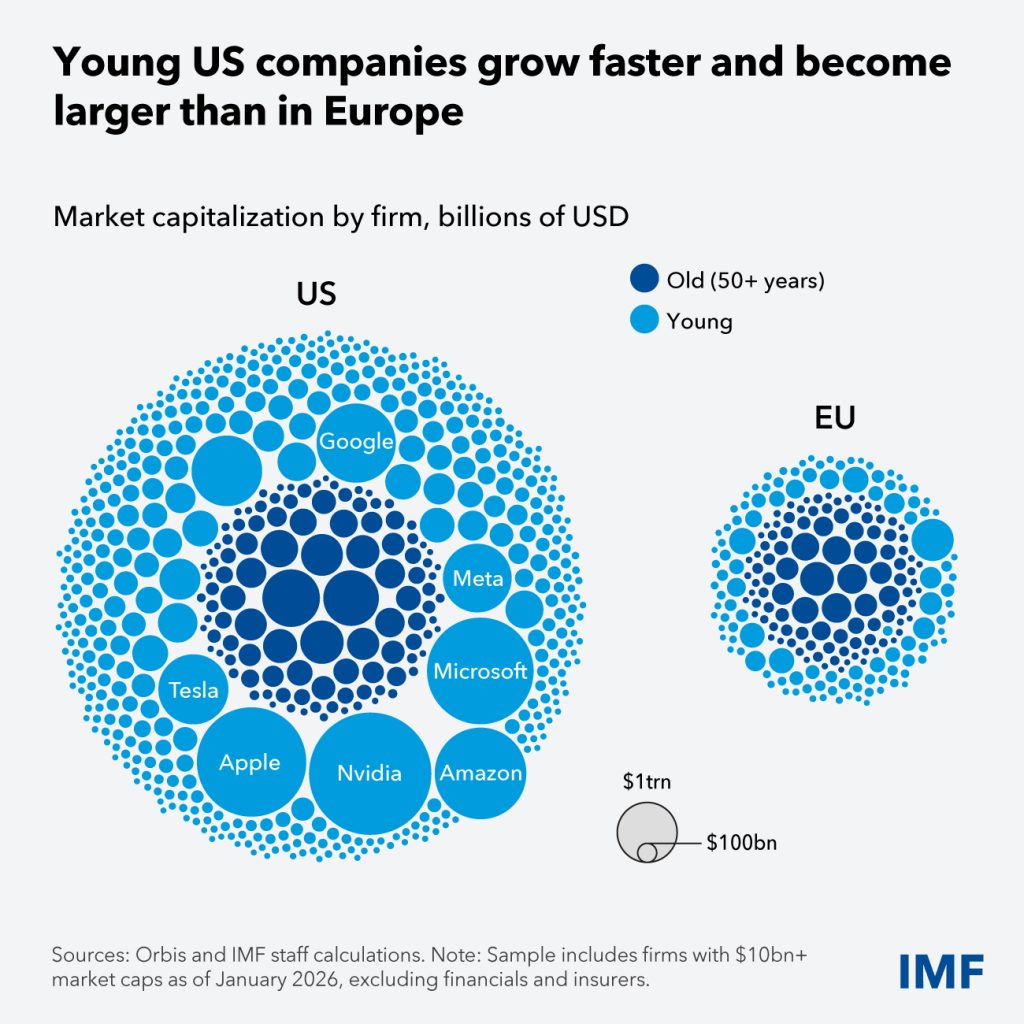
The Chart of the Week shows that behind this shortfall is the staggering difficulty that European firms face in scaling up. In the United States, the stock market valuation of young firms (under the age of 50) is $42.9 trillion, compared to a meager $5 trillion in the European Union.

This reflects imperfections in European integration. For all the achievements of the European single market, capital flows remain fragmented along national lines, opportunities for workers are hampered by regulations, and it is often difficult to market products across borders. The result is that the EU has too many small, old, and low-growth companies. The average European firm that has been in business for 25 years or more employs about 10 workers. A comparable US company employs 70 people.
It is therefore no surprise that Europe’s labor productivity levels are about 20 percent below those of the United States.
Our research shows that addressing this issue requires integration at various levels: of capital markets, to allow more funding to go to risky new businesses; of labor markets, to allow people to move to opportunity; and of consumer markets, so that companies can sell to bigger markets. The good news is that these are all changes that Europe can bring about.
 
 
Compliments of the International Monetary FundThe post IMF | Europe Can Regain Its Productivity Edge by Scaling Up first appeared on European American Chamber of Commerce New York [EACCNY] | Your Partner for Transatlantic Business Resources.

EACC

World Bank | How Forever Chemicals are Impacting International Trade

Blog | “Forever chemicals” are synthetic substances that have been widely used for decades in industrial and consumer products due to their resistance to heat, oil, and water. Officially called per- and polyfluoroalkyl substances – or PFAS – they are man-made chemicals that do not degrade easily and accumulate in soil, water, air, and ultimately, the food we eat.

Forever chemicals can pose serious environmental and health risks, but they are also fast becoming a challenge in international trade, resulting in import bans and customs delays. Countries risk being excluded from global value chains, unless they can adapt to a growing patchwork of emerging regulations and standards. At the center of this challenge is testing and measurement capacity: PFAS-compliance is only as credible as a country’s ability to detect them.
The impacts for society are potentially wide-ranging, not just for people’s health and well-being, but for the broader economy. Businesses and firms can face challenges expanding, thus hindering job creation and better opportunities for people. Addressing PFAS is complex because they are found in everyday products, from clothing, cookware and cosmetics to cleaning products, electronics and food.
In industries that rely intensively on PFAS, exports also generate a “double pollution” effect: PFAS are embedded in products shipped abroad, while being simultaneously released into domestic soil and water through manufacturing sites or wastewater treatment plants, creating aligned incentives for exporting and importing jurisdictions to act.
The impacts on people’s health can be significant. Long-term exposure to PFAS is linked to hormone disruption, immune-system effects, liver and heart impacts and certain cancers. As such, major economies are rapidly tightening controls around forever chemicals.
Some countries are setting bans on certain products and limiting access to potentially contaminated drinking-water. For example, the European Union (EU) limits PFAS residues in food and food packaging materials, and will soon introduce one of the world’s broadest PFAS bans under its Registration, Evaluation, Authorization and Restriction of Chemicals (REACH) Regulation. Other large economies such as Australia, Brazil, Japan, South Korea, and China are following suit.
A recent EU study found that current levels of pollution due to PFAS could cost the EU approximately EUR 440 billion by 2050. These costs far exceed the value added that is generated by the production and use of PFAS, and are borne domestically. Yet, in many countries, these challenges remain unaddressed, slowing investment in PFAS-free alternatives and testing and enforcement capacity.
For exporters, this rapidly evolving patchwork of different regulations is more than a technicality – they are market access requirements. To remain competitive in international trade, industry sectors in high-income countries are taking action to identify, mitigate and prevent PFAS-related risks in their supply chains.
As consumer awareness grows, products with third-party verified “PFAS-free” labels will gain a competitive advantage in the market, further adding to the complexity. Together, these new standards and regulations are reshaping global supply chains and setting new market access conditions. The 2025 World Development Report on “Standards for Development” argues that, without action, developing countries will be unable to participate and risk losing out on export opportunities.
Countries would benefit from starting to develop their own robust PFAS regulations, using international standards where available and possible to address industrial pollution and protect human health – but also to avoid imports of waste contaminated by PFAS. A major constraint, however, is access to credible testing and verification services to demonstrate compliance with new PFAS standards.
Thousands of PFAS compounds are under scrutiny, and even advanced laboratories can test only a limited subset of them using methods that are still evolving and not fully harmonized across jurisdictions. This challenge is amplified by the extreme sensitivity required for the detection of PFAS. Many regulatory thresholds are set at parts per billion—levels comparable to finding a single drop of water in 20 Olympic-sized swimming pools.
Detecting PFAS requires specialized equipment, skilled technicians, and rigorously accredited laboratories, which remain scarce even in advanced economies and largely absent in most developing ones.
The majority of developing economies with exports high in PFAS have limited capacity to detect them. Export requirements create demand for testing, documentation, and traceability—often drawing on the same laboratories and inspection bodies that support domestic food safety, water quality monitoring, and environmental protection. Overstretching these systems can disrupt both trade and environmental monitoring and public health.

PFAS are used across almost all sectors of the economy—from pharmaceuticals and medical devices to aviation, electronics, and automotive manufacturing. Many countries have a high level of dependence on PFAS-sensitive exports, and these products account for a sizeable share of total exports and GDP. As the chart above illustrates, several economies with high exposure to PFAS-sensitive exports—such as Viet Nam, Malaysia, Taiwan (China), and Thailand—also operate with relatively limited accredited chemical testing capacity, while advanced economies tend to cluster toward higher laboratory availability.
Forever chemicals are frequently present where firms least expect them—embedded in coatings, electronics, or packaging materials rather than final products. Firms would do well to monitor regulatory developments, assess risks related to PFAS across their entire supply chain, and invest in traceability and reporting systems to document compliance.
Trade can act as a “blessing in disguise” in addressing market access and public health concerns around PFAS. Investments in building detection capacity can help preserve market access and bring about public health benefits. However, this cannot be addressed through narrowly targeted, export-specific measures alone – it requires a coherent and strategic whole-of-government approach.
Closer integration of policy approaches across different sectors such as trade, health, the environment, and industrial policy can play a key role in addressing the PFAS challenge, ultimately boosting trade and export opportunities and improving people’s lives.


Compliments of the World Bank The post World Bank | How Forever Chemicals are Impacting International Trade first appeared on European American Chamber of Commerce New York [EACCNY] | Your Partner for Transatlantic Business Resources.

EACC

European Council | Council Agrees Position to Streamline Rules on Artificial Intelligence

Today the Council agreed its position on the proposal to streamline certain rules regarding artificial intelligence (AI).
The proposal forms part of the so-called “Omnibus VII” legislative package in the EU’s simplification agenda. The package includes proposals for two regulations aiming to simplify the EU’s digital legislative framework and the implementation of harmonised rules on AI.
“Streamlining the AI rules is essential for ensuring the EU’s digital sovereignty. As presidency, we worked on this proposal with urgency, reaching a swift agreement to facilitate the timely application of the AI act. The proposal will bring greater legal certainty, make the rules more proportionate and ensure more harmonised implementation across member states. We are ready to work with our co-legislators in our common efforts to support our companies, facilitate innovation and build a more competitive Europe.” -Marilena Raouna, Deputy Minister for European affairs of the Republic of Cyprus.
The Commission proposed to adjust the timeline for applying rules on high-risk AI systems by up to 16 months, so that the rules start to apply once the Commission confirms the needed standards and tools are available. The Commission also proposed further targeted amendments to the AI Act that would extend certain regulatory exemptions granted to SMEs also to small mid-caps (SMCs), reduce requirements in a very limited number of cases, extend the possibility to process sensitive personal data for bias detection and mitigation, reinforce the AI Office’s powers and reduce governance fragmentation.
Main amendments introduced by the Council
The presidency has treated the proposal with utmost priority. Member states shared the sense of urgency and, in that perspective, broadly maintained the thrust of the Commission’s proposal.
The Council mandate, however, adds a new provision in the AI act, prohibiting AI practices regarding the generation of non-consensual sexual and intimate content or child sexual abuse material. The text also introduces a fixed timeline for the delayed application of high-risk rules: the new application dates would be 2 December 2027 for stand-alone high-risk AI systems and 2 August 2028 for high-risk AI systems embedded in products.
Furthermore, the Council mandate reinstates the obligation for providers to register AI systems in the EU database for high-risk systems, where they consider their systems to be exempted from classification as high-risk. It also reinstates the standard of strict necessity for the processing of special categories of personal data for the purpose of ensuring bias detection and correction.
In addition to these, the text postpones the deadline for the establishment of AI regulatory sandboxes by competent authorities at national level until 2 December 2027. It also clarifies the competences of the AI Office for the supervision of AI systems based on general-purpose AI models where the model and that system are developed by the same provider by listing exceptions where national authorities remain competent, including law enforcement, border management, judicial authorities and financial institutions.
Finally, the Council mandate adds a new obligation for the Commission to provide guidance to assist economic operators of high-risk AI systems covered by sectoral harmonisation legislation in complying with the high-risk requirements of the AI act in a manner that minimises compliance burden.
Next steps
Following today’s approval of the Council’s mandate, the presidency will start negotiations with the European Parliament.
Background
In October 2024, the European Council called on all EU institutions, member states and stakeholders, as a matter of priority, to take work forward, notably in response to the challenges identified in the reports by Enrico Letta (‘Much more than a market’) and Mario Draghi (‘The future of European competitiveness’). The Budapest declaration of 8 November 2024 subsequently called for ‘launching a simplification revolution’, by ensuring a clear, simple and smart regulatory framework for businesses and drastically reducing administrative, regulatory and reporting burdens, in particular for SMEs.
Since February 2025, as a follow-up to the call by EU Leaders at that and subsequent meetings, the Commission has put forward ten ‘Omnibus’ packages aiming to simplify existing legislation on sustainability, investment, agriculture, small mid-caps, digitalisation and common specifications, defence readiness, chemical products, digital issues including on AI, environment, the automotive sector and food and feed safety. On 19 November 2025, the Commission submitted its seventh omnibus package – the Digital Omnibus, consisting of two proposals, one aiming to simplify the EU’s digital legislative framework and one aiming to simplify the implementation of harmonised rules on AI. This initiative follows from a broader political objective of enhancing EU competitiveness, by reducing businesses’ administrative burden and creating more favourable conditions for them to operate in the EU.
 
 
Compliments of the European CouncilThe post European Council | Council Agrees Position to Streamline Rules on Artificial Intelligence first appeared on European American Chamber of Commerce New York [EACCNY] | Your Partner for Transatlantic Business Resources.

EACC

ECB | A Highway for the Future of Europe’s Digital Finance

Blog|  Piero Cipollone, Member of the Executive Board of the ECB
As payments and financial markets go digital, central bank money must evolve too. Through initiatives such as Pontes and Appia, the Eurosystem is working with market participants to ensure that tokenised finance can settle safely in central bank money, supporting innovation, integration and Europe’s financial sovereignty.
Technology is transforming how we communicate, travel, work and pay. The way that central banks issue money also needs to change, to meet the evolving needs of the societies we serve.
Issuing money is at the very core of what central banks do. Yet most of the money we use in our day-to-day transactions is created by the private sector – for example, when a bank finances a mortgage. Ultimately, people accept this private form of money as payment because they have the option to convert it, on a one-to-one basis, into central bank money – the safest of assets and the reference point that anchors the entire system. This interplay helps build and maintain trust.
Central bank money comes in two forms. For our everyday payment needs we have cash. And as our lives increasingly move online, the Eurosystem is developing the digital euro – a digital form of cash to complement banknotes and coins.
Meanwhile, in wholesale financial markets, central bank money takes the form of the deposits banks hold at their central bank, recorded as entries on its books. Banks can use these deposits for large-volume transactions and to settle payments among themselves. This central bank money provides the bedrock of today’s wholesale financial market infrastructures.
But wholesale financial markets are not immune to change. Thanks to tokenisation and distributed ledger technologies (DLTs), it will be possible to represent financial assets such as bonds as digital tokens – or, put simply, files – that can be transferred and updated more efficiently than is currently the case. These new technologies hold the promise of greater innovation, efficiency and integration across financial markets.
With tokenised assets and DLTs, transactions will be settled faster and more efficiently, lowering processing costs and risks. The entire lifecycle of an asset – from trading to settlement to custody – will run on the same platform, available 24/7. Cross‑border activity will become simpler and cheaper, with lower costs across the board. Smart contracts will enable further innovative solutions. More efficient and integrated financial markets will also mean cheaper funding for the real economy.
To reap the benefits of these technologies, investors will need a safe asset to settle transactions – central bank money. And this is exactly what we are working towards.
Thanks to the Eurosystem’s Pontes initiative, we will already be able to offer a way to settle DLT‑based wholesale transactions in central bank money in the third quarter of 2026. We will do so initially by connecting our financial backbone – the TARGET Services – to these new DLT platforms. This will provide the safety and institutional credibility that is needed if tokenised finance is to flourish in Europe. And this is just the beginning.
To fully realise the potential of tokenisation and DLTs, investors will need central bank money to be more directly integrated on these platforms. With this goal in mind, this week we published the roadmap for our Appia initiative.
The aim of Appia is to design – together with market participants – the next generation of Europe’s financial infrastructure. This process will guide our own gradual, continuous enhancements of Pontes to ensure that it evolves in line with Appia. But it will also steer the market towards building its own solutions and infrastructures in a way that ensures competition, integration and innovation for European financial markets.
Underpinning all this will be safe, tokenised euro central bank money, giving the market the settlement anchor it needs to grow safely. Market participants have been clear that this is essential. Appia will be developed through a broad public‑private partnership, and the final design will reflect extensive collaboration through experiments, proofs of concept and common standards.
There is one more dimension to consider. In today’s world, financial infrastructure can have geopolitical implications. If Europe does not build its own digital roads, it risks having to rely exclusively on those built by others. To avoid sleepwalking into such a situation, we must not succumb to complacency or fall behind. Europe has both the technology and the means to avoid this dependency.
With Appia, an integrated European ecosystem will replace today’s fragmented infrastructures. It will support efforts to develop a savings and investments union, while ensuring that the euro remains the trusted anchor of Europe’s digital economy.
Change is inevitable – but how we respond to it is up to us. Through Appia, Europe is choosing to shape its own digital financial space.
 
 
Compliments of the European Central Bank The post ECB | A Highway for the Future of Europe’s Digital Finance first appeared on European American Chamber of Commerce New York [EACCNY] | Your Partner for Transatlantic Business Resources.

EACC

European Parliament | Protecting Copyrighted Work and the EU’s Creative Sector in the Age of AI

Secure transparency, remuneration and the possibility for rightsholders to prevent the use of their protected content in AI training

Protect the news media sector to ensure media pluralism and diversity of information

Introduce new licensing rules to address potential infringements of copyright law

To protect the creative sector in the EU, the use of copyrighted work by artificial intelligence requires transparency and fair remuneration, Parliament says.

On Tuesday, MEPs adopted a series of recommendations to protect copyrighted creative work from use by artificial intelligence (AI), by 460 votes to 71, and with 88 abstentions. They believe that EU copyright law should apply to all systems of generative artificial intelligence (genAI) on the EU market, regardless of the place of training.
Remuneration and transparency
MEPs insist that use of copyrighted material by genAI must be fairly remunerated in order to protect the EU’s creative sector, which generates 6.9% of the EU’s gross domestic product. They also want the Commission to examine how remuneration for past use can be ensured, but not through a global licence for providers to train their genAI systems in exchange for a flat-rate payment.
MEPs also stress the importance of full transparency for the use of protected content by genAI. They want AI providers and deployers to provide an itemised list of all copyrighted works used to train AI and detailed records of crawling activities for inference and retrieval-augmented generation. Lack of these could be perceived as copyright infringement, triggering legal consequences for AI providers and deployers. If such a court case is then decided in favour of the rightsholder, AI providers or deployers will have to bear all legal costs and related expenses.
Licensing market and opt-out from training
MEPs want the Commission to create a new licensing market for copyrighted material, including voluntary collective licensing agreements per sector, which would include individual creators and small and medium-sized enterprises. They want to make sure rightsholders can exclude their work from being used in AI training and they suggest that the European Union Intellectual Property Office (EUIPO) could manage such an opt-out list.
Protection for news media sector
MEPs urge the Commission to protect the press and news media sector whose work is regularly exploited by AI systems. News media outlets whose traffic and revenues are diverted by AI systems should be fully compensated and they should also have the right to refuse use of their content for training AI systems. MEPs insist that the aggregation of news content must ensure media pluralism and diversity of information, avoiding the selective processing of information or self-preferencing practices by gatekeepers benefiting their AI services.
Content created by AI and individual protection
Content fully generated by AI should not be protected by copyright, MEPs say. They also want to make sure individuals are protected from dissemination of manipulated and AI-generated content and stress the obligation of digital service providers to act against such illegal use.
Quote
Rapporteur Axel Voss (EPP, DE) said after vote: “We need clear rules for the use of copyright-protected content for AI training. Legal certainty would let AI developers know which content can be used and how licences can be obtained. On the other hand, rightsholders would be protected against unauthorised use of their content and receive remuneration. If we want to promote and develop AI in Europe while also protecting our creators, then these provisions are absolutely indispensable.”


Compliments of the European ParliamentThe post European Parliament | Protecting Copyrighted Work and the EU’s Creative Sector in the Age of AI first appeared on European American Chamber of Commerce New York [EACCNY] | Your Partner for Transatlantic Business Resources.

EACC

IMF | AI Can Lift Global Growth

Blog | AI can lift global growth but lasting productivity benefits depend on how fast we learn to measure, finance, and govern it.

Artificial intelligence is the defining driver of global economic conversation—and, increasingly, of economic growth itself. In the United States, AI-related investment now accounts for a large share of GDP growth, fueling new demand for servers, data centers, software, and power infrastructure. Policymakers are scrambling to understand what this means: Is the world witnessing a short-lived investment bubble or a lasting productivity boom comparable to the IT revolution of the 1990s?
The US economy, the world’s largest and still at the center of the global business cycle, has entered a two-speed expansion. AI-intensive sectors are racing ahead, while construction, manufacturing, and industries that are sensitive to interest rates are falling behind. According to the Bureau of Economic Analysis, investment in information-processing equipment and software grew by 16.5 percent from a year earlier in the third quarter of 2025. Stripped of AI, GDP would have been markedly weaker.
This pattern has global echoes. Growth in Europe and Japan has stabilized but remains dependent on loose monetary policy. Emerging markets have benefited from lower yields and a weaker dollar, but their growth impulses increasingly depend on technology-related investment and capital inflows. Global growth has not collapsed—but it’s increasingly concentrated in narrow sectors and regions.
What makes the current AI wave unusual is its capital intensity. Training large language models and deploying generative systems require vast computing power and physical infrastructure. AI is more like electricity—an enabling technology that requires continuous investment in grids, hardware, and complementary assets—than other recent innovations such as social media or digital commerce, which grew on preexisting networks. To match global demand, data centers worldwide may require $6.7 trillion in capital expenditure by 2030, estimates suggest.
Measuring immeasurables
This investment boom is transforming the structure of the economy—but also revealing how poorly our measurement systems capture intangible capital. National accounts were designed for an industrial age when factories and machinery dominated. Today, value increasingly resides in data, algorithms, proprietary models, and cloud infrastructure.
Official statistics record part of this shift—software and R&D, for example—but miss much of what drives productivity. The costs of training large models, refining datasets, and creating new applications are often expensed rather than capitalized. Even semiconductors, central to the AI ecosystem, are treated as intermediate goods rather than as carriers of embedded intellectual property.
As a result, GDP data simultaneously overstate the immediate contribution of AI (by counting massive capital outlays) and understate its broader economic impact (by missing the productivity spillovers). This is the same statistical paradox that masked the early productivity gains of the IT revolution. When measurement lags reality, policymakers risk misreading the economy—tightening too much because apparent slack seems small or easing too soon because inflation looks demand-driven, when it may reflect structural change.
The Federal Reserve, for example, now faces a more complex policy landscape. If AI adoption quietly raises potential output, the economy may be running less hot than headline data imply. Conversely, the surge in electricity demand and infrastructure bottlenecks could set a new floor for inflation. Misjudging either side could mean policy errors in both directions.

New geographies
AI’s rise is also redrawing trade and capital-flow patterns. Imports and exports of computers, servers, and semiconductors have surged, signaling a global reallocation of supply chains. Manufacturing and assembly are shifting toward Southeast Asia, India, and specialized US hubs such as Texas and the Gulf Coast.
This re-regionalization is not de-globalization; it’s a new geography of interdependence. The US and China remain dominant players, with Europe seeking to catch up through industrial policy and investment incentives. For many emerging markets, AI demand is already translating into exports and foreign direct investment—particularly in energy and component manufacturing—but also into vulnerability to technological and geopolitical shocks.
Capital flows increasingly follow the map of AI infrastructure. Equity markets have rewarded hyperscalers—the handful of firms building and financing the global computing backbone—with valuations and cash flows unseen since the dot-com era. As a result, a small group of tech giants now accounts for a disproportionate share of global AI-related capital expenditure and productivity expectations.
Research by the Institute of International Finance reveals a distinction between digital participation (the use of imported digital tools) and digital depth (the ability to produce and export digital goods and services and embed them in domestic value chains). Emerging markets with digital depth—China, India, Korea, and a smaller group of specialized hubs—are attracting more stable foreign direct investment linked to AI-era production. Their export profiles show rising shares of information and communications technology services, royalties, and digital content. Others remain primarily consumers of imported technologies and therefore rely more heavily on volatile portfolio flows driven by global liquidity cycles.
As AI becomes central to economic activity, digital depth may play a role in capital flow dynamics comparable to fiscal credibility or exchange-rate regimes—an underappreciated channel that global policymakers will need to monitor closely.
The scale of computing power required for AI training and inference has made electricity generation and grid capacity critical macroeconomic variables.
The macroeconomic implications are profound. Energy bottlenecks could delay AI diffusion, anchor a higher level of core inflation, and generate localized overheating even as other sectors remain weak. Grid investment is becoming a central supply-side constraint, blurring the line between industrial and macroeconomic policy.
Diffusion or concentration?
The deeper question is whether the AI boom will translate into broad-based productivity growth or remain confined to a narrow set of businesses and industries. History suggests that the payoff from general purpose technologies comes only after years of complementary investment—in skills, management practices, and institutional adaptation. Electricity and IT took decades to diffuse widely enough to raise aggregate productivity.
If AI adoption remains concentrated among hyperscalers and specialized service providers, the returns may plateau quickly, leaving the economy vulnerable once the investment cycle peaks. But if AI applications spread across industries, the potential for a sustained lift in potential output becomes real. Corporate surveys suggest diffusion is underway but uneven. While many firms are experimenting with AI, only a smaller group is implementing it at scale.
The risk is that diffusion will collide with inadequate infrastructure and outdated statistics. The mismatch between rapid technological change and slow policy adaptation could make the next few years unusually volatile. Growth could oscillate between bursts of investment and pauses for adjustment while policymakers struggle to interpret what the numbers mean.
Behind the numbers
The AI boom is unfolding against a backdrop of global uncertainty. Tariff wars, immigration restrictions, and fiscal imbalances have left the world economy more fragmented and less predictable. In this environment, AI stands out not just as a technological story but as a macroeconomic stabilizer—one of the few genuine sources of incremental demand and optimism.
Yet this narrow engine cannot carry the entire global economy indefinitely. The US expansion remains capital-heavy and employment-light. Europe risks missing out unless it retools its industrial and digital policy. Emerging markets must balance opportunity with prudence, ensuring that cheap energy or favorable regulation does not substitute for long-term competitiveness.
Policymakers and statisticians must move faster. Measurement frameworks must evolve to capture intangible capital; fiscal and monetary tools must account for sectoral divergence and new supply constraints; and international cooperation must ensure that the benefits of AI diffusion are not confined to a few economies.


Compliments of the International Monetary FundThe post IMF | AI Can Lift Global Growth first appeared on European American Chamber of Commerce New York [EACCNY] | Your Partner for Transatlantic Business Resources.

EACC

European Commission | EU and Canada Launch Negotiations for a Digital Trade Agreement

Yesterday in Toronto, Commissioner for Trade and Economic Security, Maroš Šefčovič, and Canada’s Minister for International Trade Maninder Sidhu launched negotiations for an EU-Canada Digital Trade Agreement (DTA). Building on nine years of successful implementation of the EU-Canada Comprehensive Economic and Trade Agreement (CETA), this new deal will upgrade EU-Canada trade by making it easier and safer for businesses to trade digitally across borders and providing stronger protections for consumers online.
The launch of DTA negotiations reflects the mutual commitment to secure, open and rules-based trade, and to strengthening and diversifying trade with like-minded partners. Through this agreement, the EU and Canada aim to play a leading role in shaping high-standard international rules for digital trade.
Focus on trust and predictability
The agreement is expected to set clear, predictable rules for businesses and consumers engaged in digital trade, while ensuring that both the EU and Canada retain the right to develop and implement policies addressing new digital economy challenges. More specifically, the DTA will aim to:

Create a safe online environment with binding, high-standard consumer protections for personal data and privacy, and protect against unsolicited commercial messages. This will boost consumer confidence and assurance in digital transactions.
Enhance legal certainty for businesses by promoting paperless trade; ensure the validity of electronic signatures, contracts and invoices; and prohibit customs duties on electronic transmissions for more efficient and predictable digital transactions.
Promote fair digital trade by prohibiting unjustified data localisation requirements and forced transfers of software source code, thereby protecting businesses from protectionist practices and fostering confidence in digital markets.

Background
Discussions at the EU-Canada Summit in June 2025 prepared the ground for the launch of the DTA negotiations, with both partners reaffirming their commitment to reinforcing their economic partnership and diversifying markets. A successful scoping exercise took place in September 2025, with preliminary discussions starting in February 2026.
CETA provides a framework for trade in goods and services, as well as for cross-border investment and public procurement. Since it entered into force nine years ago, trade in goods has jumped 76 percent – to over €81 billion. Trade in services has surged 97 percent – to nearly €51 billion. The DTA will complement CETA by addressing emerging needs in the digital economy.
The DTA will also build on the EU-Canada Digital Partnership, signed in December 2023. While the Digital Partnership sets a non-binding framework for regulatory and research cooperation, the DTA will provide binding commitments that businesses and consumers can rely on.
Digital trade is growing in size and importance, with over 60% of global GDP linked to digital transactions. The EU is the world’s leading exporter and importer of digitally deliverable services. As of 2023, 54 % of the EU’s service trade was conducted digitally, amounting to €670 billion in imports and €661 billion in exports from outside the EU. This includes, for example, telecommunication services, computer and information services, and other services that are typically delivered digitally (financial services, insurance and pension services, etc).
 
 
Compliments of the European CommissionThe post European Commission | EU and Canada Launch Negotiations for a Digital Trade Agreement first appeared on European American Chamber of Commerce New York [EACCNY] | Your Partner for Transatlantic Business Resources.