EACC

VAT: New e-commerce rules in the EU will simplify life for traders and introduce more transparency for consumers

New Value-Added Tax (VAT) rules for online shopping enter into force later this week* as part of efforts to ensure a more level playing field for all businesses, to simplify cross-border e-commerce and to introduce greater transparency for EU shoppers when it comes to pricing and consumer choice.
The EU’s VAT system was last updated in 1993 and has not kept pace with the rise in cross-border e-commerce that has transformed the retail sector in recent years. The Coronavirus pandemic has also further accelerated the boom in online retail, and again underlined the need for reform to ensure that the VAT due on online sales gets paid to the country of the consumer. The new rules also respond to the need to simplify life for shoppers and traders alike.
The new rules come into force on 1 July and will affect online sellers and marketplaces/platforms both inside and outside the EU, postal operators and couriers, customs and tax administrations, as well as consumers.
What is changing?
As of 1 July 2021, a number of changes will be introduced to the way that VAT is charged on online sales, whether consumers buy from traders within or outside the EU:

Under the current system, goods imported into the EU valued at less than €22 by non-EU companies are exempt from VAT. As of Thursday, this exemption is lifted so that VAT is charged on all goods entering the EU – just like for goods sold by EU businesses. Studies and experience have shown that this exemption is being abused, with unscrupulous sellers from outside the EU mislabelling consignments of goods, e.g. smartphones, in order to benefit from the exemption. This loophole allows these companies to undercut their EU competitors and costs EU treasuries an estimated €7 billion a year in fraud, leading to a bigger tax burden for other taxpayers.

Currently, e-commerce sellers need to have a VAT registration in each Member State in which they have a turnover above a certain overall threshold, which varies from country to country. From 1 July, these different thresholds will be replaced by one common EU threshold of €10,000 above which the VAT must be paid in the Member State where the goods are delivered. To simplify life for these companies and to make it much easier for them to sell into other Member States, online sellers may now register for an electronic portal called the ‘One Stop Shop’ where they can take care of all of their VAT obligations for their sales across the whole of the EU. This €10,000 threshold is already applicable for electronic services sold online since 2019.

Rather than grappling with complicated procedures in other countries, they can register in their own Member State and in their own language. Once registered, the online retailer can notify and pay VAT in the One Stop Shop for all of their EU sales via a quarterly declaration. The One Stop Shop will take care of transmitting the VAT to the respective Member State.

In the same vein, the introduction of an Import One Stop Shop for non-EU sellers will allow them to register easily for VAT in the EU, and will ensure that the correct amount of VAT makes its way to the Member State in which it is finally due. For consumers, this means a lot more transparency: when you buy from a non-EU seller or platform registered in the One Stop Shop, VAT should be part of the price you pay to the seller. That means no more calls from customs or courier services asking for an extra payment when the goods arrive in your home country, because the VAT has already been paid.

Already, businesses outside the EU have been registering in large numbers for the Import One Stop Shop, including the biggest global online marketplaces.
Background
Current EU VAT rules were last updated in 1993 – long before the digital age – and are ill-suited to the needs of businesses, consumers and administrations in an era of cross-border internet shopping. In the meantime, the online shopping boom has transformed retail across the world, and has accelerated even further during the pandemic.
While the new rules represent a big change in the way EU online businesses deal with their VAT needs, it will bring untold benefits when it comes to ease of doing business, cutting down on fraud and improving the consumer experience for online shoppers in the EU.
A similar ‘Mini One Stop Shop’ for VAT has already been running successfully since 2015 for cross-border sales of electronic services. Its extension to online sales of goods will offer even more advantages for online retailers and consumers in the EU. Similar reforms have been put in place and are working well in other jurisdictions such as Norway, Australia and New Zealand.
For more information
Full details including advice and factsheets for businesses and consumers, are available on our dedicated website.
Compliments of the European Commission.
The post VAT: New e-commerce rules in the EU will simplify life for traders and introduce more transparency for consumers first appeared on European American Chamber of Commerce New York [EACCNY] | Your Partner for Transatlantic Business Resources.

EACC

Data protection: EU Commission adopts adequacy decisions for the UK

The EU Commission has today adopted two adequacy decisions for the United Kingdom – one under the General Data Protection Regulation (GDPR) and the other for the Law Enforcement Directive. Personal data can now flow freely from the European Union to the United Kingdom where it benefits from an essentially equivalent level of protection to that guaranteed under EU law. The adequacy decisions also facilitate the correct implementation of the EU-UK Trade and Cooperation Agreement, which foresees the exchange of personal information, for example for cooperation on judicial matters. Both adequacy decisions include strong safeguards in case of future divergence such as a ‘sunset clause’, which limits the duration of adequacy to four years.
Věra Jourová, Vice-President for Values and Transparency, said: “The UK has left the EU but today its legal regime of protecting personal data is as it was. Because of this, we are adopting these adequacy decisions today. At the same time, we have listened very carefully to the concerns expressed by the Parliament, the Members States and the European Data Protection Board, in particular on the possibility of future divergence from our standards in the UK’s privacy framework. We are talking here about a fundamental right of EU citizens that we have a duty to protect. This is why we have significant safeguards and if anything changes on the UK side, we will intervene”.
Didier Reynders, Commissioner for Justice, said: “After months of careful assessments, today we can give EU citizens certainty that their personal data will be protected when it is transferred to the UK. This is an essential component of our new relationship with the UK. It is important for smooth trade and the effective fight against crime. The Commission will be closely monitoring how the UK system evolves in the future and we have reinforced our decisions to allow for this and for an intervention if needed. The EU has the highest standards when it comes to personal data protection and these must not be compromised when personal data is transferred abroad.”
Key elements of the adequacy decisions

The UK’s data protection system continues to be based on the same rules that were applicable when the UK was a Member State of the EU. The UK has fully incorporated the principles, rights and obligations of the GDPR and the Law Enforcement Directive into its post-Brexit legal system.
With respect to access to personal data by public authorities in the UK, notably for national security reasons, the UK system provides for strong safeguards. In particular, the collection of data by intelligence authorities is, in principle, subject to prior authorisation by an independent judicial body. Any measure needs to be necessary and proportionate to what it intends to achieve. Any person who believes they have been the subject of unlawful surveillance may bring an action before the Investigatory Powers Tribunal. The UK is also subject to the jurisdiction of the European Court of Human Rights and it must adhere to the European Convention of Human Rights as well as to the Council of Europe Convention for the Protection of Individuals with regard to Automatic Processing of Personal Data, which is the only binding international treaty in the area of data protection. These international commitments are an essential elements of the legal framework assessed in the two adequacy decisions.
For the first time, the adequacy decisions include a so-called ‘sunset clause’, which strictly limits their duration. This means that the decisions will automatically expire four years after their entry into force. After that period, the adequacy findings might be renewed, however, only if the UK continues to ensure an adequate level of data protection. During these four years, the Commission will continue to monitor the legal situation in the UK and could intervene at any point, if the UK deviates from the level of protection currently in place. Should the Commission decide to renew the adequacy finding, the adoption process would start again.
Transfers for the purposes of UK immigration control are excluded from the scope of the adequacy decision adopted under the GDPR in order to reflect a recent judgment of the England and Wales Court of Appeal on the validity and interpretation of certain restrictions of data protection rights in this area. The Commission will reassess the need for this exclusion once the situation has been remedied under UK law.

Background
On 19 February, the Commission published two draft adequacy decisions and launched the procedure for their adoption. Over the past months, the Commission has carefully assessed the UK’s law and practice on personal data protection, including the rules on access to data by public authorities in the UK. The Commission has been in close contact with the European Data Protection Board, which gave its opinion on 13 April, the European Parliament and the Member States. Following this in-depth process, the European Commission requested the green light on the adequacy decisions from Member States’ representatives in the so-called comitology procedure. The adoption of the decisions today, following the agreement from Member States’ representatives, is the last step in the procedure. The two adequacy decisions enter into force today.
The EU-UK Trade and Cooperation Agreement (TCA) includes a commitment by the EU and UK to uphold high levels of data protection standards. The TCA also provides that any transfer of data to be carried out in the context of its implementation has to comply with the data protection requirements of the transferring party (for the EU, the requirements of the GDPR and the Law Enforcement Directive). The adoption of the two unilateral and autonomous adequacy decisions is an important element to ensure the proper application and functioning of the TCA. The TCA provides for a conditional interim regime under which data can flow freely from the EU to the UK.  This interim period expires on 30 June 2021.
Compliments of the European Commission.
The post Data protection: EU Commission adopts adequacy decisions for the UK first appeared on European American Chamber of Commerce New York [EACCNY] | Your Partner for Transatlantic Business Resources.

EACC

US Federal Reserve Board releases results of annual bank stress tests

The results show that large banks continue to have strong capital levels and could continue lending to households and businesses during a severe recession.
The Federal Reserve Board on Thursday released the results of its annual bank stress tests, which showed that large banks continue to have strong capital levels and could continue lending to households and businesses during a severe recession.
“Over the past year, the Federal Reserve has run three stress tests with several different hypothetical recessions and all have confirmed that the banking system is strongly positioned to support the ongoing recovery,” said Vice Chair for Supervision Randal K. Quarles.
All 23 large banks tested remained well above their risk-based minimum capital requirements and as laid out previously by the Board, the additional restrictions put in place during the COVID event will end. All large banks will be subject to the normal restrictions of the Board’s stress capital buffer, or SCB, framework.
The SCB framework was finalized last year and maintains strong capital requirements in the aggregate for large banks with an increase in requirements for the largest and most complex banks. It sets capital requirements via the stress tests, and as a result, banks are required to hold enough capital to survive a severe recession. If a bank does not stay above its capital requirements, which include the SCB, it is subject to automatic restrictions on capital distributions and discretionary bonus payments.
The Board’s stress tests help ensure that large banks can support the economy during economic downturns. The tests evaluate the resilience of large banks by estimating their losses, revenue, and capital levels—which provide a cushion against losses—under hypothetical scenarios over nine future quarters.
This year’s hypothetical scenario includes a severe global recession with substantial stress in commercial real estate and corporate debt markets. The unemployment rate rises by 4 percentage points to a peak of 10-3/4 percent. Gross domestic product falls 4 percent from the fourth quarter of 2020 through the third quarter of 2022. And asset prices decline sharply, with a 55 percent decline in equity prices.
Under that scenario, the 23 large banks would collectively lose more than $470 billion, with nearly $160 billion losses from commercial real estate and corporate loans. However, their capital ratios would decline to 10.6 percent, still more than double their minimum requirements.
Also on Thursday, the Board corrected an error with the results for BNP Paribas USA from the June and December 2020 stress tests. As a result, the projected pre-provision net revenue, projected pre-tax net income, and projected capital ratios were corrected.
For media inquiries, call 202-452-2955.
Compliments of the U.S. Federal Reserve.
The post US Federal Reserve Board releases results of annual bank stress tests first appeared on European American Chamber of Commerce New York [EACCNY] | Your Partner for Transatlantic Business Resources.
EACC

Making digital transition work for all SMEs

The webinar looked at the state of digital transformation in European regions, taking stock of the latest research showing an increasing digital divide across European regions and urban-rural communities. Invited speakers shared their views on how public authorities at all levels can facilitate the digital transition of small and medium enterprises (SMEs), showcasing some best practices and collaboration initiatives from the European Entrepreneurial Regions.
In the opening session, Mr Ivan Štefanec, Member of the European Parliament and President of SME Europe, identified three topics crucial for accelerating the digital transition of SMEs – the need to work on the digital infrastructure, digital skills and the legal framework for the digital economy.
Ms Outi Slotboom from the European Commission’s DG GROW provided some facts and figures explaining why small businesses tend to lag behind in digital transition. She indicated that EU programmes and instruments had to be designed in a way to address diverse needs of SMEs – addressing advanced companies with more sophisticated digital solutions and, on the other hand, providing more basic forms of support for traditional companies.
Mr Eddy Van Hijum, member of the CoR and rapporteur on the SME Strategy, said that European programmes should strike a balance between supporting R&D and innovation of front runners in advanced technologies and providing more conventional support for the application of proven digital technologies in smaller businesses and family firms in various sectors. Mr Van Hijum highlighted the importance of involving local and regional authorities in the development and implementation of national recovery plans, also in their parts related to digitalisation.
The first panel session of the webinar was dedicated to the presentation of preliminary results of the study run by the European Committee of the Regions ECON commission on ‘The state of digital transformation at regional level and COVID-19 induced changes to economy and business models, and their consequences for regions’. Representatives of the Formit Foundation (MsSimona Cavallini) and Eurochambres (Mr Christoph Riedmann) revealed concerns over the growing territorial digital divide in Europe. The final report, expected to be published by mid-July, proposes a framework for measuring digital preparedness in regions, identifies the specific contextual conditions which are needed to favour the digital transformation of SMEs and analyses the type of support local and regional authorities may provide. The study builds on a survey responded by 87 entities (LRAs, chambers of commerce, etc.) from 21 EU countries and further illustrations through 8 in-depth case studies.
Reacting to the study results, Mr Dan Dalton from Allied for Start-ups, said that the pandemic has emphasised the importance of digitalisation in the economy and created new market opportunities for start-ups across Europe. He stressed the importance of public financing to be used as a framework to unlock private investment and to address market failures, such as digital infrastructure in rural areas.
The second panel session provided an opportunity to look in a greater detail into regional instruments supporting digitalisation of SMEs, building on the collaboration and best practices in the European Entrepreneurial Regions (EER).
The session started with a presentation by Ms Anne-Marie Sassen from the European Commission’s DG CONNECT, focussing on ways how EU instruments such as Digital Innovation Hubs (DIHs), clusters and industry alliances can foster digital transition of SMEs. Ms Sassen has particularly highlighted the ongoing pre-selection process for EDIHs , explaining the added value of promoting networking of EDIHs, clusters and Europe Enterprise Network offices to offer a seamless service to SMEs on the ground.
Mr Vincent Duchêne from the Idea Consult, partner in the ongoing collaboration project of the EER regions, presented a framework of the EER regions’ collaboration in the area of digital transition. The main focus of the cooperation in this area is currently on the future collaboration between EDIHs.
Further presentations from representatives of the North Brabant (EER 2013), Lower Austria (EER 2017) and Silesia (EER 2021-22) delivered an insight into some best practices for supporting SMEs by regional authorities, using available EU programmes. Speakers highlighted the key objectives and benefits resulting from cross-regional cooperation on digitalisation.
In the conclusion, Mr Michael Murphy, President of the CoR ECON commission, said that,in order to meet the objectives of Europe’s Digital Decade, public authorities in the EU need a multi-level, collaborative and inclusive approach to promote digital transition and digital cohesion in the EU, wisely using the resources of the MFF and the Recovery and Resilience Facility . Mr Murphy said that the digital adoption and catch-up of existing SMEs should be among the top priorities in the new EU digital programmes.
​​​​​​​​​The final report of the CoR/Eurochambres on ‘The state of digital transformation at regional level and COVID-19 induced changes to economy and business models, and their consequences for regions’ will be published by mid-July and you will receive a link by e-mail.
Compliments of the European Committee of the Regions.
The post Making digital transition work for all SMEs first appeared on European American Chamber of Commerce New York [EACCNY] | Your Partner for Transatlantic Business Resources.

EACC

EU Climate Law: MEPs confirm deal on climate neutrality by 2050

EU carbon sinks will de facto raise 2030 emissions reduction target to 57%
Greenhouse gas budget must guide 2040-target
New independent EU scientific body to monitor progress

The new EU Climate Law increases the EU’s 2030 emissions reductions target from 40% to at least 55%. With the contribution from new carbon sinks it could raise to 57%.
Parliament endorsed the Climate Law, agreed informally with member states in April, with 442 votes to 203 and 51 abstentions. It transforms the European Green Deal’s political commitment to EU climate neutrality by 2050 into a binding obligation. It gives European citizens and businesses the legal certainty and predictability they need to plan for this transition. After 2050, the EU will aim for negative emissions.
Stepping up ambition in 2030
The new EU Climate Law increases the EU’s target for reduction of greenhouse gas (GHG) emissions by 2030 from 40% to at least 55%, compared to 1990 levels. Additionally, an upcoming proposal from the Commission on the LULUCF Regulation to regulate GHG emissions and removals from land use, land use change and forestry, will increase EU carbon sinks and will hence de facto increase the 2030 EU’s target to 57%.
Greenhouse gas budget must guide upcoming 2040 target
The Commission will make a proposal for a 2040 target at the latest six months after the first global review in 2023 foreseen in the Paris Agreement. In line with Parliament’s proposal, the Commission will publish the maximum amount of GHG emissions estimated the EU can emit until 2050 without endangering the EU’s commitments under the Agreement. This so-called ‘GHG budget’ will be one of the criteria to define the EU’s revised 2040 target.
By 30 September 2023, and every five years thereafter, the Commission will assess the collective progress made by all EU countries, as well as the consistency of national measures, towards the EU’s goal of becoming climate neutral by 2050.
European Scientific Advisory Board on Climate Change
Given the importance of independent scientific advice, and on the basis of a proposal from Parliament, a European Scientific Advisory Board on Climate Change will be set-up to monitor progress and to assess whether European policy is consistent with these objectives.
Quote
Parliament rapporteur Jytte Guteland (S&D, Sweden) said: “I am proud that we finally have a climate law. We confirmed a net emissions reductions target of at least 55%, closer to 57% by 2030 according to our agreement with the Commission. I would have preferred to go even further, but this is a good deal based on science that will make a big difference. The EU must now reduce emissions more in the next decade than it has in the previous three decades combined, and we have new and more ambitious targets that can inspire more countries to step up.”
Next steps
The deal is expected to be approved by the Council shortly. The Regulation will then be published in the Official Journal and enter into force 20 days later. The Commission plans to present a series of proposals on 14 July 2021 in order for the EU to be able to reach the more ambitious 2030-target.
Background
Parliament has played an important role in pushing for more ambitious EU climate legislation and declared a climate emergency on 28 November 2019.
Compliments of the European Parliament.
The post EU Climate Law: MEPs confirm deal on climate neutrality by 2050 first appeared on European American Chamber of Commerce New York [EACCNY] | Your Partner for Transatlantic Business Resources.

EACC

Financial stability: EU Commission adopts final one-year extension of the transitional regime for capital requirements for non-EU central counterparties (CCPs)

The European Commission has today extended – by one additional year –the current transitional regime regarding the capital requirements that EU banks and investment firms must maintain when exposed to non-EU central counterparties (‘CCPs’). This transitional regime will therefore continue to apply until 28 June 2022.
Mairead McGuinness, EU Commissioner responsible for financial services, financial stability and Capital Markets Union said, “Today’s decision gives us a bit more breathing space while we continue to work on equivalence decisions. It also gives EU banks and investment firms sufficient time to properly prepare for the possibility of higher capital charges. There will be no more extensions after today’s one.”
This is the last and final extension possible under the Capital Requirements Regulation (‘CRR’). Exposures to those non-EU CCPs which will not be recognised by ESMA by 28 June 2022 will no longer be eligible for lower capital requirements after that date. Stakeholders should start preparing for this possibility.
Background
CCPs operate between the counterparties of a derivatives contract. When a contract is centrally cleared, the CCP steps in and takes the place of the buyer to the seller, and the seller to the buyer. Following the financial crisis, their use was encouraged by the G20, as central clearing reduces risks in derivatives trading, notably the risk of contagion in case a counterparty defaults.
Under the CRR, EU CCPs and non-EU CCPs recognised by ESMA are considered to be ‘Qualifying CCPs’ (‘QCCPs’). EU banks and investment firms are subject to a significantly lower capital requirement for exposures to QCCPs compared to exposures to non-QCCPs.
At this time, a transitional regime under the CRR allows EU banks and investment firms to consider any non-EU CCP that has applied for recognition by ESMA as a QCCP during the recognition process. CCPs in Argentina, Chile, China, Colombia, Indonesia, Israel, Malaysia, Russia, Taiwan, Thailand and Turkey and the United States of America currently benefit from that transitional regime. Those CCPs have not been recognised by ESMA as the Commission has not adopted equivalence decisions for their home jurisdictions, or adopted such a decision only recently.
In the meantime, the Commission will continue its work on equivalence assessments. Nevertheless, the outcome of those assessments cannot be predicted and for various reasons there is no guarantee that the Commission will adopt equivalence decisions for all of these jurisdictions. An equivalence decision by the Commission is a prerequisite for ESMA to recognise a non-EU CCP. It is therefore possible that these non-EU CCPs, or some of them, will not be recognised by ESMA to provide clearing services in the EU.
Compliments of the European Commission.
The post Financial stability: EU Commission adopts final one-year extension of the transitional regime for capital requirements for non-EU central counterparties (CCPs) first appeared on European American Chamber of Commerce New York [EACCNY] | Your Partner for Transatlantic Business Resources.

Read More
EACC

IMF | Four Facts about Soaring Consumer Food Prices

Rising world food prices for producers are making headlines and causing concerns among the public. The most recent data show a moderation in consumer food price inflation globally, but as we explain below, that could change in the coming months. This would only add to the high prices that consumers in many countries already lived through last year.
If prices eventually rise again, there will likely be sizeable differences between countries. Due to various factors, it is probable that the effect would be felt most by consumers in emerging markets and developing economies still wrestling with the effects of the pandemic.

‘Emerging markets and low-income countries are more vulnerable to food price shocks.’

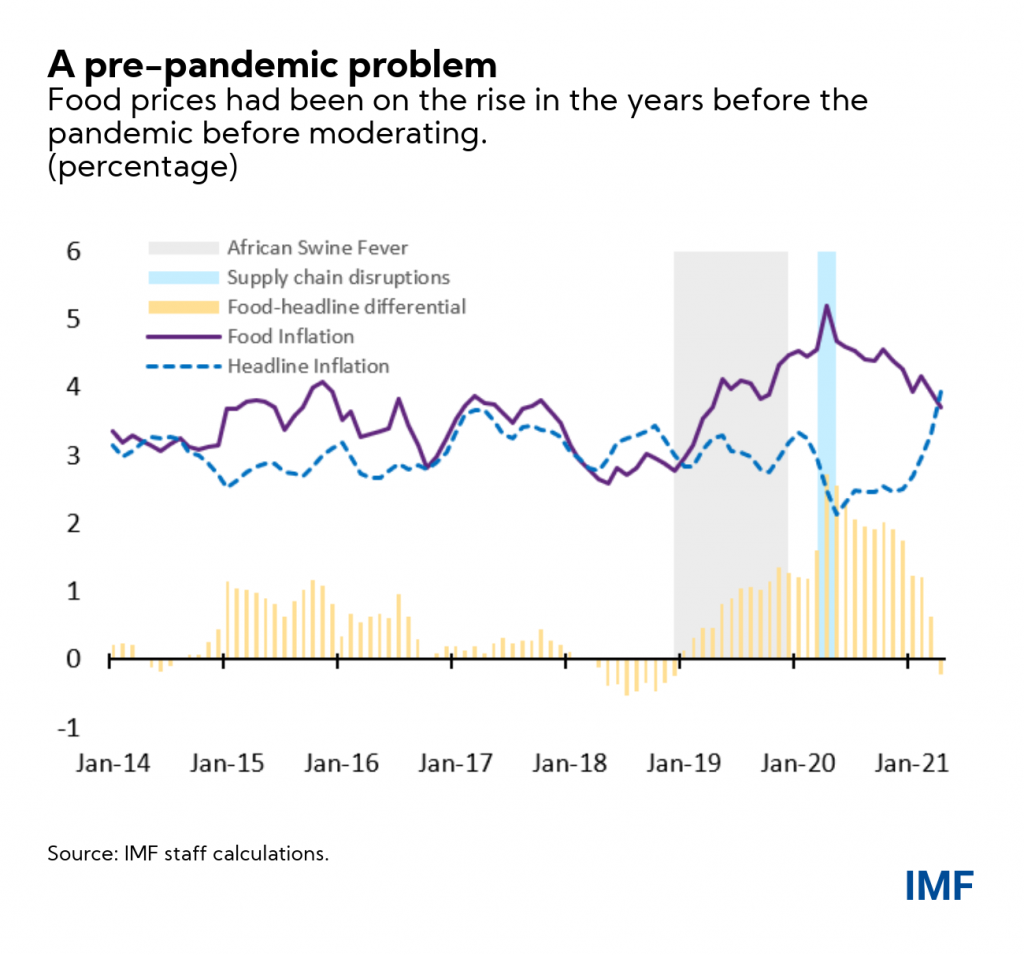
Fact #1: Food price inflation started increasing before the pandemic.
The increase in consumer food price inflation predates the pandemic. In the summer of 2018, China was hit by an outbreak of African swine fever, wiping out much of China’s hog herd, which represents more than 50 percent of the world’s hogs. This sent pork prices in China to an all-time high by mid-2019 creating a ripple effect on the prices of pork and other animal proteins in many regions around the world. This was compounded by the introduction of Chinese import tariffs on US pork and soybeans during the US-China trade dispute.
Fact #2: Early lockdown measures and supply chain disruptions induced a spike in consumer food prices.
At the start of the pandemic, food supply chain disruptions, a shift from food services (such as dining out) towards retail grocery, and consumer stockpiling (coupled with a sharp appreciation of the US dollar) pushed up consumer food price indices in many countries—with consumer food inflation peaking in April 2020—even though producer prices of primary commodities, including food and energy, were declining sharply as demand for primary food commodities was disrupted. By early summer 2020, however, various consumer food prices had moderated, pushing down consumer food inflation in many countries.
So while food prices at your grocery store (i.e., consumer food prices) may have increased, it is an exaggeration to say that they are currently rising at their fastest pace in years. They are also not currently contributing to headline inflation, though they may do so later this year and in 2022 (see the outlook below). Producer prices, on the other hand, have recently soared (see fact #4). But it takes at least 6-12 months before consumer prices reflect changes in producer prices. Also, on average, the pass-through from producer to consumer prices is only about 20 percent. This is because consumer food prices include the shipping costs of primary food commodities, the processing, marketing and packaging of food, and final distribution costs such as transport costs.
The last two facts will help us understand what to expect for consumer food prices.
Fact #3: Soaring shipping and transport costs.
Ocean freight rates as measured by the Baltic Dry Index (a measure of shipping costs) have increased around 2-3 times in the last 12 months while higher gasoline prices and truck driver shortages in some regions are pushing up the cost of road transport services. Higher transport costs will eventually increase consumer food inflation.
Fact #4: Global food producer prices have rallied reaching multi-year highs.
From their trough in April 2020, international food (producer) prices have increased by 47.2 percent attaining their highest (real) levels on May 2021 since 2014 (highest level ever in current dollar terms).  Between May 2020 and May 2021, soybean and corn prices increased by more than 86 and 111 percent, respectively.
There are three main factors behind the recent rally in producer prices: (1) Demand for staples for both human consumption and animal feed has remained high, especially from China, as countries have stockpiled food reserves due to pandemic-related worries about food security. (2) The recent 2020-2021 La Niña episode—a global weather event occurring every few years—has led to dry weather in key food exporting countries, including Argentina, Brazil, Russia, Ukraine, and the United States. This has caused, in some cases, harvests and harvest outlooks to fall short of expectations. As demand has outpaced supply, US and world stocks-to-use ratios—a measure of market tightness—reached multi-year lows for some staples. (3) Strong demand for biofuels increased speculative demand by non-commercial traders, and export restrictions are additional factors supporting world producer prices.
Outlook
Based on the four facts presented, it is plausible that consumer food price inflation will pick up again in the remainder of 2021 and 2022. Indeed, the recent sharp increase in international food prices has already slowly started to feed into domestic consumer prices in some regions as retailers, unable to absorb the rising costs, are passing on the increases to consumers. More is likely to come, however, since international food prices are expected to increase by about 25 percent in 2021 from 2020, stabilizing in 2021. A pass-through of 20 percent (13 percent in the first year and 7 percent in the second) would, thus, imply an increase in consumer food price inflation of about 3.2 percentage points and 1.75 percentage points on average in 2021 and 2022, respectively. An additional 1 percentage point to the 2021 global consumer food inflation could be added by the higher freight rates.
The impact, however, will vary by country. Consumers in emerging markets could experience even higher increases due to the higher dependency on food imports (e.g. countries in sub-Saharan Africa and the Middle East and North Africa). The pass-through from producer prices to consumer prices also tends to be larger for emerging markets. For low-income countries struggling from the pandemic, the effects of further food inflation could be dire and risk a backslide in efforts to eliminate hunger.
Emerging markets and low-income countries are also more vulnerable to food price shocks because consumers in these countries typically spend a relatively large proportion of their income on food. Finally, for emerging markets and developing economies an additional risk factor is the currency depreciation against the US dollar—possibly due to falling export and tourism revenues and net capital outflows. Since most food commodities are traded in US dollars, countries with weaker currencies have seen their food import bill increase.
Compliments of the IMF.
The post IMF | Four Facts about Soaring Consumer Food Prices first appeared on European American Chamber of Commerce New York [EACCNY] | Your Partner for Transatlantic Business Resources.

EACC

EU Cybersecurity: EU Commission proposes a Joint Cyber Unit to step up response to large-scale security incidents

The Commission is today laying out a vision to build a new Joint Cyber Unit to tackle the rising number of serious cyber incidents impacting public services, as well as the life of businesses and citizens across the European Union. Advanced and coordinated responses in the field of cybersecurity have become increasingly necessary, as cyberattacks grow in number, scale and consequences, impacting heavily our security. All relevant actors in the EU need to be prepared to respond collectively and exchange relevant information on a ‘need to share’, rather than only ‘need to know’, basis.
First announced by President Ursula von der Leyen in her political guidelines, the Joint Cyber Unit proposed today aims at bringing together resources and expertise available to the EU and its Member States to effectively prevent, deter and respond to mass cyber incidents and crises. Cybersecurity communities, including civilian, law enforcement, diplomatic and cyber defence communities, as well as private sector partners, too often operate separately. With the Joint Cyber Unit, they will have a virtual and physical platform of cooperation: relevant EU institutions, bodies and agencies together with the Member States will build progressively a European platform for solidarity and assistance to counter large-scale cyberattacks.
The Recommendation on the creation of the Joint Cyber Unit is an important step towards completing the European cybersecurity crisis management framework. It is a concrete deliverable of the EU Cybersecurity Strategy and the EU Security Union Strategy, contributing to a safe digital economy and society.
As part of this package, the Commission is reporting today on progress made under the Security Union Strategy over the past months. Furthermore, the Commission and the High Representative of the Union for Foreign Affairs and Security Policy have presented the first implementation report under the Cybersecurity Strategy, as requested by the European Council, while at the same time they have published the Fifth Progress Report on the implementation of the 2016 Joint Framework on countering hybrid threats and the 2018 Joint Communication on increasing resilience and bolstering capabilities to address hybrid threats. Finally, the Commission has issued the decision on establishing the office of the European Union Agency for Cybersecurity (ENISA) in Brussels, in accordance with the Cybersecurity Act.
A new Joint Cyber Unit to prevent and respond to large-scale cyber incidents
The Joint Cyber Unit will act as a platform to ensure an EU coordinated response to large-scale cyber incidents and crises, as well as to offer assistance in recovering from these attacks. Today, the EU and its Member States have many entities involved in different fields and sectors. While the sectors may be specific, the threats are often common – hence, the need for coordination, sharing of knowledge and even advance warning.
The participants will be asked to provide operational resources for mutual assistance within the Joint Cyber Unit (see proposed participants here). The Joint Cyber Unit will allow them to share best practice, as well as information in real time on threats that could emerge in their respective areas. It will also work at an operational and at a technical level to deliver the EU Cybersecurity Incident and Crisis Response Plan, based on national plans; establish and mobilise EU Cybersecurity Rapid Reaction Teams; facilitate the adoption of protocols for mutual assistance among participants; establish national and cross-border monitoring and detection capabilities, including Security Operation Centres (SOCs); and more.
The EU cybersecurity ecosystem is wide and varied and through the Joint Cyber Unit, there will be a common space to work together across different communities and fields, which will enable the existing networks to tap their full potential. It builds on the work started in 2017, with the Recommendation on a coordinated response to incidents and crises – the so-called Blueprint.
The Commission is proposing to build the Joint Cyber Unit through a gradual and transparent process in four steps, in co-ownership with the Member States and the different entities active in the field. The aim is to ensure that the Joint Cyber Unit will move to the operational phase by 30 June 2022 and that it will be fully established one year later, by 30 June 2023. The European Union Agency for Cybersecurity, ENISA, will serve as secretariat for the preparatory phase and the Unit will operate close to their Brussels offices and the office of CERT-EU, the Computer Emergency Response Team for the EU institutions, bodies and agencies.
The investments necessary for setting up the Joint Cyber Unit, will be provided by the Commission, primarily through the Digital Europe Programme. Funds will serve to build the physical and virtual platform, establish and maintain secure communication channels, as well as improve detection capabilities. Additional contributions, especially to develop Member States’ cyber-defence capabilities, may come from the European Defence Fund.
Keeping Europeans safe, online and offline
The Commission is reporting today on the progress made under the EU Security Union Strategy, towards keeping Europeans safe. Together with the High Representative of the Union for Foreign Affairs and Security Policy, it is also presenting the first implementation report under the new EU Cybersecurity Strategy.
The Commission and the High Representative presented the EU Cybersecurity strategy in December 2020.  Today’s report is taking stock of the progress made under each of the 26 initiatives set out in this strategy and refers to the recent approval by the European Parliament and the Council of the European Union of the regulation setting up the Cybersecurity Competence Centre and Network. Good progress has been made to strengthen the legal framework for ensuring resilience of essential services, through the proposed Directive on measures for high common level of cybersecurity across the Union (revised NIS Directive or ‘NIS 2′). Regarding the security of 5G communication networks, most Member States are advancing in the implementation of the EU 5G Toolbox, having already in place, or close to readiness, frameworks for imposing appropriate restrictions on 5G suppliers. Requirements on mobile network operators are being reinforced through the transposition of the European Electronic Communications Code, while the European Union Agency for Cybersecurity, ENISA, is preparing a candidate EU cybersecurity certification scheme for 5G networks.
The report also highlights the progress made by the High Representative on the promotion of responsible state behaviour in cyberspace, notably by advancing on the establishment of a Programme of Action at United Nations level. In addition, the High Representative has started the review process of the Cyber Defence Policy Framework to improve cyber defence cooperation, and is conducting a ‘lessons learned exercise’ with Member States to improve the EU’s cyber diplomacy toolbox and identify opportunities for further strengthening EU and international cooperation to this end. Moreover, the report on the progress made in countering hybrid threats, that the Commission and the High Representative have also published today, highlights that since the 2016 Joint Framework on countering hybrid threats – a European Union response was established, EU actions have supported increased situational awareness, resilience in critical sectors, adequate response and recovery from the ever increasing hybrid threats, including disinformation and cyberattacks, since the onset of the coronavirus pandemic.
Important steps were also taken over the last 6 months under the EU Security Union Strategy to ensure security in our physical and digital environment. Landmark EU rules are now in place that will oblige online platforms to remove terrorist content referred by Member States’ authorities within one hour. The Commission also proposed the Digital Services Act, which puts forward harmonised rules for the removal of illegal goods, services or content online, as well as a new oversight structure for very large online platforms. The proposal also addresses platforms’ vulnerabilities to amplifying harmful content or the spread of disinformation. The European Parliament and the Council of the European Union agreed on temporary legislation on the voluntary detection of child sexual abuse online by communications services. Work is also ongoing to better protect public spaces. This includes supporting Member States in managing the threat represented by drones and enhancing the protection of places of worship and large sports venues against terrorist threats, with a €20 million support programme underway. To better support Member States in countering serious crime and terrorism, the Commission also proposed in December 2020 to upgrade the mandate of Europol, the EU Agency for law enforcement cooperation.
Members of the College said:
Margrethe Vestager, Executive Vice-President for a Europe Fit for the Digital Age, said: “Cybersecurity is a cornerstone of a digital and connected Europe. And in today’s society, responding to threats in a coordinated manner is paramount. The Joint Cyber Unit will contribute to that goal. Together we can really make a difference.”
Josep Borrell, High Representative of the Union for Foreign Affairs and Security Policy, said: “The Joint Cyber Unit is a very important step for Europe to protect its governments, citizens and businesses from global cyber threats. When it comes to cyberattacks, we are all vulnerable and that is why cooperation at all levels is crucial. There is no big or small. We need to defend ourselves but we also need to serve as a beacon for others in promoting a global, open, stable and secure cyberspace.”
Margaritis Schinas, Vice-President for Promoting our European Way of Life, said: “The recent ransomware attacks should serve as a warning that we must protect ourselves against threats that could undermine our security and our European Way of Life. Today, we can no longer distinguish between online and offline threats. We need to pool all our resources to defeat cyber risks and enhance our operational capacity. Building a trusted and secure digital world, based on our values, requires commitment from all, including law enforcement.”
Thierry Breton, Commissioner for the Internal Market, said: “The Joint Cyber Unit is a building block to protect ourselves from growing and increasingly complex cyber threats. We have set clear milestones and timelines that will allow us – together with Member states- to concretely improve crisis management cooperation in the EU, detect threats and react faster. It is the operational arm of the European Cyber Shield.”
Ylva Johansson, Commissioner for Home Affairs, said: “Countering cyberattacks is a growing challenge. The Law Enforcement community across the EU can best face this new threat by coordinating together. The Joint Cyber Unit will help police officers in Member States to share expertise. It will help build law enforcement capacity to counter these attacks.”
Background
Cybersecurity is a top priority of the Commission and a cornerstone of the digital and connected Europe. The increase of cyberattacks during the coronavirus crisis has shown how important it is to protect health and care systems, research centres and other critical infrastructure. Strong action in the area is needed to future-proof the EU’s economy and society.
The EU is committed to delivering on the EU Cybersecurity Strategy with an unprecedented level of investment in Europe’s green and digital transition, through the long-term EU budget 2021-2027, notably through the Digital Europe Programme and Horizon Europe, as well as the Recovery Plan for Europe.
Moreover, when it comes to cybersecurity, we are as protected as our weakest link. Cyberattacks do not stop at the physical borders. Enhancing cooperation, including cross-border cooperation, in the cybersecurity field is therefore also an EU priority: in recent years, the Commission has been leading and facilitating several initiatives to improve collective preparedness, as EU joint structures have already supported Member States, both at technical and at operational level. Today’s recommendation on building a Joint Cyber Unit is another step towards greater cooperation and coordinated response to cyber threats.
At the same time, the Joint EU Diplomatic Response to Malicious Cyber Activities, known as the cyber diplomacy toolbox, encourages cooperation and promotes responsible state behaviour in cyberspace, allowing the EU and its Member States to use all Common Foreign and Security Policy measures, including, restrictive measures, to prevent, discourage, deter and respond to malicious cyber activities.
To ensure security both in our physical and digital environments, the Commission presented in July 2020 the EU Security Union Strategy for the period 2020 to 2025. It focuses on priority areas where the EU can bring value to support Member States in fostering security for all those living in Europe: combatting terrorism and organised crime; preventing and detecting hybrid threats and increasing the resilience of our critical infrastructure; and promoting cybersecurity and fostering research and innovation.
Compliments of the European Commission.
The post EU Cybersecurity: EU Commission proposes a Joint Cyber Unit to step up response to large-scale security incidents first appeared on European American Chamber of Commerce New York [EACCNY] | Your Partner for Transatlantic Business Resources.

EACC

FSB | Global Transition Roadmap for LIBOR

Transition away from LIBOR requires significant commitment and sustained effort from both financial and non-financial institutions across many LIBOR and non-LIBOR jurisdictions.
The Financial Stability Board has identified that continued reliance of global financial markets on LIBOR poses clear risks to global financial stability. On 5 March 2021, ICE Benchmark Administration (IBA) and the UK Financial Conduct Authority (FCA) formally confirmed the dates that panel bank submissions for all LIBOR settings will cease, after which representative LIBOR rates will no longer be available. The majority of LIBOR panels will cease at the end of this year, with a number of key US dollar (USD) settings continuing until end-June 2023, to support rundown of legacy contracts only.
This updated Global Transition Roadmap (GTR) is intended to inform those with exposure to LIBOR benchmarks of some of the steps they should be taking now and over the remaining period to LIBOR cessation dates to successfully mitigate these risks. These are considered prudent steps to take to ensure an orderly transition by end-2021 and are intended to supplement existing timelines/milestones from industry working groups and regulators.
This does not constitute regulatory advice or affect any transition expectations set by individual regulators, which may require firms to move faster in some instances. It is important that all regulated financial institutions have an open and constructive LIBOR transition dialogue with their regulators, both home state and host state, throughout the transition period. As benchmark transitions vary across currency regions and legislation and other actions to promote transition are taking different paths in different jurisdictions, financial institutions, non-financial firms and others with exposure to LIBOR benchmarks should also monitor developments with regard to other IBORs relevant to their business.
Compliments of the Financial Stability Board.
The post FSB | Global Transition Roadmap for LIBOR first appeared on European American Chamber of Commerce New York [EACCNY] | Your Partner for Transatlantic Business Resources.

EACC

ECB Interview | A powerful push for digitalisation

Interview with Fabio Panetta, Member of the Executive Board of the ECB, conducted by Martin Arnold on 14 June 2021 |

You are getting close now to a decision on whether to pursue further work on the digital euro. You recently completed your public consultation on this, in which the biggest concerns were about privacy. So how do you address people’s concerns about privacy and still do all the necessary checks to make sure that it’s not abused for money laundering, tax evasion, and all of those things?
If the central bank gets involved in digital payments, privacy is going to be better protected. Why? Because we’re not like private companies. We have no commercial interest in storing, managing or monetising the data of users of a digital means of payment. We’re not a profit-maximising institution, we work in the interest of citizens. So we’re a different animal than private service providers. This also emerged from the public consultation. People feel safer if their information is in the hands of the central bank – a public institution – than if it is in the hands of private companies. Second, there are many ways in which we can protect confidential data while allowing the checks foreseen by law to avoid illicit transactions, such as those linked to money laundering, the financing of terrorism or tax evasion.
How would that work?
First of all, we could segregate the data. Suppose that I have to give you money. I’m the payer and you’re the payee. I would go to my bank, which would know that I’m making a payment and would transmit a code to the payment operator. The payment operator would transfer the payment between one code and another code. It would not know the identity of the payer behind the one code and the payee behind the other. So the payment will go through, but nobody in the payment chain would have access to all the information. But this is only one example. We could use cryptographic codes. It could be possible, for example, to make offline payments for small amounts, in which no data are recorded outside the wallets of the payer and payee. One could imagine that for payments of small amounts – €70 or €100 – you could have offline payments without a connection.
But don’t you need to link back to the identity if you’re going to restrict people to a certain amount? 
For these amounts, one can also imagine that you don’t do that. Why do we want to have all payments traceable? Because there are issues in terms of money laundering, the financing of terrorism and tax evasion. This risk is much lower for small transactions, as long as they are not used to split a larger payment into many smaller ones. We addressed this in past experimentation by introducing “anonymity vouchers”, making it possible to anonymously transfer a limited amount of digital euro over a defined period of time. So the concept is that controls should be cost-effective. For very small amounts, we could permit truly anonymous payments, but in general, confidentiality and privacy are different from anonymity. Full anonymity must be considered very carefully, because there is a trade-off between guaranteeing full anonymity and guaranteeing compliance with fundamental regulations in areas such as anti-money laundering, combating the financing of terrorism and tax evasion. And let’s not forget that citizens will still be able to use cash, which guarantees anonymity. There are many things we can do, with the help of technology, so people feel safe about how their data are used, and at the same time, so a payment can be reconstructed ex post if the police want to assess whether there’s been any illicit activity, any crime going on. But that would not be in line with the incentives of private intermediaries, which are interested in the commercial value of transaction data. We’ve done some preliminary experimentation on how to safeguard confidentiality with national central banks, which will be published. So we’re discussing possible ways to guarantee privacy. Why are we doing this? For obvious reasons and because the message that emerged from the consultation, as you said before, is very clear. Privacy is a top priority for users.
What about people who say that, while the ECB may not have commercial interests, you are a public sector body? So the idea of the government spying on people by looking at what they’re doing with their money, isn’t that also a concern for people?
I start from the assumption that people should be able to rely on a public institution, and we’ll make sure to set up governance structures to avoid any possible abuse of data. We’ll act within the scope of European legislation, which is the most advanced worldwide in protecting data, with an independent data protection supervisor that we will be interacting with.
Can you tell me a bit more about the experimentation? What does that entail? 
The experimentation we’ve done so far is to get a preliminary sense of the pros and cons of different technologies and the limits of, for example, handling payments while safeguarding confidentiality. In this preliminary phase, we’ve organised four work streams in which we’ve tested the possibility of running a digital euro with a centralised system, a decentralised one, a mixture of the two and with offline payments. If the Governing Council gives us the green light in July, we’ll start a formal investigation phase focusing on the design of a digital euro. After two years, we’ll get back to the Governing Council, and in the meantime we’ll interact with other European authorities and institutions – the Parliament, the Commission, the Council, the Eurogroup – all those who are involved, because the digital euro will require legislative changes. So at the end of these two years, ideally, we would have more clarity on the steps which would be necessary to issue a digital euro, if the decision were taken to launch it. Then we expect to have, by and large, three years to be able to implement what we have decided on, by working together with the technology providers and banks on the end user features of a digital euro so it could be integrated into the services that they’re already offering to their customers.
Why do you need legislation?
Because, for now, a digital euro is not explicitly foreseen in the European legislation. There are different ways in which you could define the legal basis for a digital euro, depending on its characteristics. Existing legislation may also need to be adjusted to cater for a digital euro. For example, to allow the anti-money laundering authorities to have powers to verify, ex post, not only transactions through bank accounts, but also through the digital euro.
Let’s take a slight step back. There are still some people who are scratching their heads and saying, what is the problem that you’re trying to solve with this project? What is the point of the digital euro?
First of all, for many centuries, from ancient Greece to the Roman Empire and Charlemagne, the sovereign has always offered money to citizens – sovereign money, which is the ultimate reserve of value for citizens. We’re doing the same. We intend to continue to do so. So why do we need a digital euro for this? There are two reasons. First, people are paying more and more digitally, and less and less with our current means of payment – cash. And second, people are buying more and more online, and with e-commerce it is relatively difficult to pay with cash. So people are using the means of payment backed by the central bank less and less. We’re moving into a digital era, so by introducing a digital euro we would be changing how people can access our balance sheet and use our means of payment.
So it is the decline of cash that you are responding to? But you can pay digitally with electronic money, you don’t need a digital euro to do so. I can already buy pretty much anything I like sitting here with my mobile phone. 
First of all, there is no digital means of payment that you can use everywhere in the euro area, from Finland to Cyprus.
What about a Visa card?
You can’t use it everywhere. As you know, even here in Frankfurt you can’t use Visa or American Express in every shop. And it can be expensive to use them. Second, I think that this is not just about preserving the role of the instrument of the central bank. There are many other reasons. First, we would offer a means of payment that is risk-free. I think that people do have the right to access the balance sheet of the central bank, which is the only risk-free institution, even less risky than the sovereign. One could imagine that, in most cases, liabilities of commercial banks are pretty similar to the liability of the central bank. But there are situations when differences do matter. You remember in the financial crisis when banks stopped trusting each other. So in that situation, the liability of a commercial bank was not perceived by citizens or by banks themselves as riskless. So you must have a riskless means of payment, a riskless financial instrument in the economy. And this is the liability of the central bank.
Are you also worried about the threat from cryptocurrencies and other central bank currencies? 
This is not why we started this analysis and will possibly start a project, but of course there is the potential threat that could come from others issuing a digital means of payment. This could be a so-called global stablecoin or another sovereign providing a digital means of payment. And if people do want to pay digitally and we don’t offer them a digital means of payment, somebody else would do that. So I can give you many, many reasons. And by the way, it’s not just about payments. This, I think, is a historical change that will not only change the way the financial system works. This will change the attitude of citizens towards digital instruments. I think this is a fundamental change to how payments will function in the future, both for the financial system and for society at large. And it is generating huge interest.
Do you think the end consumer is going to notice a big difference? Because legally they will have a claim directly on the central bank. But for all intents and purposes, it’s just going to be numbers on a screen, the same way that their digital deposits are shown on a banking app. 
Most of the time I would agree with you, but not always. The great financial crisis was a very big wakeup call. It’s not true that people don’t differentiate. Most of the time, they don’t need to differentiate between different means of payment, among liabilities of different issuers of different means of payment. But there are situations in which people do understand very well. They optimise. They don’t care about whether they have bank deposits or cash, unless the bank deposit becomes risky. In that case, they seem to understand the difference very well and they seem to differentiate very carefully.
Some people imagine that the central bank is going to be operating these digital euro accounts directly. But is that really how it’s going to work? You’re more likely to outsource the management and the operation of this to the commercial banks and some fintechs, right?
It’s theoretically possible that the central bank would handle the accounts of individual citizens. But it’s extremely unlikely that this would be the choice we would make. Why? First of all, there are currently, I believe, around two million or more bank employees in Europe, dealing with 400 million customers. There’s no way that the limited number of employees at the central bank could do this. So even if we were crazy enough to embark on such a project, we could not do it. We’re very productive, but not that presumptuous. Second, we don’t want to use the digital euro to change the structure of the financial system or to destabilise the functioning of the financial sector. Banks already provide citizens with a large number of services, and in the future they would add access to the digital euro as one additional service to build a business model with the “digital euro inside”. Banks are also much better than central banks at onboarding, and at know-your-customer and anti-money laundering checks. We could not do it. So even if it is theoretically possible, it’s very unlikely. What we want is for the digital euro to be a sort of raw material that we would hand over to banks to provide the services they are providing now, plus access to the digital euro, in the same way they’re already providing access to cash.
Only banks?
Well it would be intermediaries that are involved in the provision of payment services. They would need to be regulated and supervised intermediaries. So not only banks.
Is there a danger of crowding out innovation by the private sector? 
We’re a very peculiar supplier of services, because in general, private service providers want to take market share from competitors. We’re not that type of provider. What we want to do is negate the risk that the digital euro would crowd out banks and innovation in payments. So we’ll take care of that. I think the digital euro would be a source of innovation, not the opposite. And we’ll not crowd out banks, because this will be a public good provided by the central bank to foster innovation, progress and efficiency in the financial system.
That must be one of your primary concerns: to avoid destabilising the banking system in any way or facilitating runs on banks in crisis times? 
Absolutely. We’re reflecting on how to avoid that. What we want to offer is a means of payment, not a form of investment. To avoid crowding out banks, we are discussing possible alternatives. One possibility is to put a cap on the amount of digital euro that individual users could hold. So you can hold a maximum of, say, €3,000, but not more. Any money in excess of that would have to be transferred into a bank account. Another possibility is that you can hold as much as you want, but beyond a certain threshold, you would face a financial disincentive. Up to €3,000 euro, amounts held in digital euro would never be treated less favourably than cash, they would never be remunerated at interest rates below zero. But if for some reason you wanted to hold more than that, then you would face a financial disincentive that would discourage you from doing so. Why would we do that? Because if people could hold an unlimited amount of digital euro, they could shift all their deposits from bank accounts into digital euro, especially in the run-up to a crisis, potentially precipitating a banking crisis. Which would destabilise the financial system. By the way, these proposals which originate from the ECB are now being discussed quite widely around the globe.
Are you leaning towards one or the other of those?
No, we will take that decision after consulting with stakeholders, citizens, merchants and banks, and there are implications and pros and cons in either method. For example, the cap may be more powerful. You cannot hold more than €3,000 full stop. Right. But then we would have to deal with a number of complications. Suppose that you have €2,800 in your digital euro account and I owe you €500. If I make a payment to you, what happens to the €300 that exceeds the threshold, the cap of €3,000? Either the payment cannot go through, which would be disastrous as it would create uncertainty about the completion of a payment, or a waterfall mechanism would have to be set up to transfer the rest to a bank account. But that would mean obliging you to have a bank account, which is at odds with the concept of financial inclusion, which is one of our objectives. Access would need to be provided to basic bank accounts that are free of charge. Tiered remuneration is of course more market friendly. But is it powerful enough? In a crisis, it could be very difficult to have a financial disincentive that is large enough to cause you not to seek security if you fear that your bank could go under and that you could be bailed in. So you would need to bring down the remuneration of digital euro in excess of a threshold when there are concerns about a financial crisis. But then that would be a signal that would need to be managed. So, you see that there are solutions, but each of them – cap or tiered remuneration – has advantages and disadvantages.
Is a digital euro going to use blockchain, or distributed ledger technology?
In our tests, we have experimented with two systems. One is a centralised system known as TIPS. We have used this to analyse the functioning of a theoretical digital euro. How many transactions can be done per second using that infrastructure? And how much time does it take to complete each transaction? We had excellent results with TIPS, suggesting we could handle hundreds of millions of transactions per day, and the completion time for payments was negligible. Then we have also looked at distributed ledger technology (DLT). While there are types of DLT which are used by commercial banks for financial transactions, there’s no experience of DLT that could serve the needs of 400 million customers. And we’ve also experimented with a combination of the two, because there’s no reason why one should exclude the other. We could have a centralised system with different nodes, and then these different nodes would interact with the centralised base enabling you to multiply the power of the system. But this is a question for the IT experts.
Regulation of cryptocurrencies and stablecoins, how do you see that? Do you think that stablecoins need to be more tightly regulated? 
We still have unstable coins. To become stablecoins, a necessary although not sufficient condition is that they need to be regulated and supervised. And obviously, the coins have a number of risks for individual consumers and for the financial system at large. So what is the mechanism behind the so-called stable or unstable coins? The stablecoin issuer sells the coin to you, then uses the proceeds from the sale to invest in reserve assets. But those reserve assets do not have the certainty or stability of their value. They may be low-risk assets, but they are not risk-free assets. It is also uncertain whether the issuer holds an adequate amount of such assets to back the value of coins in circulation. Then there is the possibility of the value of the asset changing and the value of the coin changing. In periods of financial tension, there could be an expectation that the value of the coin would change significantly because of the value of the asset, and then there could be a risk of people going to the issuer and withdrawing their money. That is the mechanism that leads to a run. But unlike in the case of banks, there is currently no supervision. There is no deposit guarantee scheme and there is no emergency liquidity provision by the central bank, because the central bank cannot commit public money to save entities that are not subject to adequate prudential requirements, meaning that there is an inherent instability in the function of these coins – and for this reason they are still unstable coins. Once we have regulation and oversight, it is possible they might become more deserving of the name “stablecoins”. But only the money issued by the central bank is truly stable. Europe is at the forefront of regulation in this field. The European Commission’s legislative proposal for a regulation on Markets in Crypto-Assets (MiCA) sets out a number of mechanisms to reduce the risks to consumers and to financial stability. And the message sent is that until the regulation is in place, the presumption would be that no stablecoin should start operating in the euro area. At the same time, we are looking to adopt our oversight framework. We are currently discussing our new Eurosystem oversight framework for payment instruments – the PISA framework – and it will be adopted to include oversight of stablecoins. Once this is done, then we will discuss the possible introduction of such coins.
What about cryptocurrencies – bitcoin and the like? How are you managing them at the moment? Because the regulation framework isn’t in place yet. 
There is no formal mechanism that we can use to prevent any investor in the euro area from buying crypto-assets. They are not currencies; they are not money. The risks they bear are very high. I think there should be careful regulation. MiCA introduces regulation for crypto-assets. Our PISA framework will also give us the possibility to conduct oversight of crypto-assets.
What does this mean, oversight of crypto-assets? 
It’s very difficult to regulate them, to oversee them, because there is no responsible legal entity. They are decentralised. They could be in China. They could be in Switzerland or in South America. They could be anywhere. But to the extent that intermediaries are involved in the supply of those crypto-assets, then we would have regulation and oversight in place.
In my view, crypto-assets are very dangerous animals. They are not money, they are contracts that are perfectly fine for gamblers. We should try to protect consumers as much as possible. And we know from recent experience that those crypto-assets are largely used for criminal activities. We also have the issue of energy consumption. Bitcoin mining, for example, uses a huge amount of energy. This is not sustainable.
When will this supervision start? When is PISA coming into force?
By the end of this year, I hope. But we also need the MiCA regulation, because it is complementary to our PISA framework.
Let’s talk about monetary policy and the implications for that. You talked about imposing negative interest rates on digital euro to disincentivise people from holding too much of it. Could it be a way to make interest rates even more negative?
No, because first of all, we’re not planning to withdraw cash. The reason why there is an effective lower bound for monetary policy is that if you bring interest rates too low, people would turn to cash, as the cost of storing cash would become lower than the cost of holding a non-cash instrument.
We’re not introducing the digital euro because we want to change the way we implement monetary policy in any way. We’re not planning to withdraw cash. So we would never use the digital euro for monetary policy, and we would never use it to impose deeply negative interest rates by design, because we’ll continue to supply cash.
Have you got any idea of the cost of launching the digital euro project? 
Currently we pay for the costs of producing banknotes and end users are not charged, but we are not losing money. Quite the contrary, because we earn seigniorage – which results from the difference between the face value of money and the cost of issuing it. Likewise, with the digital euro we won’t charge end users and we will incur some costs, but we won’t lose money. Seigniorage means we’ll have more liabilities and more assets, and we’ll make money out of that investment under normal market conditions. As part of the investigation phase, we’ll discuss the overall architecture and how the various stakeholders involved in the transactions charge each other, but citizens paying with digital euro won’t be charged. And I don’t think that the cost of issuing a digital euro will be large. We already have experience with wholesale and retail payments. Suppose that we use TIPS – the technology is already in place. And national central banks already use DLT. So I don’t expect the cost to be prohibitive. And the proceeds would be very large, because that’s a way of maintaining the size of the balance sheet, which means that you have more liabilities and more assets. This means that you’ll earn more seigniorage.
Will intermediaries make money on it?
The ECB as the issuer will not charge users. Intermediaries will offer services with digital euro inside to cover their costs. This is a complicated issue that will have to be addressed: the interaction between banks, intermediaries and customers. And competition has to be ensured to limit the fees and charges for customers.
How will this change the world of finance, the world of money for the consumer out there? 
This would be a very powerful push for digitalisation. It would allow everybody to have access to a safe, risk-free, cost-free means of payment in the digital era. We’re currently still in a period of transition, but 20 years from now, everybody will be using digital instruments. The digital euro and cash could co-exist, but I’m sure that everybody would be using digital means of payment. You can build programmable products at lower cost. For instance, users could decide to allow automatic payments for routine transactions, such as paying bills, using a toll road, going to the cinema or parking.
So is this just for the eurozone or will it be available to people outside the eurozone? And if so, is there a danger you erode the monetary sovereignty of smaller countries? 
There is indeed such a danger, and that is why we’re considering which potential users should have access to digital euro. Within the euro area, €3,000 would already be above the cash requirements of most people today. But in some countries, including some not far from us, with lower GDP per capita, €3,000 in digital euro form could be too large an amount, as it could trigger financial instability by depleting bank deposits. We’ll have to reflect very carefully on access and limits for foreign users. Of course, foreigners that come to the euro area as tourists should have access to digital euro. But here too, we would use limits.
Then there is another and more positive international dimension: the possibility of doing cross-border payments. We’re already cooperating at the international level. The advantages of introducing central bank digital currencies would be maximised if we made them interoperable, as they could make cross-border payments more efficient and much cheaper.

Compliments of the European Central Bank.
The post ECB Interview | A powerful push for digitalisation first appeared on European American Chamber of Commerce New York [EACCNY] | Your Partner for Transatlantic Business Resources.