Read More
EACC

IMF | Longer Delivery Times Reflect Supply Chain Disruptions

Supply chain disruptions have become a major challenge for the global economy since the start of the pandemic. Shutdowns of factories in China in early 2020, lockdowns in several countries across the world, labor shortages, robust demand for tradable goods, disruptions to logistics networks, and capacity constraints have resulted in big increases in freight costs and delivery times.
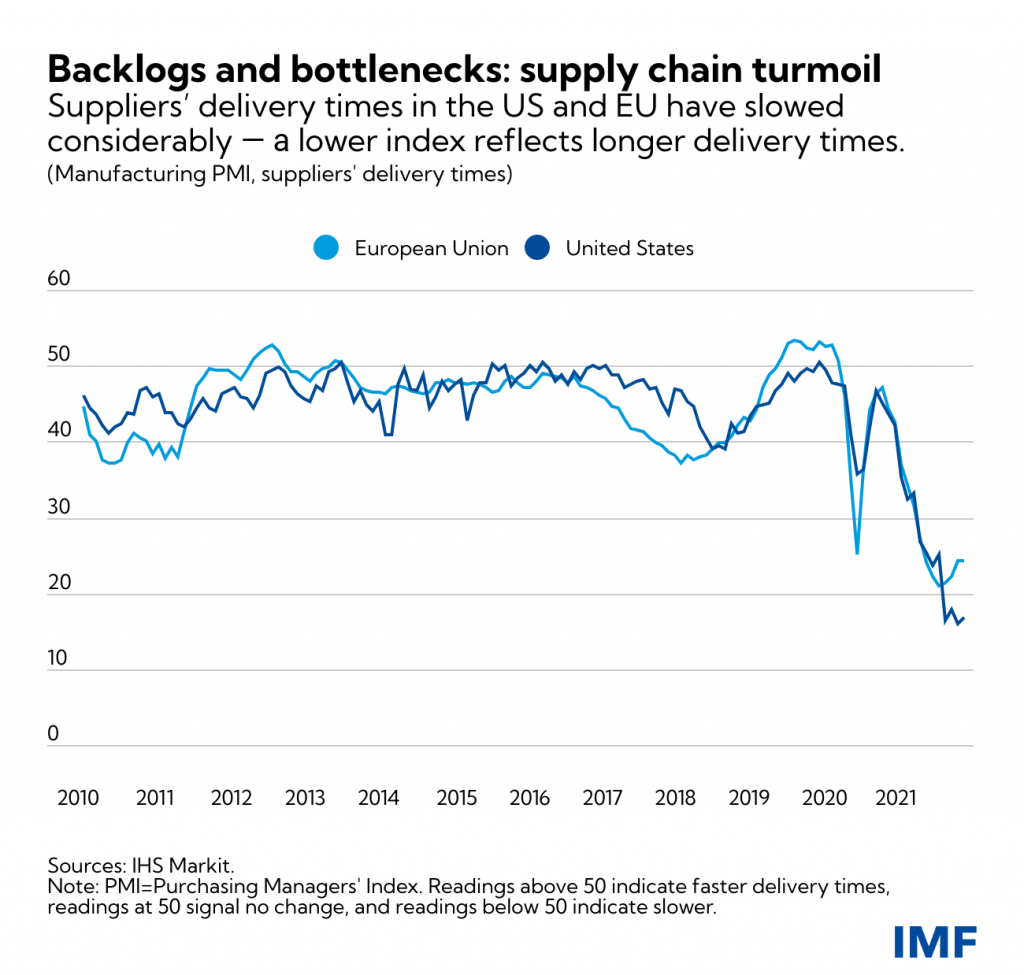
Our chart of the week shows suppliers’ delivery times in the United States and the European Union have hit record highs since late 2020 (the data goes back to 2007). IHS Markit’s suppliers’ delivery times index is constructed from Purchasing Managers Index business surveys and reflects the extent of supply chain delays.
To calculate the index, purchasing managers are asked if their suppliers’ delivery times are, on average, slower, faster, or unchanged compared to the previous month. Readings above 50 indicate faster delivery times, readings at 50 signal no change, and readings below 50 indicate slower delivery times compared with those of the prior month.
The recent sharp drop in the delivery times index reflects surging demand, widespread supply constraints, or a combination of both. During such times, suppliers usually have greater pricing power, causing a rise in prices. Moreover, these supply chain delays can reduce the availability of intermediate goods which, combined with labor shortages, can slow down production and output growth.
Once the number of new COVID-19 cases starts to decline, capacity constraints and labor shortages should ease, taking some of the pressure off supply chains and delivery times. However, some experts believe that there’s unlikely to be swift relief from supply chain disruptions. Elevated demand during the holiday season in some of the world’s largest economies, another wave of new COVID-19 cases, and extreme weather events, if they materialize, could cause supply chain disruptions.
Authors:

Parisa Kamali is an economist in the External Policy Division of the IMF’s Strategy, Policy, and Review Department

Shiyao Wang is a research assistant in the External Policy Division of the IMF’s Strategy, Policy, and Review Department

Compliments of the IMF.
The post IMF | Longer Delivery Times Reflect Supply Chain Disruptions first appeared on European American Chamber of Commerce New York [EACCNY] | Your Partner for Transatlantic Business Resources.

EACC

U.S FED | How Long is Too Long? How High is Too High?: Managing Recent Inflation Developments within the FOMC’s Monetary Policy Framework

Speech by Governor Randal K. Quarles on the economic outlook at the 2021 Milken Institute Global Conference “Charting a New Course,” Beverly Hills, California |
Thank you to the Milken Institute for the opportunity to join you today. This morning I’d like to outline my view of current economic conditions and the economic outlook and then turn to the implications for monetary policy. In particular, with employment still well below its February 2020 peak, I will focus on how the escalation in inflation this year is testing the monetary policy framework adopted by the Federal Open Market Committee (FOMC) in August 2020.1
Outlook for Economic Growth
Recent data suggest that growth in the third quarter is likely to be lower than we had expected, but the foundations remain in place for strong economic growth over the remainder of this year and next. Employment is growing, financial conditions are accommodative, businesses are investing, and households, in the aggregate, have a large stock of savings to draw on for future spending. Weaker growth in payrolls in August and September, along with uneven consumer spending in July and August, appear to reflect ongoing concerns in some parts of the country about the spread of COVID-19, especially in high-contact service industries. Supply bottlenecks and labor shortages that have been more widespread and persistent than many expected are camouflaging continued strong underlying demand for goods, services, and workers. Supply constraints are particularly evident in interest-sensitive parts of the economy, such as residential investment and vehicle sales, limiting the scope for additional monetary accommodation to stimulate activity in those sectors.
I expect that these developments, however, have for the most part simply postponed activity temporarily and that robust growth will return in the coming months. There is evidence in recent weeks that we seem to be moving into a new phase of the economy. Nominal retail sales rose seven-tenths of 1 percent in September on the heels of a nine-tenths increase in August, an indication that consumers kept up their pace of spending. Robust business investment in equipment and intangibles continued in the second quarter, and indicators suggest another gain in the third quarter. Forward indicators of business spending and the need for firms to replenish depleted inventories point to strong investment into next year.
The Labor Market Continues to Strengthen
Without a doubt, the headline job gains in August and September were lower than expected, but, as I will show, based on almost every other major labor market indicator, there is ample evidence that the demand for labor is strong. At last measure, the Labor Department reported that job openings remained near a record high in August, and a record number of workers were voluntarily quitting their jobs, an indicator of their confidence in finding a better one. Other measures of job openings by education level indicate that jobs are plentiful even for less-skilled workers who have been affected the most by the COVID event. Another indicator I’ve been watching closely is the so-called U-6 unemployment rate, which consists of people who are working part time but prefer full-time work and discouraged workers who want a job but have given up looking. U-6 unemployment declined significantly over the past two months to 8.5 percent in September, roughly the same level as in the middle of 2017, when most everyone considered the job market to be quite healthy. In fact—and this will not be news to most of you—shortages of skilled workers in many occupations predated the COVID event and are likely to persist after its effects have faded. Some of this shortage reflects the aging of the workforce, changes in the types of jobs people want to do, and the time it takes to train workers.
Strong demand for labor is outpacing supply, and, naturally, that development is putting upward pressure on wages. Through September, average hourly wages are up 4.6 percent over the past 12 months, the largest and most sustained increase in wages for workers since the 1990s.
I noted the imbalance between the demand and supply for labor, and some of the labor market indicators that are still well short of pre-COVID levels are those related to labor force participation, which has been about unchanged this year on balance. I expect that as conditions normalize, this measure will pick up, but it is unlikely to return to its February 2020 level. One reason is that a disproportionate number of older workers responded to the initial shock of the COVID event by retiring, which may be an area where participation and employment struggle to retrace lost ground. Longer-lasting changes in labor force participation could make wage pressures more persistent and have implications for the assessment of maximum employment.
Tapering Asset Purchases
Since the middle of last year, the Fed has been increasing its holdings of Treasury securities and agency mortgage-backed securities by $120 billion a month to foster smooth market functioning and to support the economy by putting downward pressure on interest rates. Conditions had improved considerably by the time we announced our forward guidance for asset purchases in December, but the unemployment rate remained at 6.7 percent, near-term growth was being constrained by heightened social-distancing restrictions amid surging hospitalizations from COVID-19, and inflation was running significantly below 2 percent. As we sit here today, demand for labor is strong, and unemployment has declined to 4.8 percent. We have exceeded the previous high for real gross domestic product and are close to reaching the pre-COVID trend. Inflation, about which I will say more shortly, is running at more than twice the FOMC’s longer-run goal.
Taking all of the evidence into account, I think it is clear that we have met the test of substantial further progress toward both our employment and our inflation mandates, and I would support a decision at our November meeting to start reducing these purchases and complete that process by the middle of next year. Bear in mind that asset purchases are pressing down on the accelerator, adding each month to the amount of accommodation the Fed is providing to the economy through downward pressure on longer-term interest rates. Reducing purchases and ending them on this schedule is not monetary tightening, but a gradual reduction in the pace at which we are adding accommodation.
Monetary Policy When the Goals Are Not Complementary
A move to reduce the pace of asset purchases soon also is entirely consistent with the FOMC’s plan to pursue our longer-run maximum-employment and price-stability goals, and our new monetary policy strategy, which we refer to as our framework. The forward guidance that we put in place for asset purchases was an operationalization of the new framework. Last December, with inflation running well below 2 percent and unemployment still elevated, we committed to continue purchasing assets at least at the current pace until we had made substantial further progress toward our goals. In most situations, those goals are complementary. That is, high unemployment usually coincides with subdued inflationary pressures. Therefore, at the time, we did not foresee those goals coming into conflict.
But we are facing a situation now where inflation is high even though employment has yet to fully recover from the COVID event. In that case, according to the FOMC’s monetary policy framework, when objectives are not complementary, the Committee “takes into account the employment shortfalls and inflation deviations and the potentially different time horizons over which employment and inflation are projected to return to levels judged consistent with its mandate.”2
Applying those principles throughout 2021, we have been very patient and focused on the need for the labor market to recover as quickly as practicable from the severe damage experienced during the darkest days of the COVID event. We are remaining patient because, despite some periods of rapid progress, the recovery in jobs has been uneven and is still incomplete.
Early on, patience was easy: In December of last year, my FOMC colleagues and I were expecting much lower inflation—the median projection for 2021 by FOMC participants was 1.8 percent. The FOMC’s preferred inflation gauge did not crack 2 percent until March 2021. But, by June, prices had risen 4 percent over the previous 12 months, ticked up to 4.2 percent in July, and increased further to 4.3 percent in August. The median of the most recent projections by FOMC participants traces a path in which inflation ends the year just a touch lower than the current level. Nonetheless, I do not see the FOMC as behind the curve, for three reasons: Most of the biggest drivers of the very high current inflation rates will ease in coming quarters, some measures of underlying inflation pressures are less worrisome, and longer-term inflation expectations are anchored, at least for now.
First, let me address the big drivers of this year’s price increases. The inflation we have experienced so far has been very unusual and largely related to supply constraints associated both with production and distribution problems related to COVID and with a demand shock arising from the unprecedented and rapid reopening of the economy. We all saw the remarkable price increases and shortages in the used car market. There have been a few other very specific and identifiable supply problems that have driven some other prices to very high levels—the semiconductor shortages that led to auto production slowdowns, for example, and, in some cases, labor shortages or restrictions related to the COVID event were associated with trade disruptions.
Second, if we recognize that much of the excessive inflation we are seeing this year is directly attributable to disruptions that, like the COVID event, will end, then monetary policy often can look through those types of disruptions to consider what inflation will be in the future when this episode passes. To get a fix on where inflation is headed, it is helpful to consider measures of inflation that try to filter out the most unusual and presumably transitory price increases that may be driving headline inflation. The Federal Reserve Bank of Dallas’s trimmed mean measure of inflation systematically removes prices that are increasing or decreasing at abnormally large rates, in order to get some perspective on underlying inflation pressures. For the 12 months through August, the Dallas trimmed mean inflation was an even 2 percent. Of course, while this metric may provide a better indicator of future PCE (personal consumption expenditures) inflation, I do not mean to suggest that this is necessarily a better reading on current inflation—consumers and businesses have to pay for the goods whose prices have risen sharply, and those increases are being felt.
That brings us to the third reason that I do not think the FOMC is behind the curve: anchored inflation expectations. We monitor longer-term expectations of future inflation because we believe they influence changes in actual inflation over the medium term. In fact, our new framework recognizes that stable, well-anchored inflation expectations help return inflation to 2 percent when it is running high, as it is now, as well as when it has fallen somewhat below that goal, as it often does during a recession.
So far, market-based measures of longer-term inflation expectations, as well as surveys of professional forecasters, have increased only moderately this year, moves that more or less reversed declines in those expectations over the previous half-dozen years. Measuring expectations is an inexact science, but smoothing through the ups and downs in expectations in recent years leaves these indicators within a range that has been consistent with inflation near our 2 percent goal.
How Long is Too Long?
Going forward, the question is not only whether inflation will fall in the coming months, but also how far it will fall and if it will fall soon enough to avoid spurring a concerning rise in longer-term inflation expectations. I agree with my FOMC colleagues and most private forecasters that inflation likely will decline considerably next year from its currently very elevated rate. For instance, most of the September Summary of Economic Projections forecasts for PCE inflation in 2022 were between 1.9 and 2.3 percent, with a minimum of 1.7 percent and a maximum of 3.0 percent.3 But I see significant upside risks to my current inflation outlook. Supply constraints in production and distribution already have become more widespread and have lasted longer than most forecasters anticipated. As noted earlier, labor supply constraints are making it difficult for businesses to keep up with demand. This dynamic will continue to support robust wage growth, putting further upward pressure on prices. Moreover, there is evidence in the past couple of months that a broader range of prices are beginning to increase at moderate rates, and I am closely watching those developments.
The fundamental dilemma that we face at the Fed right now is this: Demand, augmented by unprecedented fiscal stimulus, has been outstripping a temporarily disrupted supply, leading to high inflation. But the fundamental productive capacity of our economy as it existed just before COVID—and, thus, the ability to satisfy that demand without inflation—remains largely as it was, and the factors that are disrupting it appear to be transitory. Looked at purely in that light, constraining demand now, to bring it into line with a transiently interrupted supply, would be premature. Given the lags with which monetary policy acts, we could easily find that demand is damping just as supply is increasing, leading us to undershoot our inflation target—and, in the worst case, we could depress the incentives for supply to return, leading to an extended period of sluggish activity and unnecessarily low employment.
But “transitory” does not necessarily mean “short lived.” Indeed, we are discovering that it’s going to take more time than we had thought for supply to return to normal, and with demand already high during that time, I am monitoring the extent to which it could be further boosted by the additional fiscal programs currently under discussion. If those dynamics should lead this “transitory” inflation to continue too long, it could affect the planning of households and businesses and unanchor their inflation expectations. This could spark a wage-price spiral that would not settle down even when the logistical bottlenecks and supply chain kinks have eased. So the central question we have to answer is “How long is too long?”
I am among those who see a good chance that inflation will remain above 2 percent next year, but I am not quite ready to conclude that this “transitory” period is already “too long.” We haven’t yet met the more stringent tests for liftoff that we have laid out in forward guidance about the federal funds rate. Let me quote from the latest FOMC statement: Raising rates will not be appropriate “until labor market conditions have reached levels consistent with the Committee’s assessments of maximum employment and inflation has risen to 2 percent and is on track to moderately exceed 2 percent for some time.”4 Importantly, the level of uncertainty around the paths for inflation and employment are higher than normal as we navigate the unprecedented reopening of the world economy. Therefore, we will remain outcome based, waiting to see further improvements in employment and the evolution of inflation pressures in coming months. And, if the broadly held expectation that inflation will recede next year turns out to be wrong or if inflation expectations show signs of becoming unanchored to the upside, I am confident that the monetary policy tools at our disposal can bring inflation down toward our 2 percent goal.
How High Is Too High?
I said just now that the central question is “How long is too long?” I am also keenly aware, however, that inflation of 4 percent or more certainly cannot be characterized as only “moderately” above 2 percent, and thus we also have to deal with the question of “How high is too high?” Moreover, the two questions are obviously related: we can tolerate inflation of 2.5 percent as supply returns to normal without dramatically affecting inflation expectations, for a much longer period than we can tolerate inflation of 4.5 percent. So, how high is too high? I cannot speak for my FOMC colleagues on this issue, but I will conclude with some thoughts of my own.
In 2012, the FOMC formally adopted a longer-run inflation target of 2 percent, and since then, that target has been reaffirmed annually by the Committee including in our new framework adopted in August 2020.5 The key innovations in the new framework relative to the previous incarnation are designed primarily to address the risk that inflation and inflation expectations could settle below our 2 percent target. That risk emanates from the understanding that several longer-run changes in the U.S. economy may have conspired to reduce the level of the equilibrium federal funds rate—the level at which it is neither slowing nor speeding up economic activity. In turn, a lower average level of interest rates would make it more difficult, on balance, for the Federal Reserve to respond to negative shocks to the economy with sizable cuts to interest rates. The inability to cut interest rates sufficiently can then reinforce downward pressures on inflation such that it begins to run persistently below the FOMC’s 2 percent goal and causes inflation expectations to fall with it.
As is well known by now, those revisions to the Fed’s monetary policy framework put new emphasis on reaching maximum employment and introduced new flexibility in how to account for progress toward our price-stability goal by seeking inflation that averages 2 percent over time to ensure longer-term inflation expectations remain anchored at this level. This revision implies that monetary policy will provide more support for economic activity over a typical business cycle than had been the case, in order to prevent longer-term inflation expectations—and, ultimately, inflation itself—from settling below 2 percent.
In this low interest rate environment, some researchers have suggested going further than our current framework does in allowing inflation to run moderately above 2 percent for some time following periods where it has run persistently lower than 2 percent, and actually raising the inflation target to 2.5 percent or 3 percent or even 4 percent.6 At the outset of our recently completed review, we reaffirmed that inflation at a rate of 2 percent is most consistent over the longer run with our congressional mandate for price stability.7 I believe that any future discussion of a higher target would need to address whether it remained consistent with that congressional mandate. I would also emphasize that at this point, the public is very accustomed to a world of inflation near 2 percent, which has allowed households and businesses to operate with considerable certainty. Research shows that such certainty is valuable for households and businesses to make sound financial decisions and to avoid economic distortions that could hinder economic growth.8
My strong support for our consensus framework is predicated not only upon its new features designed to address inflation that falls too low, but also its commitment to prevent longer-term inflation expectations from rising materially above a level consistent with our 2 percent goal. In this sense, the current elevated rates of inflation are not challenging our new framework any more than they would have challenged our previous framework or, for that matter, most reasonable frameworks for conducting monetary policy. As I said earlier, when our price-stability and employment goals are not complementary, the framework calls for policy to depend on the remaining shortfall from our maximum-employment goal, on the extent to which inflation continues to exceed 2 percent, and on the amount of time we expect it will take for employment and inflation to meet our goals.
I remain quite optimistic about the capacity and willingness of consumers and businesses to power a robust expansion as we put the COVID event behind us, even with the headwinds coming from the supply side. But that forecast for growth and uncertainty about the resolution of supply constraints mean that there are upside risks to inflation next year. So my focus is beginning to turn more fully from the rapidly improving labor market to whether inflation begins its descent toward levels that are more consistent with our price-stability mandate, as most forecasters and most of my colleagues on the FOMC expect over the next year. I would also be quite wary of further increases in inflation expectations in this environment. If inflation does remain more than moderately above 2 percent, be assured that the FOMC has the framework and the tools to address it.
Compliments of the U.S. Federal Reserve.
The post U.S FED | How Long is Too Long? How High is Too High?: Managing Recent Inflation Developments within the FOMC’s Monetary Policy Framework first appeared on European American Chamber of Commerce New York [EACCNY] | Your Partner for Transatlantic Business Resources.

Read More
EACC

IMF | Surging Energy Prices May Not Ease Until Next Year

Soaring natural gas prices are rippling through global energy markets—and other economic sectors from factories to utilities.
An unprecedented combination of factors is roiling world energy markets, rekindling the memories of the 1970s energy crisis and complicating an already uncertain outlook for inflation and the global economy.

‘Energy futures indicate that prices are likely to moderate in the coming months.’

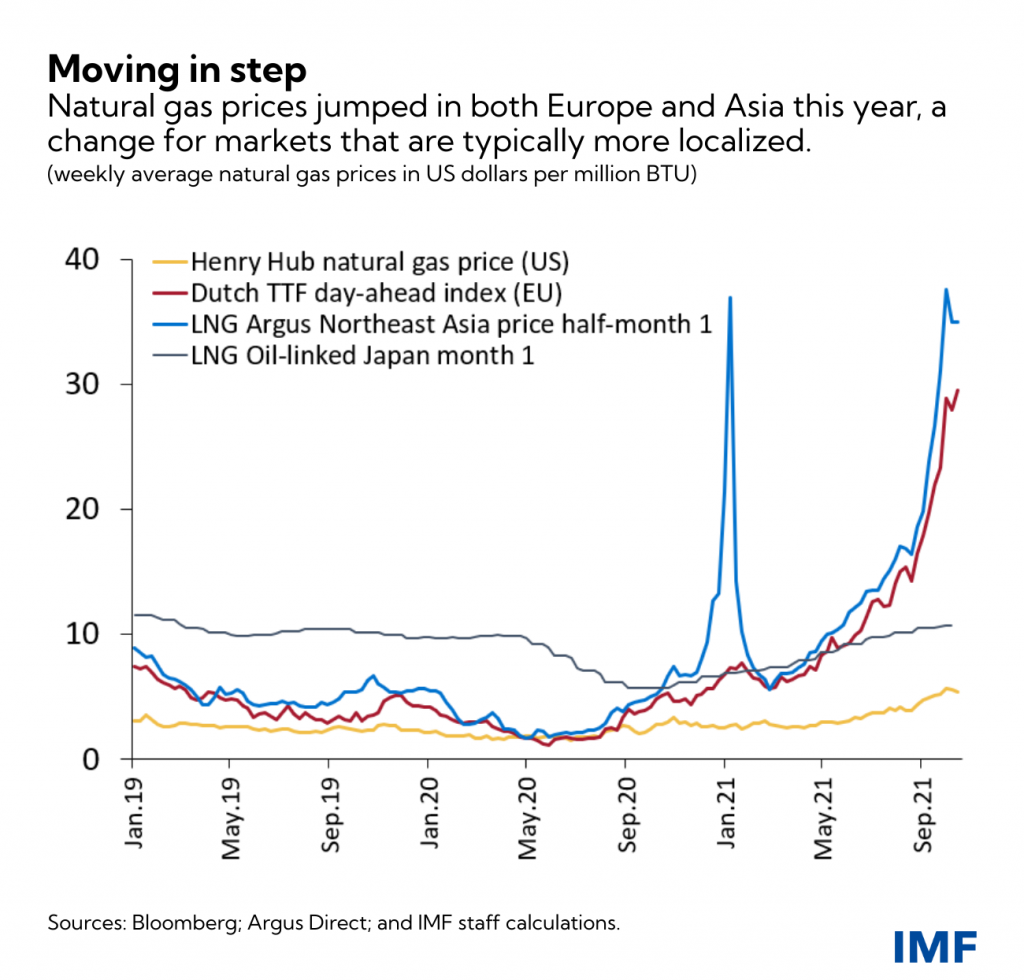
Spot prices for natural gas have more than quadrupled to record levels in Europe and Asia, and the persistence and global dimension of these price spikes are unprecedented. Typically, such moves are seasonal and localized. Asian prices, for example, saw a similar jump last year but those didn’t spill over with an associated similar rise in Europe.

Our expectation is that these prices will revert to more normal levels early next year when heating demand ebbs and supplies adjust. However, if prices stay high as they have been, this could begin to be a drag on global growth.
Meanwhile, ripple effects are being felt in coal and oil markets. Brent crude oil prices, the global benchmark, recently reached a seven-year high above $85 per barrel, as more buyers sought alternatives for heating and power generation amid already tight supplies. Coal, the nearest substitute, is in high demand as power plants turn to it more. This has pushed prices to the highest level since 2001, driving a rise in European carbon emission permit costs.
Bust, boom, and inadequate supply
Given this backdrop, it helps to look back to the start of the pandemic, when restrictions halted many activities across the global economy. This caused a collapse of energy consumption, leading energy companies to slash investment. However, consumption of natural gas rebounded fast—driven by industrial production, which accounts for about 20 percent of final natural gas consumption—boosting demand at a time when supplies were relatively low.
Energy supply, in fact, has reacted slowly to price signals due to labor shortages, maintenance backlogs, longer lead times for new projects, and lackluster interest from investors in fossil fuel energy companies. Natural gas production in the United States, for example, remains below precrisis levels. Production in the Netherlands and Norway is also down. And Europe’s biggest supplier, Russia, has recently slowed its shipments to the continent.
Weather has also exacerbated gas market imbalances. The Northern Hemisphere’s severe winter cold and summer heat boosted heating and cooling demand. Meanwhile, renewable power generation has been reduced in the United States and Brazil by droughts, which curbed hydropower output as reservoirs ran low, and in Northern Europe by below-average wind generation this summer and fall.
Coal supplies and inventories
While coal can help offset natural gas shortages, some of those supplies are also disrupted. Logistical and weather-related factors have crippled production from Australia to South Africa, while coal output in China, the world’s largest producer and consumer, has fallen amid emissions goals that disincentivize coal use and production in favor of renewables or gas.
In fact, Chinese coal stockpiles are at record lows, which increases the threat of winter fuel supply shortfalls for power plants. And in Europe, natural gas storage is below average ahead of winter, adding risk of more price increases as utilities compete for scarce resources before the arrival of cold weather.
Energy prices and inflation
Coal and natural gas prices tend to have less of an effect on consumer prices than oil because household electricity and natural gas bills are often regulated, and prices are more rigid. Even so, in the industrial sector, higher natural gas prices are confronting producers that rely on the fuel to make chemicals or fertilizers. These dynamics are particularly concerning as they are affecting already uncertain inflation prospects amid supply chain disruptions, rising food prices, and firming demand.
Should energy prices remain at current levels, the value of global fossil fuel production as a share of gross domestic product this year would rise from 4.1 percent (estimated in our July projection) to 4.7 percent. Next year, the share could be as high as 4.8 percent, up from a projected 3.75 percent in July. Assuming half of this increase in costs for oil, gas, and coal is due to reduced supply, this would represent a 0.3 percentage point reduction in global economic growth this year and about 0.5 percentage point next year.
Energy prices to normalize next year
While supply disruptions and price pressures pose unprecedented challenges for a world already grappling with an uneven pandemic recovery, the silver lining for policymakers is that the situation doesn’t compare to the early 1970s energy shock.
Back then, oil prices quadrupled, directly hitting household and business purchasing power and, eventually, causing a global recession. Nearly a half century later, given the less dominant role that coal and natural gas plays in the world’s economy, energy prices would need to rise much more significantly to cause such a dramatic shock.

Moreover, we expect natural gas prices to normalize by the second quarter as the end of winter in Europe and Asia eases seasonal pressures, as futures markets also indicate. Coal and crude oil prices are also likely to decline. However, uncertainty remains high and small demand shocks could trigger fresh price spikes.
Tough policy choices
That means central banks should look through price pressures from transitory energy supply shocks, but also be ready to act sooner—especially those with weaker monetary frameworks—if concrete risks of inflation expectations de-anchoring do materialize.
Governments should act to prevent power outages in the face of utilities curtailing generation if it becomes unprofitable. Blackouts, particularly in China, could dent chemical, steel, and manufacturing activity, adding to global supply-chain disruptions during a peak season for sales of consumer goods. Finally, as higher utility bills are regressive, support to low-income households can help mitigate the impact of the energy shock to the most vulnerable populations.
Authors:

Andrea Pescatori is Chief of the Commodities Unit in the IMF Research Department

Martin Stuermer is an economist at the Commodities Unit of the IMF’s Research Department

Nico Valckx is currently a senior economist with the IMF’s Research Department

Compliments of the IMF. 
The post IMF | Surging Energy Prices May Not Ease Until Next Year first appeared on European American Chamber of Commerce New York [EACCNY] | Your Partner for Transatlantic Business Resources.
EACC

ECB Speech | “Hic sunt leones” – open research questions on the international dimension of central bank digital currencies

Speech by Fabio Panetta, Member of the Executive Board of the ECB, at the ECB-CEBRA conference on international aspects of digital currencies and fintech | Frankfurt am Main, 19 October 2021 |
It is a pleasure to welcome you on behalf of the European Central Bank (ECB) to the fifth annual meeting of the International Finance and Macroeconomics Program of the Central Bank Research Association (CEBRA). This year’s meeting is taking place virtually. And it brings together participants from nearly 20 time zones, which is fitting for a conference that seeks to shed light on how digitalisation is changing money and finance globally.
In my remarks today, I will focus on the international dimension of central bank digital currencies, or CBDCs. The ECB launched an investigation phase for the digital euro over the summer.[1] One of the aspects we are investigating is whether it would be possible to use the digital euro in cross-border contexts, and under which conditions. Many other central banks are reflecting on whether they would allow non-residents to access their own digital currency if they were to decide to introduce one.[2]
Decisions about the issuance and design of CBDCs require a careful assessment of the trade-offs between risks and opportunities. The international dimension makes that assessment more challenging still. So, it is already worth thinking about the implications of the cross-border use of CBDCs.
This is where research can help policy. The international dimension of CBDCs is almost unexplored in terms of research. The Latin phrase “hic sunt leones” – here be lions – was used in pre-Renaissance maps to identify uncharted territories that could potentially be dangerous. And in the realm of digital currencies, just like in the pre-Renaissance world, we need research to map those territories. To replace myths with knowledge. To provide the conceptual backbone and evidence that guide our thinking. And to point to the opportunities and challenges ahead.
The literature on the international aspects of CBDCs is still in its infancy. Many of you are contributing to this literature. After reviewing what we already know about the international dimension of CBDCs, I will discuss today open questions of direct policy relevance, in particular: what is different about CBDCs compared to alternative monetary and financial instruments? And how much international cooperation do we need in view of externalities from CBDC issuance, interactions among CBDCs, and the emergence of other innovations such as global stablecoins?
In international fora, the ECB is also involved in technical and policy discussions on how CBDCs could facilitate cross-border payments through different degrees of integration and cooperation – ranging from basic compatibility with common standards to establishing international payment infrastructures.[3] Today, however, I will focus on aspects that are relevant for research on international macroeconomics and finance.
Charted territories
Let’s start by considering what we already know about the international dimension of CBDCs. Available research points to three main implications of allowing non-residents unrestricted access to a given CBDC.
First, a CBDC that can be used outside the jurisdiction where it is issued might increase the risk of digital currency substitution – or digital “dollarisation”.[4] If a foreign CBDC were to be widely adopted, this might lead to the domestic currency losing its function as a medium of exchange, unit of account and store of value – ultimately impairing the effectiveness of domestic monetary policy and raising financial stability risks. These risks are particularly relevant for emerging markets and less developed economies that have unstable currencies and weak fundamentals. Currency substitution could also occur in small advanced economies that are open to trade and integrated in global value chains.[5] Since international trade and finance are complements to each other, financial integration may matter, too.[6] It is hard to gauge in advance how significant the risks of digital currency substitution could be, and in which currencies this substitution could occur. Trade and finance linkages with the issuers of international reserve currencies – the United States, the euro area and China – vary considerably across countries (Chart 1). That, in turn, suggests that the risks of currency substitution vary significantly across countries and currencies. In any case, the introduction of a CBDC in one jurisdiction must do no harm.[7] In particular, it must not put the financial system of other jurisdictions at risk.

Chart 1
International trade and financial linkages with the United States, the euro area and China

Sources: ADB MRIO 2019, IMF CPIS, Haver Analytics, IntLink and ECB staff calculations.Notes: International trade and financial exposures as of 2019. Trade exposures vis-à-vis the United States, the euro area and China are calculated based on Belotti, F. et al. (2021), “icio – Economic Analysis with Inter-Country Input-Output tables”, Stata Journal, forthcoming. Financial exposures are calculated as the sum of total portfolio investment assets and liabilities of a country held in either the United States, the euro area or China. All data are in US dollars. The financial exposures to China include Hong Kong.

The second implication of allowing non-residents to use CBDCs relates to global spillovers. Issuing a CBDC can magnify the cross-border transmission of shocks, increase exchange rate volatility and alter capital flow dynamics.[8] One reason for this is that CBDCs combine characteristics such as scalability, liquidity and (potentially) renumeration, which make them appealing relative to financial assets that are traded internationally. Research finds that introducing a CBDC available to non-residents “super charges” uncovered interest rate parity – in other words, it alters the standard relation between interest rate differentials across countries and the exchange rate. That, in turn, leads to a stronger rebalancing of global portfolios in response to shocks, and to higher exchange rate volatility. Economies not issuing a CBDC are then subject to stronger spillovers. And their central banks need to be more reactive to output and inflation fluctuations, which reduces their autonomy. Chart 2 shows model simulations by ECB staff illustrating how the presence of a foreign CBDC affects the reaction function of a recipient central bank. That central bank faces stronger shock spillovers and may need to be twice as reactive to inflation and output fluctuations.[9] By contrast, the reaction function of the central bank issuing the CBDC hardly changes. Of course, the design of the CBDC, including the introduction of restrictions on remuneration and quantities, has a considerable influence on the extent of these spillovers.[10]

Chart 2
Optimal monetary policy in the presence and absence of a CBDC

Source: Ferrari, M., Mehl, A. and Stracca, L. (2020), “Central bank digital currency in an open economy”, CEPR Discussion Paper Series, No 15335, Centre for Economic Policy Research, October.Notes: Model-based optimal response to output and inflation of the central bank Taylor rule in the presence and absence of CBDC under a fixed-remuneration design. The key parameters optimised are interest rate persistence, the elasticity with respect to inflation and the elasticity with respect to output.

Finally, research suggests that issuing a CBDC which can be used by non-residents might have an impact on the international role of currencies. The costs of cross-border payments might fall, which may enhance the role of a currency as a global payment unit. And the specific features of a CBDC – such as safety, liquidity, efficiency and scalability – might further bolster its international use. But there is a flipside to this: broader international demand may cause the exchange rate to appreciate. This could weigh on the currency’s attractiveness as an invoicing unit for exports in other jurisdictions and, in turn, reduce global interest in the currency. On the whole, model simulations by ECB staff suggest that issuing a CBDC would underpin the international role of a currency, albeit not to a particularly large extent. This is visible from Chart 3, which contrasts two model simulations – one simulation without a CBDC and the other with a CBDC issued by one of the three countries in the model. The share of that country’s currency in global export payments (shown as blue bars) increases when it is available as a CBDC.[11] However, the rise is modest, at about 5 percentage points – less than a 10% increase relative to the baseline simulation without a CBDC. Also here the caveat applies that the impact of CBDCs on the international role of currencies depends on choices related to their design, such as restrictions on remuneration and quantities. But the message is clear: the international role of a currency depends more on fundamental forces, such as the size of the economy and the stability of its fundamentals.

Chart 3
Model simulations of the impact of a CBDC and its design on international currency use
(currency breakdown of global export payments in percentages) 

Source: ECB calculations.Notes: The chart shows the currency breakdown of global export payments in alternative model simulations, where “currency in focus” is the currency of the country that issues a CBDC (one of the three countries in the model). It is based on simulations using a three-country DSGE model in the spirit of Eichenbaum et al. (2020) with baseline assumptions (no capital controls, a 1% liquidation cost for debt securities and symmetric 33%-weights for all countries). See ECB (2021), “Central bank digital currency and global currencies”, The international role of the euro, Frankfurt am Main, June.

Uncharted territories
Let me now turn to the uncharted territories – the “terra incognita” identified by lions on medieval maps – in order to explore two broad sets of questions.
What is different about CBDCs?
The first is as follows: what is truly unique about CBDCs? And do we sufficiently account for this in our models? Existing research often models CBDCs as safe and liquid instruments. That is convenient as it allows us to draw on standard macro-monetary models, with some tweaks here and there. But to truly understand the risks and opportunities of CBDCs, we need to take them more seriously and acquire a deeper understanding of what makes them different from other monetary and financial instruments. Consider a few examples that illustrate why this is important – building on the three implications of CBDCs I just discussed.
First, how much of the discussion on the risks arising from digital dollarisation is new? The determinants emphasised in existing research often seem all too reminiscent of the macro literature of the 1990s on dollarisation. It would be good to understand what is truly unique about CBDCs now as compared with dollarisation back then. For instance, maybe the determinants are unchanged but CBDCs make dollarisation more likely by lowering transaction costs. Or perhaps CBDCs could be bundled with other useful services, such as privacy services, rewards or conditional payments.
Second, on international spillovers, introducing any other internationally traded safe and liquid instrument, such as a highly rated bond, into a macro model would also produce strong spillovers. Can we truly apply the same insights to CBDCs? We need to make sure we do not miss relevant channels and idiosyncrasies. For instance, what impact might a CBDC have on the effectiveness of capital account management measures?[12]
Third, concerning the international role of currencies, the effects obtained are likely calibration or estimation-dependent. Under which conditions will standard economic fundamentals remain the main drivers of international currency status? Research so far indicates that digitalisation does not change anything fundamental. To what extent would CBDCs still have the potential to affect the configuration of global reserve currencies and the stability of the international monetary system?[13]
So, a broad agenda for research concerns what is truly unique about CBDCs. Answering these questions is potentially important for policymaking.
First of all, it would help us to calibrate our models and better anticipate the future. For example, one challenge we face is estimating the potential demand for CBDCs, which is crucial to understanding their financial stability implications.[14] Depending on a CBDC’s design, this also entails estimating international demand. One approach is to conduct surveys about the potential interest of users – consumers and firms – in CBDCs.[15] Another is to draw information from the experience with instruments that are closely related to CBDCs, such as cash and bank deposits, for instance based on surveys of consumers’ payment choices and preferences.[16] Knowing what sets CBDCs apart would help us understand what is useful to look at, and what is not.
Moreover, answering these questions would also help us to assess whether lessons gleaned from history remain relevant. For instance, recent research looked at the experience of France in the 1930s to gauge whether CBDCs could make bank runs more likely.[17] And more recent systemic bank crises, like that of Japan in the 1990s, have been deemed useful episodes to consider.[18] Having a better understanding of what makes CBDCs unique would allow us to assess whether things are different this time round.
Let me stress again that the answers are likely to depend on the specific design features of CBDCs. And since design choices are best made when the implications are properly understood, this again points to the need to understand how CBDCs differ from alternative monetary and financial instruments.
International cooperation
Other questions that naturally emerge when considering the international context are: how much global cooperation is optimal? And how relevant are strategic interactions among potential digital currency issuers? This is the second set of unexplored questions which I would like to discuss today.
Allowing non-residents to use a CBDC issued in another jurisdiction may give rise to externalities, both positive and negative. An important goal is to “do no harm” if a decision to issue a CBDC were to be made. The question then is: how much international cooperation is desirable to internalise such externalities and avoid outcomes that are detrimental globally.
So far, the academic literature does not provide much guidance. But international cooperation offers clear benefits. Exchanging information on the progress of national CBDC projects in international fora allows us to share our experiences about possible problems and solutions, to draw attention to neglected issues and to further everyone’s understanding of the policy and technical challenges. It helps to forge consensus on what works and what doesn’t.[19] There are also benefits to discussing high-level principles at the international level, for instance to find consensus on important economic, financial and regulatory issues of common interest.[20] And there might be gains from reflecting on common standards to make CBDC projects interoperable, for instance to move from the cross-border use of CBDCs to cross-currency payments between CBDCs. Therefore, it might be beneficial to discuss common technical or regulatory standards to foster cross-border payments while limiting the impact on the monetary system.[21]
Cooperation is not without costs, however. And the costs may increase with the number of central banks involved and with their diverse objectives, legal frameworks, financial structures, mandates and preferences, which would likely be reflected in different CBDC designs. So the natural question to ask is: how much global cooperation is optimal?
This is a complex question to answer. One might be tempted to aim for uniform standards for CBDCs – a “one size fits all” approach. But the question then is whether meaningful cooperation is possible at all if conditions differ sharply across countries. Take privacy – an important design feature of a digital euro that was raised by members of the public and professionals in the public consultation we concluded earlier this year.[22] Privacy is unlikely to be equally important in all regions of the world. Where diverse preferences exist, some stakeholders might not see much merit in enforcing global standards. For instance, one concrete open question is: how could a jurisdiction with more stringent requirements on the traceability of payments allow cross-currency transactions with a jurisdiction granting higher privacy standards?
Another point to consider is the existence of strategic interactions – where decisions of one player depend on the actions of the other players – as they can tilt the balance of the benefits and costs of global cooperation. Many countries are simultaneously reflecting on CBDCs. But strategic interactions have not been studied much in the context of CBDCs, and the international dimension even less so. In fact, it is not only strategic interactions among potential CBDC issuers that might matter. Strategic interactions between CBDCs and innovative payment solution providers from the private sector, such as global stablecoins, also potentially matter, notably when such providers can leverage their large existing user base and their experience in bundling appealing services together.
There are still lots of open questions surrounding strategic interactions and the timing of actions. The field of CBDCs could be seen as a clean slate at the moment. But this will not last for long.[23] The countries that have already introduced their own CBDC (such as the Bahamas) cannot set global standards. But this will change. China is expected to introduce the digital renminbi relatively soon, while other jurisdictions – including the euro area – are actively preparing to potentially launch their own digital currency. Can the “pioneer” central banks that have decided, or are deciding, on the design of their CBDC based on their own considerations, be expected to seek general consensus on a standard approach before moving forward? The costs and benefits of being the first to issue a digital currency are not well understood. Is it better to get it first – by aiming to set standards for others while putting domestic objectives at risk – than it is to get it right? Late adopters might have a more limited menu of potential design features to choose from. Another risk is that of a fragmented equilibrium emerging, with isolated islands of a few interoperable CBDCs that cannot interact with other CBDCs outside of their own small group.
In any case, when reflecting on cooperation or strategic interactions, we need to be mindful of the differences between jurisdictions. Crucially, the domestic central bank’s mandate should always be preserved.
Conclusion
Let me now conclude. This conference brings together academics and policymakers to discuss issues related to the international dimension of CBDCs. We are seeing clear progress in better understanding the technical implications of allowing non-residents access to CBDCs. Yet many policy and research questions remain open. Today I have outlined two high-level themes that could steer the discussion. I hope that this conference will provide a platform to explore these questions and many others. In turn, this will help us push the frontier of knowledge deeper into the uncharted territories in the realm of CBDCs, and show that they are not, in fact, a lion’s den but rather full of potential opportunities.
Compliments of the European Central Bank.
The post ECB Speech | “Hic sunt leones” – open research questions on the international dimension of central bank digital currencies first appeared on European American Chamber of Commerce New York [EACCNY] | Your Partner for Transatlantic Business Resources.
EACC

EU Commission relaunches the review of EU economic governance

The European Commission has today adopted a Communication that takes stock of the changed circumstances for economic governance in the aftermath of the COVID-19 crisis and relaunches the public debate on the review of the EU’s economic governance framework. The Communication follows President von der Leyen‘s commitment in the State of the Union address to build a consensus on the future of the EU’s economic governance framework. The Commission had previously suspended this public debate, which was first launched in February 2020, to focus on responding to the economic and social impact of the COVID-19 pandemic.
Valdis Dombrovskis, Executive Vice-President for an Economy that Works for People, said: “Europe is now sailing into calmer waters after the turbulence of the pandemic. Thanks to our coordinated and assertive response, we are now exceeding growth expectations. But the crisis has also made some challenges more visible: higher deficits and debt, wider divergences and inequalities and a need for more investment. We need economic governance rules that can tackle those challenges head-on. So today, we are launching a public debate. We want to hear views and ideas, and build consensus and ownership for effective economic surveillance. That way, we can make our societies and economies more sustainable, fair and competitive – and fully prepared for future challenges.”
Paolo Gentiloni, Commissioner for Economy, said: “After last year’s unprecedented shock, Europe’s economy is recovering strongly. Now we need to ensure that our future growth is both sustained and sustainable. We are relaunching this review of our economic governance against a backdrop of enormous investment needs, as the climate emergency becomes more acute with every passing year. At the same time, the powerful fiscal support provided during the pandemic has led to higher debt levels. These challenges make it all the more essential to have a transparent and effective fiscal framework. Achieving this is our joint responsibility and is crucial to the future of our Union.”
The relaunched debate will draw on both the Commission’s view of the effectiveness of the economic surveillance framework presented in February 2020 and the lessons learnt from the COVID-19 crisis described in today’s Communication. The Commission invites all key stakeholders to engage in this public debate so as to build consensus on the future of the economic governance framework. It is crucial to have in place a framework that can fully support Member States to repair the economic and social impact of the COVID-19 pandemic and respond to the EU’s most pressing challenges.
The Commission will consider all views expressed during this public debate. It will, in the first quarter of 2022, provide guidance for fiscal policy for the period ahead, with the purpose of facilitating the coordination of fiscal policies and the preparation of Member States’ Stability and Convergence Programmes. This guidance will reflect the global economic situation, the specific situation of each Member State and the discussion on the economic governance framework. The Commission will provide orientations on possible changes to the economic governance framework with the objective of achieving a broad-based consensus on the way forward well in time for 2023.
A new context in the aftermath of the COVID-19 pandemic
Since its inception, the EU’s economic governance framework has guided Member States to achieve their economic and fiscal policy objectives, coordinate their economic policies, address macroeconomic imbalances, and ensure sound public finances. The framework has evolved over time, and changes, such as the six-pack and two-pack legislation, were introduced to respond to new economic challenges.
Despite these evolutions, some vulnerabilities remained which the fiscal framework has not effectively addressed. At the same time, it has grown increasingly complex. Added to this, the economic context has significantly changed since the rules were first established.
These and other issues were already apparent in February 2020 when the Commission presented its Communication on the EU economic governance review. While the review’s main conclusions remain valid and relevant, the severe impact of the COVID-19 crisis further underlines the challenges facing the framework and has made the challenges even more acute.
New challenges and lessons learnt
The public debate on the review of the economic governance framework will need to take into account and address the issues that had been identified in the 2020 Communication. These include how we can ensure sustainable public finances, prevent and correct macroeconomic imbalances, simplify existing rules, and improve their transparency, ownership and enforcement.
Additionally, the review of the EU economic governance framework should reflect on the new challenges highlighted by the COVID-19 crisis. It could also draw useful lessons from the successful EU policy response to the outbreak, in particular from the governance of the Recovery and Resilience Facility.
An inclusive and open debate
A wide-ranging and inclusive engagement with all stakeholders is crucial to build a broad-based consensus on the way forward for the EU economic governance framework. The Commission is therefore inviting stakeholders to engage in the debate and provide their views on how the economic governance framework has worked so far and on possible solutions to enhance its effectiveness. These stakeholders include the other European institutions, national authorities, social partners and academia.
The debate will take place through various fora, including dedicated meetings, workshops and the online survey which has been relaunched today. Citizens, organisations and public authorities are invited to submit their contributions by 31 December 2021.
Compliments of the European Commission. 
The post EU Commission relaunches the review of EU economic governance first appeared on European American Chamber of Commerce New York [EACCNY] | Your Partner for Transatlantic Business Resources.
EACC

FTC Data Spotlight on scammers impersonating Amazon: How businesses can reduce injury to consumers

The FTC has been warning consumers for years about impersonation scams – calls that falsely claim to come from the IRS, the Social Security Administration, or other offices or businesses. The messages try to coerce people into making immediate payments or turning over sensitive personal information. The FTC’s latest Data Spotlight focuses on the rampant rise of Amazon impersonation scams that have already bilked consumers out of millions of dollars.
From July 2020 through June 2021, about one in three people who reported a business impersonator to the FTC said the scammer claimed to be calling from Amazon. The FTC has guidance for consumers on how to spot, stop, and report impersonators. But the findings in the Data Spotlight also suggest steps Amazon and other businesses can take to reduce the impact on consumers when well-known company names are being misused by scammers.
How big is the problem? In that one-year period, reports about Amazon impersonators increased more than fivefold. About 96,000 people reported being targeted, and nearly 6,000 said they lost money. Reported losses topped more than $27 million with the reported median individual loss totaling about $1,000. (To put those figures in context, according to reports the FTC received during the same period, the next most frequently impersonated company was Apple with about 16,000 reports.)
What’s more, the data suggest that Amazon impersonation scams may be disproportionately harming older adults. Over the past year, people age 60 and up were over four times more likely than younger people to report losing money to an Amazon impersonator – and their median reported loss was $1,500, compared to $814 for those under age 60.
The Data Spotlight explains numerous ways scammers are taking advantage of Amazon’s name and ubiquity, but it often involves an unexpected message from “Amazon,” warning that there’s been suspicious activity or unauthorized purchases on the person’s Amazon account. Sometimes, when the person calls back the number in the message, a phony “Amazon representative” tricks them into allowing remote access to their computer to supposedly facilitate a refund. You can guess what happens next: a series of lies that make the person believe too much money has been (supposedly) refunded and must be returned.
What can be done? The FTC’s usual advice to consumers is to ignore unexpected messages like this and, if there are doubts about whether a call, email, or text message is legit, to contact the company at a verifiable customer service line. Unfortunately, many companies – Amazon included – have made it challenging for consumers to detect and stop scams like this because people can’t find an easy way to identify if a questionable message is genuine.
Another option for large, frequently impersonated institutions – public or private – is to develop consistent policies about how they communicate with consumers. For example, some entities have a general policy of not calling consumers out of the blue. Instead, they may respond by phone to in-bound consumer inquiries or may follow up after sending a consumer a letter in the mail. When institutions share these policies with the public and apply them consistently, consumers may more easily identify when an unsolicited message is a phony.
There’s no one-size-fits-all approach for how impersonated companies can help people spot and stop this form of fraud. But simply shifting the responsibility to consumers isn’t the answer. It’s in businesses’ best interest to consider solutions that will help protect their good name and their loyal customers.
Compliments of the U.S. Federal Trade Commission.
The post FTC Data Spotlight on scammers impersonating Amazon: How businesses can reduce injury to consumers first appeared on European American Chamber of Commerce New York [EACCNY] | Your Partner for Transatlantic Business Resources.

Read More
EACC

IMF | Housing Prices Continue to Soar in Many Countries Around the World

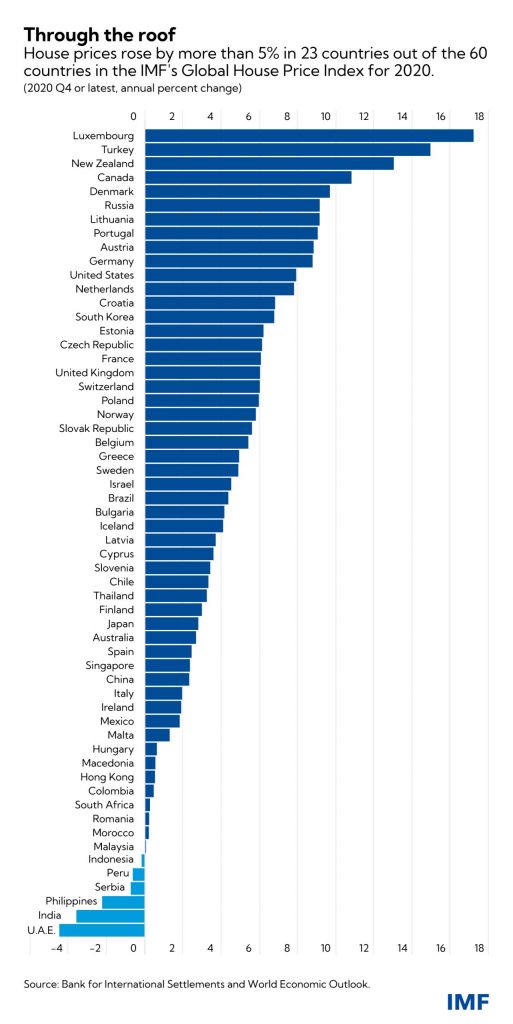
While most economic indicators deteriorated last year, house prices largely shrugged off the effects of the pandemic. Of the over 60 countries that enter into the IMF’s Global House Price Index, three-quarters saw increases in house prices during 2020, and this trend has largely continued in countries with more recent data.

IMF research indicates that low interest rates contributed to the boom in house prices, as did policy support provided by governments and workers’ greater need to be able to work from home. In many countries, including the United States, online searches for homes reached record levels. Along with these demand factors, house prices also increased as supply chain disruptions raised the costs of several inputs into the construction process.
While fundamentals of demand and supply can account for much of the buoyancy of housing markets during the pandemic, policymakers are nonetheless keeping a close watch on developments in this sector. The increases in house prices relative to incomes makes housing unaffordable to many segments of the population, as highlighted in the IMF’s recent study of housing affordability in Europe. The post-pandemic working arrangements could also exacerbate inequality concerns as high-earners in tele-workable jobs bid for larger homes, making homes less affordable for less affluent residents. The surge in house prices has also had an impact on headline inflation in some countries and could contribute to more persistent inflationary pressures.
Over a decade ago, a turnaround in house prices marked the onset of the Global Financial Crisis. However, the twin booms in household credit and house prices in many countries before that crisis—and many previous housing crashes—appear less prevalent today. Hence, in a plausible scenario, a rise in interest rates, a withdrawal of policy support as economies start to recover, and a restoration of the timely supply of building materials, could lead to some normalization in house prices.
This blog is based on work by Hites Ahir, Nina Biljanovska, Chenxu Fu, Deniz Igan and Prakash Loungani of the IMF Global Housing Watch knowledge group.
The post IMF | Housing Prices Continue to Soar in Many Countries Around the World first appeared on European American Chamber of Commerce New York [EACCNY] | Your Partner for Transatlantic Business Resources.

EACC

Speech: “A new era of transatlantic cooperation”

Speech by EVP Margrethe Vestager at the Information Technology Industry Council |
Good morning. Thank you, for the invitation to speak today and to Mr Oxman for the kind presentation.
If we go by the polls, the Western World is experiencing what we could call a ‘One Third’ political crisis.
Just the other day, a survey here in Belgium revealed that One Third of people no longer believe they are living in a democracy. One Third believe society would be better run if we replaced parliamentary democracy with dictatorship. And in case you think it’s just Belgium, One Third is also the proportion of Americans who did not trust the results of the recent Presidential election. Meanwhile in France, One Third is also the proportion of people under 30 who would be happy for their country to become a military dictatorship.
These polls are a wake-up call – for politicians, for the media and for our civil society. It is a call to action for all of us who believe in the values that underpin a tolerant, pluralist society. We must work harder to reach this One Third of the population, especially where it concerns young people. And not just to reach them, but to listen, and to address the root cause of their discontent.
It is also a wake-up call for industry leaders in technology. There can be little doubt that trends in technology have had an effect on the One Third political crisis.
Digital connectivity has brought us enormous benefits, to ease communication – not least helping us make it through the pandemic – and to growth and innovation. At the same time, recent revelations have confirmed how technology has also had a deeply polarising effect in our societies. Algorithms can push users to extremes, widen political divisions, and weaken our sense of common humanity. The spread of disinformation has muddled the political debate and become a tool of foreign interference in our democratic processes.
So what do we do about it?
We begin with a return to values – those core ideas which unite us, which have defined our civilisation for hundreds of years, and which are the basis of our democracies. Maybe we have allowed ourselves to grow complacent, taking our values for granted, a bit too much. So it’s worth restating them.
Pluralism, democracy, equality, and free and open markets.
These are precisely the values that have tied the EU and the US together for generations. They are the starting point for our forum for renewed transatlantic cooperation – the Trade and Technology Council.
On both sides of the Atlantic, we face common challenges. How do we ensure our supply chains are resilient? How do we foster open trade? How do we benefit from technology while minimising its harmful effects on our markets, or on our mental health?
For each of these challenges, there are options, different political directions we could take. By cooperating across the Atlantic, by building on the common values we share, we can steer in the same direction. We can advance our shared interests, without letting the current of history sweep away the things we hold most dear.
Our first meeting of the Trade and Technology Council took place two weeks ago, in Pittsburgh. And the venue was well chosen by our hosts. The story of this city’s transformation, from a fossil fuelled economy to a high technology hub, expresses well what the TTC is all about.
I was stuck by the openness of our discussion and the common sense of purpose: to use our combined weight to build a positive vision for democracies to lead a global digital transformation based on our shared values.
This does not mean we will agree on everything. And some of our discussions revealed that. But it does mean that we can use this forum to understand each other better, and build the trust necessary to work through some of the more difficult issues as well.
We have agreed an ambitious agenda ahead of our next meeting, to be delivered through ten working groups. It is comprehensive in scope yet realistic by focusing on our main priorities.
For example, I am particularly encouraged by our agreement on Artificial Intelligence, both in terms of the key principles we have committed to and the concrete projects we will be developing together. It shows our shared ambition that there is no contradiction between promoting innovation while upholding our fundamental rights.
We have committed to work together on semiconductors, to assess the gaps and vulnerabilities in the supply chain, and work together to diversify, reduce strategic dependencies and increase our respective security of supply, while avoiding a subsidy race.
We have outlined shared concerns when it comes to role of platforms, for instance on illegal and harmful content, algorithmic amplification, disinformation, data access to researchers, or the need to appropriately address their market power. We will hold in-depth discussion on all these issues.
Openness is one of the values we share with the United States, and that it will be a defining feature of how the new Council operates.
Dialogue and discussion with industry and all other stakeholders, in an inclusive way, will be a hallmark of the TTC.
As always, the devil will be in the details. For the TTC, the ten designated working groups will hash out many of those details. I have no doubt that by keeping up the open and frank dialogue; we will find a lot of common ground.
But if ‘the devil is in the details’, where is the angel?
I think the angel is in our shared values. On both sides of the Atlantic, we share a common belief in freedom, in equality of opportunity, in fairness, and in the supremacy of democracy over all other forms of government. We reject tyranny and we defend the human rights – of all women and men.
In the EU, as in the US, we believe that Two Thirds is not enough. We believe in shaping our economies and our politics so that there is a place for Three Thirds.
Thank you.
Compliments of the European Commission.
The post Speech: “A new era of transatlantic cooperation” first appeared on European American Chamber of Commerce New York [EACCNY] | Your Partner for Transatlantic Business Resources.

EACC

ECB Speech | Globalisation after the pandemic

2021 Per Jacobsson Lecture by Christine Lagarde, President of the ECB, at the IMF Annual Meetings, 16 October 2021 |
It is a pleasure to be back in Washington and to deliver this year’s Per Jacobsson Lecture.
As a young man in the 1920s, Jacobsson worked in the Economic and Financial Section of the League of Nations Secretariat. There, he was actively involved in work on Europe’s financial reconstruction in the wake of the greatest shock that had hit the continent: the First World War.
The outbreak of that conflict in 1914, which killed so many and injured even more, marked the end of the first era of globalisation. The unprecedented flows of trade that had characterised the global economy between the 1870s and the early 1900s collapsed, as borders were replaced by battlelines.
The pre-war world quickly became, as the writer Stefan Zweig put it, “the world of yesterday”. This shows how fast what had once seemed so permanent can change. Globalisation will always be vulnerable to global shocks, as we have recently seen with the pandemic.
But the pre-pandemic world has not joined the world of yesterday just yet. A powerful economic logic drove the most recent era of globalisation, and that logic remains just as valid today.
However, we are seeing this logic challenged in important ways. Protectionism is rising, climate change is accelerating and industrial policy is shifting. Economies that have embraced globalisation, like Europe, are more exposed to these changes.
Europe has reaped the benefits of globalisation in the past and has suffered enormously from its fall-back. To reap the benefits in the future in a globalised world in transition, Europe must adapt.
That means using Europe’s economic weight to support reciprocated trade openness globally, while strengthening its own domestic demand to insure against a more volatile global economy.
A stronger Europe would be a global public good, providing an anchor of stability in a less predictable world. And it has the scale to prepare this journey. Will it have the will?
Europe in a globalised world
In the decades before the pandemic, rapid globalisation profoundly transformed international trade for the better. Between 1995 and 2010, the pace of world trade growth expanded twice as fast as that of world GDP growth.[1] And the nature of trade was transformed by the expansion of global value chains, a web of interlinkages that developed as production unbundled across borders.
This integration was driven by technological progress in the private sector[2], but it was also enabled by public policy. Governments across advanced economies pushed for trade barriers to be lowered and the World Trade Organization to be expanded to include emerging economies. Globalising trade was seen as desirable for two main theoretical reasons:
The first was the classical argument, going back to David Ricardo, about the mutual gains from trade.[3] Lowering barriers would allow countries to exploit their comparative advantages. Countries would also benefit from lower import prices, technology spillovers and productivity gains from the international division of labour.
The second reason was to exploit diverse sources of demand as a means of diversifying risk in the face of domestic shocks. Deeper trade integration would allow countries to “rotate” demand to growing external economies when they experienced domestic slowdowns. As a result, business cycle volatility could be partially decoupled from its adverse effects on long-term growth.[4]
Both these arguments were broadly borne out.
Globalisation did increase growth: across all economies, a one-point increase in measures of globalisation was associated with an increase in the five-year growth rate by 0.3 percentage points.[5] Hundreds of millions of people were lifted out of poverty in emerging markets. And Europe benefited, too. Between 2000 and 2017, jobs supported by exports to the rest of the world increased by two-thirds, to 36 million.[6]
Trade integration also allowed countries’ growth to become less beholden to swings in domestic conditions.[7] This proved especially valuable for Europe in the wake of the sovereign debt crisis. The ability to rotate demand from the domestic economy to the rest of the world provided a crucial outlet for producers. Between 2010 and 2014, external demand as a share of euro area GDP more than doubled.
But the flipside of greater trade openness is greater exposure to global shocks and, if the correct policies are not in place, the potential for people to turn against globalisation. For example, international trade can have implications for income inequality in advanced economies, which in turn can spur protectionism if not tackled effectively through distributional policies.[8]
Between 1999 and 2019, trade as a share of GDP rose from 31% to 54% in the euro area, whereas in the United States it rose from 23% to 26%. But while Europe’s social model meant that protectionist pressures remained minor, we began to see a new shift towards protectionism in other major economies in the late 2010s.
Still, our deep integration into the global economy meant that we in Europe were particularly exposed to these changes – and our scope to benefit from open trade and diverse demand was arguably reduced.
Europe’s largest gains from trade had taken place against the backdrop of a particular geopolitical constellation, marked by the global dominance of the United States after the end of the Cold War and a multilateral commitment to governance by rules. But the re-emergence of protectionism began to call that global economic order into question.
In parallel, waning trade growth reduced the scope for countries to rotate demand to external economies when they needed to. After 2008, the pace of globalisation slowed and world trade growth no longer outstripped world GDP growth. In fact, by 2019 world trade growth had more than halved since the year before. This contributed to a manufacturing recession in the euro area on the eve of the pandemic.
For all these reasons, I was already highlighting back in 2019 the need for Europe to acknowledge that the world around us was changing fast, and to reconsider whether its growth model was sufficiently balanced in light of these changes.[9]
A globalised world in transition
The pandemic has so far only reinforced this message. Though it is still too early to draw firm conclusions, the pre-crisis trends that capped the gains from both trade and diversifying demand could be becoming stronger.
First, the trend towards protectionism shows no signs of abating. In 2020, more than 1,900 new restrictive trade measures were implemented worldwide. That is 600 measures more than the average of the previous two years.[10] And there is evidence of further discriminatory practices being introduced this year.[11]
This could cloud the outlook for future growth in world trade, especially if it elicits tit-for-tat responses. ECB analysis shows that, in a hypothetical case in which one major economy raises tariffs and non-tariff barriers by 10% and other countries respond in kind, world trade would be almost 3% lower than its baseline and global GDP would be almost 1% lower.[12]
Moreover, new trade barriers not only harm euro area exports but the nature of these barriers is creating new vulnerabilities for Europe. Behind some protectionist measures is a shift in industrial policy, mainly led by China and the United States, towards security over efficiency in supply chains. This could create geopolitical biases in global supply chains in the future, especially for goods considered strategically important.
Such shifts would raise hard questions for industries where Europe is dependent on a limited number of global suppliers. For example, 45% of Europe’s imports of active pharmaceutical ingredients are sourced from China, as is 98% of our supply of rare earth metals.[13]
Second, there are signs that the global economy could increasingly be a source of shocks for Europe rather than a stabiliser against volatility.
We are already seeing that the just-in-time supply chains which have defined this era of globalisation are highly vulnerable to systemic shocks. And the efficiency of those supply chains multiplies the consequences of disruptions. The World Bank estimates that, for many goods traded in global value chains, a delay by one day is equal to putting in place a tariff of over 1%.[14]
This naturally affects the euro area more than other economies by virtue of our exposure to globalisation. For example, ECB analysis finds that exports of euro area goods would have been almost 7% higher in the first half of this year were it not for pandemic-induced supply bottlenecks. For the rest of the world, the figure is only 2.3%.[15]
Looking ahead, imported volatility might increase rather than decrease. Even after the disruptions created by the pandemic are resolved, we will have to contend with the consequences of a changing climate and changing industrial structures.
As the world heats up and climatic conditions become more extreme, we will face increasingly frequent ecological shocks. And we know from past experience that these shocks can have profound effects on supply chains.
For example, after the Tōhoku earthquake in Japan in 2011, US affiliates of Japanese multinationals saw their output fall at roughly the same rate as the declines in imported inputs from Japan.[16] Likewise, the 2013 drought in New Zealand – which produces around half of the world’s powdered milk – caused a significant spike in world milk prices, with EU prices jumping by around a fifth between May and October of that year.
Even the necessary response to climate change – the acceleration of the green transition – could initially create frictions in the global environment. In September, policies to reduce energy consumption in Asia led to supply chain disruptions after companies shut down production to comply with requirements.
It is likely that multinational companies will respond to these disruptions by diversifying their supply chains in order to increase their resilience. We already saw such diversification occur in the wake of the SARS pandemic two decades ago.[17] At the start of this year, around a quarter of major companies said that diversifying suppliers would be their top priority over the next few years.[18]
But reorganisation of this nature could have implications for the composition of global demand.
For a start, it could accelerate rebalancing away from investment-led growth in major emerging markets, which could make the outlook for external demand more uncertain. Consider that China has contributed, on average, one-third of total global growth since 2005 – more than the contribution of all advanced economies put together.[19]
Also, firms could end up holding permanently higher inventories as an insurance policy against disruptions. There is already evidence that companies hold higher levels of foreign inputs that are more difficult to source[20], and changes in these inventories play a key role in the dynamics of international trade. Companies run down inventories when uncertainty rises during recessions – sharply cutting foreign orders[21] – and trade only recovers when inventories have been stabilised[22]. A move away from just-in-time supply chains could therefore mean longer periods of inventory adjustment.
Today, faced with historically long delivery times, global manufacturers’ stockpiling of inputs continues to run higher than before the pandemic.[23] We do not yet know if this will become a permanent feature of our economy or if it is just a panic-driven reaction to current shortages. But if it does persist, we could see a more volatile industrial business cycle.
Navigating the post-pandemic world
So how should Europe respond to these changes?
There are two priorities, both of which would help Europe act as an anchor of stability in a more fractured and uncertain world.
As a first priority, we need to be clear that turning our back on trade openness is not the answer.
Even if the protectionist actions of others mean that the gains from trade are no longer as pronounced, the answer is not to respond in kind. Instead, we should use our economic weight to shape openness in a European direction, which means one characterised by being reasonable rather than reactionary, by cooperation rather than conflict, and by redistributing the gains of globalisation to those who have lost out. This is essential to make openness sustainable.
In particular, Europe has immense potential to use the size of its single market to set its values and standards in other parts of the world through open trade – the so-called Brussels effect.[24] This is already tangible in many areas. But it is naturally strongest where the single market is at its deepest. So, as new sectors emerge, like digital services and the green economy, it is crucial that our single market deepens in tandem so that we can continue to use our domestic strength to exert a positive global influence.
At the same time, we need to protect against risk in areas where our vulnerabilities are excessive. There are vital goods and services that we cannot easily produce at home, and where we need more insurance against external shocks. This lies behind Europe’s ambition to increase its “open strategic autonomy”. The European Commission has found that 34 products used in the EU are extremely vulnerable to supply chain disruptions given their low potential for diversification and substitution inside the Union.[25]
To achieve strategic autonomy, some re-shoring or near-shoring of specific sectors – like semiconductors and pharmaceuticals – is probably inevitable in the long term. And the European Commission is already taking measures to strengthen the international role of the euro, which can ultimately make European companies more resilient to the unfavourable actions of others, such as foreign sanctions.
The second priority is for Europe to strengthen its own domestic demand. This is essential to compensate for a more uncertain global landscape in which economies may find it harder to rely on external demand in times of need. That would make European growth more robust, as well as helping stabilise global growth if the contribution of other economies weakens.
In the decade before the pandemic, Europe tended to import demand from the rest of the world. Annual domestic demand growth was, on average, 2 percentage points lower in the decade after 2008 than in the decade preceding it, and it was slower than that of our main trading partners. This was reflected in a persistent current account surplus.
To reverse that trend, we need to learn the lessons of the past and implement policies that strengthen our internal sources of growth. There are three components to this.
First, we need to steer public and private investment towards the areas of the economy that will generate higher real incomes in the future, namely the green and digital sectors. Green investment is estimated to have a multiplier two to three times higher than non-green investment.[26] The pandemic has already shifted activity in this direction, but we need to provide the financing and regulatory framework to help the economy adjust smoothly.
Europe already has the ideal tool in place to kickstart this process, in the form of the €750 billion Next Generation EU (NGEU) fund set up in response to the pandemic. The European Commission estimates that NGEU could raise potential output by 3% in some countries by 2024.[27] But we also need to flank NGEU – which is temporary – with permanent progress on broadening and deepening Europe’s capital markets for green and innovative investment.[28]
Second, unlike after the great financial crisis, fiscal policy support should not be withdrawn until the recovery is more mature. But it should shift from a blanket approach to a more targeted action plan that supports sustainably higher demand. This means that fiscal policy will need to facilitate structural changes in the economy rather than preserving sunset sectors. And, taking a medium-term perspective, it will need to follow a rules-based framework that underpins both debt sustainability and macroeconomic stabilisation.
Third, monetary policy will continue supporting the economy in order to durably stabilise inflation at our 2% inflation target over the medium term. The ECB is committed to preserving favourable financing conditions for all sectors of the economy over the pandemic period. And once the pandemic emergency comes to an end – which is drawing closer – our forward guidance on rates as well as asset purchases will ensure that monetary policy remains supportive of the timely attainment of our target.[29]
Conclusion
Let me conclude.
Europe, more than any other major economy, reaped the gains of globalisation in the decades leading up to the pandemic. But now we must sow the seeds for a future in which globalisation becomes a more unpredictable terrain.
The benefits of trade and diversifying demand are still there to be had. But they are facing headwinds that Europe cannot ignore. This means we must adapt and change to continue thriving in a global economy and to remain an anchor of stability and peace.
The good news is that we are already on the right path. As Stefan Zweig once wrote, “once a man has found himself there is nothing in this world that he can lose.” Europe’s historic response to the pandemic shows that it has found itself.
That allows us to focus on building resilience to face global challenges as and when they arise. In this sense, the pandemic has given us an opportunity and we must seize it.
1. Cigna, S., Gunnella, V. and Quaglietti, L. (forthcoming), “Global Value Chains: Measurement, Trends and Drivers”, Occasional Paper Series, ECB, Frankfurt am Main.
2. Baldwin, R. (2016), The Great Convergence: Information Technology and the New Globalization, Harvard University Press, Cambridge, MA.
3. Ricardo, D. (1817), On the Principles of Political Economy and Taxation, John Murray, London, reprinted in Sraffa, P. (1951) (ed.), The Works and Correspondence of David Ricardo, Vol. 1, Cambridge University Press, Cambridge.
4. Kose, M.A., Prasad, E.S. and Terrones, M.E. (2006), “How do trade and financial integration affect the relationship between growth and volatility?”, Journal of International Economics, Vol. 69, No 1, pp. 176-202.
5. Lang, V.F. and Tavares, M.M. (2018), “The Distribution of Gains from Globalization”, IMF Working Papers, No 18/54, International Monetary Fund
6. Arto, I., Rueda-Cantuche, J.M., Cazcarro, I., Amores, A.F., Dietzenbacher, E., Victoria Román, M. and Kutlina-Dimitrova, Z. (2018), “EU exports to the world: effects on employment”, European Commission, November.
7. Kose, M.A., Prasad, E.S. and Terrones, M.E., op. cit.
8. Stolper, W.F. and Samuelson, P.A. (1941), “Protection and Real Wages”, The Review of Economic Studies, Vol. 9, No 1, pp. 58-73; Mayda, A.M. and Rodrik, D. (2005), “Why are some people (and countries) more protectionist than others?”, European Economic Review, Vol. 49, pp. 1393–1430.
9. Lagarde, C. (2019), “The future of the euro area economy”, speech at the Frankfurt European Banking Congress, 22 November.
10. Cigna, S., Gunnella, V. and Quaglietti, L., op. cit.
11. As evidenced by 2021 data from Global Trade Alert (number of new interventions implemented each year – all state interventions).
12. Lane, P.R. (2019), “Globalisation and monetary policy”, speech at the University of California, 30 September.
13. European Commission, “In-depth reviews of strategic areas for Europe’s interests”.
14. World Bank (2020), World Development Report: Trading for Development in the Age of Global Value Chains.
15. Frohm, E., Gunnella, V., Mancini, M. and Schuler, T. (2021), “The impact of supply bottlenecks on trade”, Economic Bulletin, Issue 6, ECB.
16. Boehm, C.E., Flaaen, A. and Pandalai-Nayar, N. (2019), “Input Linkages and the Transmission of Shocks: Firm-Level Evidence from the 2011 Tōhoku Earthquake”, The Review of Economics and Statistics, Vol. 101, No 1, MIT Press, March, pp. 60-75.
17. Shingal, A. and Agarwal, P. (2020), “How did trade in GVC-based products respond to previous health shocks? Lessons for COVID-19”, EUI RSCAS Working Paper, No 2020/68, Global Governance Programme 415.
18. Ernst & Young (2021), “How COVID-19 impacted supply chains and what comes next”, February.
19. ECB (2017), “China’s economic growth and rebalancing and the implications for the global and euro area economies”, Economic Bulletin, Issue 7, ECB.
20. Alessandria, G., Kaboski, J.P. and Midrigan, V. (2013), “Trade wedges, inventories, and international business cycles”, Journal of Monetary Economics, Vol. 60, No 1, pp. 1-20.
21. Novy, D. and Taylor, A.M. (2020), “Trade and Uncertainty”, The Review of Economics and Statistics, Vol. 102, No 4, pp. 749-765.
22. Alessandria, G., Kaboski, J.P. and Midrigan, V. (2011), “US Trade and Inventory Dynamics”, American Economic Review, Vol. 101, No 3, pp. 303-307.
23. Williamson, C. (2021), “Global manufacturing prices spike higher amid supply constraints, but demand pressures show signs of easing”, IHS Markit, 4 October.
24. Bradford, A. (2015), “The Brussels Effect”, Northwestern University Law Review, Vol. 107, No 1.
25. European Commission (2021), “Strategic dependencies and capacities”, Commission Staff Working Document, 5 May.
26. Specifically, the multipliers are estimated to be 1.1-1.5 for renewable energy investment and 0.5-0.6 for fossil fuel energy investment, depending on horizon and specification. See Batini, N., di Serio, M., Fragetta, M., Melina, G. and Waldron, A. (2021), “Building Back Better: How Big Are Green Spending Multipliers?”, IMF Working Papers, No 2021/087, International Monetary Fund, March.
27. Pfeiffer, P., Varga, J. and in ‘t Veld, J. (2021), “Quantifying Spillovers of Next Generation EU Investment”, European Economy Discussion Papers, No 144, European Commission, July
28. Lagarde, C. (2021), “Towards a green capital markets union for Europe”, speech at the European Commission’s high-level conference on the proposal for a Corporate Sustainability Reporting Directive, 6 May.
29. Lagarde, C. (2021), “Monetary policy during an atypical recovery”, speech at the ECB Forum on Central Banking “Beyond the pandemic: the future of monetary policy”, Frankfurt am Main, 28 September.
Compliments of the European Central Bank.
The post ECB Speech | Globalisation after the pandemic first appeared on European American Chamber of Commerce New York [EACCNY] | Your Partner for Transatlantic Business Resources.

EACC

USTR | Ambassador Katherine Tai’s Remarks As Prepared for Delivery on the World Trade Organization

October 14, 2021 | GENEVA |
United States Trade Representative Katherine Tai today delivered a speech an event hosted by the Graduate Institute’s Geneva Trade Platform about the World Trade Organization’s important role in the global economy, why it must adapt to the rapidly changing global economy, and how it can help unlock broad-based economic prosperity.
You can watch Ambassador Tai’s speech at https://www.youtube.com/watch?v=DaKSYxJEGNk.
Ambassador Tai’s remarks as prepared for delivery are below:
Good afternoon.  Thank you to Dmitry and Richard, the Geneva Trade Platform, and the Graduate Institute of International and Development Studies for hosting me today and putting together this event.
It is a pleasure to be back in Geneva.  I have looked forward to making this trip since becoming the United States Trade Representative in March, and I am grateful to be here with all of you today.
I spent a lot of time in this city earlier in my career representing the United States Government with pride before the World Trade Organization.
I appreciate the importance of the institution.  And I respect the dedicated professionals representing the 164 members, as well as the WTO’s institutional staff working on behalf of the membership.  I also want to thank Director-General Dr. Ngozi for leading this organization through a difficult and challenging year.
Let me begin by affirming the United States’ continued commitment to the WTO.
The Biden-Harris Administration believes that trade – and the WTO – can be a force for good that encourages a race to the top and addresses global challenges as they arise.
The Marrakesh Declaration and Agreement, on which the WTO is founded, begins with the recognition that trade should raise living standards, ensure full employment, pursue sustainable development, and protect and preserve the environment.
We believe that refocusing on these goals can help bring shared prosperity to all.
For some time, there has been a growing sense that the conversations in places like Geneva are not grounded in the lived experiences of working people.  For years, we have seen protests outside WTO ministerial conferences about issues like workers’ rights, job loss, environmental degradation, and climate change as tensions around globalization have increased.
We all know that trade is essential to a functioning global economy.  But we must ask ourselves: how do we improve trade rules to protect our planet and address widening inequality and increasing economic insecurity?
Today, I want to discuss the United States’ vision for how we can work together to make the WTO relevant to the needs of regular people.
We have an opportunity at the upcoming 12th ministerial conference – or MC12 – to demonstrate exactly that.
Throughout the pandemic, the WTO rules have kept global trade flowing and fostered transparency on measures taken by countries to respond to the crisis.  But many time-sensitive issues still require our attention.  We can use the upcoming ministerial to deliver results on achievable outcomes.
The pandemic has placed tremendous strain on peoples’ health and livelihoods around the world.  The WTO can show that it is capable of effectively addressing a global challenge like COVID-19, and helping the world build back better.
There are several trade and health proposals that should be able to achieve consensus in the next month and a half.
I announced in May that the United States supports text-based discussions on a waiver of intellectual property rights for COVID-19 vaccines.  The TRIPS Council discussions have not been easy, and Members are still divided on this issue.  The discussions make certain governments and stakeholders uncomfortable.  But we must confront our discomfort if we are going to prove that, during a pandemic, it is not business as usual in Geneva.
The United States is also working on a draft ministerial decision aimed at strengthening resiliency and preparedness through trade facilitation.  Our proposal would improve the sharing of information, experiences, and lessons learned from COVID-19 responses to help border agencies respond in future crises.
It is important that our work on trade and health does not end at MC12.  This pandemic will not be over in December, and it will not be the last public health crisis we encounter.  In the next six weeks, we also have an opportunity to conclude the two-decades-long fisheries subsidies negotiations and show that the WTO can promote sustainable development.
We want to continue working with Members to bridge existing gaps in the negotiations.
To this end, the United States is sharing options to respond to developing countries’ request for flexibilities.  We believe that any agreement must establish effective disciplines that promote sustainability.
It must also address the prevalence of forced labor on fishing vessels.  We call on all Members to support these goals.
I recognize that discussing these complex issues during a pandemic is hard.  Despite this challenge, we can reach meaningful outcomes and set ourselves up for candid and productive long-term conversations on reforming the WTO.
As I mentioned earlier, the reality of the institution today does not match the ambition of its goals.  Every trade minister I’ve heard from has expressed the view that the WTO needs reform.
The Organization has rightfully been accused of existing in a “bubble,” insulated from reality and slow to recognize global developments.  That must change.
We are used to talking to each other, a lot.  We need to start actually listening to each other.
We also must include new voices, find new approaches to problems, and move past the old paradigms we have been using for the last 25 years.
We need to look beyond simple dichotomies like liberalization vs. protectionism or developed vs. developing.  Let’s create shared solutions that increase economic security.
By working together and engaging differently, the WTO can be an organization that empowers workers, protects the environment, and promotes equitable development.
Our reform efforts can start with the monitoring function.  In committees, Members deliberate issues and monitor compliance with the agreements.  This important work is a unique and underappreciated asset of the WTO.
Increasingly, however, Members are not responding meaningfully to concerns with their trade measures.  The root of this problem is a lack of political will.  But committee procedures can be updated to improve monitoring work.
At MC12, Ministers can direct each committee to review and improve its rules.
It is also essential to bring vitality back to the WTO’s negotiating function.  We have not concluded a fully multilateral trade agreement since 2013.
A key stumbling block is doubt that negotiations lead to rules that benefit or apply to everyone. But we know that negotiations only succeed when there is real give and take.
We can successfully reform the negotiating pillar if we create a more flexible WTO, change the way we approach problems collectively, improve transparency and inclusiveness, and restore the deliberative function of the organization.
Over the past quarter century, WTO members have discovered that they can get around the hard part of diplomacy and negotiation by securing new rules through litigation.
Dispute settlement was never intended to supplant negotiations.  The reform of these two core WTO functions is intimately linked.
The objective of the dispute settlement system is to facilitate mutually agreed solutions between Members.  Over time, “dispute settlement” has become synonymous with litigation – litigation that is prolonged, expensive, and contentious.
Consider the history of this system.
It started as a quasi-diplomatic, quasi-legal proceeding for presenting arguments over differing interpretations of WTO rules.  A typical panel or Appellate Body report in the early days was 20 or 30 pages.  Twenty years later, reports for some of the largest cases have exceeded 1,000 pages.  They symbolize what the system has become: unwieldy and bureaucratic.
The United States is familiar with large and bitterly fought WTO cases.  Earlier this year, we negotiated frameworks with the European Union and the United Kingdom to settle the Large Civil Aircraft cases that started in 2004.
We invoked and exhausted every procedure available.  And along the way, we created strains and pressures that distorted the development of the dispute settlement system.
With the benefit of hindsight, we can now ask: is a system that requires 16 years to find a solution “fully functioning?”
This process is so complicated and expensive that it is out of reach for many – perhaps the majority – of Members.
Reforming dispute settlement is not about restoring the Appellate Body for its own sake, or going back to the way it used to be.
It is about revitalizing the agency of Members to secure acceptable resolutions.
A functioning dispute settlement system, however structured, would provide confidence that the system is fair.  Members would be more motivated to negotiate new rules.
Let’s not prejudge what a reformed system would look like. While we have already started working with some members, I want to hear from others about how we can move forward.
Reforming the three pillars of the WTO requires a commitment to transparency.  Strengthening transparency will improve our ability to monitor compliance, to negotiate rules, and to resolve our disputes.
I began these remarks with an affirmation of commitment.  I’d like to conclude with an affirmation of optimism.
I am optimistic that we can and will take advantage of this moment of reflection.
In reading over the Marrakesh Agreement’s opening lines, I was struck by the founding Members’ resolve to develop “a more viable and durable multilateral trading system.”
These words are just as relevant today as they were then. We still need to work together to achieve a more viable and durable multilateral trading system.
It is easy to get distracted by the areas where we may not see eye to eye.  But in conversations with my counterparts, I hear many more areas of agreement than disagreement.
We all recognize the importance of the WTO, and we all want it to succeed.
We understand the value of a forum where we can propose ideas to improve multilateral trade rules.  We should harness these efforts to promote a fairer, more inclusive global economy.
WTO Members are capable of forging consensus on difficult, complicated issues. It’s never been easy, but we’ve done it before.  And we can do it again.
Thank you.
The post USTR | Ambassador Katherine Tai’s Remarks As Prepared for Delivery on the World Trade Organization first appeared on European American Chamber of Commerce New York [EACCNY] | Your Partner for Transatlantic Business Resources.