
EACC

EU and US agree to start discussions on a Global Arrangement on Sustainable Steel and Aluminium and suspend steel and aluminium trade disputes

European Commission President von der Leyen and United States President Biden agreed today to start discussions on a Global Arrangement on Sustainable Steel and Aluminium. This marks a new milestone in the transatlantic relationship, and in EU-US efforts to achieve the decarbonisation of the global steel and aluminium industries in the fight against climate change. The two Presidents also agreed to pause the bilateral World Trade Organization disputes on steel and aluminium. This builds on our recent successes in rebooting the transatlantic trade relationship, such as the launch of the EU-US Trade and Technology Council and the suspension of tariffs in the Boeing-Airbus disputes.
Steel and aluminium manufacturing is one of the highest carbon emission sources globally. For steel and aluminium production and trade to be sustainable, we must address the carbon intensity of the industry, together with problems related to overcapacity. The Global Arrangement will seek to ensure the long-term viability of our industries, encourage low-carbon intensity steel and aluminium production and trade, and restore market-oriented conditions. The arrangement will be open to all like-minded partners to join.
Furthermore, following the United States’ announcement that they will remove Section 232 tariffs on EU steel and aluminium exports up to past trade volumes, the European Union will take the steps to suspend its rebalancing measures against the United States. The two sides have also agreed to pause their respective WTO disputes on this issue.
European Commission President Ursula von der Leyen said: “The global arrangement will add a powerful new tool in our quest for sustainability, achieving climate neutrality, and ensuring a level playing field for our steel and aluminium industries. Defusing yet another source of tension in the transatlantic trade partnership will help industries on both sides. This is an important milestone for our renewed, forward-looking agenda with the US.”
Executive Vice-President and Commissioner for Trade Valdis Dombrovskis said: “We have today agreed to hit the pause button on our steel and aluminium trade dispute, while hitting the start button on cooperating on a new Global Arrangement on Sustainable Steel and Aluminium. This is another significant step in the wider reset of transatlantic relations. The US decision to restore past trading volumes of EU steel and aluminium exports means we can move on from a major irritant with the US. It gives us breathing space to work on a comprehensive solution to tackle global overcapacity. The EU will therefore reciprocate this de-escalation by suspending our own rebalancing measures. We can now focus on a more forward-looking transatlantic trade agenda, while also working on a final, lasting outcome to this issue.”
Background
In June 2018, the US Trump administration introduced tariffs on €6.4 billion of European steel and aluminium exports, and further tariffs in January 2020 that affected around €40 million of EU exports of certain derivative steel and aluminium products. The EU introduced rebalancing measures in June 2018 on US exports to the EU in a value of €2.8 billion (a similar EU response followed the second set of US tariffs in 2020). The remaining rebalancing measures, affecting exports valued up to €3.6 billion, were scheduled to enter into force on 1 June 2021. The EU suspended these measures until 1 December 2021 in order to give space for the parties to work together on a longer-term solution. Following today’s announcement by the US, these measures will not be introduced.
Compliments of the European Commission.
The post EU and US agree to start discussions on a Global Arrangement on Sustainable Steel and Aluminium and suspend steel and aluminium trade disputes first appeared on European American Chamber of Commerce New York [EACCNY] | Your Partner for Transatlantic Business Resources.

EACC

Questions and Answers: EU-US negotiations on trade on steel and aluminium

What is the Global Arrangement on Sustainable Steel and Aluminium?
The arrangement is intended to facilitate the decarbonising of the steel and aluminium industries, as well as addressing the issue of overcapacity in these industries caused by non-market practices in some economies.
The EU and US have agreed to start discussions on this Arrangement as soon as possible, and conclude them within two years. We want to make this Arrangement open to all like-minded economies.
How will the Arrangement help achieve decarbonisation?
Each participant in the arrangement should undertake to facilitate trade in steel and aluminium that meets relevant standards, for instance as regards low-carbon intensity.
They should ensure that domestic policies support the production of steel and aluminium with low carbon intensity.
In addition, they should consult on government investment in decarbonisation, and refrain from non-market practices that contribute to high carbon intensity steel and aluminium production.
How will the Arrangement restore market-oriented conditions in the steel trade?
Each participant will promote trade in carbon friendly steel and aluminium.
Each participant will ensure that domestic policies encourage “Green Steel and Aluminium production”.
Participants would undertake to apply measures in line with their trade defence rules.
Moreover, they will refrain from non-market practices that contribute to non-market oriented capacity.
They will also screen inward investments from non-market-oriented actors in accordance with their respective domestic legal framework.
Is this Arrangement exclusive to the EU and the US?
No; the EU and the US will encourage other like-minded economies to participate.
Will you negotiate one arrangement for both sectors or two separate arrangements?
This is not yet decided, and will depend upon further consultations between the EU and US and with the respective industries.
What did the US do with the Section 232 tariffs?
The US has announced that it will no longer apply the Section 232 tariffs on a certain amount of EU exports of steel and aluminium (under “tariff-rate quotas” (TRQs)), effective as of 1st December 2021.
These TRQs amount to the historical volumes of EU steel and aluminium exports to the US.
What are “historical volumes”?
The volume of EU steel and aluminium that was exported to the US prior to the imposition of the 232 measures in 2018.
What is the EU doing in response?
The EU intends to suspend its rebalancing measures against the US that were introduced in June 2018 in response to the US Section 232 tariffs on steel, aluminium and derivative products. It will also suspend the increase in rebalancing measures set for 1 December.
In addition, the EU has agreed with the US that both sides will hit the pause button on their respective WTO cases against each other.
What are the “rebalancing measures”?
The US tariffs applied towards the EU from June 2018 affected €6.4 billion of European steel and aluminium exports, and further tariffs applied from February 2020 affected around €40 million of EU exports of certain derivative steel and aluminium products.
In response, the EU introduced rebalancing measures in June 2018 on US exports to the EU in a value of €2.8 billion.
The remaining rebalancing measures, affecting exports valued up to €3.6 billion, were scheduled to enter into force on 1 June 2021. The EU suspended these measures until 1 December 2021 in order to give space for the parties to work together to reach a longer-term solution.
Following today’s announcement by the US, all these measures will be suspended.
What are the next steps?
The EU will initiate its decision-making procedure under the EU Trade Enforcement Regulation with a view to suspend the rebalancing measures. The decision-making involves an examination and voting procedure with Member States.
How will this help EU workers and business?
The removal of the Section 232 tariffs on historical volumes of EU exports of steel and aluminium should reduce costs for steel and aluminium exporters, helping to support the sustainability of two industries that together employ 3.6 million people in the EU.
Compliments of the European Commission.
The post Questions and Answers: EU-US negotiations on trade on steel and aluminium first appeared on European American Chamber of Commerce New York [EACCNY] | Your Partner for Transatlantic Business Resources.

EACC

Joint EU-US Statement on a Global Arrangement on Sustainable Steel and Aluminium

The United States and the EU have today taken joint steps to re-establish historical transatlantic trade flows in steel and aluminium and to strengthen their partnership and address shared challenges in the steel and aluminium sector. As a part of that partnership, they intend to negotiate for the first time, a global arrangement to address carbon intensity and global overcapacity.
The European Union and the United States have a shared commitment to joint action and deepened cooperation in these sectors and are taking joint steps to defend workers, industries and communities from global overcapacity and climate change, including through a new arrangement to discourage trade in high-carbon steel and aluminum that contributes to global excess capacity from other countries and ensure that domestic policies support lowering the carbon intensity of these industries.
In a demonstration of renewed trust, and reflecting long-standing security and supply chain ties, the United States will not apply section 232 duties and will allow duty-free importation steel and aluminium from the EU at a historical-based volume and the EU will suspend related tariffs on U.S. products.
As a first step, the United States and the EU will create a technical working group charged with developing a common methodology and share relevant data for assessing the embedded emissions of traded steel and aluminum.
The global arrangement reflects a joint commitment to use trade policy to confront the threats of climate change and global market distortions, putting their workers and communities at the center of the trade agenda. The global arrangement will be open to any interested country that shares our commitment to achieving the goals of restoring market-orientation and reducing trade in carbon intensive steel and aluminium products.
Compliments of the European Commission.
The post Joint EU-US Statement on a Global Arrangement on Sustainable Steel and Aluminium first appeared on European American Chamber of Commerce New York [EACCNY] | Your Partner for Transatlantic Business Resources.

EACC

EU Commission strengthens cybersecurity of wireless devices and products

Today, the Commission has taken action to improve the cybersecurity of wireless devices available on the European market. As mobile phones, smart watches, fitness trackers and wireless toys are more and more present in our everyday life, cyber threats pose a growing risk for every consumer. The delegated act to the Radio Equipment Directive adopted today aims to make sure that all wireless devices are safe before being sold on the EU market. This act lays down new legal requirements for cybersecurity safeguards, which manufacturers will have to take into account in the design and production of the concerned products. It will also protect citizens’ privacy and personal data, prevent the risks of monetary fraud as well as ensure better resilience of our communication networks.
Margrethe Vestager, Executive Vice-President for a Europe Fit for the Digital Age, said: “You want your connected products to be secure. Otherwise how to rely on them for your business or private communication? We are now making new legal obligations for safeguarding cybersecurity of electronic devices.”
Thierry Breton, Commissioner for the Internal Market said: “Cyber threats evolve fast; they are increasingly complex and adaptable. With the requirements we are introducing today, we will greatly improve the security of a broad range of products, and strengthen our resilience against cyber threats, in line with our digital ambitions in Europe. This is a significant step in establishing a comprehensive set of common European Cybersecurity standards for the products (including connected objects) and services brought to our market.”
The measures proposed today will cover wireless devices such as mobile phones, tablets and other products capable of communicating over the internet; toys and childcare equipment such as baby monitors; as well as a range of wearable equipment such as smart watches or fitness trackers.
The new measures will help to:

Improve network resilience: Wireless devices and products will have to incorporate features to avoid harming communication networks and prevent the possibility that the devices are used to disrupt website or other services functionality.

Better protect consumers’ privacy: Wireless devices and products will need to have features to guarantee the protection of personal data. The protection of children’s rights will become an essential element of this legislation. For instance, manufacturers will have to implement new measures to prevent unauthorised access or transmission of personal data.

Reduce the risk of monetary fraud: Wireless devices and products will have to include features to minimise the risk of fraud when making electronic payments. For example, they will need to ensure better authentication control of the user in order to avoid fraudulent payments.

The delegated act will be complemented by a Cyber Resilience Act, recently announced by President von der Leyen in the State of the Union speech, which would aim to cover more products, looking at their whole life cycle. Today’s proposal as well as the upcoming Cyber Resilience Act follow up on the actions announced in the new EU Cybersecurity Strategy presented in December 2020.
Next Steps
The delegated act will come into force following a two-month scrutiny period, should the Council and Parliament not raise any objections.
Following the entry into force, manufacturers will have a transition period of 30 months to start complying with the new legal requirements. This will provide the industry with sufficient time to adapt relevant products before the new requirements become applicable, expected as of mid-2024.
The Commission will also support the manufacturers to comply with the new requirements by asking the European Standardisation Organisations to develop relevant standards. Alternatively, manufacturers will also be able to prove the conformity of their products by ensuring their assessment by relevant notified bodies.
Background
Wireless devices have become a key part of the life of citizens. They access our personal information and make use of the communication networks. The COVID-19 pandemic has dramatically increased the use of radio equipment for either professional or personal purposes.
In recent years, studies by the Commission and various national authorities identified an increasing number of wireless devices that pose cybersecurity risks. Such studies have for instance flagged the risk from toys that spy the actions or conversations of children; unencrypted personal data stored in our devices, including those related with payments, that can be easily accessed; and even equipment that can misuse the network resources and thus reduce their capability.
Compliments of the European Commission.
The post EU Commission strengthens cybersecurity of wireless devices and products first appeared on European American Chamber of Commerce New York [EACCNY] | Your Partner for Transatlantic Business Resources.

Read More
EACC

OECD | G20 economies are pricing more carbon emissions but stronger globally more coherent policy action is needed to meet climate goals

Almost half of all energy-related CO2 emissions in G20 economies are now covered by a carbon price, as several countries introduced or extended carbon taxes or emissions trading systems in the last few years.
More needs to be done using the full range of policy tools, if countries are to match their long-term climate ambitions with outcomes, according to a new OECD report.
Carbon Pricing in Times of COVID-19: What has changed in G20 economies? finds that G20 economies priced 49% of CO2 emissions from energy use in 2021, up from 37% in 2018.
The increase was driven by new emissions trading systems (ETS) in Canada, China and Germany, new carbon levies in Canada, and a new carbon tax in South Africa, as well as Mexico’s introduction of carbon taxes at the subnational level.
“G20 economies are lifting their ambition and efforts, including through the explicit and implicit pricing of carbon emissions. However, progress remains uneven across countries and sectors and is not well enough coordinated globally. We need a globally more coherent approach which enables countries to lift their ambition and effort to the level required to meet global net zero by 2050, with every country carrying an appropriate and fair share of the burden while avoiding carbon leakage and trade distortions,” OECD Secretary-General Mathias Cormann said. “Carbon prices and equivalent measures need to become significantly more stringent, and globally better coordinated, to properly reflect the cost of emissions to the planet and put us on the path to genuinely meet the Paris Agreement climate goals.”
G20 economies account for around 80% of global greenhouse gas emissions with energy-related CO2 emissions making up around 80% of total G20 GHG emissions.
The share of emissions covered by carbon prices varies substantially across G20 economies with Korea in the lead at 97% of emissions priced. G20 emissions pricing is highest in road transport (where 94% of emissions are covered by fuel excise taxes) and electricity (64% of emissions priced) and lowest in industry (24%) and buildings (21%). Recent changes have been concentrated in the electricity sector.
Recent progress has been driven by “explicit” carbon pricing which uses carbon taxes and emissions trading systems to raise the cost of carbon-intensive fuels, thus encouraging firms and households to make more climate-friendly choices. This also generates revenue that can be used to provide targeted support to improve energy access and affordability, enhance social safety nets, or invest in low-carbon infrastructure. Explicit carbon prices also offer an incentive for investment in clean technologies.
In all, 12 G20 economies now have explicit carbon pricing instruments in place or participate in the EU ETS. Explicit carbon prices in the G20 have risen to an average of EUR 4 per tonne of CO2, with ETS prices at EUR 3 versus EUR 1 in 2018 as carbon prices in the EU’s ETS quadrupled. On the other hand, average carbon taxes across the G20 remain below EUR 1 per tonne.
The report also calculates an average “effective carbon rate” – the sum of explicit carbon prices and fuel excise taxes – for G20 economies and finds it has increased by around EUR 2 since 2018 to EUR 19 per tonne of CO2.
To access the report and country notes, visit https://oe.cd/carbonpricing-g20.
Register to attend a virtual presentation of the report on Wednesday 3 November during COP26, when Mr Saint-Amans will discuss key findings alongside WRI Vice President for Climate Helen Mountford.
Contact:

Catherine Bremer, OECD Media Office | +33 1 45 24 80 97 | catherine.bremer@oecd.org

Compliments of the OECD.
The post OECD | G20 economies are pricing more carbon emissions but stronger globally more coherent policy action is needed to meet climate goals first appeared on European American Chamber of Commerce New York [EACCNY] | Your Partner for Transatlantic Business Resources.

EACC

Europol | Cyber scams 2.0 – new tips to help boost your cyber skills

They say that everything happens for a reason. When it comes to cybercrime, this seems to be an accurate statement. Criminals will target individuals with a very specific reason in mind: steal their money and their personal data. In order to do so, they look for any weak points of entry that they can use to implement their scams and extortion plans. One of the solutions to this threat lies within the field of crime prevention – the more aware individuals are of potential cyber scams, the more prepared and secure they can be.
An essential way to boost awareness is to make sure that the public stays up to date with any new tricks that criminals might have up their sleeves. In order to address this, Europol’s European Cybercrime Centre (EC3) and the European Banking Federation (EBF) have launched Cyber Scams 2.0, a reviewed and updated version of the 2018 Cyber Scams campaign. Over the next two weeks, the new materials, available in eight languages, will be promoted on social media channels by national law enforcement agencies (LEAs), banking associations and other cybercrime fighters.
Some of the Cyber Scams materials added to the campaign include:

Tech support scams
Updated Vishing advice
ID theft methods

In addition, the campaign is also raising awareness on SIM swapping, emphasizing the importance of identifying and reporting any such attempts.
Cyber Scams 2.0 is an excellent example of public-private cooperation, with EU’s banks and law enforcement agencies coming together to help build a more cyber-resilient society. The initiative was launched as part of EBF’s #DigitalThursdays event, against the backdrop of October’s European Cybersecurity Month , the EU’s annual campaign dedicated to promoting cybersecurity.
Compliments of Europol.
The post Europol | Cyber scams 2.0 – new tips to help boost your cyber skills first appeared on European American Chamber of Commerce New York [EACCNY] | Your Partner for Transatlantic Business Resources.

EACC

Banking Package 2021: new EU rules to strengthen banks’ resilience and better prepare for the future

The European Commission has today adopted a review of EU banking rules (the Capital Requirements Regulation and the Capital Requirements Directive). These new rules will ensure that EU banks become more resilient to potential future economic shocks, while contributing to Europe’s recovery from the COVID-19 pandemic and the transition to climate neutrality.
Today’s package finalises the implementation of the Basel III agreement in the EU. This agreement was reached by the EU and its G20 partners in the Basel Committee on Banking Supervision to make banks more resilient to possible economic shocks. Today’s proposals mark the final step in this reform of banking rules.
The review consists of the following legislative elements:

a legislative proposal to amend the Capital Requirements Directive (Directive 2013/36/EU);
a legislative proposal to amend the Capital Requirements Regulation (Regulation 2013/575/EU);
a separate legislative proposal to amend the Capital Requirements Regulation in the area of resolution (the so-called “daisy chain” proposal).

The package is comprised of the following parts:

Implementing Basel III – strengthening resilience to economic shocks

Today’s package faithfully implements the international Basel III agreement, while taking into account the specific features of the EU’s banking sector, for example when it comes to low-risk mortgages. Specifically, today’s proposal aims to ensure that “internal models” used by banks to calculate their capital requirements do not underestimate risks, thereby ensuring that the capital required to cover those risks is sufficient. In turn, this will make it easier to compare risk-based capital ratios across banks, restoring confidence in those ratios and the soundness of the sector overall.
The proposal aims to strengthen resilience, without resulting in significant increases in capital requirements. It limits the overall impact on capital requirements to what is necessary, which will maintain the competitiveness of the EU banking sector. The package also further reduces compliance costs, in particular for smaller banks, without loosening prudential standards.

Sustainability – contributing to the green transition

Strengthening the resilience of the banking sector to environmental, social and governance (ESG) risks is a key area of the Commission’s Sustainable Finance Strategy. Improving the way banks measure and manage these risks is essential, as is ensuring that markets can monitor what banks are doing. Prudential regulation has a crucial role to play in this respect.
Today’s proposal will require banks to systematically identify, disclose and manage ESG risks as part of their risk management. This includes regular climate stress testing by both supervisors and banks. Supervisors will need to assess ESG risks as part of regular supervisory reviews. All banks will also have to disclose the degree to which they are exposed to ESG risks. To avoid undue administrative burdens for smaller banks, disclosure rules will be proportionate.
The proposed measures will not only make the banking sector more resilient, but also ensure that banks take into account sustainability considerations.

Stronger supervision – ensuring sound management of EU banks and better protecting financial stability

Today’s package provides stronger tools for supervisors overseeing EU banks. It establishes a clear, robust and balanced “fit-and-proper” set of rules, where supervisors assess whether senior staff have the requisite skills and knowledge for managing a bank.
Moreover, as a response to the WireCard scandal, supervisors will now be equipped with better tools to oversee fintech groups, including bank subsidiaries. This enhanced toolkit will ensure the sound and prudent management of EU banks.
Today’s review also addresses – in a proportionate manner – the issue of the establishment of branches of third-country banks in the EU. At present, these branches are mainly subject to national legislation, harmonised only to a very limited extent. The package harmonises EU rules in this area, which will allow supervisors to better manage risks related to these entities, which have significantly increased their activity in the EU over recent years.
Members of the College said:
Valdis Dombrovskis, Executive Vice-President for an Economy that Works for People, said: “Europe needs a strong banking sector to keep lending to the economy as we recover from the COVID-19 pandemic. Today’s proposals ensure that we implement the key parts of the Basel III international standards. This is important for the stability and resilience of our banks. We do it by taking into account the specificities of the EU banking sector, and avoiding a significant increase in capital requirements. Today’s package will make EU banks stronger and able to support the economic recovery and the green and digital transitions.”
Mairead McGuinness, EU Commissioner responsible for Financial services, financial stability and Capital Markets Union, said: “Banks have an essential role to play in the recovery and it is in all our interests that EU banks are resilient going forward. Today’s package makes sure that the EU banking sector is fit for the future, and can continue to be a reliable and sustainable source of finance for the EU economy. By incorporating ESG risk assessments, banks will be better prepared and protected to weather future challenges such as climate risks.”
Didier Reynders, Commissioner for Justice, said: “The board members and key function holders of banks can have a significant influence on the activities of a credit institution. They play a pivotal role in directing the businesses and managing banks’ activities in a cautious and sound manner. Harmonised rules were necessary to assess whether board members and key function holders are suitable for their duties. Today’s adopted rules will clarify the respective obligations of credit institutions and competent authorities. They will then ensure consistency at EU level and will ultimately contribute to the increased robustness of banks.”
Next steps
The legislative package will now be discussed by the European Parliament and Council.
Background
In the aftermath of the financial crisis, regulators from 28 jurisdictions across the globe, within the Basel Committee on Banking Supervision (BCBS), agreed on a new international standard for strengthening banks, known as Basel III. This agreement was finalised in 2017. The EU has already implemented the vast majority of these rules, which has resulted in the EU’s banking sector being much more robustly capitalised.
As a result, EU banks remained resilient during the COVID-19 crisis, as evidenced by the fact that they continued lending. Today’s reforms complete the post-financial crisis agenda with a view to substantially boosting the competitiveness and sustainability of the EU’s banking sector.
Compliments of the European Commission.
The post Banking Package 2021: new EU rules to strengthen banks’ resilience and better prepare for the future first appeared on European American Chamber of Commerce New York [EACCNY] | Your Partner for Transatlantic Business Resources.

EACC

State of the Energy Union 2021: Renewables overtake fossil fuels as the EU’s main power source

The Commission adopted today its State of the Energy Union Reports for 2021, taking stock of the progress that the EU is making in delivering the clean energy transition, nearly two years after the launch of the European Green Deal. While there are a number of encouraging trends, greater efforts will be required to reach the 2030 goal of cutting net emissions by at least 55% and achieving climate neutrality by 2050, and the data will need to be analysed carefully next year for more long-term post-COVID trends.
The report shows that renewables overtook fossil fuels as the number one power source in the EU for the first time in 2020, generating 38% of electricity, compared to 37% for fossil fuels. To date, 9 EU Member States have already phased out coal, 13 others have committed to a phase-out date, and 4 are considering possible timelines. Compared to 2019, EU27 greenhouse gas emissions in 2020 fell by almost 10%, an unprecedented drop in emissions due to the COVID-19 pandemic, which brought overall emission reductions to 31%, compared to 1990.
Primary energy consumption declined by 1.9% and final energy consumption by 0.6% last year. However, both figures are above the trajectory required to meet the EU’s 2020 and 2030 targets, and efforts need to continue to address this issue at Member State and EU level. Fossil fuel subsidies dropped slightly in 2020, due to lower energy consumption overall. Renewable energy and energy efficiency subsidies both increased in 2020.
This year’s report is also published against the backdrop of an energy price spike across Europe, and around the world, driven largely by increasing gas prices. While this situation is expected to be temporary, it puts into focus the EU’s dependence on energy imports, which has increased to the highest level in 30 years, and the importance of the clean energy transition to increase the EU’s energy security. Energy poverty affects up to 31 million people in the EU according to the latest data, and this issue will remain in sharp focus in light of the economic challenges of COVID-19, and the current price situation. It is why the Commission has put a strong focus on shielding vulnerable consumers in its recent Energy Prices Communication.
The State of the Energy Union Report analyses how energy and climate policies have been impacted by the COVID-19 pandemic in the past year, and it presents the substantial legislative progress in pursuing the EU’s decarbonisation efforts. It also notes the political efforts to ensure that our post-COVID recovery programmes embrace our climate and energy objectives more than ever.
Background
The State of the Energy Union Report analyses the five pillars of the Energy Union: accelerating decarbonisation with the EU Emission Trading System (ETS) and renewables at is core; scaling up energy efficiency; enhancing energy security and safety; strengthening the internal market; research, innovation and competitiveness. It also identifies areas of future priority action in delivering the European Green Deal. Five inter-related reports accompany the main report.

Annex on Energy subsidies in the EU: Fossil fuel subsidies fell in 2020, principally owing to decreasing energy demand amid the Covid-19 pandemic, however, additional efforts need to be made in order to ensure that fossil subsides are to decrease in the future in the EU, avoiding a rebound in subsidies amid general economic recovery and increasing energy demand.

Progress on competitiveness of clean energy technologies assesses the clean energy ecosystem, from research and innovation to deployment. It assesses progress based on key competitiveness indicators. The report shows that while the EU remains at the forefront of clean energy research, further efforts are needed to increase R&I investments and to bridge the gap between innovation and market

The Climate Action Progress Report: “Speeding up European climate action towards a green, fair and prosperous future” describes progress made by the EU and its Member States in attaining their greenhouse gas emission reduction targets, and reports recent developments in EU climate policy. The report is based on data submitted by Member States under EU Regulation on the Governance of the Energy Union and Climate Action.

The Carbon Market Report describes developments in the functioning of the European carbon market, including on the implementation of auctions, free allocation, verified emissions, balancing supply and demand, market oversight and EU ETS infrastructure and compliance.

The Fuel Quality Report provides information on the progress made with regard to the greenhouse gas intensity reduction of road transport fuels and the quality and composition of fuels supplied in the EU. The report summarises the situation reported by Member States under Articles 7a and 8(3) of the Fuel Quality Directive.

Compliments of the European Commission.
The post State of the Energy Union 2021: Renewables overtake fossil fuels as the EU’s main power source first appeared on European American Chamber of Commerce New York [EACCNY] | Your Partner for Transatlantic Business Resources.

Read More
EACC

IMF | Joint Action Needed to Secure the Recovery

G20 should lead in sharing vaccine doses, helping developing countries financially, and committing to reaching net-zero carbon emissions by mid-century.
When G20 leaders gather in Rome this weekend, they can take inspiration from the bold design of the meeting venue, known as La Nuvola.
Just as the architect created a striking new space, global leaders must take bold action now to end the pandemic and create space for a more sustainable and inclusive economy.
The good news is that the foundations for recovery remain strong, because of the combined effect of vaccines and the extraordinary, synchronized policy measures led by the G20. Yet our progress is held back especially by the new virus variants and their economic impact, as well as supply-chain disruptions.

‘G20 leaders have a once-in-a-generation opportunity to move the carbon needle.’

The IMF recently reduced its global growth forecast to 5.9 percent for this year. The outlook is highly uncertain, and downside risks dominate. Inflation and debt levels are rising in many economies. The divergence in economic fortunes is becoming more persistent, as too many developing countries are desperately short of both vaccines and resources to support their recoveries.
So, what should be done?
Our new report to the G20 calls for decisive actions within each economy. For example, monetary policy should see through transitory increases in inflation, but be prepared to act quickly if risks of rising inflation expectations become tangible. Here, clear communication of policy plans is more important than ever to avoid adverse spillovers across borders.
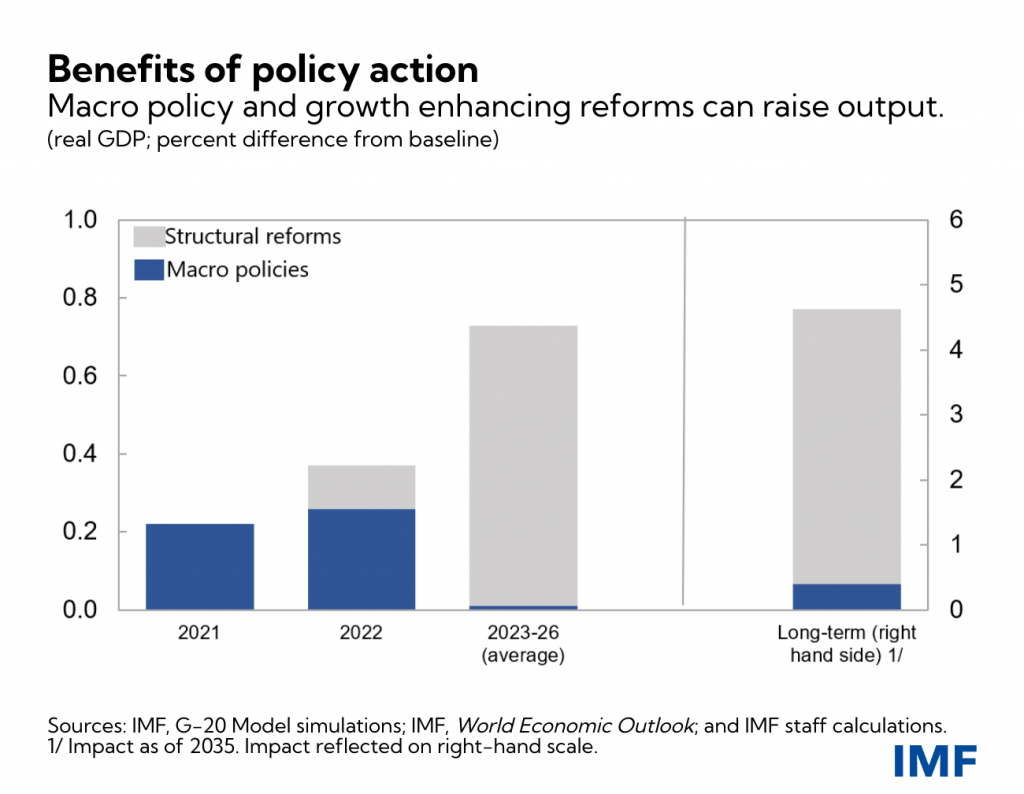
Carefully calibrating monetary and fiscal policies, combined with strong medium-term frameworks, can create more room for spending on healthcare and vulnerable people. These calibrations can deliver quick benefits through 2022.
After that, growth-enhancing structural reforms provide the bulk of added gains—think of labor market policies that support job search and retraining, and reforming product market regulations to create opportunities for new firms by reducing barriers to entry. Such a package of short-to-medium-term policies could boost aggregate real GDP in the G20 by about $4.9 trillion through 2026.
First, end the pandemic by closing financing gaps and sharing vaccine doses.
The pandemic remains the biggest risk to economic health, and its impact is made worse by unequal access to vaccines and large disparities in fiscal firepower. That’s why we need to reach the targets put forward by the IMF, with the World Bank, WHO, and WTO—to vaccinate at least 40 percent of people in every country by end-2021, and 70 percent by mid-2022.
But we are still behind: some 75 nations, mostly in Africa, are not on track to meet the 2021 target.
To get these countries on track, the G20 should provide about $20 billion more in grant funding for testing, treatment, medical supplies, and vaccines. This additional funding would close a vital financing gap.
We also need immediate action to boost vaccine supply in the developing world. While G20 countries have promised more than 1.3 billion doses to COVAX, fewer than 170 million have been delivered. Thus, it is critical that countries deliver on their pledges immediately.
Equally important is swapping delivery schedules for doses already under contract, allowing the buyer with more urgent needs to go first. Countries with high vaccination coverage should swap delivery schedules with COVAX and AVAT to speed up deliveries to vulnerable countries.
We must take these and other measures to save lives and strengthen the recovery. If COVID-19 were to have a prolonged impact, it could reduce global GDP by a cumulative $5.3 trillion over the next five years, relative to the current projection. We must do better than that!
Second, help developing countries cope financially.
Even as the global recovery continues, too many countries are still hurting badly. Think of how the pandemic caused a spike in poverty and hunger, lifting to more than 800 million the number of people who were undernourished in 2020.
In this precarious situation, vulnerable nations must not be asked to choose between paying creditors and providing health care and pandemic lifelines.
Indeed, some of the world’s poorest countries have benefited from the temporary suspension of sovereign debt payments to official creditors, initiated by the G20. Now we must speed up the implementation of the G20’s Common Framework for debt resolution. The keys are to provide more clarity on how to use the framework and offer incentives to debtors to seek Framework treatment as soon as there are clear signs of deepening debt distress. Early engagement with all creditors, including the private sector, and faster timelines for debt resolution will make a difference in the role and attractiveness of the Common Framework.
Providing help to deal with debt is important, but it’s not enough. Given their massive financing needs, many developing nations will need more support with raising revenue, as well as more grants, concessional financing, and liquidity support. Here the IMF has stepped up in unprecedented ways, including through new financing for 87 countries and a historic allocation of Special Drawing Rights of $650 billion.
Countries have already benefitted from holding the new SDRs as part of their official reserves. And some are using part of their SDRs for priority needs, such as vaccine imports, boosting vaccine production capacity, and supporting the most vulnerable households.
We are now calling on countries with strong external positions to voluntarily provide part of their allocated SDRs to our Poverty Reduction and Growth Trust, increasing our ability to provide zero-interest loans to low-income countries.
Third, commit to a comprehensive package to reach net-zero carbon emissions by mid-century.
New IMF staff analysis projects that increasing energy efficiency and transitioning to renewables could be a net job creator, because renewable technologies tend to be more labor-intensive than fossil fuels. In fact, a comprehensive investment plan with a combination of green supply policies could lift global GDP by about 2 percent this decade—and create 30 million new jobs.
In other words, as we strive to reach net-zero emissions, we can boost prosperity—but only if we act together and help ensure a transition that benefits all. The most vulnerable within societies and among countries will need more help making the structural transformation to a low-carbon economy.
One thing is clear: putting a robust price on carbon lies at the heart of any comprehensive policy package. Here G20 leadership will be critical, particularly when it comes to building support for an international carbon price floor. Moving together could also help overcome political constraints.
Under a proposal put forward by the IMF, a price floor for large carbon emitters would take into account a country’s level of development. It would also allow for equivalent regulations in lieu of an explicit price mechanism like emissions trading. This could jump-start cuts in greenhouse gases at a critical moment for the world.
At COP26 in Glasgow, G20 leaders will have a once-in-a-generation opportunity to move the carbon needle in the right direction and support developing economies. These countries have the fastest growth in population and in demand for energy. But they have the least fiscal firepower to ramp up investment in climate adaptation and emissions reduction—and often lack the technology needed.
At a minimum, this requires richer countries to deliver on their longstanding promise to provide $100 billion per year for green investment in the developing world.
For our part, we are extending a call to channel SDRs to establish the new Resilience and Sustainability Trust that our members strongly endorsed at our Annual Meetings. This will serve the needs of low-income and vulnerable middle‑income countries, including in their transition to a greener economy.
Completing and further strengthening the historic agreement on global minimum corporate tax will also help mobilize revenue for transformative investments.
These and other priorities will be top of mind for global leaders as they gather in La Nuvola.
This futuristic, versatile structure was built through a combination of vision, cooperation, and hard work—exactly what we need from the G20 at this pivotal moment. To secure the recovery and build a better future for all, we must take strong joint action now.
Author:

Kristalina Georgieva, Managing Director

Compliments of the IMF.
The post IMF | Joint Action Needed to Secure the Recovery first appeared on European American Chamber of Commerce New York [EACCNY] | Your Partner for Transatlantic Business Resources.

Read More
EACC

IMF | Needed – A Global Approach to Data in the Digital Age

Global principles on data policy can help level the playing field while addressing financial stability and inclusion, competition, and privacy.
Companies around the world are engaged in a digital data gold rush, panning the digital economy for our personal data, sifting flecks of it in online pools and streams of our preferences, choices, and locations. Data is the ultimate portable good, but moving it across borders requires countries to have coherent policies that build trust. Without global principles for managing data, we could face deepening digital fault lines between nations, as massive data pools become increasingly isolated. This would be especially costly for smaller and lower-income countries.

‘Policies to protect privacy can help lessen the unauthorized use of personal data.’

Our data power artificial intelligence (AI) that can make societies more productive, driving growth, employment, and finance. Think of more efficient supply chains, vaccine breakthroughs, and lending to previously unbanked small businesses around the world. But there are also dark sides. More and more data can be captured without our effective consent by large platforms, such as Alibaba, Facebook, Google and MercadoLibre, whose valuations have grown exponentially in recent years.
Cross-cutting issues
A new IMF staff paper discusses these challenges for growth, stability, and the international system, which are at the core of the IMFs mandate and makes the case for global cooperation to address them. Policymakers will need to start by recognizing they face several key challenges spanning financial stability and inclusion, competition, and privacy.
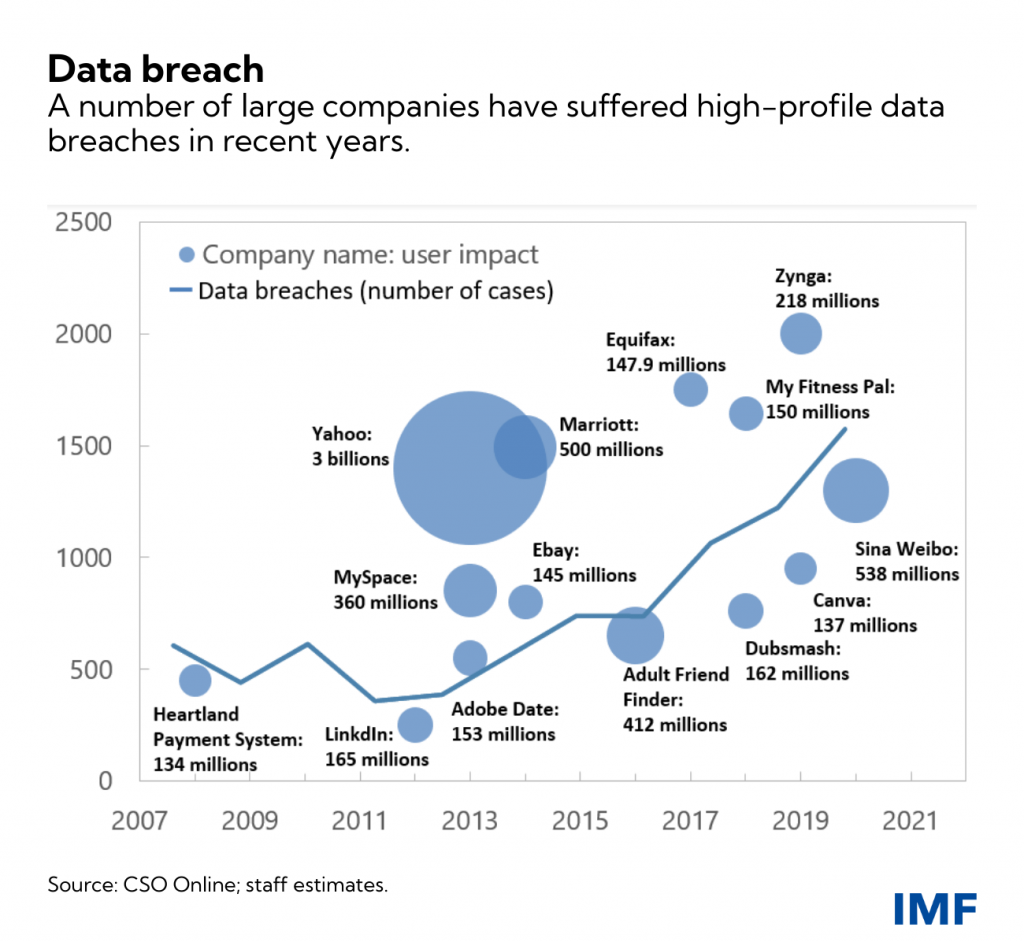
Fostering competition and stability in the digital economy: The concentration of data in large platforms reduces competition and increases the risks of hacking and single points of failure in modern economic and financial networks (seen in recent widespread service disruptions). Indeed, cyberattacks have been a key challenge in the data economy.

Promoting inclusive digitalization: Data can support greater efficiency and inclusion, including in the provision of financial services, as we have seen with the boom in fintech credit in many emerging and developing countries. But it can also be used by monopolists for price discrimination, raising profits at the expense of customers. Data-driven analytics could also be used to exclude some people from economic and financial services based on socioeconomic or other personal characteristics (what is known as “algorithmic bias”). This can disadvantage or exclude some individuals from important services that society views as essential, such as AI-driven credit scoring that worsens racial bias in mortgage lending, or facial recognition technology that fails to recognize darker skin tones.
Balancing privacy trade-offs: Policies to protect privacy—an important objective in most countries—can help lessen the unauthorized use of personal data. Privacy of financial and medical data, for example, is a key underpinning of trust in these systems. However, solely focusing on protecting privacy may prevent other uses of data that generate economic and social value—for example from sharing anonymized data on vaccine trials across borders—and may make it hard for start-ups to obtain the data they need to compete against data-rich incumbents. Clear rules are needed to tackle these trade-offs, including giving people effective control over their data while balancing public policy needs for certain types of data disclosure.
Moving toward global principles
Addressing these challenges should start at home. A number of new policy tools and approaches are being considered to provide solutions to these challenges at a domestic level. Policymakers will need to continue their focus on developing the updated laws, systems, and procedures for regulating data collection and use. At the same time, they will also need to consider mandates for making networks compatible with each other and allowing users to move and store their data on different networks.
Furthermore, policymakers could consider whether and how agencies could be created to manage consent and protect privacy, as well as provide data as a public good. Setting up “data fiduciaries”—where third-party companies collect and share data on behalf of individuals (as being explored in India)—or the data equivalent of credit bureaus (for broader classes of data beyond finance) are ideas to think about here. Balancing all the trade-offs will require unprecedented cooperation among regulators and government agencies responsible for competition, financial stability, integrity, consumer protection, and privacy.
But these issues are global. The mobility of data across borders is the basis for a rapidly growing portion of international trade in services, whose value reached about 6 trillion dollars in 2018. So, given the risk of further policy divergencies, cooperation among countries will be critical to help prevent fragmentation from taking hold in the global digital economy.

Needed—a common approach on data
Countries’ treatment of privacy, competition, and stability reflects their national priorities. And the resulting fragmentation could be damaging to smaller countries with smaller data pools and those more dependent on multinational digital firms. For example, strong privacy protections in some advanced countries may work as trade barriers for exporters of services from developing nations whose businesses have to incur exceptional costs to comply with protections.
Therefore, a strong case exists for common global principles for the data economy. For example, a common understanding of definitions in government rules to protect personal privacy, as well as to what kinds of firms and business activities they should apply, could help reduce some of the policy divergences among countries.
Many of the other domestic policy approaches being proposed for managing the data economy—for example, requirements that data be more easily shared across platforms to promote competition or on how to manage an individual’s consent—could also benefit from common principles on their international application. Provided privacy concerns can be adequately addressed, there is scope for international coordination on compilation and sharing of data sources from private digital companies for regulatory and public policy purposes.
As domestic and international efforts advance, the tensions between data privacy, security, competition, and stability will continue to play out in the global digital economy.
Authors:

Vikram Haksar is an Assistant Director in the IMF’s Strategy Policy and Review department

Yan Carrière-Swallow is an economist in the Macro Financial unit of the IMF’s Strategy, Policy and Review Department

Kathleen Kao is a Counsel in the Financial Integrity Group of the IMF’s Legal Department

Gabriel Quirós-Romero is Deputy Director in the IMF Statistics Department

Compliments of the IMF.
The post IMF | Needed – A Global Approach to Data in the Digital Age first appeared on European American Chamber of Commerce New York [EACCNY] | Your Partner for Transatlantic Business Resources.