

Read More
EACC

European Green Deal: EU Commission proposes rules for cleaner air and water

Today the Commission is proposing stronger rules on ambient air, surface and groundwater pollutants, and treatment of urban wastewater. Clean air and water are essential for the health of people and ecosystems. Air pollution alone means nearly 300,000 Europeans die prematurely each year, and the proposed new rules will reduce deaths resulting from levels of the main pollutant PM2.5 above World Health Organization guidelines by more than 75% in ten years. Across air and water, all of the new rules provide clear return on investment thanks to benefits in health, energy savings, food production, industry, and biodiversity. Learning the lessons from current laws, the Commission proposes to both tighten allowed levels of pollutants and to improve implementation to ensure pollution reduction goals are more often reached in practice. Today’s proposals are a key advance for the European Green Deal‘s zero pollution ambition of having an environment free of harmful pollution by 2050. They also respond to specific demands of the Conference on the Future of Europe.
Executive Vice-President for the European Green Deal, Frans Timmermans, said: “Our health depends on our environment. An unhealthy environment has direct and costly consequences for our health. Each year, hundreds of thousands Europeans die prematurely and many more suffer from heart- and lung diseases or pollution-induced cancers. The longer we wait to reduce this pollution, the higher the costs to society. By 2050, we want our environment to be free of harmful pollutants. That means we need to step up action today. Our proposals to further reduce water and air pollution are a crucial piece of that puzzle.”
Commissioner for the Environment, Oceans and Fisheries, Virginijus Sinkevičius, said: “The quality of the air we breathe and the water we use is fundamental for our lives and the future of our societies. Polluted air and water harm our health and our economy and the environment, affecting the vulnerable most of all. It is therefore our duty to clean up air and water for our own and future generations. The cost of inaction is far greater than the cost of prevention. That is why the Commission is acting now to ensure coordinated action across the Union to better tackle pollution at source – locally and cross-border.”
Cleaner ambient air by 2030, zero pollution aim by 2050
The proposed revision of the Ambient Air Quality Directives will set interim 2030 EU air quality standards, aligned more closely with World Health Organization guidelines, while putting the EU on a trajectory to achieve zero pollution for air at the latest by 2050, in synergy with climate-neutrality efforts. To this end, we propose a regular review of the air quality standards to reassess them in line with latest scientific evidence as well as societal and technological developments. The annual limit value for the main pollutant – fine particulate matter (PM2.5) – is proposed to be cut by more than half.
The revision will ensure that people suffering health damages from air pollution have the right to be compensated in the case of a violation of EU air quality rules. They will also have the right to be represented by non-governmental organisation through collective actions for damage compensation. The proposal will also bring more clarity on access to justice, effective penalties, and better public information on air quality. New legislation will support local authorities by strengthening the provisions on air quality monitoring, modelling, and improved air quality plans.
Today’s proposals leave it to national and local authorities to determine the specific measures they would take to meet the standards. At the same time, existing and new EU policies in environment, energy, transport, agriculture, R&I and other fields will make a significant contribution, as detailed in the factsheet.
Today’s proposal will help achieve dramatic improvement in air quality around Europe by 2030, leading to gross annual benefits estimated at €42 billion up to €121 billion in 2030, for less than a €6 billion costs annually.

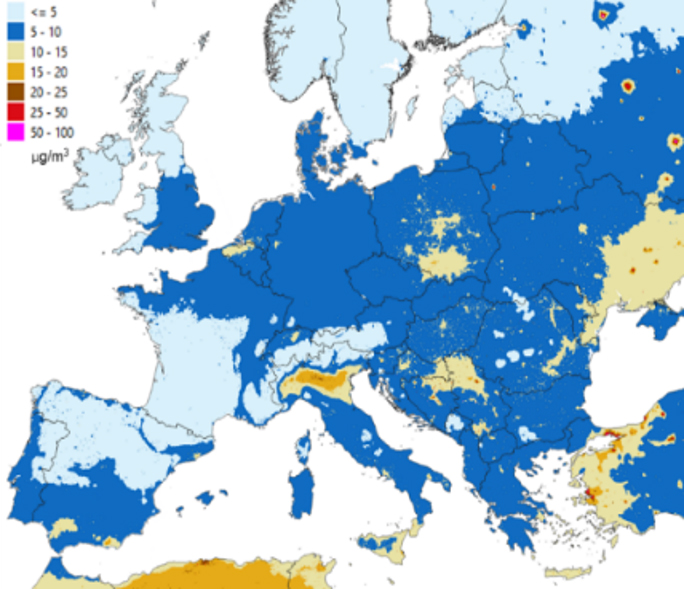
PM2.5 levels in 2020
PM2.5 levels in 2030

(WHO guidelines: <5 µg/m³, annual; 2030 proposal: <10 µg/m³; current directive: <25 µg/m³)[i]
Air pollution is the greatest environmental threat to health and a leading cause of chronic diseases, including stroke, cancer and diabetes. It is unavoidable for all Europeans and disproportionately affects sensitive and vulnerable social groups. Polluted air also harms the environment causing acidification, eutrophication and damage to forests, ecosystems and crops.
Better and more cost-effective treatment of urban wastewater
The revised Urban Wastewater Treatment Directive will help Europeans benefit from cleaner rivers, lakes, groundwaters and seas, while making wastewater treatment more cost-effective. To make the best possible use of wastewater as a resource, it is proposed to aim for energy-neutrality of the sector by 2040, and improve the quality of sludge to allow for more reuse contributing thus to a more circular economy.
Several improvements will support health and environmental protection. These include obligations to recover nutrients from wastewater, new standards for micropollutants and new monitoring requirements for microplastics. Obligations to treat water will be extended to smaller municipalities with 1,000 inhabitants (from 2,000 inhabitants currently). To help manage heavy rains, made more frequent by climate change, there is a requirement to establish integrated water management plans in larger cities. Finally, building upon the Covid-19 experience, the Commission proposes to systematically monitor wastewater for several viruses, amongst which CoV-SARS-19, and anti-microbial resistance.
EU countries will be required to ensure access to sanitation for all, in particular vulnerable and marginalised groups.
As 92% toxic micro-pollutants found in EU wastewaters come from pharmaceuticals and cosmetics, a new Extended Producer Responsibility scheme will require producers to pay for the cost of removing them. This is in line with the ‘polluter pays’ principle and it will also incentivise research and innovation into toxic-free products, as well as making financing of wastewater treatment fairer.
The wastewater sector has significant untapped renewable energy production potential, for example from biogas.  EU countries will be required to track industrial pollution at source to increase the possibilities of re-using sludge and treated wastewater, avoiding the loss of resources. Rules on recovering phosphorus from sludge will support their use to make fertiliser, benefiting food production.
The changes are estimated to increase costs by 3.8% (to €3.8 billion a year in 2040) for a benefit of over €6.6 billion a year, with a positive cost-benefit ratio in each Member State.
Protection of surface and groundwater against new pollutants
Based on up-to-date scientific evidence, the Commission is proposing to update lists of water pollutants to be more strictly controlled in surface waters and groundwater.
25 substances with well-documented problematic effects on nature and human health will be added to the lists. These include:

PFAS, a large group of “forever chemicals” used among others in cookware, clothing and furniture, fire-fighting foam and personal care products;
a range of pesticides and pesticide degradation products, such as glyphosate;

Bisphenol A, a plasticiser and a component of plastic packaging;
some pharmaceuticals used as painkillers and anti-inflammatory drugs, as well as antibiotics.

The substances and their standards have been selected in a transparent and science-driven process.
In addition, learning the lessons from incidents such as the mass death of fish in the Oder river, the Commission proposes mandatory downstream river basin warnings after incidents. There are also improvements to monitoring, reporting, and easier future updates of the list to keep up with science.
The new rules recognise the cumulative or combined effects of mixtures, broadening the current focus which is on individual substances solely.
In addition, standards for 16 pollutants already covered by the rules, including heavy metals and industrial chemicals, will be updated (mostly tightened) and four pollutants that are no longer an EU-wide threat will be removed.
Next steps
The proposals will now be considered by the European Parliament and the Council in the ordinary legislative procedure. Once adopted, they will take effect progressively, with different targets for 2030, 2040, and 2050 – giving industry and authorities time to adapt and invest where necessary. 
Compliments of the European Commission.
The post European Green Deal: EU Commission proposes rules for cleaner air and water first appeared on European American Chamber of Commerce New York [EACCNY] | Your Partner for Transatlantic Business Resources.


EACC

Payments: EU Commission proposes to accelerate the rollout of instant payments in euro

The Commission has today adopted a legislative proposal to make instant payments in euro, available to all citizens and businesses holding a bank account in the EU and in EEA countries. The proposal aims to ensure that instant payments in euro are affordable, secure, and processed without hindrance across the EU.
Instant payments allow people to transfer money at any time of any day within ten seconds. This is much faster compared to traditional credit transfers, which are received by payment service providers only during business hours and arrive at the payee’s account only by the following business day, which could take up to three calendar days. Instant payments significantly increase speed and convenience for consumers, for example when paying bills or receiving urgent transfers (e.g. in case of medical emergency). In addition, they help to significantly improve cash flow, and bring cost savings for businesses, especially for SMEs, including retailers. They free up money currently locked in transit in the financial system, the so-called ‘payment float’, which can be used sooner for consumption or investment (almost €200 billion euro are locked on any given day). But at the beginning of 2022, only 11% of all euro credit transfers in the EU were instant. This proposal aims to remove the barriers that prevent instant payments and their benefits to become more widespread.
Valdis Dombrovskis, Executive Vice-President for an Economy that Works for People, said: “Instant payments are fast becoming the norm in many countries. They should be accessible to everyone in Europe too, so that we stay globally competitive and make the most of the innovation opportunities offered by the digital age. People gain with more choice and convenience, businesses gain with better control of their cash flow and lower operational costs. Today’s proposal will strengthen our economy, make it more efficient and help it to grow.”
Mairead McGuinness, Commissioner for financial services, financial stability and Capital Markets Union, said: “Moving from “next day” transfers to “ten seconds” transfers is seismic and comparable to the move from mail to e-mail. Yet today, nearly nine out of ten credit transfers in euro are still processed as traditional ‘slow’ transfers. There is no reason why many citizens and businesses in the EU are not able to send and receive money immediately, the technology to provide for instant payments has been in place since 2017. This facility to send and receive money in seconds is particularly important at a time when bills for households and SMEs are increasing and every cent counts. This initiative will directly benefit EU citizens and businesses.”
The proposal, which amends and modernises the 2012 Regulation on the Single Euro Payments Regulation (SEPA), consists of four requirements regarding euro instant payments:

Making instant euro payments universally available, with an obligation on EU payment service providers that already offer credit transfers in euro to offer also their instant version within a defined period.

Making instant euro payments affordable, with an obligation on payment service providers to ensure that the price charged for instant payments in euro does not exceed the price charged for traditional, non-instant credit transfers in euro.

Increasing trust in instant payments, with an obligation on providers to verify the match between the bank account number (IBAN) and the name of the beneficiary provided by the payer in order to alert the payer of a possible mistake or fraud before the payment is made.

Removing friction in the processing of instant euro payments while preserving the effectiveness of screening of persons that are subject to EU sanctions, through a procedure whereby payment service providers will verify at least daily their clients against EU sanctions lists, instead of screening all transactions one by one.

This proposal will support innovation and competition in the EU payments market, in full conformity with existing rules on sanctions and fighting financial crime. It will also contribute to the Commission’s wider objectives on digitalisation and open strategic autonomy. This initiative aligns with the Commission’s priority of delivering an economy that works for people and creates a more attractive investment environment.
Background
The availability of instant payments and possible related fees vary strongly across Member States, which hinders the rollout of instant transfers in the Single Market. Legislative intervention is therefore necessary to scale up instant euro payments across the EU and unlock their benefits for EU citizens and businesses, especially SMEs. The latter would also benefit from improved cash flow and a greater choice of payment means.
Today’s proposal fulfils a key commitment in the Commission’s 2020 Retail Payments Strategy, which aimed for the full uptake of instant payments in the EU. It takes the form of an amendment to the 2012 Regulation on a Single Euro Payments Area, which already contains general provisions for all euro (SEPA) credit transfers, adding specific provisions for euro (SEPA) instant payments. The proposal contains phased implementation deadlines, differentiated for the different components of the initiative and between euro area and non-euro area Member States, to allow adequate implementation time and full proportionality.
Compliments of the European Commission.
The post Payments: EU Commission proposes to accelerate the rollout of instant payments in euro first appeared on European American Chamber of Commerce New York [EACCNY] | Your Partner for Transatlantic Business Resources.

EACC

A Marshall plan for Ukraine: G7 Presidency and European Commission to invite experts to a conference on the reconstruction of the war-torn country

Joint op-ed on Ukraine Reconstruction Conference by German Chancellor Olaf Scholz and President of the European Commission Ursula von der Leyen
The courage shown by Ukrainians since Russia invaded their country is impressive. Their resilience and steadfastness in the face of this violation of international law are equally impressive. Ultimately, it is because of the courage shown by Ukraine that we will be gathering together on 25 October in Berlin, where we intend to discuss with experts how the international community can best help and support Ukraine with reconstruction.
The shape which that reconstruction takes will determine what kind of country Ukraine will be in the future. Will it be a state based on the rule of law with strong institutions? Will it have a dynamic and modern economy? Will it be a vibrant democracy which is part of Europe? Although we should always be careful when making historical comparisons, what is at stake here is nothing less than the creation of a new Marshall plan for the 21st century. This task will take generations and it must start now.
What can we and our Ukrainian partners learn from past experience of reconstruction? How can such a huge, long-term project be organised and financed? What structures are needed in order to ensure the necessary transparency and the essential confidence of investors? These are some of the questions that we intend to discuss on Tuesday in Berlin with experts and representatives from Europe, the G7, the G20, international organisations, civil society and, above all, Ukraine.
The suffering of the Ukrainians is immeasurable, the victims they mourn every day are numerous, and the impact of Putin’s war on the lives of millions of Ukrainians is deep. What we as a community can do – and have done since the very first day of the war – is to actively and reliably support Ukraine. We have imposed harsh sanctions on Russia. We have supplied weapons, supported the Ukrainian economy and helped people in their everyday lives. We have facilitated access to our internal market for Ukrainian exports and suspended import duties.
And for the time being more than 8 million Ukrainians have found refuge and protection from Putin’s bombs and missiles in Europe. Europe gave them immediate access to the labour market, to schools, medical care and housing. In the G7 and with partners in the G20, we have been fighting the global consequences of the war, including the worldwide hunger, energy and economic crises.
The international community has provided considerable financial support. G7 countries, the European Union and its members have so far provided more than 35 billion euro in emergency aid for Ukraine alone. This money is to help Ukraine meet its immediate financial needs, so that its administration can continue to function despite the war, and so that teachers, the police, doctors and soldiers can be paid and medical care can continue to be provided.
Besides this emergency aid, we need to start thinking today about the reconstruction of the country even though peace seems a long way off. We now need to start rebuilding ruined homes, schools, roads, bridges and infrastructure and restoring power supplies, so that the country can quickly get back on its feet again. For Ukraine needs the prospect of kick-starting its economy as soon as the war is over.
The key is to tackle this major undertaking together. There is agreement on this in the G7 and the European institutions. It is a huge task. The World Bank estimates the damage of the war so far at 350 billion euro. And the destruction goes on, as the most recent attacks in the last few days have shown. Neither Ukraine nor individual partners will be able to foot the bill alone. We must all lend a hand – the EU, the G7 and our partners far and wide. The international financial institutions and leading international organisations should of course be on board. In the long term, it will be important for private investors and companies to invest in Ukraine’s reconstruction too.
The clearer and more transparent the use of the money, the greater will be the willingness to help. We will therefore make sure with our Ukrainian friends that the support reaches the places where it is most needed. Together with our G7 partners and other countries, with the support of international organisations and Ukraine, we intend to lay the foundations for an inclusive donor platform to coordinate the process of immediately restoring destroyed infrastructure and embarking on long-term reconstruction. The joint platform will be the main instrument for cooperation and coordination of European and international support. It is about driving major reconstruction projects and providing technical support. In doing so, we will set the highest standards for transparency, efficiency, auditing and project monitoring.
The European Union has an important role to play here. Since the summer, Ukraine has had EU candidate status. So the road to reconstruction is at the same time Ukraine’s path towards the European Union. This also means making the Ukrainian economy more sustainable and more digital, since that is the economy of the future. It means enforcing the highest rule-of-law standards and setting up effective anti-corruption authorities. Because these are the values which Europe stands for and which will also help gain the trust of investors and donors.
We all agree that supporting Ukraine is not only the right thing to do, it is also in our very own interest. Ukraine is fighting not only for its own sovereignty and territorial integrity, but against Putin’s attempt to shift borders by force and inflict war and destruction on his neighbours. Ukraine is also defending the international rules-based order, the bedrock of our peaceful coexistence and of prosperity worldwide. So in supporting Ukraine, we are building our own future and the future of our common Europe.
Compliments of the European Commission.
The post A Marshall plan for Ukraine: G7 Presidency and European Commission to invite experts to a conference on the reconstruction of the war-torn country first appeared on European American Chamber of Commerce New York [EACCNY] | Your Partner for Transatlantic Business Resources.

EACC

Russia/Ukraine: EEAS launches a new tool to help navigate in disinformation environment

It’s been eight months since Russia launched its full-scale aggression against Ukraine. Already a year ago, in autumn last year, the military build-up became obvious, as were efforts to lay the ground for the aggression in the information space.
In the last three months leading up to the invasion of 24 February, EEAS East Stratcom Task Force observed a distinctive spike in disinformation narratives promoted by the Russian (dis)information ecosystem. In outlets known for spreading disinformation, the use of the keyword ‘Nazi’ in relation to Ukraine increased by almost 300%, while the keyword ‘genocide’ spiked by over 500%. In the last 12 months, over 1200 disinformation cases were recorded in the EUvsDisinfo repository – attacking Ukraine, the European Union, its Member States and the whole like-minded community that stood up to Russian aggression and keeps supporting Ukraine.
As the illegal military aggression continues, so do the information manipulation and disinformation campaigns. There are full-fledged disinformation and information manipulation activities ongoing in multiple languages and dozens of platforms, offline and online. It attempts to drive wedges in our society, feed on divisions, create confusion, and divert attention away from Russia’s aggression and its war crimes.
The 24th of October marks the start of the Global Media and Information Literacy Week. The last months have shown even more clearly how big a threat disinformation is, and how crucial it is to defend ourselves against it – also on the individual level. With its multi-tier approach, the EU has been at the forefront of the fight against foreign information manipulation and interference, including disinformation.
Today, East Stratcom Task Force is adding another tool that anyone could use to understand the threat better and to defend themselves against it. The EUvsDisinfo website, the EU’s first project raising awareness of disinformation, has been enriched with a new “Learn” section euvsdisinfo.eu/learn/.
This page explains the mechanisms, tactics, common narratives and actors behind disinformation and information manipulation. It offers insights into the pro-Kremlin media ecosystem, and also explains the philosophy behind foreign information manipulation and interference. The readers can also find easy response technics that anyone can apply, and afterwards they can practice their newly acquired skills through quizzes and games.
“Learn” aims to teach the readers how to judge the relevance and reliability of sources and their content as well as how to report and react to disinformation. These skills, according to the newly released Digital Competencies Framework for Citizens (DigComp 2.2), form part of the digital skills of the XXI century and are essential for informed citizens. The content of the page can be easily translated into practical exercises and case studies to discuss in a classroom.
Visit Learn to find out more.
Contacts:

Peter Stano, Lead Spokesperson for Foreign Affairs and Security Policy | peter.stano@ec.europa.eu

Paloma Hall Caballero, Press Officer for Foreign Affairs and Security Policy | paloma.hall-caballero@ec.europa.eu

Compliments of the European External Action Service, the European Commission.
The post Russia/Ukraine: EEAS launches a new tool to help navigate in disinformation environment first appeared on European American Chamber of Commerce New York [EACCNY] | Your Partner for Transatlantic Business Resources.

EACC

IMF | Europe Must Address a Toxic Mix of High Inflation and Flagging Growth

Authorities must tighten macroeconomic policies to bring down inflation, while helping vulnerable households and viable firms cope with the energy crisis

As Russia’s war in Ukraine takes a rising toll on Europe’s economies, growth is flagging across the continent, while inflation shows little sign of abating.
Europe’s advanced economies will grow by just 0.6 percent next year, while emerging economies (excluding Türkiye and conflict countries Belarus, Russia, Ukraine) will expand by 1.7 percent, according to projections in our latest World Economic Outlook. That’s down by 0.7 percentage point and 1.1 percentage points, respectively, from July’s projections.
This winter, more than half of the countries in the euro area will experience technical recessions, with at least two consecutive quarters of shrinking output; among these countries, output will fall, on an average, by about 1.5 percent from its peak. Croatia, Poland and Romania will experience technical recessions as well, with an average peak-to-trough output decline of more than 3 percent. Next year, Europe’s output and income will be nearly half a trillion euros lower as compared to the IMF’s pre-war forecasts—a stark illustration of the continent’s severe economic losses from the war.
And while inflation is projected to decline next year, it will stay significantly above central bank objectives, at about 6 percent and 12 percent, respectively, in advanced and emerging European economies.
Growth and inflation could both get worse than these already sobering forecasts. European policymakers have swiftly responded to the energy crisis and built adequate gas storage ahead of the heating season, but further disruptions to energy supplies could lead to more economic pain.
Our scenarios show that a complete shutoff of remaining Russian gas flows to Europe, combined with a cold winter, could result in shortages, rationing and gross domestic product losses of up to 3 percent in some central and eastern economies. On top of these, it could also result in yet another bout of inflation across the continent.
Even without any new energy supply disruptions, inflation could remain higher for longer. Most of the inflation surge so far is driven by high commodity prices—primarily energy, but also food, particularly in the Western Balkan countries. While these prices might remain elevated for some time, there is hope that they will stop increasing and thereby contribute to a steady decline in inflation throughout 2023.
Inflation risks
However, our latest Regional Economic Outlook shows that the pandemic and Russia’s war in Ukraine might have fundamentally altered the inflation process, with rising input and labor shortages contributing notably to the recent high-inflation episode. This suggests there may be less economic slack and, accordingly, more underlying inflationary pressures, than commonly thought across Europe.
These results highlight a risk to our forecasts and those by others that inflation will fall steadily next year. Other wild cards include a de-anchoring of medium-term inflation expectations, or a much sharper acceleration in wages that would trigger an adverse feedback loop between prices and wages.

European policymakers face severe trade-offs and tough policy choices as they address a toxic mix of weak growth and high inflation that could worsen.
In a nutshell, they should tighten macroeconomic policies to bring down inflation, while helping vulnerable households and viable firms cope with the energy crisis. And, in these extraordinarily uncertain times, stand ready to adjust policies in either direction in response to how the situation evolves. This will depend on whether incoming data signal higher inflation, a deepening recession—which would warrant some reconsideration of policy—or both.
Central banks should continue raising policy rates for now. Real interest rates remain generally accommodative, labor markets are projected to be broadly resilient, inflation forecasts are above target, and inflation is still at risk of further increase.
Tightening needed
In advanced economies, including in the euro area, tight monetary policy will likely be needed in 2023 unless activity and employment weaken more than expected, materially bringing down medium-term inflation prospects.
A tighter stance is generally warranted in most emerging European economies, where inflation expectations are not as well anchored, demand pressures are stronger and nominal wage growth is high—often in the double digits.
Continuing to raise policy rates for now is also an insurance policy against risks, including a de-anchoring of inflation expectations or a feedback loop between prices and wages, that would require even stronger and more painful central bank responses down the road.
For example, in advanced European countries, our analysis suggests that if workers and firms start setting wages based on past inflation rather than central bank targets—as was partly the case prior to the 1990s, inflation could be nearly 2 percent higher at the end of next year. Should this happen, policy rates may need to rise by 2 percentage points and output could fall by as much as 2 percentage points more than currently projected. By contrast, if the overall demand declines—more than expected—resulting in deeper recessions and a 2 percentage points increased drop in output, both inflation and required policy rates at the end of next year could be nearly 1.5 percentage points lower than anticipated.
Fiscal policy
Fiscal policy must balance competing objectives. One is the need to rebuild fiscal space and help monetary policy in its fight against inflation. This calls for fiscal consolidation to proceed in 2023 at a faster pace in countries with less fiscal space, greater vulnerability to tighter financial conditions or stronger cyclical positions. This includes most emerging European economies.
But fiscal policy also needs to help mitigate the brutal impact of higher energy prices on people and viable firms. This suggests that the pace of consolidation may have to be slowed for a few months. Higher energy prices have increased European households’ cost of living by some 7 percent on average this year despite the widespread measures taken to ease this burden.
Going forward, it will be important to keep energy-related support temporary to contain fiscal costs, and to maintain the price signals that will foster energy savings. Compared with price interventions, a better option is to support low- and middle-income households through lump-sum rebates on their energy bills. A close alternative is to combine general lump-sum discounts with additional support for the poor through the welfare system, financed by higher taxes for high-income households. Yet another, less efficient alternative is to implement higher tariffs for higher levels of energy consumption; while such an approach is not fully targeted to the vulnerable, it is still a better option than broad price caps.

Finally, steady implementation of reforms that enhance productivity, relieve supply constraints in energy and labor markets, and expand economic capacity remain essential to raise growth and ease price pressures over the medium-term. This includes accelerating the implementation of the 800-billion-euro economic recovery package, the Next Generation EU programs.
Strength, coordination and solidarity pulled Europe out of the COVID-19 crisis. Once again, the task ahead is immense, but if European policymakers muster the spirit of the pandemic response, it can be accomplished.

Author:

Alfred Kammer is the Director of the European Department at the International Monetary Fund

Compliments of the IMF.
The post IMF | Europe Must Address a Toxic Mix of High Inflation and Flagging Growth first appeared on European American Chamber of Commerce New York [EACCNY] | Your Partner for Transatlantic Business Resources.

EACC

U.S. FED | Welcoming remarks by Governor Bowman at “Toward an Inclusive Recovery”

Welcome, and thank you for joining us to discuss topics important to the nation’s economy. This research seminar is part of the Federal Reserve’s series of events called “Toward an Inclusive Recovery.”
Today’s seminar, hosted by the Board of Governors, will focus on how the COVID-19 pandemic affected educational outcomes and the subsequent impact we anticipate for transitions to the labor force. We have invited accomplished researchers to discuss their work—and what practical lessons might be drawn from it—that could help inform community development practice and public policy considerations.
As I am sure you are aware, the pandemic created significant disruptions for our students and the education system. At the onset of the pandemic, steps taken to slow the spread of COVID-19 resulted in widespread closures of businesses and schools. Many, myself included, were immediately concerned about the negative effects on education from changes that included shifting to virtual instruction, lack of access to technology, and changes to the accessibility and provision of childcare. It is critical to consider that access to education at every step along a student’s learning path serves as a pipeline into the labor force and enables future generations of Americans to participate and thrive in our dynamic labor market. The disruption of education throughout the pandemic undoubtedly led to an absence of workers in the labor force, creating a shortage that held back the early economic recovery.
Education outcomes, including learning losses and achievements, take time to measure, aggregate, and analyze. As we enter the fourth academic year affected by the pandemic, data on student performance are becoming more available. Much of this early data confirms our initial concerns. For example, early test scores show that throughout the country nine-year-olds suffered a decline in learning outcomes during the pandemic. But other data also indicate that learning losses were unequal and disproportionately affected low-performing students and low-income students.
It is likely that the sudden shift to online classes contributed to the learning declines. According to the Board’s 2020 Survey of Household Economics and Decisionmaking (the SHED), only 22 percent of parents with children attending virtual classes agreed that their children learned as much as they would have attending classes in person at school. I hope that the return to in-person learning and reopening of schools will enable children to resume normal learning and that academic achievement will rebound.
It seems that even with this return to in-person attendance, many schools are struggling to provide students with the same quality of education as they did pre-pandemic. With the return to onsite education, many schools are confronting challenges that impair their ability to meet the educational needs of students. A number of educators appear to have left the profession, as indicated by the nearly 100,000 more job openings for teachers in July 2022 than before the pandemic.1
Complicating these issues, across the country the return to in-person instruction has been met by an increase in chronic absenteeism, which is defined as a student missing at least 10 percent of school days in a school year. Compared to a typical school year pre-pandemic, 72 percent of U.S. public schools reported an increase in chronic absenteeism among their students during the 2021–22 school year, which is a 39 percent increase over the previous year.2
Missed school typically means missed learning, so chronic absenteeism is a key metric of school performance. It’s likely that these challenges will result in lower graduation rates and possibly less stable employment than would have otherwise been the case.
These outcomes raise difficult questions about how to best respond to the needs of students and educators going forward. For example, how can curricula be adjusted to meet students where they are today, after nearly three years of pandemic-impacted learning? How can we best re-engage the larger proportion of students who may have become disconnected as a result of these pandemic-related disruptions to their education? What does this all mean for the future of the labor force?
In addition to the challenges facing primary and secondary education, higher education was not immune to pandemic disruptions. Like K-12 education, studies show that online instruction reduced the academic performance of college students.3 In addition, we have seen declines in both college enrollment and the rate of first-year college students who continue their education into a second year.4 These declines are most pronounced at community colleges and open-access programs. Some of this decline was due to a supply-induced shortage resulting from colleges unable to offer remote learning options for many technical and vocational programs. The reduction in these “hands-on” programs, such as air-conditioning repair and auto detailing, had a greater impact on male enrollment and may lead to labor supply shortages for some of these skills-based professions.5
Education is the greatest and most effective input into the future of our labor market. In order to have the strongest possible labor force in the future, it is critical to understand and act immediately to address the educational losses experienced during the pandemic. I’m sure there’s much to learn about how these education challenges, both longstanding and more recent, will ultimately affect the job market. That’s a question of particular interest to policymakers, and it’s one of the most important reasons that we host events like this seminar. I look forward to hearing from the experts we have invited here today to discuss ideas to successfully and quickly address academic declines, expand K-12 education options, improve higher education outcomes, and prepare this generation to participate and thrive in the future labor force.
I hope that the research presented today is useful to you in your work. Community development professionals in our audience may consider how the design and implementation of their services can be enhanced. And researchers may encounter ideas that spark new work that can shed further light on these important topics. Thank you so much for joining us.
Compliments of the U.S. Federal Reserve.
1. Bureau of Labor Statistics Job Openings and Labor Turnover Survey. Accessed via FRED. Return to text

2. National Center for Education Statistics, “More than 80 Percent of U.S. Public Schools Report Pandemic Has Negatively Impacted Student Behavior and Socio-Emotional Development,” press release, July 6, 2022. Return to text

3. Michael S. Kofoed, Lucas Gebhart, Dallas Gilmore, and Ryan Moschitto, “Zooming to Class?: Experimental Evidence on College Students’ Online Learning during COVID-19,” Discussion Paper Series No. 14356 (Bonn, Germany: IZA Institute of Labor Economics, May 2021). Return to text

4. Persistence and Retention, Fall 2020 Beginning Postsecondary Student Cohort (PDF), Persistence and Retention Report Series (National Student Clearinghouse Research Center, June 2022). Return to text

5. Diane Whitmore Schanzenbach and Sarah Turner, “Limited Supply and Lagging Enrollment: Production Technologies and Enrollment Changes at Community Colleges during the Pandemic,” NBER Working Paper 29639 (National Bureau of Economic Research, January 2022). Return to text

The post U.S. FED | Welcoming remarks by Governor Bowman at “Toward an Inclusive Recovery” first appeared on European American Chamber of Commerce New York [EACCNY] | Your Partner for Transatlantic Business Resources.

EACC

EU Commission makes additional proposals to fight high energy prices and ensure security of supply

The Commission is today proposing a new emergency regulation to address high gas prices in the EU and ensure security of supply this winter. This will be done through joint gas purchasing, price limiting mechanisms on the TTF gas exchange, new measures on transparent infrastructure use and solidarity between Member States, and continuous efforts to reduce gas demand. The regulation contains the following main elements:

Aggregation of EU demand and joint gas purchasing to negotiate better prices and reduce the risk of Member States outbidding each other on the global market, while ensuring security of supply across the entire EU;
Advancing work to create a new LNG pricing benchmark by March 2023; and in the short term proposing a price correction mechanism to establish a dynamic price limit for transactions on the TTF gas exchange, and a temporary collar or bandwith to prevent extreme price spikes  in derivatives markets;

Default solidarity rules between Member States in case of supply shortages,  extending the solidarity obligation to Member States without direct pipeline connection to involve also those with LNG facilities; and a proposal to create a mechanism for gas allocation for Member States affected by a regional or Union gas supply emergency.

In combination with already agreed measures on gas and electricity demand reduction, gas storage, and redistribution of surplus energy sector profits, these new steps will improve stability on European gas markets this winter and beyond. The measures will also help to further mitigate the price pressure felt by European citizens and industry, while ensuring security of supply and a functioning internal market. The Commission will continue its work in other areas, including revision of the State aid Temporary Crisis Framework later this month, and further development of ways to limit the impact of high gas prices on electricity prices.
In addition, the Commission will carry out a needs assessment on REPowerEU to speed up the clean energy transition and avoid fragmentation in the single market, with a view to making proposals to enhance the EU financial firepower for REPowerEU. The Commission is also proposing a targeted flexible use of Cohesion Policy funding to tackle the impact of the current energy crisis on citizens and businesses, using up to 10% of the total national allocation for 2014-2020, worth close to €40 billion.
Joint purchasing
While the EU has made strong progress on filling its gas storage for this winter, achieving over 92% filling as of today, we need to prepare for possible further disruption, and lay a sound foundation for the following year. Therefore, we propose to equip the EU with new legal tools to jointly purchase gas. The Commission would contract a service provider to organise demand aggregation at EU level, grouping together gas import needs and seeking offers on the market to match the demand. We propose a mandatory participation by Member States’ undertakings in the EU demand aggregation to meet at least 15% of their respective storage filling targets. Companies would be allowed to form a European gas purchasing consortium, in compliance with EU competition rules. Joint purchasing will help smaller Member States and companies in particular, which are in a less favourable situation as buyers, to access gas volumes at better conditions.
The Regulation also includes provisions to enhance transparency of intended and concluded gas supply purchases, in order to assess whether the objectives of security of supply and energy solidarity are met.  The Commission should be informed before the conclusion of any gas purchase or memorandum of understanding above a volume of 5TWh (just over 500 million cubic meters) and may issue a recommendation in case of a potentially negative impact on the functioning of joint purchasing, the internal market, the security of supply or energy solidarity.
Addressing high gas exchange prices
Although wholesale prices have decreased since the peak of summer 2022, they remain unsustainably high for a growing number of Europeans. Building on our previous work with Member States to mitigate the impact of high electricity prices and redistribute excessive energy sector profits to citizens and industry, we are today proposing a more targeted intervention in market gas prices. Many gas contracts in Europe are indexed to the main European gas exchange, the TTF, which no longer accurately reflects the price of LNG transactions in the EU. The Commission is therefore developing a new complementary price benchmark with ACER to address this systemic challenge. The new benchmark will provide for stable and predictable pricing for LNG transactions. Under the proposed Regulation, the Commission would task ACER to create an objective daily price assessment tool and subsequently a benchmark that could be used by energy market operators to index the price in their gas contracts.
While this benchmark is being developed, the Commission proposes to put in place a mechanism to limit prices via the main European gas exchange, the TTF, to be triggered when needed. The price correction mechanism would establish, on a temporary basis, a dynamic price limit for transactions on the TTF. Transactions at a price higher than the dynamic limit would not be allowed to take place in the TTF. This will help avoid extreme volatility and excessive prices. In addition, to limit excessive price volatility and prevent extreme price spikes in the energy derivatives markets, the Commission proposes introducing a new temporary intra-day price spike collar to be established by EU derivatives exchanges. This mechanism will protect energy operators from large intra-day price movements.
To ease the liquidity issues many energy companies currently face in meeting their margin requirements when using derivative markets, the Commission has adopted today new rules for market participants, expanding the list of eligible collateral on a temporary basis to non-cash collaterals, including government guarantees. Secondly, the Commission has adopted new rules increasing the clearing threshold from €3 billion to €4 billion. Below this threshold, non-financial firms will not be subject to margin requirements on their OTC (over-the-counter) derivatives. Both these measures will provide much needed relief for companies, while also maintaining financial stability. The introduction of these measures follows extensive consultation with European and national regulators, as well as stakeholders and market participants. Finally, ACER and the European Securities and Markets Authority (ESMA) are enhancing their cooperation, by creating a new joint Task Force, to strengthen their capabilities to monitor and detect possible market manipulation and abuse in Europe’s spot and derivative energy markets, as a precautionary measure to protect the stability of the market.
Solidarity and demand reduction
The Commission is closely monitoring demand reduction measures. Preliminary analysis on the basis of reporting by Member States shows that in August and September EU gas consumption would be around 15% lower than the average of the previous 5 years. Similar efforts will be needed every month until March in order to comply with the Council Regulation. Member States will report every two months on their progress. The Commission stands ready to trigger the EU Alert or review such targets if current measures prove insufficient. To reinforce preparedness for possible emergencies, the Commission also proposes measures allowing Member States to further reduce non-essential consumption to ensure that gas is being supplied to essential services and industries, and to extend solidarity protection to cover critical gas volumes for electricity generation. This should under no circumstances affect the consumption of households that are vulnerable customers.
As not all Member States have put in place the necessary bilateral solidarity agreements, the Commission proposes setting default rules. This will ensure that any Member State facing an emergency will receive gas from others in exchange for fair compensation. The obligation to provide solidarity will be extended to non-connected Member States with LNG facilities provided that the gas can be transported to the Member State where it is needed. To optimise the use of LNG and pipeline infrastructure the Commission proposes new tools to provide information on available capacity, and new mechanisms to ensure that capacity is not booked and left unused by market operators. The Commission is also proposing today a Council Recommendation on critical infrastructure protection in light of the suspected sabotage of the Nord Stream 1 & 2 gas pipelines.
Background
The Commission has been tackling the issue of rising energy prices for the past year, and Member States have deployed many measures at national level which the Commission provided through the Energy Prices Toolbox adopted in October 2021
The energy market situation has worsened considerably since Russia’s invasion of Ukraine and its further weaponisation of its energy resources to blackmail Europe, which exacerbated an already tight supply situation after the COVID-19 pandemic. As Russia has continued to manipulate gas supplies, cutting off deliveries to Europe for unjustified reasons, markets have become tighter and more nervous. The Commission therefore expanded on the Energy Prices Toolbox in Spring 2022 with the Communication on short-term market interventions and long-term improvements to the electricity market design and the REPowerEU Plan. The Commission proposed new minimum gas storage obligations and gas demand reduction targets to ease the balance between supply and demand in Europe, and Member States swiftly adopted these proposals before the summer.
Prices increased further over the summer months, which were also marked by extreme weather conditions caused by climate change. In particular, droughts and extreme heat have had an impact on electricity generation by hydropower and nuclear, further reducing supply.  Therefore, in September the Commission proposed and Member States agreed additional measures based on Article 122 of the Treaty to reduce electricity demand and capture unexpected energy sector profits to distribute more revenues to citizens and industry. Today’s proposals complement the steps already taken, and continue our work to tackle the exceptional situation on global and European energy markets. The Commission has also published today the first part of its annual State of the Energy Union Report.
Quotes by Members of the College of Commissioners
President Ursula von der Leyen said: “Russia’s war on Ukraine has severe consequences on global and European energy markets. We act in unity and have prepared well for the winter ahead, filling our gas storages, saving energy, and finding new suppliers. Now we can tackle excessive and volatile prices with more security. We will introduce a temporary mechanism to limit excessive prices this winter, while we develop a new benchmark so that LNG will be traded at a fairer price. We provide legal tools for joint EU purchasing of gas, ensure solidarity in security of supply for all Member States and negotiate with our reliable gas suppliers to secure gas at affordable prices. But we must also accelerate investment in renewables and infrastructure. Investing more and faster in the clean energy transition is our structural response to this energy crisis.”
Executive Vice-President Frans Timmermans said: “The next few winters will be tough, but today’s package helps to keep European families warm and industry going. By taking measures now and developing the tools to buy gas together instead of outbidding each other, we can again head into the next heating season with enough gas in storage. In response to the extremely volatile prices caused by Putin’s weaponisation of energy, the Commission is also working to return stability to the energy market. But cheap fossil fuels will not return and we need to accelerate our transition to renewables. This is why we need to consider ways to fund additional investment in Europe’s green energy transition via REPowerEU.”
Executive Vice-President Margrethe Vestager, in charge of competition policy, said: “In crisis situations with supply shortages, joining forces to negotiate can be an effective way to achieve better prices and better conditions. In the context of the current gas crisis, we stand ready to accompany firms willing to enter into a joint purchasing consortium, subject to safeguards and in line with our competition rules. Our goal is to ensure the full benefits of joint purchasing can be reaped and further passed through.”
Commissioner for Energy Kadri Simson said: “Russia’s invasion of Ukraine has fundamentally changed the situation on the EU energy market. Tools and rules that served us well before are no longer adequate to ensure secure and affordable energy supply. To tackle this crisis effectively, we need to be able to buy gas together, to target excessively high prices, and to ensure solidarity between our Member States in case of shortages. The steps we have taken so far are working, with prices easing and demand decreasing. But today’s proposals are needed to better prepare for this winter and beyond.”
Commissioner for Financial services, financial stability and Capital Markets Union Mairead McGuinness said: “Our measures today are significant for energy operators and energy derivative markets, while maintaining stability in the financial system. These time-limited and targeted measures focus on easing the liquidity stress that some energy firms have faced in meeting their margin requirements and on tackling extreme price volatility on energy derivative markets. We have worked closely with ESMA, the EBA and ACER, as well as national energy and financial regulators. Russia’s brutal war on Ukraine is impacting energy markets with consequences also for consumers and businesses, which we are addressing today.”
Compliments of the European Commission.
The post EU Commission makes additional proposals to fight high energy prices and ensure security of supply first appeared on European American Chamber of Commerce New York [EACCNY] | Your Partner for Transatlantic Business Resources.

EACC

ECB | Which workers are most affected by changes in the policy rate?

The ECB Blog investigates how change in the policy rate affects wages very differently depending on characteristics of employees and firms, such as firms’ size and their access to credit. Results show that the effects are symmetric during times of easing and tightening.
The ECB uses its policy rates to achieve price stability. But its decisions also have side effects on labour markets. To better understand how interest rate cuts and hikes affect labour market outcomes we look at workers, firms and credit. We investigate how characteristics such as workers’ age and education, or the size of the companies where they are employed, determine the extent to which payslips and hours worked are affected by monetary policy decisions.
But how can we gather the necessary information? We link two datasets from Portugal: one dataset provides detailed information on the employees of firms, and the other, information on loans to those firms.[1] Both date back to the launch of the euro. This allows us to match data on individual workers and the firms they work for, with the bank loans the firms drew down over two decades which includes periods of monetary policy easing and tightening.[2]
Our work began before the recent monetary policy normalisation and was initially focused on periods of monetary easing but we can prove that the effects are symmetric, for both policy easing and tightening. For example, workers with high education tend to benefit most after rate cuts in terms of wage increases and hours worked. But they are also among the most affected when the ECB increases policy interest rates, which slows wage growth. At the same time, workers in small and young firms are the most positively affected by policy rate cuts in terms of wage increases and hours worked. But they are also among the most affected during policy rate hikes.
But let us take a step back and look at the design of our study.
Rate cuts affect wages more in small firms
The recent public debate about the distributive effects of monetary policy has focused on workers’ income, age, race[3] and origin. There is also evidence that employers’ characteristics drive wage differences. To find out more we took three steps:

We investigated which firms benefit the most from policy rate changes
We then assessed which employees in these firms benefited the most
We looked at the loan data to understand the role of credit in this context

Step 1: In which type of firms do workers benefit the most from ECB rate changes?
We address this question by estimating the heterogeneous impact of monetary policy conditions on wages, hours worked and employment across different types of firms. We estimate that a 1 percentage point (pp) decrease in the monetary policy rate is associated with a 1.16 pp stronger increase in wages of workers in small firms compared to large firms, as shown by Chart 1. Smaller firms increase wages more after a rate cut than bigger firms. We also estimate that workers in young firms benefit the most compared to workers in old firms. Since workers in smaller and younger firms tend to earn lower wages, policy rate cuts narrow the wage differential across firms in the economy.
Step 2: Which type of workers benefit the most from policy rate changes?
To address this question, we assess the impact of monetary policy on workers with high vs low levels of education. Following a monetary policy rate cut, the hours worked and wages earned by employees with more education increase by more than those of less educated workers. In particular, the labour market effects are most pronounced for better educated workers in small firms. Interest rate cuts are associated with the movement of highly educated workers towards small firms. In turn, this is coupled with a stronger increase in capital investment in small firms. What could be the reason for that? One interpretation is that small firms can often have less success securing credit than larger firms. This handicap is reduced in the aftermath of monetary policy easing. Small firms use improved access to finance for more capital investment, and this increases the value for better educated employees. So, we took a closer look at credit in our third step.

Chart 1
Monetary policy, wages and firm size
Estimated impact of one percentage point policy rate cut, on average wages, of firms of different sizes.
Dots represent the mean estimates of impact on wages. The vertical lines represent the variation in these estimates (‘’margin of error’’).

Sources: Jasova, Mendicino, Panetti, Peydro, Supera (2022). Notes: X-axis shows the size of firms. They increase in size relative to each other as you move right along the x-axis. The y-axis shows the estimated wage increase of employees in the firms represented on the x-axis. The wage increase estimated on the y-axis is always relative to the increases in wages in the largest firms (these firms are visible in the 80-100 quintile). In all cases, the impact on wages has been caused by a 1 percentage point cut in the monetary policy rate.

Monetary easing improves access to credit for small firms
Step 3: What is the role of credit in driving wage differentials after a rate cut?
We start by comparing the impact of a rate cut on wages for firms with and without bank credit. We find that credit plays an important role in explaining the effects of monetary rate changes on the distribution of wages. The wage outcomes for workers in small firms is fully driven by firms with an existing bank-borrowing relationship. In fact, for small firms without bank credit, it simply does not matter. Next, we use a novel measure of firm-level credit sensitivity to monetary policy, as well as measures of bank health, to capture financial constraints that firm and/or banks, respectively, might be experiencing. By alleviating financial constraints, monetary policy rate cuts allow easier access to credit for constrained firms and for firms borrowing from more constrained banks. Workers in these firms benefit more in terms of wages earned and hours worked when rates are falling. In particular, we also find that these effects depend on the state of the economy and are 2 to 3.5 times stronger in crisis periods than in normal times.
What is most relevant at present is that the effects of policy rate changes are symmetric for times of easing and tightening. So, in times of increasing policy rates, the wages of workers in larger firms are less negatively affected than those in smaller firms. This increases the wage differential across firms in the economy. But, at the same time, workers with less education are less affected. Since low-education workers tend to earn lower wages, rate increases narrow the wage differential across workers in the economy.
While the traditional view in macroeconomics focuses on aggregate effects, more recent research sheds a light on how heterogeneous the effects of monetary policy can be. It is important for policymakers to be aware that their decisions affect different types of workers and firms differently for at least two reasons. First, understanding the distributional consequences of monetary policy can help policymakers understand the impact of their actions on inequality. In this respect, earnings are a relevant source of inequality. Second, understanding heterogeneity can also be important to draw conclusions for aggregate effects, and especially so, in a monetary union where countries differ in their compositions of workers and firms. In this post we have argued that the repercussions of monetary policy on workers’ individual wages vary depending on whether they work in small or large firms as well as on their education level. Hence, the overall impact of policy rate changes in a country is going to be affected by the share of small vs large firms as well as by the share of workers with high vs low education levels.
Compliments of the European Central Bank.
Footnotes:
1. All results reported in this blog will be made available in Jasova, Mendicino, Panetti, Peydro, Supera, 2022 (Monetary Policy, Labour Income Redistribution and the Credit Channel: Evidence from Matched Employer-Employee and Credit Registers, forthcoming, ECB Working Paper)
2. Portuguese data are special in that they allow us to follow workers over time as they move across different firms and, at the same time, have a detailed picture of firm borrowing conditions. The results presented in this article are derived from two primary matched datasets. The first is the linked employee-employer dataset covering all private sector employees in Portugal (Quadros de Pessoal) constructed by the Portuguese Ministry of Labour Solidarity and Social Security. The second is the credit register reporting monthly level data on all loans that firms receive from credit institutions supervised by the Bank of Portugal (Central de Responsabilidades de Credito). In addition, the analysis uses firm-level balance sheet data (Informacao Empresarial Simplificada) and Bank of Portugal’s proprietary bank balance sheet data (Balanco das Instituicoes Monetarias e Financeiras).
3. See, among others, Dossche, Slacalek and Wolswijk, Monetary Policy and Inequality, Economic Bulletin Article, European Central Bank Economic Bulletin Issue 2, 2021, and references therein.
The post ECB | Which workers are most affected by changes in the policy rate? first appeared on European American Chamber of Commerce New York [EACCNY] | Your Partner for Transatlantic Business Resources.

EACC & Member News

Two Views – Women on Supervisory Boards

Thaima Samman

Partner at SAMMAN, President at European Network for Women In Leadership, Board Member Focus Home Interactive


Liesbeth Mol

Chief Quality Officer and member of the Executive Board, Deloitte Netherlands


Women on Supervisory Boards: Why is this issue important? Who is affected?

Liesbeth

In the Netherlands, supervisory boards have traditionally shown the same picture: white men in grey suits. Luckily this picture has been changing over the past five years. As the role of the supervisory board became more relevant and gained in-depth, awareness rose that the presence of diverse viewpoints within them is important in order to avoid “groupthink” and tunnel vision. Yet the tendency was still to appoint new supervisory board members from the “old boys network.” Forcing a breakthrough legislation was necessary. In the Netherlands, we now have so-called quota legislation, in which it is ruled that 1/3 of the supervisory boards will have to be comprised of women. As long as this quotum has not been reached, appointments of new male supervisory board members are invalid. The impact of this legislation on the supervisory boards is already being felt. A lot of listed companies now have at least 1/3 of women on their supervisory boards. The next important step will be that management boards also have the necessary diversity.

Thaima

The issue of the representation of women in all facets of life goes to the heart of democratic values and governance. In my role as President of the European Network for Women in Leadership, I see the subject of the feminization of leadership and management under discussion all over Europe. Studies have shown that companies with higher levels of gender diversity outperform those with male-dominated management, and the larger goal—beyond women on supervisory boards—is for more women in executive roles generally.

Following Norway’s lead in 2006, eight EU countries have adopted mandatory gender quotas for listed companies, including France, Belgium, Italy and the Netherlands, with ten others having taken a more incentive-driven approach. In their search for female talent, male leadership is discovering that this talent exists! The visibility of successful women and a constellation of heterogenous role models contributes to the development of a pipeline of female talent and future female leaders.

This trend, however, is not irreversible, and we need to remain vigilant, especially in times of social and economic upheaval. Some companies appoint women to their boards to comply with the law but make sure that they have no real power or influence. Having the same few women sit on several supervisory boards rather than looking for other talent is also not uncommon.


What have you seen on the ground?

Liesbeth

The NSE supervisory board has oversight over the NSE executive board. NSE is Deloitte’s European organization and consists of 28 geographies.

On our board, we have over 50% female representatives, all with different cultural backgrounds. We also have three independent non-executives on our supervisory board, which assures the objectivity of this board. We strive for a certain percentage of women and different cultures on this board and have open conversations about how to reach the targets. We have a strong focus on people and on the long term, and we keep in mind the impact our decisions will have on our legacy. We believe strongly that our diverse board provides the diversity of thought necessary for discussions and decisions of value, for both the short and long term.

My main takeaway is that inclusivity and diversity are a “must” for boards; we have to take firm steps and be open about dilemmas and our values. Whatever form of diversity we strive for, cultural diversity, gender diversity, ultimately, it is about diversity of thought. And we in our NSE board see the benefits of having diversity of thought: in decision making and in having meaningful discussions.

Thaima

The Deloitte example is a great one and a best practice to communicate broadly.

I am currently a board member of Focus Interactive, a gaming company. The company clearly wants to work with their supervisory board members on business strategy. The other board members coming from the same world, my female colleague and I bring fresh air and new perspectives, she with a financial background, and I with my law and public affairs perspectives—gained from ten years at Microsoft as Legal and Corporate Affairs General Counsel, and subsequent work with a Law and Corporate Affairs firm.

My takeaways:

  • Don’t be shy, and forget the impostor syndrome: the knowledge and experience that makes you different from the other members might very well be the reason you were chosen. If the company leadership is not interested by your ideas or recommendations, they will simply not act on them—don’t take it personally.
  • You are there to make/approve decisions engaging the company. Being assertive goes down well, provided you have a constructive approach. Feel free to ask questions and speak up, remind others of the rules and check compliance execution. You are protecting the company by doing so.

What’s coming next?

Liesbeth

An important next step is moving from diversity to inclusion. The good news is that there will be more women on boards as a result of quota legislation. However, if the culture does not change and women do not feel safe enough to ask questions and express differing views, there is no inclusion and no benefit from having diverse points-of-view. The Chair of the supervisory board must create an atmosphere in which everybody can be open to ask questions and express views. At this moment, diversity is too often seen as just a check-the-box exercise. If boards look different but still act the same, there has been no real progress—the company will not benefit from diversity of thought. More action is needed to go from diversity to inclusion.

Global progress on gender equality is encouraging, but overall, progress is slow. It has therefore become even more important to take concrete action, appointing more women not only to supervisory boards but also to boards of directors. We should also challenge if 1/3 of women on boards is sufficient because then it still doesn’t give a balance in boards since you have a predominance of men, which obviously has its effect on discussions, decisions and also on inclusion.

Thaima

Companies now have a diversity of profiles in their workforce, and management and leadership teams are more resilient and more successful as a result. The coming together of different skills and ideas helps align companies in the diverse societies they operate in and better understand their markets and customers. These types of factors, while well understood, are not always taken into account at the right level of management, and old reflexes and stereotypes are still alive and kicking.

Women are now equally, if not more, educated than men. Aside from the topic of women on supervisory boards, tackling the broader issue of women in leadership positions also addresses corporate governance and the need to recruit and retain female talent.

There is not one legal tradition in Europe but several. This results in huge differences between countries according to their cultures, histories and legal traditions. I believe it is necessary for the European Union to continue taking initiatives to align the policies of member states, levelling them up to the standards in the more advanced countries. The recent deal on the Directive on Women on Boards, which had been blocked for ten years, should make a big difference and will complement EU efforts to mainstream gender into wider policy-making processes, including, most recently, by making it a criterion for receiving EU Covid recovery funding.

EACC

Interview with Luis de Guindos, Vice-President of the ECB, conducted by Dalius Simenas on 10 October 2022

Some experts are sceptical whether monetary tightening and rapid raising of interest rates are an effective tool to tame inflation, which in the euro area is driven mainly by extremely high energy prices, by Russia’s energy blackmail towards those European countries supporting Ukraine against Russian aggression. Are you confident that the European Central Bank (ECB) will manage to curb the record high inflation that reached 10% in September and to get it back to the ECB’s target of 2% over the medium term?
An important part of the inflationary process that we are now facing has been driven by external factors, such as increased energy prices, more expensive raw materials, food, etc. According to our calculations, energy and food prices currently account for two-thirds of inflation in the euro area. However, inflation is also being pushed up by demand for goods and services, as is particularly the case in the Baltic countries. Increased demand can be contained through decisions to normalise monetary policy, while I agree that monetary policy has no influence on energy prices.
Nevertheless, it is very important to avoid second-round effects and prevent inflation being passed on to wages, which would push inflation higher. In order to avoid this, inflation expectations need to remain anchored. Market participants must have confidence in the credibility of the central bank. We will do whatever is necessary to bring inflation back to our 2% target over the medium term.
The OPEC+ alliance, which also includes Russia, recently decided to substantially cut oil production as of November. This has already driven oil prices higher. It is likely that this decision has not made it any easier for the ECB to achieve its goal of bringing inflation down to the target level.
Oil prices are global prices as they depend on producers and the world economic outlook. From an economic perspective, lower oil prices could help reduce inflation and, at the same time, support the economic recovery, thereby facilitating the decisions of policymakers.
What is the state of the euro area economy at the moment?
I think we are going to face a very difficult combination of low economic growth, including the possibility of a technical recession, and high inflation. According to our September projections, inflation will be hovering around 10% until the end of this year and will start to gradually decline in 2023. In this context, monetary policy has to focus on the evolution of inflation, which is what the Governing Council will be looking at when taking decisions. However, the environment will be very challenging and uncertain.
What is your forecast for the euro area’s economic development?
What we considered as our downside scenario in September, is coming closer to the baseline scenario. The current global context, including the monetary policy action, the energy shock and deterioration of the terms of trade, among others, point towards a slowdown of the global economy and, eventually, of the inflation rate as well.
Under the downside scenario from our September projections, the euro area economy would shrink by almost 1% in 2023, while the baseline scenario envisages GDP growth of 0.9%. The difference between the baseline and downside scenarios lies in the evolution of energy supplies from Russia. The assumption under the baseline scenario is that 20% of energy deliveries would continue to be supplied, whereas the downside scenario assumes a total cut-off. Currently, as I have said before, we are getting closer to the downside.
Is it correct that forecast inflation is also higher under the downside scenario?
That’s right. Under the downside scenario, annual inflation is expected to decline from an average rate of 8.4% this year to 6.9% in 2023. Under the baseline scenario, inflation is expected to go down from an average of 8.1% this year to 5.5% in 2023.
Currently the interest rate on the ECB deposit facility is 0.75% in the euro area. What should be the terminal rate to anchor inflation expectations?
That is very difficult to say. We are dependent on the data we receive. There is a very high level of uncertainty. We do not know how the war will develop and what impact it will have on energy prices. All these factors make it very difficult to determine the level of the terminal rate.
We have adopted a prudent stance: our response will depend on how the data evolves in the coming months. In December we will have new projections for inflation and GDP growth that will guide our decisions, despite the high uncertainty.
Historically, average interest rates in advanced economies hovered around 4%. Is this a reality that euro area businesses and mortgage borrowers will face again?
This will depend on various circumstances. Over the last 15 years interest rates have been much lower than that figure and we have had negative interest rates for a long period of time. In my view, structural factors that pushed inflation down in recent times have started to shift. Globalisation is not going to be as intense as it was, and the energy shock can drive inflation higher. So, I think that monetary policy has to adjust to these new structural features that may push inflation upwards when compared to the past decade.
The cost of borrowing for governments has risen dramatically in recent weeks and months. For instance, the Estonian government recently issued ten-year bonds at 4%, despite having among the lowest levels of debt in the euro area. Yields of ten-year government bonds of southern euro area countries fluctuated on average around 3-5%. What is your advice to governments – how should they keep the rising borrowing costs under control?
Fiscal policy has to be supportive of the process of monetary policy normalisation conducted by the ECB. We cannot ignore the fact that inflation is the main problem in the euro area, which is quite obvious in the Baltic countries. Inflation is reducing the purchasing power of households, especially of those that are more vulnerable, and is dampening investment.
Thus, we have to pursue a normalisation of monetary policy. Higher interest rates are needed to try to subdue the rising level of inflation that is clearly above our 2% target over the medium term.
Could you please specify what kind of fiscal policy would be compatible with the anchoring of inflation expectations?
As we are in the process of normalisation of our monetary policy, fiscal policy needs to play a different role than the one played during the pandemic. In the current context, fiscal policy has to be more selective and targeted to support the most vulnerable groups of society. If countries start putting in place indiscriminate measures across the board, the mission of monetary policy will become more challenging and we may be unable to achieve the ultimate goals of reducing dependence on Russian energy and supporting the green transition.
Fiscal policy and monetary policy do not seem to be going hand in hand. The governments of Germany, Lithuania and other euro area countries have chosen the path of subsidising energy prices, which increases their borrowing and budget deficits.
I don’t comment on the policy decisions of any government. But, as a general recommendation, fiscal policy has to be compatible with the process of normalisation of our monetary policy stance. State support has to be temporary and targeted to the most vulnerable groups while facilitating the green transition.
What is your assessment of the policy implemented by the Lithuanian government?
I think that Lithuania is implementing a very prudent fiscal policy. With a public debt ratio of 40% of GDP, Lithuania’s public debt and budget deficit are clearly below the euro area average.
The main problem is inflation, which currently is above 20% – at levels also observed in the other Baltic countries. Disparities in inflation rates among euro area countries will have to be monitored and analysed in detail.
Compliments of the European Central Bank.
The post Interview with Luis de Guindos, Vice-President of the ECB, conducted by Dalius Simenas on 10 October 2022 first appeared on European American Chamber of Commerce New York [EACCNY] | Your Partner for Transatlantic Business Resources.