Read More
EACC

IMF | Industrial Policy Can Lift Productivity – but Comes With Risks and Trade-offs

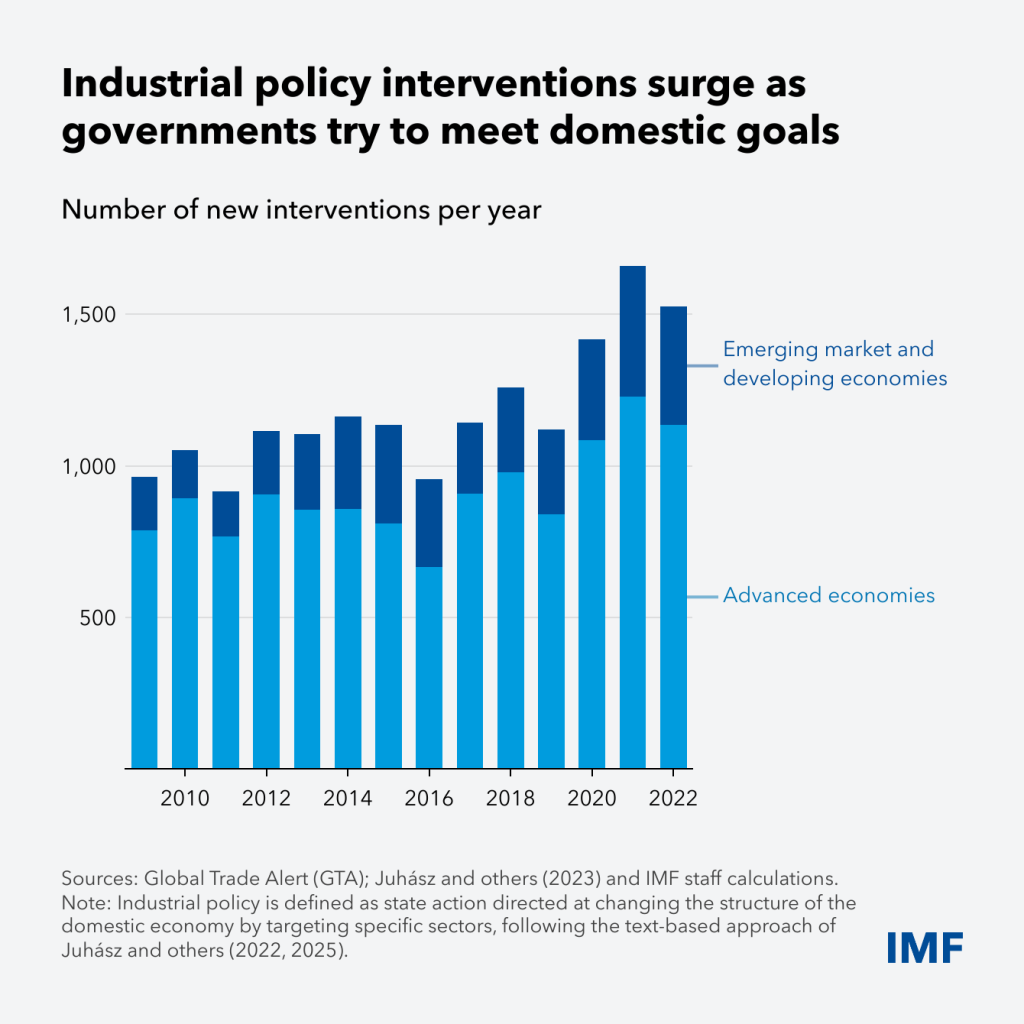
Blog post | Governments across both advanced and emerging market economies have increasingly rolled out new support for targeted companies and industries over the past decade and a half.
Industrial policy, as it’s known, is used for a range of goals, including to boost productivity growth, protect manufacturing jobs, improve self-dependence and the resilience of supply chains, and develop “infant” industries to diversify the economy. In the energy sector, for example, some countries have used industrial policy to reduce dependence on imported oil and gas.
Such policies can help jump-start domestic industries and transform the structure of an economy. But gains are not guaranteed and can come with costs—both to government  budgets and economic efficiency, as we show in an analytical chapter of the latest World Economic Outlook. Industrial policies involve trade-offs that countries should consider, according to our research using economic models, case studies, and empirical analyses.

So, how can countries design industrial policies to maximize their effects and limit the associated trade-offs?
Impact on targeted sectors
For a start, the effectiveness of industrial policies depends on industry-specific characteristics that can be hard to determine in advance. Our simulations show that industrial policy can help boost domestic sectors when productivity scales up with output. This could reflect workers learning on the job or industries becoming more efficient with scale.
Countries can use a mix of subsidies and trade protections to promote domestic production in strategic industries. In principle, early support through industrial policy can deliver dynamic gains and long-lasting productivity improvements in sectors that become more efficient with experience. Because production costs decrease as volume grows, targeted industries can learn by doing and become competitive globally.
However, these industrial policies come with significant trade-offs: consumers can face higher prices for a prolonged period, and governments can incur substantial budgetary costs. Success also isn’t guaranteed, because it depends on industry-specific traits that are often difficult to predict. Catching up technologically may not be achievable if companies are too far behind, learn slowly, or domestic firms can’t readily access large markets, for example through exports.
Empirically, our analysis of the effects of recent industrial policies suggests industrial policy is associated with better economic outcomes in targeted industries, particularly in countries with strong institutions. But the gains are small.
Direct subsidies to an industry are associated with about a 0.5 percent improvement in value added and 0.3 percent higher total factor productivity three years after implementation, reflecting higher capital accumulation and employment. These improvements are modest compared with sample average industry value added growth of 6.5 percent per year and total factor productivity growth of about 4 percent per year.
Moreover, earlier IMF analysis reaffirms larger gains can come from structural reforms to improve the overall business environment and better enable credit access for all firms.
Aggregate impacts
While industrial policy can help specific industries, translating these into broader economic benefits can be challenging.
Our multi-sector, multi-country quantitative model shows that employment, productivity and output all improve in targeted industries. But, because resources are drawn away from untargeted sectors, those sectors end up shrinking and losing productivity, potentially delivering a negative impact on aggregate productivity. So, even if targeted support can boost priority sectors, and increase resilience and independence, our analysis suggests it can also create misallocation of resources and dampen aggregate outcomes, leaving the economy worse off.
Calibrating policy 
Our findings highlight the importance of carefully designing and implementing industrial policy. Governments should consider the risks of wasteful spending, especially when debt is elevated and fiscal space limited. They should weigh the opportunity cost of industrial policy against economy-wide reforms that can often boost economic outcomes without relying on precise sector targeting or large fiscal costs. And they should recognize and manage trade-offs explicitly. Although not the focus of this chapter, large-scale industrial policy can also have cross-country spillovers, and trigger retaliation by trading partners.
Countries that do pursue industrial policies should include mechanisms for regular evaluation and recalibration, all underpinned by a strong institutional and macroeconomic framework. Policymakers should encourage market discipline through vigorous domestic and international competition.
Doing so will increase the likelihood that industrial policy delivers on its promise—without compromising fiscal sustainability or economic efficiency.
 
This blog is based on Chapter 3 of the October 2025 World Economic Outlook, “Industrial Policy: Managing Trade-Offs to Promote Growth and Resilience.” The authors of this chapter are Shekhar Aiyar, Hippolyte Balima, Mehdi Benatiya Andaloussi, Thomas Kroen, Rafael Machado Parente, Chiara Maggi, Yu Shi, and Sebastian Wende, with research assistance from Shrihari Ramachandra and Yarou Xu.
 
Compliments of the IMFThe post IMF | Industrial Policy Can Lift Productivity – but Comes With Risks and Trade-offs first appeared on European American Chamber of Commerce New York [EACCNY] | Your Partner for Transatlantic Business Resources.

EACC & Member News

Loyens & Loeff – Developments in tariffs and their interaction with transfer pricing

Tariffs are by no means a new phenomenon, but recent developments have had a profound impact on global supply chains and international trade. From the US tariff waves introduced under the Trump administration to the retaliatory measures imposed by key trading partners, including the European Union, protectionist policies have re-emerged as a defining feature of the international trade landscape. As tariffs represent a cost in the supply chain, these may trigger important transfer pricing considerations for multinational enterprises.

Read more

Read More
EACC

IMF | Inside the AI-Led Resource Race: Material Demands – for Energy, Chips, and Minerals – Will Determine Who Dominates Data

Article by Thijs van de Graaf published in the IMF’s Finance & Development Magazine | Artificial intelligence is often cast as intangible, a technology that lives in the cloud and thinks in code. The reality is more grounded. Behind every chatbot or image generator lie servers that draw electricity, cooling systems that consume water, chips that rely on fragile supply chains, and minerals dug from the earth.
That physical backbone is rapidly expanding. Data centers are multiplying in number and in size. The largest ones, “hyperscale” centers, have power needs in the tens of megawatts, at the scale of a small city. Amazon, Microsoft, Google, and Meta already run hundreds worldwide, but the next wave is far larger, with projects at gigawatt scale. In Abu Dhabi, OpenAI and its partners are planning a 5-gigawatt campus, matching the output of five nuclear reactors and sprawling across 10 square miles.
Economists debate when, if ever, these vast investments will pay off in productivity gains. Even so, governments are treating AI as the new frontier of industrial policy, with initiatives on a scale once reserved for aerospace or nuclear power. The United Arab Emirates appointed the world’s first minister for artificial intelligence in 2017. France has pledged more than €100 billion in AI spending. And in the two countries at the forefront of AI, the race is increasingly geopolitical: The United States has wielded export controls on advanced chips, while China has responded with curbs on sales of key minerals.
The contest in algorithms is just as much a competition for energy, land, water, semiconductors, and minerals. Supplies of electricity and chips will determine how fast the AI revolution moves and which countries and companies will control it.
A hungry industry
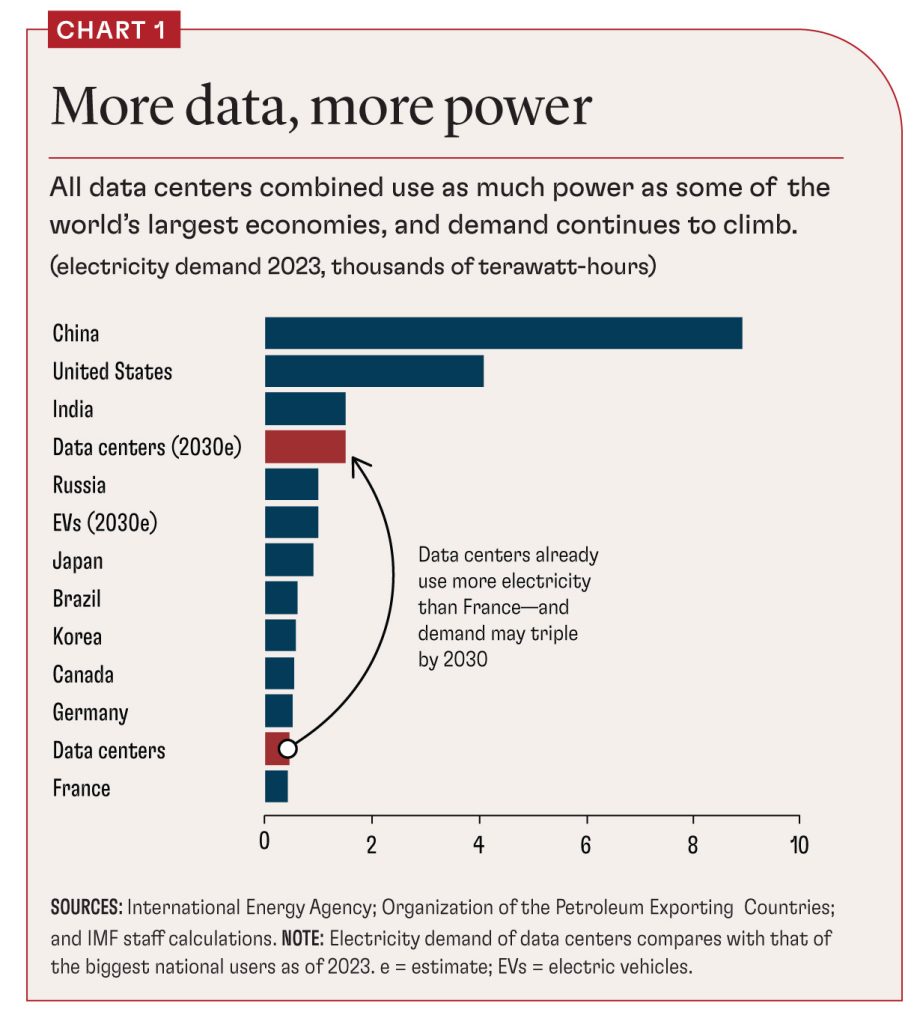
Artificial intelligence is devouring electricity. Data centers already use about 1.5 percent of global electricity supply, roughly the same as the United Kingdom. Only a portion of that demand comes from AI, but it is growing fast. Training an advanced model can consume as much power as thousands of households use in a year, and running it at scale multiplies the burden. The International Energy Agency (IEA) expects data center demand to more than double by 2030, with AI responsible for much of the increase.
Globally this surge is manageable: AI accounts for less than a tenth of added power demand this decade, far below that of electric vehicles or air-conditioning. But national balances tell a different story. In the US and Japan, data centers could account for nearly half of new demand by 2030. In Ireland, they already use more than a fifth of the country’s electricity, the highest share among advanced economies.
The local strains are sharper still. Unlike steel plants or mines, data centers cluster near big cities, can be built in months rather than years, and keep getting bigger. This combination makes them uniquely disruptive to local grids.
In northern Virginia, the world’s largest data hub, data centers already consume about one-quarter of the state’s power, forcing utilities to delay or cancel other connections. Rising electricity bills became a flash point in the state’s governor’s race. In Ireland, Dublin’s grid operator froze new projects in 2022, approving only those that could generate their own power. Singapore halted approvals altogether in 2019 and now allows facilities only under strict efficiency rules.
Big Tech turns to power
Technology companies are becoming power players themselves. The largest firms are now among the world’s biggest corporate buyers of renewable energy. Microsoft, Amazon, and Google have each signed multibillion-dollar power purchase agreements that rival those of traditional utilities. Their decisions about where to site data centers increasingly shape which solar and wind projects get built.
Some are adding on-site generation at data centers to cut reliance on the grid, or are betting directly on new technologies. Microsoft has explored nuclear, from small modular reactors to possible acquisitions of mothballed plants such as Three Mile Island in Pennsylvania. Google is backing advanced geothermal. Amazon is testing hydrogen for backup power. With President Donald Trump rolling back many of President Joe Biden’s climate policies, the AI power race has unexpectedly cast Big Tech as a lifeline for clean-energy investment.
Over time, Big Tech’s capital could help accelerate innovation in clean power, but it could also cement dependence on fossil fuels. While AI has boosted renewables in Europe, demand in the US—home to more than 40 percent of the world’s data centers—still leans heavily on natural gas, adding to emissions.

Smarter machines
Artificial intelligence is not only a voracious consumer of electricity, it can also help manage it, balancing power grids, forecasting renewable output, and optimizing energy use in buildings and industry. Some cities are even piping waste heat from server farms into district heating networks. These applications will not erase the sector’s footprint, but they can soften the strain.
Efficiency is improving too. New generations of chips, such as Nvidia’s Blackwell processors and Google’s tensor processing units (TPUs), are designed to deliver more operations per watt. On the software side, China’s DeepSeek, released in January 2025, was trained at a fraction of the cost and energy of what OpenAI and Google spent on comparably sized models.
Yet efficiency brings its own paradox. History suggests that cheaper computing power sparks more use, an effect known as the Jevons paradox. AI may indeed deliver smarter, leaner models, but the appetite for applications is likely to grow even faster.
If electricity is AI’s first constraint, semiconductors are the second. Training state-of-the-art models requires thousands of specialized chips, most designed by Nvidia and manufactured almost exclusively in Taiwan Province of China by the Taiwan Semiconductor Manufacturing Company (TSMC). That concentration has made chips the single most strategic choke point in the AI supply chain.
The geopolitical stakes are already clear. The US has restricted advanced chip exports to China while subsidizing domestic fabrication plants. Far from stifling progress in China, those curbs may have pushed its companies to innovate around them, as DeepSeek has shown. Beijing is racing to build its own domestic champions. Europe, Japan, and India are pouring billions into their own industries. Access to chips is now a litmus test of technological sovereignty.

Mineral footprint
Chip fabrication itself is resource-hungry. A single cutting-edge fabrication plant can consume as much electricity as a small city and require vast amounts of ultrapure water. But the deeper story lies farther upstream, in the minerals that make advanced chips and data centers possible.
They need gallium and germanium for advanced circuitry, silicon for chips, rare earths for cooling fans, copper for the cabling that binds servers together. A single hyperscale campus can contain nearly as much copper as a midsize mine produces in a year.
By 2030, data centers could be consuming more than half a million metric tons of copper and 75,000 tons of silicon each year—enough to lift their share of global demand to 2 percent, according to the IEA. For gallium, the leap is sharper still: Data centers could account for more than a tenth of total demand. Those percentages may sound modest, but they come on top of surging requirements from electric vehicles, wind turbines, and defense industries, all chasing the same finite supply.
That supply is highly concentrated. China controls 80–90 percent of global refining of silicon, gallium, and rare earths. In 2023 it restricted exports of gallium and germanium; since late 2024 new curbs have followed on tungsten, tellurium, bismuth, indium, and molybdenum. All are critical inputs for microprocessors, diodes, and server hardware. Prices for many of these metals have spiked. Washington, Brussels, Tokyo, and Seoul have responded with critical-mineral strategies, from recycling programs to alliances with resource-rich countries in Africa and Latin America.
The scramble for minerals, as for chips, leads to concentrated supply chains and high barriers to entry, with clear geopolitical stakes. Securing stable, sustainable access will shape who can truly harness the AI revolution.
Land and water
Hyperscale data centers thrive where cheap power, abundant water, and fast fiber-optic links converge. Land is seldom the limiting factor. These sites are vast by urban standards but modest compared with farming or mining acreage. Even so, their arrival can still reshape local economies as farmland in northern Virginia or Oregon is concreted over by endless rows of server halls.
Water is more contentious. Cooling demands millions of gallons a day, and two-thirds of new US centers since 2022 have been built in water-stressed regions, Bloomberg News reports. In Arizona, projects have sparked fights over whether scarce water supplies should go to households or to Big Tech. Similar disputes are emerging in Spain and Singapore. Yet most of AI’s water footprint is indirect. Power plants that supply data centers consume far more water than the centers themselves.
Climate and minimizing network delays also shape siting decisions. Ireland’s dense cluster reflects its role as a transatlantic cable hub. Abu Dhabi’s planned 5-gigawatt campus was chosen partly to minimize delays with Asia and Europe. And colder countries, from Norway to Iceland, tout their climate advantage: less energy needed for cooling.
The result is a patchwork geography: Some governments impose curbs to protect grids and water; others vie to host projects with cheap renewables, district heating, or simply space to build. This is another reminder of how material constraints will shape the future of AI.
Policy challenges
The resource demands of AI force governments to treat power plants, grids, water, and minerals as an integral part of their digital policies.
One challenge is knowing what to plan for. Forecasts of data center demand diverge widely: For 2030, the highest published estimate is nearly seven times the lowest. Yet the pace of building leaves little time for certainty. Governments must expand electricity systems fast enough to keep up, but without overbuilding or locking in fossil fuels.
Another gap is transparency. Even in an information age, there is little public reporting from the industry on data center use of electricity, water, or minerals. Greater disclosure would give regulators, utilities, and communities a clearer picture of what is coming.
Finally, sustainability and equity. Expanding grids and supply chains without environmental and social safeguards risks repeating the boom-and-bust cycles of past commodity races. And the benefits of the AI boom will be tilted toward the rich world if developing economies remain just suppliers of raw materials and face higher implied costs for energy and capital.
If managed well, the AI boom could accelerate clean energy and foster more resilient supply chains. If not, it risks locking in new emissions and deepening resource dependence.
This is not just a digital contest. It’s a material one—over electrons, gallons, wafers, and ores. How governments and companies handle those foundations will decide not only who leads in AI, but how sustainable and widely shared its gains will be.

Thijs van de Graaf is associate professor of international politics at Ghent University, energy fellow at the Brussels Institute for Geopolitics, and author of reports on the energy transition’s geopolitics for the International Renewable Energy Agency.

 
Opinions expressed in articles and other materials are those of the authors; they do not necessarily reflect IMF policy.

 
Compliments of the IMFThe post IMF | Inside the AI-Led Resource Race: Material Demands – for Energy, Chips, and Minerals – Will Determine Who Dominates Data first appeared on European American Chamber of Commerce New York [EACCNY] | Your Partner for Transatlantic Business Resources.

EACC

ECB | From Headlines to Hard Data: Mapping the Uneven Impact of Geopolitical Risk in Europe

ECB Blog post by Martin Bijsterbosch, Matteo Falagiarda and Lucia Žídeková | Geopolitical tensions such as the war in Ukraine have shaken Europe’s economies. Understanding the economic impact of such shocks is crucial for monetary policy. This ECB Blog post presents a news-based indicator that tracks country-level geopolitical risk.
Geopolitical tensions around the world have increasingly affected European economies and slowed down growth. Armed conflicts and other tensions between states and political actors can disrupt supply chains, heighten uncertainty, weigh on consumer and business sentiment and fuel financial market volatility.[1]
All of this comes at a cost for our economies, while also affecting the transmission of monetary policy. However, measuring geopolitical risk and its economic consequences is no easy task. This blog post presents a new indicator for mapping country-level geopolitical risk. The indicator is then used to measure the varying ways in which the geopolitical shock stemming from Russia’s February 2022 invasion of Ukraine has affected economies across Europe.
Measuring geopolitical risk
In response to the ongoing geopolitical tensions worldwide, several new tracking tools have been put forward in various studies. One leading contribution, by Caldara and Iacoviello (2022), uses US newspaper sources to map the emergence and evolution of risks both globally and for the major economies. Yet it reflects a fundamentally US-centric perspective on the geopolitical risks affecting these countries.
Meanwhile, other approaches typically either focus only on a subset of the large EU economies or are country-specific. Until recently, no single contribution had offered comprehensive coverage of all of the EU countries based on domestic news sources. Our indicator addresses this blind spot by providing an EU-wide, domestically anchored view of geopolitical risk.
So how do we go about measuring geopolitical risk?
In line with the definition provided by Caldara and Iacoviello (2022), we understand geopolitical risk to mean “the threat, realisation, and escalation of adverse events associated with wars, terrorism, and any tensions among states and political actors that affect the peaceful course of international relations”.[2]
We also adopt a similar text-based methodology but extend it to capture these developments from a European perspective. To this end we draw on domestic news sources for all EU countries. Specifically, we use the English-language coverage of leading EU newspapers and agencies to detect and track tensions. This yields a more granular and regionally grounded measure of geopolitical risk in Europe.
The indicator is based on a dictionary of keywords and has been constructed using an automated text search. The keywords cover a wide range of geopolitical risk-related terms. The search terms combine references to war, conflict, invasion, terrorism, military buildup and nuclear threat with words expressing tension, threat, risk or crisis. Non-geopolitical references (such as film titles, sporting events or historical anniversaries) have been systematically excluded. Thanks to this design, the indicator is able to capture how the media covers both the outbreak and the escalation of geopolitical events.
Our indicator depicts the monthly volume of articles referencing adverse geopolitical developments as a share of the total number of articles published. It shows how perceived geopolitical risk has varied across countries and over time, closely tracking the major geopolitical events in Europe over the last two decades (Chart 1). For example, before the Ukraine war central and eastern European (CEE) countries generally faced lower geopolitical risk than other EU nations. Since February 2022, however, they have been among the most affected.[3]

Chart 1
Geopolitical risk indicator
(percentage of articles referencing adverse geopolitical developments relative to the total number of articles published)

Sources: ECB calculations.
Notes: The geopolitical risk indicator is constructed following the methodology of Caldara and Iacoviello (2022). Using a dictionary of keywords similar to those used in the original study, an automated text search method is applied to a selection of leading domestic newspapers and major news agencies from EU countries, retrieved via Factiva. The indicator is computed monthly as the share of articles referencing adverse geopolitical developments relative to the total number of articles published. This approach adapts the original framework to a European context, providing a localised measure of geopolitical risk as reflected in domestic media coverage.

The Russian invasion of Ukraine in February 2022 represented a major geopolitical shock – the largest perceived geopolitical shock for at least 20 years. The invasion compounded already high inflationary pressures, dented consumer and business sentiment, increased uncertainty and triggered volatility in financial markets. Internationally, it disrupted trade and financial flows.
Also, it contributed to market fragmentation and put already stressed supply chains under further strain. While the impact of these risks varied across countries, our indicator shows that the perceived risks were greater in regions closer to the conflict (Chart 2, panel a) and in countries with stronger economic and trade ties to Russia before the war (Chart 2, panel b).
CEE countries were particularly affected, in part due to their reliance on energy-intensive production, the high share of food and energy in their household spending, their economic openness, their integration into global supply chains and their pre-war trade and financial links with Russia. Austria, Finland and Sweden also displayed elevated geopolitical risk.
For Finland and Sweden, this was probably due to their proximity to Russia and their limited protection from the conflict before joining NATO. In Austria’s case, it could also stem from the country’s historical neutrality and the absence of a collective defence alliance (it is not a member of NATO).
Chart 2

Geopolitical risk, regional exposure and energy dependence
(panel a: x-axis: distance of the capital to Moscow in km; y-axis: average geopolitical risk indicator since Feb. 2022; panel b: x-axis: pre-war oil and gas dependence on Russia as a %; y-axis: average GRI since Feb. 2022)

a) Proximity to the Ukraine war

b) Pre-war dependence on Russian energy

Sources: Eurostat and authors’ calculations.
Notes: The country indicators are normalised to a baseline value of 100 for the period from January 2014 to July 2025. Panel b): Import dependency on oil, petroleum products and natural gas from Russia, calculated as a composite indicator. For each fuel (crude oil and petroleum products, natural gas), import dependency is measured as the ratio of net imports (imports minus exports) to gross available energy of that fuel (2015–2020 average). The composite indicator is obtained by weighting each fuel-specific dependency rate by its share in total energy.

How does geopolitical risk affect Europe’s economies?
The war in Ukraine and its broader geopolitical ramifications have had significant and heterogeneous effects across European economies. To capture these dynamics, we incorporated the geopolitical risk indicator into macroeconomic models that include both domestic and global economic and financial variables. The results show that geopolitical risk shocks had a substantial impact on real GDP, investment, exports and inflation between 2022 and 2024 (Chart 3). Investment was hit particularly hard, with a drop of around three percentage points in CEE countries. This shows that greater geopolitical uncertainty makes firms more cautious by driving up risk premia and discouraging long-term investment plans.
Geopolitical risks also played a significant role in driving inflation higher between 2022 and 2024. This finding is consistent with the cost-push interpretation of economic shocks.
According to this theory, heightened geopolitical tensions disrupt supply chains and push up production and energy costs. And this contributes to higher prices. At the same time, geopolitical tensions can also lower inflation by weighing on confidence, tightening financial conditions and dampening both domestic and global demand. Although the overall impact of these effects can vary, our findings suggest that the factors pushing prices up outweigh those pulling them down.[4]
CEE countries have been more affected by geopolitical risks than the euro area overall. Interestingly, there is little difference between CEE countries that form part of the euro area and those that do not, highlighting the entire region’s vulnerability to geopolitical disruptions.
Unlike in the euro area as a whole, geopolitical shocks in CEE countries had a bigger impact on exports than on investment. This is largely due to their strong connections to global trade and supply chains, their reliance on external demand and their pre-war economic ties with Russia. As many of these connections have been disrupted by the war in Ukraine, the export sectors in CEE countries are particularly sensitive to these geopolitical challenges.

Chart 3
Economic impact of the geopolitical shock stemming from the Ukraine war beyond long-term trends
(percentage points)

Source: ECB calculations.
Notes: Cumulative contribution of geopolitical risk shocks to detrended variables over the period 2022-2024. Historical decomposition based on region-specific VAR models estimated on quarterly data covering the period 2004-2024. Endogenous variables include the geopolitical risk indicator, real GDP, real investment, real exports and HICP. Exogenous variables comprise a financial volatility index (VIX), global energy prices and a linear trend. Geopolitical risk shocks are identified via a set of narrative and sign restrictions.

Tracking geopolitical risk: an economic imperative
Geopolitical shocks, such as the Russian invasion of Ukraine, have had a profound and uneven impact on European economies. Given their geographical proximity to the conflict, their economic openness and their pre-war economic linkages with Russia, CEE countries have proven particularly vulnerable.
Understanding the economic impact of geopolitical shocks is crucial for economic policymakers and central banks. This will enable them to craft targeted and timely responses to mitigate adverse effects and support economic resilience. For Europe, mapping geopolitical risk and tracking its repercussions is no longer a choice. It is an economic imperative.
 
The views expressed in each blog entry are those of the author(s) and do not necessarily represent the views of the European Central Bank and the Eurosystem.
 
Compliments of the European Central Bank
 

For an early assessment of the impact of the Russian invasion of Ukraine on global stock markets, see Chiţu, L., Eichler, E., McQuade, P. and Ferrari Minnesso, M. (2022), “How do markets respond to war and geopolitics?” ECB Blog, 28 September.
Caldara, D. and Iacoviello, M. (2022), “Measuring geopolitical risk”, American Economic Review, Vol. 112, No 4, pp. 1194-1225.
The CEE countries in this blog post comprise Bulgaria, Croatia, Czech Republic, Estonia, Hungary, Latvia, Lithuania, Poland, Romania, Slovakia and Slovenia. For further analysis of the drivers and implications of higher inflation in euro area CEE countries, see Falagiarda, M. (2024), “Inflation in the eastern euro area: reasons and risks”, ECB Blog, 10 January.
It is also important to note that the model controls for global energy prices, so the estimated impact of geopolitical risk mainly reflects effects beyond those associated with energy-price movements, such as supply-chain disruptions, higher risk premia and precautionary increases in price mark-ups.

The post ECB | From Headlines to Hard Data: Mapping the Uneven Impact of Geopolitical Risk in Europe first appeared on European American Chamber of Commerce New York [EACCNY] | Your Partner for Transatlantic Business Resources.
EACC

EU Opens Registration for Craft and Industrial Product Names Under New Geographical Indication Scheme

From 1 December 2025, Europe’s glassblowers, potters, cutlers, jewellers and other makers will be able to register their product names under the EU’s new geographical indication (GI) scheme for craft and industrial goods. This marks the first time GI protection, long used for food and drink, will cover non-agricultural products, completing the Single Market for GIs.
The system will protect iconic goods such as Bohemian glass, Limoges porcelain, Solingen knives and Donegal tweed, whose reputation and quality stem from their place of origin. This protection will safeguard traditional skills, support local jobs and help consumers recognise genuine, high-quality European products. By turning heritage into opportunity, it will strengthen regional economies, preserve cultural identity and curb counterfeits both online and offline.
Producers may apply through a recognised association or individually. Each application must include a ‘product specification’ outlining the name, production process and geographical area, and should be submitted to the relevant national authority in the EU Member States.
The GI registration procedure has two steps:

National level – the authority reviews the application and runs a national opposition procedure.
EU level – the application is then assessed by the EUIPO, which handles the EU-wide opposition procedure and decides on protection and registration.

Denmark, Finland, Lithuania, Luxembourg, Malta, the Netherlands and Sweden have obtained a derogation for the national phase and producers will exceptionally be able to apply directly to the EU Intellectual Property Office (EUIPO), which manages the whole procedure.
The Commission may intervene in cases where a registration could affect public policy or the EU’s trade and external relations.
Guidance, templates and contacts are available on the EUIPO’s CIGI Hub, including information on financial and technical support.
Background
Geographical indications are intellectual property rights that link a product’s qualities, reputation, or features to its place of origin.
Regulation (EU) 2023/2411 creates EU-wide protection for craft and industrial geographical indications (CIGIs). It builds on over 30 years of the agricultural GI system, which protects more than 3,600 names and generates about €75 billion a year – roughly 15% of EU food and drink exports.
The Regulation, adopted on 18 October 2023, sets up a single EU title for CIGIs, allowing producers to stop misuse of their names and secure international protection. Existing national craft and industrial GIs will end one year after the Regulation takes effect, in December 2026.
The CIGI scheme is run by the EUIPO, supervised by the Commission. The Commission may intervene where a registration could affect public policy or the EU’s trade and external relations.
 
 
Compliments of the European CommissionThe post EU Opens Registration for Craft and Industrial Product Names Under New Geographical Indication Scheme first appeared on European American Chamber of Commerce New York [EACCNY] | Your Partner for Transatlantic Business Resources.
EACC

Federal Reserve Bank of Dallas | Economic Uncertainty and the Design and Conduct of Monetary Policy

Dallas Fed President Lorie Logan delivered these remarks at “The SNB and its Watchers 2025” Conference at the Karl Brunner Institute.
 
Good afternoon.
Thank you to the Karl Brunner Institute for inviting me to participate in this important conference. As always, the views I’ll share are mine and not necessarily those of my colleagues on the Federal Open Market Committee (FOMC).
It is an honor to join this distinguished panel addressing a topic that is both timely and timeless: the role of economic uncertainty in monetary policy.
The topic is timely because this is a moment of substantial uncertainty about the economic outlook. And it is timeless because, really, there’s nothing especially new about that situation. Uncertainty is a pervasive feature of the macroeconomy and monetary policymaking.
Theoretical models in which one knows the precise current state of the economy, fully understands the economic mechanisms and has perfect foresight about the future can sometimes provide useful baseline approximations. But these are merely approximations. The world is complex, multifaceted and ever-changing. A policymaker cannot know with certitude the current state of every relevant aspect of the economy, let alone exactly how every part of the economy works or what shocks may arrive.
Yet policymakers must still make policy decisions. Even a choice not to act is itself a decision. And we cannot let uncertainty paralyze us. Rather, it’s incumbent on policymakers to tackle uncertainty head-on.
First off, policymakers can reduce uncertainty about the state of the economy by gathering economic information from a wide range of sources. For me, those sources include official statistics, private-sector data, financial market conditions, surveys of households and businesses, and reports from business and community leaders and market contacts about what they are seeing in the economy and financial system. Besides sharpening the economic picture, taking on information from a wide range of sources makes the policy process more robust to disruptions in the flow of information from any one source, such as the government shutdown in the United States that recently paused publication of many federal official statistics . But even after thorough information-gathering, some uncertainty will always remain.
Another important area of uncertainty is about how the economy works, and especially the mechanisms through which monetary policy influences the economy. Again, policymakers can work to reduce the uncertainty—for example, by consulting a wide range of models and experts to see where there’s consensus and by investing in research to deepen understanding over time. But as with uncertainty about the state of the economy, uncertainty about the mechanisms can only be reduced, not eliminated.
And we can never know what the future may bring. The shifting winds of geopolitics and technology only add to the range of potential shocks right now.
In the end, therefore, policy decisions must take uncertainty into account. That can mean adjusting a policy decision to reflect risk management considerations instead of doing what would be optimal if the situation were certain. Research shows that how to make these adjustments depends crucially on the source of uncertainty. For example, if policymakers want to provide economic stimulus but are uncertain how much stimulus will come from a specified reduction in interest rates, it can be optimal to move in small steps and learn more about the size of the effect. On the other hand, if policymakers are uncertain about the persistence of shocks to inflation, it can be optimal to move more aggressively than one would under certainty so as to mitigate the danger of unanchored expectations. There are also many cases when policymakers should look through uncertainty, either because there is no benefit to adjusting in one direction or another, or because the key aspects of the economic outlook are certain enough to provide clear counsel even as some uncertainties remain.
In that spirit, I’ll describe the aspects of the U.S. economic outlook and monetary policy strategy that seem relatively certain to me at this time, as well as some key uncertainties I’m continuing to work to resolve. I’ll then briefly discuss the outlook for the Federal Reserve’s balance sheet.
The economic and monetary policy outlook
The FOMC has made two 25-basis-point rate cuts in recent months. While I supported the September rate cut, I would have preferred to hold rates steady at our October meeting.
Congress gave the FOMC a dual mandate: to pursue maximum employment and stable prices. The labor market has remained roughly balanced and cooling slowly. Inflation remains too high, taxing the budgets of businesses and families, and appears likely to exceed the FOMC’s 2 percent target for too much longer. This economic outlook didn’t call for cutting rates.
Payroll job gains fell markedly in 2025. But slow job gains don’t necessarily mean there’s more slack in the labor market. Labor supply has fallen at the same time as demand, particularly due to changes in immigration policy and labor force participation. In consequence, we haven’t seen a rapidly widening gap between the number of jobs available and the number of people who want work. The unemployment rate rose slowly during the year. Unemployment claims have stayed low, although I’m mindful of recent layoff announcements by some employers. And, thanks in part to financial conditions, resilient consumer and business spending continues to support employment.
The risks to the labor market do lie mainly to the downside. In this low-hiring environment, the job market could have difficulty absorbing any significant pickup in layoffs from the current low level. Asset valuations can sometimes snap back without much warning, which might take the wind out of consumer spending. However, the resolution of the federal government shutdown takes one near-term downside risk off the table.
Turning to the price stability side of the mandate, inflation in the United States is still too high and too slow to return to target. The FOMC targets a 2 percent inflation rate as measured by the annual change in the price index for personal consumption expenditures, or PCE. Inflation by that measure exceeded the target in each of the past four years. It’s on track to do so again this year. The index rose 1.8 percent just in the first eight months of the year, and forecasters expect it to end the year up about 2.9 percent.
While inflation has come down significantly from the post-pandemic peak, it’s still not convincingly headed all the way back to 2 percent. I remain concerned about the trajectory of underlying inflation, even after accounting for temporary factors that affect prices in the near term. The Blue Chip Economic Indicators surveys dozens of private-sector forecasters about their economic outlooks. The Blue Chip consensus outlook is for 2.6 percent PCE inflation in 2026 and around 2.4 percent in 2027, followed by fluctuations between 2.1 and 2.2 percent all the way out to at least 2031—never all the way back to target.
The FOMC has repeatedly reaffirmed its commitment to the 2 percent inflation target. Our obligation to the public is to deliver on this commitment, as well as our equally serious obligation to pursue maximum employment.
The FOMC’s long-run strategy calls for a balanced approach to our two objectives. I carefully weigh the potential labor market costs of measures to reduce inflation. But labor demand and supply have remained in rough balance. When the FOMC met in October, it had already mitigated downside risks by cutting rates at its previous meeting in September. The remaining risks to employment are ones the FOMC can monitor closely and respond to if they are becoming more likely to materialize, not ones that currently warrant further preemptive action. For those reasons, I did not see a need to cut rates at the October meeting. And with two rate cuts now in place, I’d find it difficult to cut rates again in December unless there is clear evidence that inflation will fall faster than expected or that the labor market will cool more rapidly.
Uncertainties in the near and longer terms
One key uncertainty is how much more room there may be to reduce rates while still maintaining a restrictive policy stance that can further slow inflation. The gradual cooling in the labor market during 2025, among other evidence, demonstrates that policy was at least modestly restrictive before the September and October rate cuts. At the same time, economic and financial developments raise substantial doubts about whether we entered 2025 with more than 75 basis points of restriction. For example, if policy had been significantly restrictive, I would have expected to see a more rapid increase in labor market slack. And I wouldn’t have expected to see soaring asset valuations in many markets, nor corporate credit spreads compressed to historic lows. That’s not to say labor market and financial conditions are uniformly easy. Some workers are experiencing greater difficulty finding work, and financing is tighter in some sectors, such as housing. But those pockets of pressure are more consistent with modest restriction than significant or severe restriction.
Policy restriction is a function of real interest rates, not nominal ones. Forecasters expect about 2.7 percent inflation over the coming year. That puts the current real fed funds rate around 1.2 percent, which is toward the low end of typical model-based estimates of neutral, although all of these estimates are highly uncertain. Put another way, with inflation running persistently above target, a fed funds rate close to 4 percent isn’t nearly as restrictive as you might have thought.
Policy also has to account for headwinds and tailwinds hitting the economy. Elevated asset valuations and compressed credit spreads aren’t just indications that policy most likely isn’t very restrictive. They’re also indications that the fed funds rate needs to offset tailwinds from financial conditions.
Putting it together, even in September I was not certain we had room to cut rates more than once or twice and still maintain a restrictive stance. And having made two cuts, I’m not certain we have room for more. Monetary policy works with a lag. It’s too soon to directly assess the degree of restriction from the current stance of policy, with two rate cuts already on board. In the absence of clear evidence that justifies further easing, holding rates steady for a time would allow the FOMC to better assess the degree of restriction from current policy. Taking the time to learn more can help us avoid unnecessary reversals that might generate unwanted financial and economic volatility.
Looking further in the future, ongoing structural changes could meaningfully shift the economy’s long-run trajectory. The artificial intelligence (AI) investment boom and elevated valuations for companies involved in AI reflect investors’ hopes that generative AI will transform human work, productivity and economic growth. Should those hopes come to fruition, the implications for inflation and labor markets will be profound—especially for younger workers, who by some accounts are already being affected in some occupations. Federal, state and local agencies around the United States are also seeking to support economic growth by removing or changing regulations. If successful, these efforts could raise productivity and permit more employment growth with less inflation. Meanwhile, to the extent that higher tariff rates change trade flows, patterns of investment and work in the United States could need to adjust.
Over time, any or all of these factors could substantially influence where the FOMC will need to set the policy rate to achieve its dual mandate goals. My team and I are closely analyzing developments in these areas. It’s crucial to identify and react in a timely way to major changes in the economy. For now, though, the potential long-run structural shifts aren’t key ingredients in my near-term monetary policy views. While the AI investment boom is supporting spending and financial conditions, for example, the direct effects on employment and productivity have so far been relatively contained. The nature of the potential labor market transformation from generative AI remains unclear: what kinds of human work will it ultimately replace, and what kinds will it complement? And big bets on new technology don’t always pan out. The sources of financing for these investments bear careful monitoring.
While AI investors may be taking big risks in search of outsized returns, central bankers are famously conservative. I’ll be looking for more concrete evidence on the size, direction and timing of potential long-term structural changes as I consider how to I take them on board in my outlook.
Balance sheet normalization
Let me conclude with a few words on the Fed’s balance sheet. The FOMC decided in October to stop reducing the Fed’s asset holdings as of Dec. 1, ending a phase of balance sheet normalization that began in mid-2022.
Asset runoff reduced not only the asset side of the Fed’s balance sheet but also the bank reserves on the liability side of the balance sheet. This symmetry is important because the Fed implements monetary policy in a regime of ample reserves, which meets banks’ demand for reserves with market rates close to interest on reserves. As I’ve argued elsewhere, ample reserves are efficient. Reserves are the safest and most liquid asset in the financial system and one that does not cost the Fed to create. The Friedman rule therefore says it’s efficient to eliminate banks’ opportunity cost of holding reserves, and that’s what the ample-reserves regime achieves.
In recent months, money market rates moved up toward and sometimes above the interest rate on reserve balances (IORB). After averaging 8 to 9 basis points below IORB in the first eight months of 2025, the tri-party general collateral rate (TGCR) averaged slightly above interest on reserves in the subsequent period. TGCR is a rate on overnight repos collateralized by Treasury securities. It’s a safe rate in a liquid and competitive market, and I view it as the cleanest single measure of money market conditions. The rise in TGCR made it appropriate to end asset runoff, as the FOMC decided to do.
Importantly, ending asset runoff only slows but does not stop the decline in reserves. If the Fed’s assets are held fixed, trend growth in non-reserve liabilities such as currency will absorb more of the balance sheet over time. The demand for reserves will likely also change over time in response to economic growth, changes in the banking and payments businesses, and adjustments in regulation. To maintain ample reserve conditions over time, the FOMC will need to determine when to start adding to its assets.
In an efficient system, market rates should be close to, but perhaps slightly below, interest on reserves on average over time. “On average” is key there. Market rates can fluctuate from day to day. Bringing the average level close to IORB also requires some tolerance for modest, temporary moves above IORB.
Repo rate spreads to IORB have receded only somewhat in recent weeks from the peaks reached in late October and early November. Looking at where TGCR and other rates are settling, I expect it will not be long before it is appropriate to resume balance sheet growth so that money market rates can average close to, but perhaps slightly below, IORB. Those reserve management purchases will be technical steps. By no means will they represent a change in the stance of policy.
However, the size and timing of reserve management purchases should not be mechanical, in my view. While purchases will need to offset relatively predictable trend growth in currency, reserve demand will likely also change over time in response to economic growth, changes in the banking and payments businesses, and adjustments in regulations. Reserve supply will need to roughly track those developments to remain efficient.
Thank you.
 
Compliments of the Federal Reserve Bank of DallasThe post Federal Reserve Bank of Dallas | Economic Uncertainty and the Design and Conduct of Monetary Policy first appeared on European American Chamber of Commerce New York [EACCNY] | Your Partner for Transatlantic Business Resources.

EACC

ECB | The Transformative Power of AI: Europe’s Moment to Act

Speech by Christine Lagarde, President of the ECB | BratislavAI Forum on artificial intelligence and education as part of an OECD high-level event to mark the 25th anniversary of “Better Policies for Better Lives”, Bratislava
 
It’s a privilege to speak with you today about artificial intelligence.
In 1987 Robert Solow famously remarked that “you can see the computer age everywhere but in the productivity statistics.”
The same observation could be made today. We see AI advancing at remarkable speed. Yet its aggregate impact is still barely visible in the data.
Over the past year global corporate investment in AI reached USD 252 billion, and private AI firms raised a record USD 100 billion.[1] Five leading US investors in terms of capital expenditure are now companies that focus heavily on AI. None of these companies numbered among the top ten investors a decade ago. [2]
Some view this surge as temporary exuberance running ahead of underlying fundamentals. But a debate framed only in terms of short-term ups and downs may miss the bigger picture.
History offers many examples of intense investment waves that – despite swings in the investment cycle – ultimately left behind transformative technologies that reshaped economies for decades.[3]
So the key question is not whether there are cycles – that is almost certain – but how long it will take before the enduring productivity benefits become visible.
And there are reasons to believe AI could spread faster, and deliver tangible economic gains sooner, than previous technology waves.
If that is the path we are on – and I believe it may be – Europe needs to position itself accordingly. We need to remove all the obstacles that stop us from embracing this transformation. Otherwise we risk letting the wave of AI adoption pass us by and jeopardise Europe’s future.
History shows: disruptions first, benefits later
To understand what is at stake, it is useful to look at history.
Earlier general purpose technologies, such as electricity, computers or the internet, followed a recognisable trajectory. Disruption arrived early, with broad-based productivity gains only emerging slowly.[4]
For example, it took around thirty years before the impact of electricity showed up clearly across the economy. Power grids had to be built, factories redesigned and workers reallocated from legacy tasks to new ones.
Computers, too, required long-term investments in hardware, software, skills and new business models before they translated into measurable improvements.
If Europe’s AI wave resembles the spread of electricity in the 1920s, annual productivity growth could be about 1.3 percentage points higher. But if it follows the US digital boom of the late 1990s, the boost would be closer to 0.8 points.[5] Even that lower bound would be significant for Europe, marking a clear step up from recent trend productivity.
Could this time be different?
But AI has features that could compress this cycle and push forward even greater productivity gains. Two features – innovation and diffusion – point to a faster path.
The first is that frontier innovation may accelerate because of the recursive nature of AI.
AI systems can use their own output to enhance their performance in a continuous loop. This can lower not only the cost of producing goods and services, but also the cost of generating new ideas.[6]
For instance, in fifty years, science resolved approximately 200,000 protein structures. AI achieved over 200 million protein structure predictions in about one year, vastly expanding the knowledge frontier.[7]
This represents a significant change in the inputs to research and development. As the knowledge base expands almost overnight, downstream discovery can compound sooner, even before every lab or firm has fully reorganised.
By accelerating the production of ideas, AI can lift not just the level of productivity but potentially the growth rate itself.[8] Some estimates suggest that such AI-augmented R&D could double recent US productivity growth rates to between 1.6 and 2.4% annually – faster than previous technology waves.[9]
Second, the diffusion of AI technologies can be faster because much of the supporting infrastructure already exists.
It is true that there are bottlenecks. The current wave of investment in hyperscalers shows that compute capacity remains a constraint. Training and deploying larger models requires substantial investment in data centres and energy. In Europe we face particular challenges in this respect, given our higher energy costs and longer permitting delays.
But unlike past technologies, such as electricity or computers that required new physical networks or coding skills, AI runs on existing internet devices and communicates with users through human language.
Wide-scale use can therefore proceed even before the infrastructure build-out is complete. Many AI applications already deliver gains on existing hardware. So while a lack of computing capacity holds back the pace of model development, it does not necessarily block diffusion across the wider economy.[10]
Moreover, the infrastructure itself is advancing quickly. While Moore’s Law forecasts a doubling in chip capacity every two years, AI model compute power has been doubling every six months – four times faster.
What Europe stands to gain
What does this mean for Europe?
The stakes could be extraordinarily high.
With the United States and China ahead of the field, Europe has already missed the opportunity to be a first mover in AI. And we still bear the costs of having been slow adopters during the last digital revolution. We cannot afford to make the same mistake again.
Yet the story is far from over. Europe can still emerge as a strong second mover if it acts decisively. Our goal should not be to out-build the leading AI models, but rather to deploy AI across the board. By focusing on rapid adoption and smart use of existing AI technologies across our wide-ranging industries, Europe can turn a late start into a competitive edge.[11]
Our economy is highly diversified. The top ten firms in the US stock market account for roughly 40% of the market across just four sectors, whereas the top ten in the EU account for no more than 18% across almost twice as many sectors.
And European firms are already adopting generative AI on a similar scale to those in the United States. What the ECB is hearing from large European companies confirms this trend: many are investing heavily in databases, cloud solutions and AI, with providers of these services reporting double-digit growth.[12]
But to turn these benefits into a competitive advantage, we need to connect data across sectors. Thanks to industrial-scale data spaces, companies can share operational data and create training sets for AI models that no single firm could assemble alone.[13]
Initiatives like Manufacturing-X and Catena-X in the automotive sector foster collaboration in data sharing, while the European Health Data Space enables interoperable health records, allowing us to leverage the broad anonymised patient datasets generated by our universal healthcare systems.[14]
But these efforts will not be enough on their own.
If our data spaces use technology stacks that are owned and governed outside Europe, we deepen – rather than reduce – our strategic dependencies. We must diversify critical parts of the AI supply chain and avoid single points of failure. In the foundational layers, such as compute capacity based on chips and data centres, we should maintain a minimum capacity.
In the application layer, Europe should leverage the power of the Single Market to enforce interoperability and open standards. This will encourage competition among large models and prevent the kind of “lock-in” that has occurred with technology platforms in the past.
Moreover, we must overcome a familiar set of old barriers that have prevented us from being first movers in the past.
If we allow our energy costs to stay high, if regulations remain fragmented, and if capital markets fail to integrate and channel long-term, risk-bearing funding at scale, AI will diffuse more slowly.
And this time, the consequences extend beyond losing the race in AI models. We would eventually face a further loss of competitiveness for many of our sectors and industries.
Conclusion
Let me conclude.
“It’ll be ten times bigger than the Industrial Revolution – and maybe ten times faster.” These words from Demis Hassabis – joint winner of the 2024 Nobel Prize in Chemistry for his AI research – capture the potential scale and speed of what may lie ahead.
So the question is no longer whether this new frontier will arrive, but how soon – and the pace of progress in recent years suggests it is likely to be sooner than our institutions and regulations are prepared for.
That means acting now to clear the obstacles that would slow AI diffusion and so delay prosperity for all Europeans in the decades ahead.
 
 
Compliments of the European Central Bank.
——————————————————–
Notes:

Stanford Institute for Human-Centered Artificial Intelligence (2025), The 2025 AI Index Report, Chapter “Economy”.
Fox, J. (2025), “The AI spending boom is massive but not unprecedented”, Bloomberg Opinion, 8 October.
Turner, J.D. and Quinn, W. (2020), Boom and Bust: A Global History of Financial Bubbles.
David, P. A. (1990), “The Dynamo and the Computer: An Historical Perspective on the Modern Productivity Paradox”, American Economic Review, Vol. 80, No 2, pp. 355–361.
Aghion, P. and Bunel, S. (2024), “AI and Growth: Where Do We Stand?”, Federal Reserve Bank of San Francisco Working Paper, June.
Aghion, P., Jones, B.F. and Jones, C.I. (2019), “Artificial Intelligence and Economic Growth”, in Agrawal, A., Gans, J. and Goldfarb, A. (eds.), The Economics of Artificial Intelligence: An Agenda, University of Chicago Press, pp. 237–282.
See AlphaFold Protein Structure Database developed by European Bioinformatics Institute (EMBL-EBI) and Google DeepMind.
Aghion, P., Jones, B.F. and Jones, C.I. (2017), “Artificial Intelligence and Economic Growth”, NBER Working Paper, No 23928.
Besiroglu, T., Emery-Xu, N. and Thompson, N. (2022), Economic impacts of AI-augmented R&D.
Duan, J., Zhang, S. and Wang, Z. et al. (2024), “Efficient Training of Large Language Models on Distributed Infrastructures: A Survey”, arXiv preprint, July.
Tony Blair Institute for Global Change (2025), Europe in the Age of AI: How Technology Leadership Can Boost Competitiveness and Security, 17 November.
Kuik, F., Morris, R., Roma, M. and Slavík, M. (2025), “Main findings from the ECB’s recent contacts with non-financial companies”, Economic Bulletin, Issue 7, ECB.
Garicano, L. (2025), “The smart second mover: A European strategy for AI”, Silicon Continent, 9 July.
The Regulation aims to facilitate, through increased standardisation, easier access to new markets for electronic health record systems across different Member States and to increase the availability of anonymised and pseudonymised electronic health data for use in applied research and innovation.

The post ECB | The Transformative Power of AI: Europe’s Moment to Act first appeared on European American Chamber of Commerce New York [EACCNY] | Your Partner for Transatlantic Business Resources.