EACC

ECB | Monetary Policy Statement- Christine Lagarde, President of the ECB, Luis de Guindos, Vice-President of the ECB Press Conference

Frankfurt am Main, 5 February 2026
Good afternoon, the Vice-President and I welcome you to our press conference.
We would like to begin by congratulating Bulgaria on joining the euro area on 1 January 2026. We also warmly welcome Dimitar Radev, the Governor of Българска народна банка (Bulgarian National Bank), to the Governing Council. Membership of the euro area has almost doubled since 1999 and is testimony to the attractiveness of the single currency and the enduring benefits of European integration.
We will now report on the outcome of today’s meeting.
The Governing Council today decided to keep the three key ECB interest rates unchanged. Our updated assessment reconfirms that inflation should stabilise at our two per cent target in the medium term. The economy remains resilient in a challenging global environment. Low unemployment, solid private sector balance sheets, the gradual rollout of public spending on defence and infrastructure and the supportive effects of our past interest rate cuts are underpinning growth. At the same time, the outlook is still uncertain, owing particularly to ongoing global trade policy uncertainty and geopolitical tensions.
We are determined to ensure that inflation stabilises at our two per cent target in the medium term. We will follow a data-dependent and meeting-by-meeting approach to determining the appropriate monetary policy stance. In particular, our interest rate decisions will be based on our assessment of the inflation outlook and the risks surrounding it, in light of the incoming economic and financial data, as well as the dynamics of underlying inflation and the strength of monetary policy transmission. We are not pre-committing to a particular rate path.
The decisions taken today are set out in a press release available on our website.
I will now outline in more detail how we see the economy and inflation developing and will then explain our assessment of financial and monetary conditions.
Economic activity
The economy grew by 0.3 per cent in the fourth quarter of 2025, according to Eurostat’s preliminary flash estimate. Growth has mainly been driven by services, notably in the information and communication sector. Manufacturing has been resilient despite the headwinds from global trade and geopolitical uncertainty. Momentum in construction is picking up, also supported by public investment.
The labour market continues to support incomes, even though demand for labour has cooled further. Unemployment stood at 6.2 per cent in December, after 6.3 per cent in November. Growing labour incomes together with a lower household saving rate should bolster private consumption. Government spending on defence and infrastructure should also contribute to domestic demand. Business investment should strengthen further, and surveys indicate that firms are increasingly investing in new digital technologies. At the same time, the external environment remains challenging, owing to higher tariffs and a stronger euro over the past year.
The Governing Council stresses the urgent need to strengthen the euro area and its economy in the present geopolitical context. Governments should prioritise sustainable public finances, strategic investment and growth-enhancing structural reforms. Unlocking the full potential of the Single Market remains crucial. It is also vital to foster greater capital market integration by completing the savings and investments union and the banking union to an ambitious timetable, and to rapidly adopt the Regulation on the establishment of the digital euro.
Inflation
Inflation declined to 1.7 per cent in January, from 2.0 per cent in December and 2.1 per cent in November. Energy inflation dropped to -4.1 per cent, after -1.9 per cent in December and -0.5 per cent in November, while food price inflation increased to 2.7 per cent, from 2.5 per cent in December and 2.4 per cent in November. Inflation excluding energy and food eased to 2.2 per cent, after 2.3 per cent in December and 2.4 per cent in November. Goods inflation edged up to 0.4 per cent, whereas services inflation declined to 3.2 per cent, from 3.4 per cent in December and 3.5 per cent in November.
Indicators of underlying inflation have changed little over recent months and remain consistent with our two per cent medium-term target. Negotiated wage growth and forward-looking indicators, such as the ECB’s wage tracker and surveys on wage expectations, point to a continued moderation in labour costs. However, the contribution to overall wage growth from payments over and above the negotiated wage component remains uncertain.
Most measures of longer-term inflation expectations continue to stand at around 2 per cent, supporting the stabilisation of inflation around our target.
Risk assessment
The euro area continues to face a volatile global policy environment. A renewed increase in uncertainty could weigh on demand. A deterioration in global financial market sentiment could also dampen demand. Further frictions in international trade could disrupt supply chains, reduce exports and weaken consumption and investment. Geopolitical tensions, in particular Russia’s unjustified war against Ukraine, remain a major source of uncertainty. By contrast, planned defence and infrastructure spending, together with the adoption of productivity-enhancing reforms and the adoption of new technologies by euro area firms, may drive up growth by more than expected, including through positive effects on business and consumer confidence. New trade agreements and a deeper integration of our European Single Market could also boost growth beyond current expectations.
The outlook for inflation continues to be more uncertain than usual on account of the volatile global policy environment. Inflation could turn out to be lower if tariffs reduce demand for euro area exports by more than expected and if countries with overcapacity increase further their exports to the euro area. Moreover, a stronger euro could bring inflation down beyond current expectations. More volatile and risk-averse financial markets could weigh on demand and thereby also lower inflation. By contrast, inflation could turn out to be higher if there were a persistent upward shift in energy prices, or if more fragmented global supply chains pushed up import prices, curtailed the supply of critical raw materials and added to capacity constraints in the euro area economy. If wage growth moderated more slowly, services inflation might come down later than expected. The planned boost in defence and infrastructure spending could also cause inflation to pick up over the medium term. Extreme weather events, and the unfolding climate and nature crises more broadly, could drive up food prices by more than expected.
Financial and monetary conditions
Market rates have come down since our last meeting, while global trade and geopolitical tensions temporarily increased financial market volatility. Bank lending rates for firms ticked up to 3.6 per cent in December, from 3.5 per cent in November, as did the cost of issuing market-based debt. The average interest rate on new mortgages again held steady, at 3.3 per cent in December.
Bank lending to firms grew by 3.0 per cent on a yearly basis in December, after 3.1 per cent in November and 2.9 per cent in October. The issuance of corporate bonds rose by 3.4 per cent in December. According to our latest bank lending survey for the euro area, firms’ demand for credit was up slightly in the fourth quarter, especially to finance inventories and working capital. At the same time, credit standards for business loans tightened again.
Mortgage lending grew by 3.0 per cent, after 2.9 per cent in November and 2.8 per cent in October, in response to still rising demand for loans and an easing of credit standards.
Conclusion
The Governing Council today decided to keep the three key ECB interest rates unchanged. We are determined to ensure that inflation stabilises at our two per cent target in the medium term. We will follow a data-dependent and meeting-by-meeting approach to determining the appropriate monetary policy stance. Our interest rate decisions will be based on our assessment of the inflation outlook and the risks surrounding it, in light of the incoming economic and financial data, as well as the dynamics of underlying inflation and the strength of monetary policy transmission. We are not pre-committing to a particular rate path.
In any case, we stand ready to adjust all of our instruments within our mandate to ensure that inflation stabilises sustainably at our medium-term target and to preserve the smooth functioning of monetary policy transmission.
We are now ready to take your questions.
 
 
Compliments of the European Central Bank The post ECB | Monetary Policy Statement- Christine Lagarde, President of the ECB, Luis de Guindos, Vice-President of the ECB Press Conference first appeared on European American Chamber of Commerce New York [EACCNY] | Your Partner for Transatlantic Business Resources.
EACC

European Commission | Joint Press Statement Among the European Commission, the United States Government, and the Japanese Government Following February 4 Critical Minerals Ministerial Meeting

Today, the European Union, the United States and Japan met during the Critical Minerals Ministerial meeting held in Washington, DC in which several EU member states also took part.
The European Union, the United States and Japan are now taking significant steps towards increasing their economic security and national security by jointly enhancing resilience in critical minerals supply chains. They have announced their intention to expedite cooperative efforts for a mutually beneficial Partnership, with two components.
This includes a commitment within the next 30 days to conclude a Memorandum of Understanding between the European Union and the United States aimed at boosting critical minerals supply chain security. The forthcoming Memorandum of Understanding will identify areas of cooperation to stimulate demand and diversify supply for both participants by identifying and supporting projects in mining, refining, processing, and recycling. It will also include discussion of measures to prevent supply chain disruptions, promote research and innovation efforts, and facilitate the exchange of information on stockpiling. In addition, on 27 October 2025, the leaders of the United States and Japan signed a Framework for Securing the Supply of Critical Minerals and Rare Earths through Mining and Processing, covering the abovementioned areas.
Building upon existing international cooperation and initiatives, the European Union, the United States and Japan intend to develop Action Plans and explore a plurilateral trade initiative with like-minded partners on trade in critical minerals. Such a plurilateral trade initiative could include exploring the development of coordinated trade policies and mechanisms, such as border-adjusted price floors, standards-based markets, price gap subsidies, or offtake-agreements.
The Department of State will lead US engagement on the Memorandum of Understanding. The Office of the US Trade Representative will lead US engagement on the Action Plan.
The European Union, the United States and Japan intend to further engage on these aspects, as well as explore additional possibilities for critical minerals resilience and other measures, in relevant international fora, including the G7, and the Minerals Security Partnership or any successor forum.


Compliments of the European Commission The post European Commission | Joint Press Statement Among the European Commission, the United States Government, and the Japanese Government Following February 4 Critical Minerals Ministerial Meeting first appeared on European American Chamber of Commerce New York [EACCNY] | Your Partner for Transatlantic Business Resources.
Read More
EACC

IMF | Re-energizing Europe Speech by Kristalina Georgieva, Managing Director At the European Commission

Good morning to all.
Thank you, dear Ursula, for this special treat: to join your amazing team for a little while.
I’m here to talk about re-energizing Europe, why it matters, and how it can be done.
I loved being part of the Commission, and I love coming back home. Europe is a wonderful place—affluent, creative, fair. Home to the ancient cities of Athens and Rome but also to the makers of cutting-edge microchip machines and one in every two airliners worldwide.
Above all, it is home to the best invention of the 20th century: the EU’s convergence engine, lifting communities, countries, and living standards all across the membership.
But Europe’s convergence engine is stalling. It is held back by an incomplete single market and complacency about what it takes to compete in today’s and tomorrow’s world.
And this is happening while Europe faces huge external threats:

To the East, Russia’s invasion of Ukraine casts a dark shadow over Europe’s most precious achievement—peace for its people.
And to the West, the transatlantic alliance is dented, with potentially high costs. We estimate that just a trade breakdown, if it were to happen, could cost the EU some 0.3 percent of GDP this year and next, on top of half a percentage point already lost.

You have a hugely important job: to lead Europe to overcome the barriers that hold it back.
Here are the hard facts:

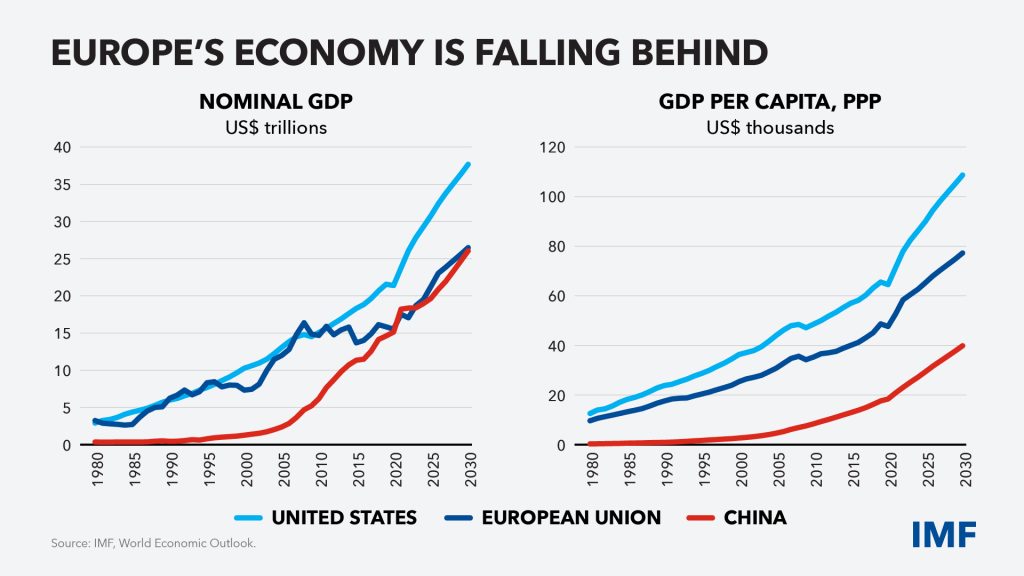
Fact one: Europe’s economy is shrinking in relative terms, and size matters. When I was called to Brussels in 2010, EU GDP was the same as the US’s and a lot bigger than China’s. But now—what the heck?—look at how this has changed: here we see GDP and, here, we see GDP per capita (Slide 1). Europe is still rich, but its relative wealth is eroding, and it’s going to become harder and harder to sustain its cherished social model.

Fact two: Europe used to lead in productivity, but now it trails behind, and productivity matters—indeed it is the core underlying challenge. On the left, productivity of the US and EU tech sectors; on the right, the same for non-tech (Slide 2). The gap keeps growing.

Fact three: Europe’s firms used to dominate, but now they are less competitive and less able to grow, and corporate scale matters. Here is market capitalization for firms born in the last 50 years—look at how the US dwarfs the EU, especially in high-tech (Slide 3).

Europe has plenty of startups, but they struggle to grow—and this drives many European innovators to foreign shores.
For its people and its standing in the world, Europe needs to grow more. And to do that, dynamically and durably, it needs to set itself one core objective: much faster productivity growth.
OK—but how?
By pursuing with higher determination two major efforts:

One, structural reforms at the national level, focused on increasing flexibility in local product and labor markets; and
Two, completion of the single market, focused on the EU’s four freedoms—the freedom of movement of goods, of services, of labor, of capital.

You and your teams have been pushing on both fronts—please push even harder.
We know over-regulation and clumsy regulation impose large costs on Europe:

In intra-EU cross-border trade, regulatory barriers are two-to-three times higher than for interstate trade in the US.
For cross-border labor movement, regulatory barriers and other factors make moving about eight times more costly than between the 50 US states.
In energy, limited grid linkages and resource endowments coupled with geopolitical factors leave Europe with an average energy price double that in the US, with high volatility and variation.
In finance, a banking system split into 27 national pieces, paired with small and fragmented capital markets, leaves Europe’s 60‑trillion‑euro financial system handling what I call “lazy money”—too afraid to prudently take sufficient risks to support growth.

You can drive solutions to these challenges.
Working with member states, you should lead a deep “regulatory housecleaning” to sweep away the legacy rules that do more harm than good—harm that includes disproportionately burdening small firms, as we can see here (Slide 4).

And as you do this, you must push back hard against uneven enforcement and “gold plating” as member states add requirements going far beyond the minimum mandated by EU Directives.
With the single market running on 27 national legal regimes for firms, we at the IMF strongly support your determination to bring to life a 28th regime—to allow firms to opt into a single, pan-EU legal framework covering company law and insolvency, broadening over time.
We urge swift action, and we urge it be done by EU Regulation, not Directive—Europe does not need a 28th regime with 27 versions!
For labor market mobility, in turn, many steps are needed. Key among them: mutual recognition of qualifications, social security portability, and flexible housing markets. Europe cannot thrive without a mobile workforce.
Moving to energy, we see a strategic vulnerability that touches every factory, data center, and household across the EU—a vulnerability that cuts directly to competitiveness and resilience. Integration requires eliminating national subsidies, building interconnectors, aligning grid access and tariffs, and fast-tracking permitting for renewables and storage.
All of this needs to be integrated into one European blueprint for electricity generation, transmission, and distribution.
Meeting Europe’s strategic needs—from energy security to defense—requires joint action. And that action, in our view, should be supported by joint funding. We at the IMF see a case for more EU debt issuance in key areas, to efficiently drive forward European public goods delivery.
Despite high public debt ratios in several member states—where we urge fiscal consolidation—the EU’s aggregate public debt load remains below that of China and the US (Slide 5). So there is some room; use it wisely, strategically. But use it.

At the same time, Europe must drive forward its savings and investment union to channel risk capital—not just from Europe’s vast pool of savings but from global markets—to its most innovative firms, delivering cross-border private risk sharing, higher returns, and faster growth.
I ask you, please look at the number of exchanges, trading platforms, and clearinghouses in the EU relative to the US (Slide 6). Ridiculous! We urge that the political emphasis shift from national to European financial markets.

We know that pan-European finance is tied up in a knot of national redlines. Countries fear imported financial and fiscal risks, defend local banking cooperatives, protect their positions in investment fund registration, and so much more.
But Europe needs one unified financial system, not 27 silos. Your recent package for the savings and investment union sets the right direction of travel. Yet getting to the destination will require much more ambition, collectively, and a will to confront vested interests and inertia.
And, speaking as a former Vice President for the EU Budget, let me add that performance-based budgeting under the Multiannual Financial Framework can play a strongly supportive role in helping align national and shared European interests.
Finally, keep trading, keep being a voice for rules-based trade! I salute your efforts to put Europe’s negotiating power to good use crafting trade deals with key partners. I celebrate your recent deals with Mercosur and India. More please!
And should anyone doubt the benefits of the common trade policy, one more animation. Here we see countries’ market size and openness. Note the US and China both sit in the bottom-right corner (Slide 7).

Now please watch carefully. See how 27 EU member states—the little blue dots—move down and to the right to merge as one large, powerful dot: this is the EU, sitting with the other “big boys.” In this simple graphic we can see how the EU’s common trade policy delivers strength.
The case for joint action—urgent, determined action—is unambiguous.
A good moment for a spot of happy news: IMF research shows that, if national and single-market reforms were to reduce intra-EU frictions to levels comparable with those in the US, EU productivity could rise by 20 percent, materially narrowing the gap to the US.
And looking beyond the models, we see ample real-world evidence that reforms pay off: Just look at Cyprus, Greece, Ireland, Portugal, and Spain.
Let me end with three practical suggestions:

First, make the single market your single-minded obsession. Appoint a single market “czar” with full authority and political credibility to drive forward implementation in both the European Council and the Commission. You all have separate areas of duty, yet they all need to come together to form a united whole. The EU’s unified approach to Brexit shows it can be done.
Second, set a hard deadline and plan backward from it with discipline and resolve. Whether it is January 2028 or some other feasible but demanding date, Europe needs a deadline that signals this single-minded focus on the single market and ironclad will to get the job done.
Third, transform Europe’s image as a “regulatory superpower” that suffocates business into one that adapts swiftly to a rapidly changing world and sweeps away obsolete rules and red tape. Use AI to help you with your regulatory deep-cleaning—why not? Transform the EU into a new global leader in streamlining and modernization.

To close, I want to leave you with a question, rhetorical yet serious: what will Europe’s next global success on the scale of Airbus be? A cutting-edge venture in AI perhaps? In defense? In energy? Unleash the single market and I am confident we will get our answer! Thank you!
 
 
Compliments of the International Monetary Fund The post IMF | Re-energizing Europe Speech by Kristalina Georgieva, Managing Director At the European Commission first appeared on European American Chamber of Commerce New York [EACCNY] | Your Partner for Transatlantic Business Resources.
EACC

ECB | Survey on the Access to Finance of Enterprises: Lending Conditions Tightened

2 February 2026

Firms reported a net tightening in bank loan interest rates and in other loan conditions related to both price and non-price factors.
Financing needs rose modestly, accompanied by a small perceived decline in availability.
Inflation expectations were broadly unchanged across horizons, with firms continuing to report upside risks to their long-term inflation outlook.
The use of artificial intelligence is widespread among euro area firms, though most firms use it very infrequently or moderately.

In the most recent round of the Survey on the Access to Finance of Enterprises (SAFE), covering the fourth quarter of 2025, euro area firms reported a net increase in interest rates on bank loans (net 12%, compared with 2% in the previous quarter). A similar increase was observed by both small and medium-sized enterprises (SMEs) and large firms. At the same time, a net 28% of firms (up from 23% in the previous quarter) observed increases in both other financing costs (i.e. charges, fees and commissions) and collateral requirements (net 14%, compared with 16% in the third quarter of 2025) (Chart 1).
In this survey round, firms reported a modest rise in their need for bank loans (net 3%, up from 0% in the third quarter of 2025), accompanied by a small perceived decline in availability (net -2%, compared with -1% in the third quarter). This increased the bank loan financing gap – an index capturing the difference between the need for and the availability of bank loans – to net 3% (up from 1% in the previous quarter). Looking ahead, firms expect the availability of external financing to remain broadly unchanged over the next three months, which was similar to the previous survey round (Chart 2).
Firms continued to perceive the general economic outlook to be the main factor constraining the availability of external financing (net 20%, compared with 19% in the previous survey round) and indicated a slight improvement in banks’ willingness to lend (net 4%, up from 2%). In this survey round, firms reported a somewhat more negative impact of their firm-specific outlook (in terms of sales and profits) on the availability of finance.
Firms reported increasing turnover over the last three months (net 7%, up from 0% in the previous survey round). A net 18% of firms (down from 25% in the previous quarter) remained optimistic about developments in the next quarter. At the same time, firms continued to see a deterioration in their profits, with a net 10% of firms reporting lower profits (down from 13%). In this survey round, a net 6% of firms (down from 8%) reported increased investments over the past three months, which was close to their earlier expectations. Looking ahead, firms were marginally more optimistic about future investment than they had been in the preceding quarter.
Firms’ expected their selling prices to rise by 2.9% on average over the next 12 months (similar to the previous survey round), while the corresponding figure for wages was 3.1% (up from 3% in the previous round) (Chart 3). At the same time, firms signalled a smaller expected increase in non-labour input costs (3.6% on average, down from 3.8% in the previous round).
Firms’ inflation expectations were broadly unchanged over all horizons (Chart 4). Median expectations for annual inflation one year ahead were 2.6% (up from 2.5% in the previous round), while for both the three and five-year horizons they were 3.0% (similar to the previous survey round). For the five-year horizon, most firms continued to indicate that risks to the inflation outlook were tilted to the upside (net 56%, up from 53% in the previous round).
In this survey round, firms were asked about their use of artificial intelligence (AI). Results show that 27% of euro area firms do not use AI, 33% use it very infrequently, 31% moderately and 7% significantly (Chart 5). SMEs are more likely than large firms not to use AI (35% versus 13%) and are also less likely to experiment with it or use it moderately. However, the share of firms making significant use of AI is similar for SMEs and large firms, indicating that AI use is also spreading among a core of smaller firms.
The report published today presents the main results of the 37thround of the SAFE survey for the euro area. The survey was conducted between 19 November and 15 December 2025. In this survey round, firms were asked about economic and financing developments over the period between October and December 2025. Additionally, firms reported their expectations for euro area inflation, selling prices and other costs. The sample comprised 5,067 firms in the euro area, of which 4,684 (92%) had fewer than 250 employees.
Notes

The report on this SAFE survey round, together with the questionnaire and methodological information, is available on the ECB’s website.
Detailed data series for the individual euro area countries and aggregate euro area results are available on the ECB Data Portal.

Chart 1
Changes in the terms and conditions of bank financing for euro area firms

(net percentages of respondents)

Base: Firms that had applied for bank loans (including subsidised bank loans), credit lines, or bank or credit card overdrafts. The figures refer to pilot 2 and rounds 30 to 37 of the survey (October-December 2023 to October-December 2025).
Notes: Net percentages are the difference between the percentage of firms reporting an increase for a given factor and the percentage reporting a decrease. The data included in the chart refer to Question 10 of the survey.

Chart 2
Changes in euro area firms’ financing needs and the availability of bank loans

(net percentages of respondents)

Base: Firms for which the instrument in question is relevant (i.e. they have used it or have considered using it). Respondents replying “not applicable” or “don’t know” are excluded. The figures refer to pilot 2 and rounds 30 to 37 of the survey (October-December 2023 to October-December 2025).
Notes: The financing gap indicator combines both financing needs and the availability of bank loans at firm level. The indicator of the perceived change in the financing gap takes a value of 1 (-1) if the need increases (decreases) and availability decreases (increases). If firms perceive only a one-sided increase (decrease) in the financing gap, the variable is assigned a value of 0.5 (-0.5). A positive value for the indicator points to a widening of the financing gap. Values are multiplied by 100 to obtain weighted net balances in percentages. The data included in the chart refer to Question 5 and Question 9 of the survey.

Chart 3
Expectations for selling prices, wages, input costs and employees one year ahead, by size class

(percentage changes over the next 12 months)

Base: All firms. The figures refer to pilot 2 and rounds 30 to 37 (October-December 2023 to October-December 2025) of the survey, with firms’ replies collected in the last month of the respective survey waves.
Notes: Weighted average euro area firms’ expectations of changes in selling prices, wages of current employees, non-labour input costs and number of employees for the next 12 months using survey weights. The statistics are computed after trimming the data at the country-specific 1st and 99th percentiles. The data included in the chart refer to Question 34 of the survey.

Chart 4
Firms’ median expectations for euro area inflation by size class

(annual percentages)

Base: All firms. The figures refer to pilot 2 and rounds 30 to 37 (October-December 2023 to October-December 2025) of the survey, with firms’ replies collected in the last month of the respective survey waves.
Notes: Survey-weighted median of euro area firms’ expectations for euro area inflation in one year, three years and five years, calculated using survey weights. The statistics are computed after trimming the data at the country-specific 1st and 99th percentiles. The data included in the chart refer to Question 31 of the survey.

Chart 5
Use of AI by firm size

(percentages of respondents)

Base: All firms. The figures refer to round 37 of the survey (October-December 2025).
Notes: The chart shows the weighted share of firms by the intensity of AI use for all firms, SMEs and large firms. The data included in the chart refer to Question QA1_2025Q4 of the survey.


Compliments of the European Central Bank The post ECB | Survey on the Access to Finance of Enterprises: Lending Conditions Tightened first appeared on European American Chamber of Commerce New York [EACCNY] | Your Partner for Transatlantic Business Resources.
EACC

EIB | Powering Europe: EIB Group Invests a Record €100 Billion to Support Shared Prosperity, Security and European Values

Financing for energy security rose to a record in 2025, with €11.6 billion invested in European grids, and mobilising around a third of the total energy transition investment
Biggest ever financing programme for startups, scale-ups and tech infrastructure consolidates EIB Group’s position as cornerstone of EU’s venture capital ecosystem
Scope of security and defence investments expanded, financing quadruples to reach nearly 5% of EIB Group’s annual EU business, in milestone year of historic decisions
Financing for housing innovation, renovation and new construction rose by 50%, while more than half of EIB Group’s EU financing went to projects in cohesion regions

The European Investment Bank (EIB) Group is deploying its full firepower to support European competitiveness, security and strategic autonomy, with a record €100 billion in annual financing. The results from the EIB Group’s activity in 2025 show historic highs in new investment for the green and digital transitions, for European security and defence, for shared priorities including housing, and for reinforcing win-win partnerships and alliances in Ukraine, accession countries and across the globe.
“Europe is a superpower, and we must punch our weight and believe in our capabilities,” said EIB Group President Nadia Calviño. “The EIB Group is making a difference. Investing in shared prosperity, security, strategic autonomy and European values, so Europe delivers on its promises to citizens and partners.”
Transition to the future
Almost 60% of EIB Group’s total financing in 2025 went to green projects, from large energy grids and interconnectors to the deployment of storage and renewables, clean technologies for the decarbonisation of heavy industry, as well as adaptation investment, such as water infrastructure, reinforcing the resilience of economies and societies to climate change and its impact.
A record €11.6 billion was devoted to grids and storage projects, supporting the security of the power supply. It is estimated that the financing signed last year will help construct or upgrade 56,000 km of power lines, from the landmark Bay of Biscay interconnector between the Iberian Peninsula and France, through an underwater cable connecting two regions in central Italy, to local grids and municipal power infrastructure in Germany.
EIB Group financing backed one fifth of all newly installed solar capacity, one in three new onshore wind projects, as well as the vast majority of all offshore wind projects in 2025. Tailored financing products supported the EU’s wind and grids manufacturing industries, while record high investment volumes in energy efficiency are expected to lower bills for small and medium-sized companies and households. EIB Group financing supported around one third of the total energy transition investment in the EU last year.
In addition to clean technologies, the EIB Group is supporting homegrown innovation in health and biotech, artificial intelligence and other disruptive technologies, digital infrastructures and critical raw materials. With the rollout of TechEU last year, the biggest ever financing programme for innovation, the EIB Group plans to mobilise at least €250 billion in investment by 2027, ensuring that ideas, technologies and innovative companies born in the EU, can stay, grow and thrive here in the EU. The financing deployed last year alone is estimated to mobilize more than €100 billion in investment, from AI-powered 6G networks, to semiconductors manufacturing.
As cornerstone financier of innovation, the European Investment Fund (EIF) – EIB’s risk-finance subsidiary – delivered close to €16 billion in guarantees and equity finance for small businesses and startups across the EU. The EIF is estimated to have contributed almost a quarter of all venture capital raised by European funds last year.  In the months ahead, it will expand its European Tech Champions Initiative, building on the huge success of the first phase, which has already anchored the creation of 12 venture capital mega funds in Europe, and the scale-up of 35 startups – including nine unicorns.
Security and defence
Responding to the new geopolitical landscape, the EIB Group significantly expanded the scope of its activities in the area of security and defence and into projects dedicated to military use. Security and defence investments quadrupled to more than €4 billion, close to 5% of the EIB Group’s EU financing.
Thanks to this step change, the EIB Group plays a leading role in safeguarding peace and security for EU citizens, with flagship projects ranging from military camps and maintenance facilities to research and development in advanced radar systems and avionics, and from sensors essential for the protection of Europe’s seabed and underwater assets to cybersecurity infrastructure and space capabilities.
Moreover, the EIB Group has been a pathfinder for EU’s financial industry, catalysing support for companies supporting Europe’s deterrence capabilities. Through intermediated lending agreements signed with commercial banks in Germany, France, Spain, Greece, and Austria, the EIB Group is facilitating access to financing for small and medium-sized companies in the supply chain of Europe’s large defence contractors, while the EIF has been nurturing, as anchor investor, the development of a venture capital ecosystem investing in defence firms with a pan-European approach.
Underpinning Europe’s economic model and values
The EIB Group is focusing on investments that underpin the European economic model and values. Investments for cohesion rose to a record high, with more than 50% of the Group’s EU investment going to projects in Europe’s less developed regions.
The EIB Group’s Affordable and Sustainable Housing Plan (available in EN, FR and DE) launched in 2025 alongside the European Commission, raised EIB Group financing for innovation, renovation and new buildings to more than €5 billion, up nearly 50% on an annual basis, with a further increase planned for 2026. From student residences in Greece, to social housing in Belgium, from hospitals and health facilities in Spain, to primary schools in France, financing for social infrastructure whose impact is felt daily by EU citizens is a key priority for the EIB Group.
Financing for agriculture and the bioeconomy also rose to a record high of nearly €8 billion, strengthening a vital sector for Europe’s economy and food security, supporting rural communities, and creating viable futures for young and new farmers, who face financing barriers
Building bridges and win-win partnerships around the world
The EIB Group also deployed more than €9 billion for its EIB Global operations, building win-win global partnerships anchoring Europe as a trusted partner in a changing world, improving living conditions in many areas. For example, in 2025, the EIB Group financing for water projects rose to a record €5 billion globally.
Financing for Ukraine rose to a new record and now exceeds €4 billion since the start of Russia’s invasion, with a new project signed or inaugurated every other week, from schools, hospitals and community facilities to district heating and power supply.
An EIB Global strategic orientation was adopted in 2025, fully aligning our operations with EU policy priorities. The EIB is the world’s largest public financier in water and a global leader investing in health, clean energy, and transport. Investments in private sector support and entrepreneurship brings opportunities for young people and women in emerging economies.
Doing more, doing better
In parallel to increasing the volume of its activities, the EIB Group has streamlined its internal processes, with the goal of accelerating investment decisions and cutting time to market. One-stop-shops have been introduced for clients, with investment checkers and reliance on established regulatory frameworks, designed to help Europe’s entrepreneurs get the right financing, at the right time, and the right scale to make a difference.
The full activity report, including a list of flagship project examples can be found here
A key figures summary for 2025 can be found here: [EN] 


Compliments of the European Investment Bank – a Premium Member of the EACCNYThe post EIB | Powering Europe: EIB Group Invests a Record €100 Billion to Support Shared Prosperity, Security and European Values first appeared on European American Chamber of Commerce New York [EACCNY] | Your Partner for Transatlantic Business Resources.

EACC

European Council | Russian Gas Imports: Council Gives Final Greenlight to a Stepwise Ban

Today, the 27 EU member states formally adopted the regulation on phasing out Russian imports of both pipeline gas and liquified natural gas (LNG) into the EU. The new rules also include measures on effective monitoring and diversification of energy supply.

The regulation is a key milestone in delivering the REPowerEU objective of ending the EU’s reliance on Russian energy.
“As of today, the EU energy market will be stronger, more resilient and more diversified. We are breaking away from detrimental reliance on Russian gas and taking a major step, in a spirit of solidarity and cooperation, towards an autonomous Energy Union.” – Michael Damianos, Minister for Energy, Commerce and Industry of the Republic of Cyprus
Stepwise ban, strict monitoring and diversification
According to the regulation, importing Russian pipeline gas and LNG into the EU will beprohibited. The ban will start to apply six weeks after the regulation enters into force. Existing contracts will have a transition period. This stepwise approach will limit the impact on prices and markets. A full ban will take effect for LNG imports from the beginning of 2027 and for pipeline gas imports from autumn 2027.
Before authorising entry of gas imports into the Union, EU countries will verify the country where gas was produced.
Non-compliance with the new rules may result in maximum penalties of at least € 2,5 million for individuals and at least € 40 million for companies, at least 3,5 % the company’s total worldwide annual turnover, or 300 % of the estimated transaction turnover.
By 1 March 2026, EU countries must prepare national plans to diversify gas supplies and identify potential challenges in replacing Russian gas. To that end, companies will be required to notify authorities and the Commission of any remaining Russian gas contracts. EU countries still importing Russian oil will also have to submit diversification plans.
Security of supply in emergencies
In the event of a declared emergency, and if security of supply is seriously threatened in one or more EU countries, the Commission may suspend the import ban for up to four weeks.
Next steps
The regulation will now be published in the Official Journal of the EU. It will enter into force one day after publication and will apply directly in all EU countries.
The Commission also plans to propose legislation to phase out Russian oil imports by the end of 2027.
Background
Following Russia’s war of aggression against Ukraine and the use of energy as a weapon, EU leaders agreed, in the Versailles Declaration of March 2022, to phase out dependence on Russian fossil fuels as soon as possible.
Consequently, gas and oil imports from Russia to the EU have both decreased significantly in recent years. However, while imports of oil have dropped to below 3% in 2025 as a result of the current sanctions regime, Russian gas still accounts for an estimated 13% of EU imports in 2025, worth over €15 billion annually. This leaves the EU exposed to significant risks in terms of its trade and energy security.


Compliments of the European Council The post European Council | Russian Gas Imports: Council Gives Final Greenlight to a Stepwise Ban first appeared on European American Chamber of Commerce New York [EACCNY] | Your Partner for Transatlantic Business Resources.

EACC

European Commission | Commission Opens Proceedings to Assist Google in Complying With Interoperability and Online Search Data Sharing Obligations Under the Digital Markets Act

Today, the European Commission has started two sets of specification proceedings to assist Google in complying with its obligations under the Digital Markets Act (‘DMA’). The specification proceedings formalise the Commission’s regulatory dialogue with Google on certain areas of its compliance with two DMA obligations.
The first set of proceedings concerns Google’s obligation under Article 6(7) of the DMA to provide third-party developers with free and effective interoperability with hardware and software features controlled by Google’s Android operating system. Today’s proceedings focus on features used by Google’s own Artificial Intelligence (‘AI’) services, such as Gemini. The Commission intends to specify how Google should grant third-party AI service providers equally effective access to the same features as those available to Google’s own services. The aim is to ensure that third-party providers have an equal opportunity to innovate and compete in the rapidly evolving AI landscape on smart mobile devices.
The second set of proceedings concerns Google’s obligation under Article 6(11) of the DMA to grant third-party providers of online search engines access to anonymised ranking, query, click and view data held by Google Search on fair, reasonable and non-discriminatory (‘FRAND’) terms. These proceedings focus on the scope of data, the anonymisation method, the conditions of access, and the eligibility of AI chatbot providers to access the data. Effective compliance and access to a useful dataset will allow third-party providers of online search engines to optimise their services and offer users genuine alternatives to Google Search.
Next steps
The Commission will conclude the proceedings within six months of their opening. Within the upcoming three months the Commission will communicate its preliminary findings to Google setting out the draft measures it intends to impose on Google to effectively comply with the DMA. Non-confidential summaries of preliminary findings and the envisaged measures will be published to enable third parties to provide comments.
These proceedings, which by their nature do not take a position on compliance with the DMA, are without prejudice to the powers of the Commission to adopt a decision finding non-compliance with any of the obligations laid down in the DMA by a gatekeeper, including the possibility to impose fines or periodic penalty payments.
Background
The DMA aims to ensure contestable and fair markets in the digital sector. It regulates gatekeepers, which are large digital platforms that provide an important gateway between business users and consumers, whose position can grant them the power to create a bottleneck in the digital economy.
On 6 September 2023, the European Commission designated Google Inc.’s Google Search, Google Play, Google Maps, YouTube, Google Android operating system, Google Chrome, Google Shopping and its online advertising services as core platform services. Google has had to fully comply with all applicable DMA obligations in respect of the designated services since 7 March 2024.
The Commission has published an annual report on the implementation of the DMA and the progress made towards achieving its objectives.
 
 
Compliments of the European Commission The post European Commission | Commission Opens Proceedings to Assist Google in Complying With Interoperability and Online Search Data Sharing Obligations Under the Digital Markets Act first appeared on European American Chamber of Commerce New York [EACCNY] | Your Partner for Transatlantic Business Resources.

EACC

European Commission | EU and India Conclude Landmark Free Trade Agreement

The EU and India concluded negotiations today for a historic, ambitious and commercially significant free trade agreement (FTA), the largest such deal ever concluded by either side. It will strengthen economic and political ties between the world’s second and fourth largest economies, at a time of rising geopolitical tensions and global economic challenges, highlighting their joint commitment to economic openness and rules-based trade.
European Commission President, Ursula von der Leyen, said: “The EU and India make history today, deepening the partnership between the world’s biggest democracies. We have created a free trade zone of 2 billion people, with both sides set to gain economically. We have sent a signal to the world that rules-based cooperation still delivers great outcomes. And, best of all, this is only the start – we will build on this success, and grow our relationship to be even stronger.”
The EU and India already trade over €180 billion worth of goods and services per year, supporting close to 800,000 EU jobs. This deal is expected to double EU goods exports to India by 2032 by eliminating or reducing tariffs in value of 96.6% of EU goods exports to India. Overall, the tariff reductions will save around €4 billion per year in duties on European products.
This is the most ambitious trade opening that India has ever granted to a trade partner. It will give a significant competitive advantage for key EU industrial and agri-food sectors, granting companies privileged access to the world’s most populous country of 1.45 billion people and fastest growing large economy, with an annual GDP of €3.4 trillion.
Opportunities for European businesses of all sizes
India will grant the EU tariff reductions that none of its other trading partners have received. For example, tariffs on cars are gradually going down from 110% to as low as 10%, while they will be fully abolished for car parts after five to ten years. Tariffs ranging up to 44% on machinery, 22% on chemicals and 11% on pharmaceuticals will also be mostly eliminated.
A dedicated chapter will also help small EU businesses take full advantage of the new export opportunities. For instance, both sides will put in place dedicated contact points to provide SMEs with relevant information on the FTA and help them with any specific issue they would face when trying to use the FTA’s provisions. In addition to this, SMEs will particularly benefit from the tariff reductions, removal of regulatory barriers, transparency, stability and predictability provided by the Agreement.
Reducing agri-food tariffs
The agreement removes or reduces often prohibitive tariffs (over 36% on average) on EU exports of agri-food products, opening a massive market to European farmers. For example, Indian tariffs on wines will be cut from 150% to 75% at entry into force and eventually to levels as low as 20%, tariffs on olive oil will go down from 45% to 0% over five years, while processed agricultural products such as bread and confectionary will see tariffs of up to 50% eliminated.
Sensitive European agricultural sectors will be fully protected, as products such as beef, chicken meat, rice and sugar are excluded from liberalisation in the agreement. All Indian imports will continue to have to respect the EU’s strict health and food safety rules.
In parallel, the EU and India are currently negotiating a separate agreement on Geographical Indications (GIs), which will help traditional iconic EU farming products sell more in India, by removing unfair competition in the form of imitations.
Privileged access to services markets and protected Intellectual Property
The agreement will grant EU companies privileged access to the Indian services market, including key sectors such as financial services and maritime transport. It has the most ambitious commitments on financial services by India in any trade agreement, going beyond what they have given to other partners.
The agreement provides a high level of protection and enforcement of Intellectual Property (IP) rights, including copyright, trademarks, designs, trade secrets and plant variety rights. It builds upon existing international IP treaties and brings Indian and EU intellectual property laws closer. This will make it easier for EU and Indian businesses that rely on IP to trade and invest in each other’s markets.
Enhancing sustainability commitments
The agreement has a dedicated trade and sustainable development chapter, which enhances environmental protection and addresses climate change, protects workers’ rights, supports women’s empowerment, provides for a platform for dialogue and cooperation on trade related environmental and climate issues and ensures effective implementation.
The EU and India will also sign a Memorandum of Understanding that intends to establish an EU-India platform for cooperation and support on climate action. The platform will be launched in the first half of 2026. Furthermore, subject to the EU’s budgetary and financial rules and procedures, €500 million in EU support over the next two years is envisaged to help India’s efforts to reduce greenhouse gas emissions and accelerate its long-term sustainable industrial transformation.
Next steps
On the EU side, the negotiated draft texts will be published shortly. The texts will go through legal revision and translation into all official EU languages. The Commission will then put forward its proposal to the Council for the signature and conclusion of the agreement. Once adopted by the Council, the EU and India can sign the agreements. Following the signature, the agreement requires the European Parliament’s consent, and the Council’s decision on conclusion for it to enter into force. Once India also ratifies the Agreement, it can enter into force.
Background
The EU and India had first launched negotiations for a free trade agreement in 2007. The talks were suspended in 2013 and then relaunched in 2022. The 14th and last formal negotiating round took place in October 2025, followed by intersessional discussions at technical and political level.
At the same time as FTA negotiations were relaunched, the EU and India also launched negotiations for a Geographical Indications Agreement and an Investment Protection Agreement. Negotiations for these agreements are still ongoing.


Compliments of the European CommissionThe post European Commission | EU and India Conclude Landmark Free Trade Agreement first appeared on European American Chamber of Commerce New York [EACCNY] | Your Partner for Transatlantic Business Resources.

EACC

European Council | Oral Conclusions Drawn by President António Costa Following the Informal Meeting of the Members of the European Council of 22 January 2026

Oral Conclusions by President António Costa following the Informal meeting of the members of the European Council, 22 January 2026
The European Union and the United States have long been partners and allies. We have built a transatlantic community forged by history, anchored in common values, and dedicated to the prosperity and security of our peoples.
We believe that relationships between partners and allies should be managed in a cordial and respectful way.
Europe and the United States have a shared interest in the security of the Arctic region, notably working through NATO. The European Union will also play a stronger role in this region.
In this context, I want to be very clear: the Kingdom of Denmark and Greenland have the full support of the European Union. Only the Kingdom of Denmark and Greenland can decide on matters concerning Denmark and Greenland.
This is a reflection of our firm commitment to the principles of international law, territorial integrity and national sovereignty, which are essential for Europe and for the international community as a whole. These principles will continue to guide our action.
Against this backdrop, yesterday’s announcement that there will be no new US tariffs on Europe is positive. The imposition of additional tariffs would have been incompatible with the EU-US trade deal. Our focus must now be on moving forward on the implementation of that deal. The goal remains the effective stabilization of the trade relations between the European Union and the US.
At the same time, the European Union will continue to stand up for its interests and will defend itself, its member states, its citizens and its companies, against any form of coercion. It has the power and the tools to do so and will do so if and when necessary.
Looking ahead, we remain ready to continue engaging constructively with the United States on all issues of common interest, including on creating the conditions for a just and lasting peace in Ukraine.
We have serious doubts about a number of elements in the charter of the Board of Peace related to its scope, its governance and its compatibility with the UN Charter.
We are ready to work together with the US on the implementation of the comprehensive Peace Plan for Gaza, with a Board of Peace carrying out its mission as a transitional administration, in accordance with UN Security Council Resolution 2803.
Let me conclude by recalling that the European Union is focused on delivering an ambitious agenda for our citizens: on defense, on competitiveness, on building a more strategically autonomous Europe.
That is why the next Leaders’ meeting, on the 12th of February, will be a strategic brainstorming dedicated to strengthening the Single Market in a new geoeconomic context.

Visit the meeting page

Compliments of the European Council The post European Council | Oral Conclusions Drawn by President António Costa Following the Informal Meeting of the Members of the European Council of 22 January 2026 first appeared on European American Chamber of Commerce New York [EACCNY] | Your Partner for Transatlantic Business Resources.

EACC

ECB | ECB and ESRB Issue Joint Report Analysing Financial Stability Risks From Geoeconomic Fragmentation

22 January 2026

Geoeconomic fragmentation and geopolitical risk have become key sources of macro-financial uncertainty, which can affect financial stability
Geopolitical shocks can amplify financial stress and dampen economic growth
Report sets out new monitoring framework integrating geopolitical indicators into financial stability analysis

The European Central Bank (ECB) and the European Systemic Risk Board (ESRB) today published a joint report entitled “Financial stability risks from geoeconomic fragmentation” with technical annex, which examines how rising geopolitical risks and heightened uncertainty can affect financial stability in the euro area and across the European Union. The report identifies the key transmission channels through which geopolitical shocks can propagate to the financial system.
The following findings indicate that geopolitical shocks and policy uncertainty tend to lead to tighter financial conditions, financial market stress, increased risk premia and reduced loan growth.

Geopolitical risks and policy uncertainty have risen markedly since the mid‑2010s, with notable increases in 2024 and 2025. At the same time, financial market volatility has remained contained or short-lived.
Estimates suggest that geopolitical risks lower expected growth outcomes, with significant downside tail risks for the real economy, accompanied by heightened financial stress. Geopolitical events can significantly alter the interconnectedness between bonds, commodities, equities and exchange rates.
The impact of geopolitical shocks is heterogeneous across EU Member States, whereby more open economies and those with higher public debt ratios tend to be more vulnerable to amplification effects.
In response to geopolitical shocks, banks and non-banks adjust their balance sheets by reducing lending, especially cross-border exposures. While this reduces the financial system’s exposure to external shocks, it also limits international diversification.

At a time of accelerating geoeconomic fragmentation and persistent geopolitical uncertainty, the ECB and the ESRB stress the importance of enhanced, more harmonised datasets, as well as complementary scenario analyses, for preserving financial stability and increasing economic resilience.[1]The report’s insights can help policymakers and financial institutions to better detect and evaluate geopolitical risks for the financial sector and calibrate macroprudential policy responses.
Notes

The report was prepared by financial stability experts under a joint workstream of the ECB’s Macroprudential Analysis Group and the ESRB’s Analysis Working Group.

Geopolitical risk is an important consideration for European banks and supervisors as they navigate global risks. In view of this, ECB Banking Supervision made geopolitical risk the focus of the adverse scenario in the 2025 stress test of euro area banks (see Box 6) and will assess banks on their geopolitical risk management in the context of the 2026 reverse stress test.


Compliments of the European Central Bank The post ECB | ECB and ESRB Issue Joint Report Analysing Financial Stability Risks From Geoeconomic Fragmentation first appeared on European American Chamber of Commerce New York [EACCNY] | Your Partner for Transatlantic Business Resources.