EACC

OECD publishes report on tax administrations’ policies and practices to enhance gender balance

November 17, 2020 |
The OECD Forum on Tax Administration (FTA) has today published a report on Advancing Gender Balance in the Workforce: A Collective Responsibility. This report, developed by the FTA’s Gender Balance Network, sets out a range of policies and practices undertaken by tax administrations and their national governments to advance gender balance in the workforce. 
This report highlights innovative approaches, legislative options, flexible workplace initiatives and leadership practices adopted by FTA members in order to assist administrations in their domestic considerations of where and how to improve gender balance and inclusion.
“Achieving gender equality requires strategic, top-down and visible leadership if we are to be successful in creating gender balance within our Administrations,” said Naomi Ferguson, Commissioner of Inland Revenue New Zealand. “The initiatives this report brings together underscore the importance of addressing historical and systemic inequalities primarily faced by women.  We also recognise that inequality can impact men and our aim is to learn from each other to create a workforce culture and environment that respects and embraces diversity and inclusion”.
“Economies are more resilient, productive and inclusive when gender inequalities are removed and we actively support women’s equal participation”, commented Grace Perez-Navarro, the Deputy Director of the OECD Centre for Tax Policy and Administration. “The FTA’s Gender Balance Network has a valuable role to play in helping to drive gender equality within tax administrations, including through the sharing of knowledge on domestic initiatives and practices.”
For more information on the OECD Gender Balance Network, including a recent interview between Commissioner Naomi Ferguson and Grace Perez-Navarro, visit: www.oecd.org/tax/forum-on-tax-administration/about/gender-balance-network
Contact:

Grace Perez-Navarro, Deputy Director of the OECD Centre for Tax Policy and Administration | Grace.Perez-Navarro@oecd.org

Achim Pross, Head of the International Co-operation and Tax Administration Division | Achim.Pross@oecd.org

Compliments of the OECD.
The post OECD publishes report on tax administrations’ policies and practices to enhance gender balance first appeared on European American Chamber of Commerce New York [EACCNY] | Your Partner for Transatlantic Business Resources.

EACC

Boosting Offshore Renewable Energy for a Climate Neutral Europe

To help meet the EU’s goal of climate neutrality by 2050, the European Commission today presents the EU Strategy on Offshore Renewable Energy. The Strategy proposes to increase Europe’s offshore wind capacity from its current level of 12 GW to at least 60 GW by 2030 and to 300 GW by 2050. The Commission aims to complement this with 40 GW of ocean energy and other emerging technologies such as floating wind and solar by 2050.
This ambitious growth will be based on the vast potential across all of Europe’s sea basins and on the global leadership position of EU companies in the sector. It will create new opportunities for industry, generate green jobs across the continent, and strengthen the EU’s global leadership in offshore energy technologies. It will also ensure the protection of our environment, biodiversity and fisheries.
Executive Vice-President for the European Green Deal, Frans Timmermans said: “Today’s strategy shows the urgency and opportunity of ramping up our investment in offshore renewables. With our vast sea basins and industrial leadership, the European Union has all that it needs to rise up to the challenge. Already, offshore renewable energy is a true European success story. We aim to turn it into an even greater opportunity for clean energy, high quality jobs, sustainable growth, and international competitiveness.”
Commissioner for Energy, Kadri Simson, said: “Europe is a world leader in offshore renewable energy and can become a powerhouse for its global development. We must step up our game by harnessing all the potential of offshore wind and by advancing other technologies such as wave, tidal and floating solar. This Strategy sets a clear direction and establishes a stable framework, which are crucial for public authorities, investors and developers in this sector. We need to boost the EU’s domestic production to achieve our climate targets, feed the growing electricity demand and support the economy in its post-Covid recovery.” 
Commissioner for Environment, Oceans and Fisheries, Virginijus Sinkevičius, said: “Today’s strategy outlines how we can develop offshore renewable energy in combination with other human activities, such as fisheries, aquaculture or shipping, and in harmony with nature. The proposals will also allow us to protect biodiversity and to address possible socio-economic consequences for sectors relying on good health of marine ecosystems, thus promoting a sound coexistence within the maritime space.”
To promote the scale-up of offshore energy capacity, the Commission will encourage cross-border cooperation between Member States on long term planning and deployment. This will require integrating offshore renewable energy development objectives in the National Maritime Spatial Plans which coastal states are due to submit to the Commission by March 2021. The Commission will also propose a framework under the revised TEN-E Regulation for long-term offshore grid planning, involving regulators and the Member States in each sea basin.
The Commission estimates that investment of nearly €800 billion will be needed between now and 2050 to meet its proposed objectives. To help generate and unleash this investment, the Commission will:

Provide a clear and supportive legal framework. To this end, the Commission today also clarified the electricity market rules in an accompanying Staff Working Document and will assess whether more specific and targeted rules are needed. The Commission will ensure that the revisions of the State aid guidelines on energy and environmental protection and of the Renewable Energy Directive will facilitate cost-effective deployment of renewable offshore energy. 

Help mobilise all relevant funds to support the sector’s development. The Commission encourages Member States to use the Recovery and Resilience Facility and work together with the European Investment Bank and other financial institutions to support investments in offshore energy through InvestEU. Horizon Europe funds will be mobilised to support research and development, particularly in less mature technologies.

Ensure a strengthened supply chain. The Strategy underlines the need to improve manufacturing capacity and port infrastructure and to increase the appropriately skilled workforce to sustain higher installation rates. The Commission plans to establish a dedicated platform on offshore renewables within the Clean Energy Industrial Forum to bring together all actors and address supply chain development.

Offshore renewable energy is a rapidly growing global market, notably in Asia and the United States, and provides opportunities for EU industry around the world. Through its Green Deal diplomacy, trade policy and the EU’s energy dialogues with partner countries, the Commission will support global uptake of these technologies.
To analyse and monitor the environmental, social and economic impacts of offshore renewable energy on the marine environment and the economic activities that depend on it, the Commission will regularly consult a community of experts from public authorities, stakeholders and scientists. Today, the Commission has also adopted a new guidance document on wind energy development and EU nature legislation.
Background
Offshore wind produces clean electricity that competes with, and sometimes is cheaper than, existing fossil fuel-based technology. European industries are fast developing a range of other technologies to harness the power of our seas for producing green electricity. From floating offshore wind, to ocean energy technologies such as wave and tidal, floating photovoltaic installations and the use of algae to produce biofuels, European companies and laboratories are currently at the forefront.
The Offshore Renewable Energy Strategy sets the highest deployment ambition for offshore wind turbines (both fixed-bottom and floating), where commercial activity is well advanced. In these sectors, Europe has already gained unrivalled technological, scientific and industrial experience and strong capacity already exists across the supply chain, from manufacturing to installation.
While the Strategy underlines the opportunities across all of the EU’s sea basins – the North Sea, the Baltic Sea, the Black Sea, the Mediterranean and the Atlantic – and for certain coastal and island communities, the benefits of these technologies are not limited to coastal regions. The Strategy highlights a broad range of inland areas where manufacturing and research is already supporting offshore energy development.
Compliments of the European Commission.
The post Boosting Offshore Renewable Energy for a Climate Neutral Europe first appeared on European American Chamber of Commerce New York [EACCNY] | Your Partner for Transatlantic Business Resources.

EACC

European Commission needs to scale up antitrust and merger control to fit a more globalised world

The European Commission, the enforcer of EU competition rules, has generally made good use of its powers in antitrust proceedings and merger control, and addressed competition concerns with its decisions. But according to a new report by the European Court of Auditors (ECA) published today, it has not yet fully addressed the complex new enforcement challenges in digital markets, the ever-increasing amount of data to be analysed or the limitations of existing enforcement tools. The auditors also found that the Commission has limited capacity to monitor markets, proactively detect antitrust infringements and check the accuracy of merger information.
EU competition rules are aimed at preventing companies from indulging in anticompetitive practices such as secret cartels, or abusing a dominant position. The Commission can impose fines on companies that infringe these rules. In the last 10 years, competition enforcement has had to come to terms with significant changes in market dynamics due to the emergence of digital markets, big data and price-fixing algorithms. The auditors examined whether the Commission had properly enforced the rules in merger control and antitrust proceedings. They assessed how effectively the Commission had been able to detect and investigate infringements, and how well it had cooperated with national competition authorities (NCAs).
“In the last decade, the Commission has been using its powers in merger control and antitrust proceedings effectively,” said Alex Brenninkmeijer, the ECA Member responsible for the report. “But it now needs to scale up market oversight to be fit for a more global and digital world. It needs to get better at proactively detecting infringements and select its investigations more judiciously. Together with stronger cooperation from NCAs, this will result in better competition enforcement in the EU internal market, protecting businesses and consumers.”
The auditors found that the level of resources at the Commission’s disposal for monitoring markets for potential problems and for own detection of antitrust cases, which it does in addition to reacting to external complaints – was relatively limited. Sector enquiries are resource-intensive: for example, the Commission’s 2015 inquiry into e-commerce required a 15-person full-time team working for two years. The auditors observed that the number of own-initiative cases had fallen since 2015. A similar reduction also affected the leniency programme for companies that volunteer insider information on anticompetitive practices in return for immunity or reduced fines. The Commission also has to decide which cases to prioritise in its investigations. It did so based on criteria which were not clearly weighted to ensure the selection of cases with the highest risk. In the field of merger control, the Commission faces further challenges: the amount of data to be verified is always increasing, as is the number of mergers to be analysed. The Commission has already simplified its procedures for some less risky mergers to some degree, but it needs to carry on that simplification work. The auditors also found that some significant transactions fell outside the Commission’s scrutiny because companies did not have to notify them to the Commission according to the turnover thresholds set out in EU legislation.
The Commission took all merger decisions within the legal deadlines, but its antitrust proceedings remain lengthy (up to eight years). This can reduce the effectiveness of its enforcement decisions. This is particularly true in rapidly evolving digital markets, where the Commission has to cope with complex investigations. Meanwhile, the legal tools at its disposal may no longer be fully adequate to deal with these new types of competition problems. The auditors also noted that the Commission had imposed recordbreaking fines on companies, but had never evaluated their deterrent effect.
The Commission generally cooperated well with NCAs, but it did not know very much about the NCAs’ own enforcement priorities. At the same time, the Commission and NCAs did not closely coordinate their market monitoring, and cases were only rarely reallocated from the NCAs to the Commission. An early warning mechanism is intended to optimise case allocation and to prevent many NCAs from needing to examine similar instances of behaviour by the same company, but the NCAs did not use it extensively. Finally, the Commission did not evaluate the effectiveness of its decisions on a regular basis, although this would have helped its future decision-making and resource allocation. The auditors make recommendations aimed at improving the Commission’s capacity to proactively detect infringements, render its competition enforcement more effective, help it coordinate better with NCAs through the European Competition Network, and report better on its own performance.
Background Information
The Commission can prohibit anticompetitive agreements between companies and abuses of dominant position (“antitrust proceedings”), and review significant concentrations of companies to determine their impact on competition in the EU’s internal market (“merger control”). Both the Commission and the NCAs can directly enforce EU competition rules in antitrust cases affecting trade between Member States.
Every year, the Commission examines over 300 merger notifications and around 200 antitrust cases. From 2010 to 2019, it imposed fines amounting to €28.5 billion for infringements. Due to limited resources, it has conducted only four own-initiative sector inquiries since 2005, which helped to detect infringements.
The auditors examined a risk-based sample of 50 antitrust cases and proposed mergers launched between 2010 and 2017, as well as a sample of notifications of antitrust investigations made by NCAs. They visited the NCAs of Bulgaria, France, the Netherlands and Poland.
ECA special report No 24/2020, “The Commission’s EU merger control and antitrust proceedings: a need to scale up market oversight”, is available in 23 EU languages at eca.europa.eu. The ECA recently published reports on state aid control and trade defence instruments.
Contact:

Damijan Fišer, Press Officer, ECA | damijan.fiser[at]eca.europa.eu

Compliments of the European Court of Auditors. 
The post European Commission needs to scale up antitrust and merger control to fit a more globalised world first appeared on European American Chamber of Commerce New York [EACCNY] | Your Partner for Transatlantic Business Resources.
EACC

REACT-EU: additional support of €47.5 billion agreed to address impact of COVID-19

Eligible expenses as of 1 February 2020, with projects selected for support up to the end of 2023
Civil society, regional and local authorities involved
EP introduces stronger focus on those hit hardest by the crisis

EU institutions reached a provisional agreement on deploying additional EU resources and measures to mitigate the immediate effects of the COVID-19 crisis.
On 18 November, European Parliament and Council concluded negotiations on providing assistance to foster crisis repair in response to the COVID-19 pandemic and its social consequences, and preparing a green, digital and resilient recovery of the EU economy (REACT-EU).
REACT-EU will provide €47,5 billion over the next two years. The resources will be made available through the EU Structural Funds, with €37.5 billion allocated for 2021 and €10 billion for 2022. Operations covered by the agreement should be eligible as of 1 February 2020. Moreover, EU countries will be allowed to use these additional resources until the end of 2023, beyond the original Commission proposal of 2022.
Resources will be allocated in accordance with the partnership principle, involving local and regional authorities, as well as relevant bodies representing civil society and social partners.
Other issues agreed:

0,35% of resources will be allocated to technical assistance, focused especially on member states badly hit by the COVID-19 pandemic and those that may experience difficulties in preparing their programmes;
Investment will be focused on the sectors most affected by the economic fallout of the pandemic;
a pre-financing rate of 11% of the additional resources allocated to programmes for the year 2021;
Member states will be able to allocate part of the additional resources to the European Social Fund, the Fund for European Aid to the Most Deprived (FEAD), the Youth Employment Initiative as well as cross-border programmes (Interreg);
an amount corresponding to aid intensity of EUR 30 per inhabitant will be allocated to the outermost regions;
the breakdown of resources will be set out at a later stage by the Commission by means of implementing acts;
the Commission will endeavour to approve any dedicated operational programme or any amendment to an existing programme within 15 working days;
EU support should be made more visible – activities linked to the use of the additional resources must contain a reference to being “funded as part of the Union’s response to the COVID-19 pandemic”.

Quotes
Co-rapporteur Andrey Novakov (EPP, BG) said: “2020 is the EU year of disruption but also the year of repair. REACT-EU is a textbook example of cohesion policy being part of the recovery. Businesses and healthcare took a hard hit and this funding will be a breath of fresh air. We hope that the Council will overcome its internal divisions to allow recovery funding to flow across the EU.”
Co-rapporteur Constanze Krehl (S&D, DE) said: “I am glad that member states agreed with our view – REACT-EU must focus on the social consequences of the COVID-19 crisis, and the regions and people who have been hit hardest by the crisis. This includes cross-border projects, and support for the most deprived people and youth. All spending must respect the Sustainable Development Goals as well as the Paris Climate Agreement – this should be self-explanatory, but it is good to remind member states of these obligations.”
Next steps
Parliament and Council are now expected to endorse the content of the agreement. The regulation will enter into force one day after its publication in the Official Journal.
Background
REACT-EU is a proposal made by the Commission to address the economic fallout of the COVID-19 pandemic, in the form of an amendment to the Common Provisions Regulation governing the current cohesion policy programming period. It follows two earlier proposals relating to cohesion policy, the Coronavirus Response Investment Initiative (CRII) and the Coronavirus Response Initiative Plus (CRII+), which both modified the rules for regional spending in order to facilitate recovery. The REACT-EU additional resources will come from the European Union Recovery Instrument.
Compliments of the European Parliament. 
The post REACT-EU: additional support of €47.5 billion agreed to address impact of COVID-19 first appeared on European American Chamber of Commerce New York [EACCNY] | Your Partner for Transatlantic Business Resources.

EACC

European Semester Autumn Package: Supporting a sustainable and inclusive recovery amid high uncertainty

The European Commission today presented its autumn economic policy package, including the Opinions on euro area Draft Budgetary Plans (DBPs) for 2021 and policy recommendations for the euro area. This is the second step in the 2021 European Semester cycle, which started in September with the publication of the Annual Sustainable Growth Strategy (ASGS) with the concept of competitive sustainability at its heart. The ASGS also provided strategic guidance for Member States in drafting their Recovery and Resilience Plans and set out the relationship between the Recovery and Resilience Facility (RRF) and the Semester. Today’s package draws upon the Autumn 2020 Economic Forecast – prepared in a context of high uncertainty – which projected that the economic shock caused by the coronavirus pandemic would leave output in the euro area and the EU below its pre-pandemic level in 2022.
Opinions on the Draft Budgetary Plans of euro area Member States
The Opinions on the 2021 DBPs take into account the ongoing health crisis, the high level of uncertainty and the severe economic downturn resulting from the COVID-19 outbreak. Given the activation of the general escape clause of the Stability and Growth Pact, the fiscal recommendations issued by the Council in July 2020 were of a qualitative nature. Today’s Opinions therefore look especially at whether the planned supportive budgetary measures for 2021 are temporary and if not, whether offsetting measures are planned.
The Commission has assessed that all DBPs are overall in line with the Council’s recommendations of 20 July 2020. Most of the measures support economic activity against the background of considerable uncertainty. Some measures set out in the Draft Budgetary Plans of France, Italy, Lithuania and Slovakia do not appear to be temporary or matched by offsetting measures. Lithuania has submitted its Draft Budgetary Plan based on a no-policy-change scenario and is invited to submit an updated Draft Budgetary Plan.
For Belgium, France, Greece, Italy, Portugal and Spain, given the level of their government debt and high sustainability challenges in the medium-term before the outbreak of the COVID-19 pandemic, it is important to ensure that, when taking supporting budgetary measures, fiscal sustainability in the medium-term is preserved.
Steps under the Stability and Growth Pact in relation to Romania
Romania has been under the excessive deficit procedure (EDP) since April 2020 due to the breach of the Treaty deficit threshold in 2019. In light of the continued high uncertainty due to the coronavirus pandemic, the Commission considers that no decision on further steps in Romania’s excessive deficit procedure should be taken at this juncture. It will reassess Romania’s budgetary situation in spring 2021.
Euro area recommendation, Alert Mechanism Report, and proposal for a Joint Employment Report
The recommendation on the economic policy of the euro area presents tailored advice to euro area Member States on those topics that affect the functioning of the euro area as a whole. This year it also provides policy guidance on the priorities that euro area Member States should pursue in their Recovery and Resilience Plans. The recommendation calls on euro area Member States to make sure that their fiscal policies remain supportive in 2021. It also calls on Member States to reorient fiscal policies towards achieving prudent medium-term positions once epidemiological and economic conditions allow. It encourages Member States to strengthen national institutional frameworks and to implement priority reforms and investments that can make the euro area and its members more sustainable and resilient. Such reforms and investment measures should create the right conditions for the economic recovery consistent with the green and digital transitions. It also calls for the completion of the Economic and Monetary Union and to strengthen the international role of the euro.
The Alert Mechanism Report (AMR), a screening device to detect potential macroeconomic imbalances, finds that while macroeconomic imbalances were narrowing until the outbreak of the COVID-19 crisis, risks of imbalances appear to be on the rise in Member States that were already experiencing imbalances prior to the COVID-19 pandemic. It recommends that in-depth reviews to identify and assess the severity of possible macroeconomic imbalances should be prepared for the same 12 Member States that had already been identified as having imbalances or excessive imbalances in February 2020. These are Croatia, Cyprus, France, Germany, Greece, Ireland, Italy, Netherlands, Portugal, Romania, Spain, and Sweden.
The proposal for a Joint Employment Report analyses the impact of the COVID-19 pandemic on the employment and social situation in Europe. The COVID-19 crisis has broken a six-year long positive trend on the labour market. The total number of people in employment and the employment rate have dropped significantly, though the increase in the unemployment rate has been moderate so far thanks to the swift adoption of short-time work schemes and similar measures. Member States that already experienced serious socio-economic challenges before the pandemic are now even more exposed to vulnerabilities. The economic shock to the labour market is being experienced differently across sectors and categories of workers. The employment fall has affected workers in non-standard forms of employment to a greater extent. Youth unemployment has increased more markedly than unemployment for other age groups. The share of young people not in employment, education or training has risen sharply. Non-EU born workers have also been severely affected. The Commission will continue to closely monitor all labour market and social developments, regularly updating the Employment Performance Monitor and Social Protection Performance Monitor. In the exceptional 2021 European Semester the Joint Employment Report will additionally help Member States identify priority areas for reforms and investment to be included in their recovery and resilience plans, against the background of the Employment Guidelines.
The Commission is committed to pursuing a sustainable growth strategy which will help the EU and its Member States achieve the United Nations Sustainable Development Goals (SDGs). The staff-working document on delivering on the SDGs explains how the Commission is taking forward its commitment to sustainable development, the 2030 Agenda for Sustainable Development and the SDGs in its policymaking.
Enhanced surveillance report and post-programme surveillance reports
The eighth enhanced surveillance report for Greece finds that, in spite of the adverse circumstances caused by the COVID-19 pandemic, the Greek authorities have taken the necessary actions to achieve the agreed commitments, delivering on a number of fundamental reforms. The report could serve as a basis for the Eurogroup to decide on the release of the next set of policy-contingent debt measures.
The post-programme surveillance reports for Cyprus, Ireland, Portugal, and Spain find that the repayment capacities of each remain sound.
Members of the College said:
Valdis Dombrovskis, Executive Vice-President for An Economy that Works for People said: “With Europe now engulfed in a second wave of the pandemic, we need to build on our efforts to support one another in weathering this storm. This Autumn Package aims to steer EU economies into calmer waters and provide policy guidance for our collective recovery. For Europe to bounce back as a competitive force on the world stage, we need targeted and temporary fiscal support measures, as well as well-chosen reforms and investments that will drive a fair, inclusive and sustainable recovery. We now need a quick political agreement on the Recovery and Resilience Facility so that it can provide a financial anchor through this storm. I encourage all Member States to set out ambitious policy agendas in their recovery and resilience plans, to the benefit of all.”
Paolo Gentiloni, Commissioner for Economy, said: “Against the backdrop of an interrupted rebound and very high uncertainty, governments must continue to address the crisis and support the recovery. Most measures included in euro area countries’ 2021 budgets rightly support economic activity. But a strong and balanced recovery depends on a swift entry into force of Next Generation EU: to rebuild confidence, relaunch investment, and push ahead with transformative reforms to preserve our planet, build fairer societies and make a success of digitalisation. So I call on EU governments to show a strong sense of responsibility to their own citizens and to all Europeans at this crucial moment. Let’s get this recovery plan over the line.”
Nicolas Schmit, Commissioner for Jobs and Social Rights, said: “The COVID-19 crisis has broken a 6-year long positive trend on the labour market, which has affected all Europeans, particularly the young, and those on temporary or atypical contracts. The EU will continue to mobilise all resources at its disposal and support Member States in their efforts to mitigate the socioeconomic consequences of the crisis, to protect workers, preserve jobs and ease job transitions towards the green and digital economy. We must focus our efforts on skills and training to adapt to the post-COVID-19 labour market. It is crucial that in a crisis, we reach out to the most vulnerable in society, and place extra emphasis on fighting poverty, exclusion and inequalities.”
Next steps
The Commission invites the Eurogroup and Council to discuss the package and endorse the guidance offered today. It looks forward to engaging in a constructive dialogue with the European Parliament on the contents of this package and each subsequent step in the European Semester cycle.
Compliments of the European Commission.
The post European Semester Autumn Package: Supporting a sustainable and inclusive recovery amid high uncertainty first appeared on European American Chamber of Commerce New York [EACCNY] | Your Partner for Transatlantic Business Resources.

EACC

Coronavirus: EU Commission approves contract with CureVac to ensure access to a potential vaccine

Today, the European Commission approved a fifth contract with the European pharmaceutical company CureVac, which provides for the initial purchase of 225 million doses on behalf of all EU Member States, plus an option to request up to a further 180 million doses, to be supplied once a vaccine has proven to be safe and effective against COVID-19.
Today’s contract with CureVac enlarges the already broad portfolio of vaccines to be produced in Europe, including the contracts signed with AstraZeneca, Sanofi-GSK, Janssen Pharmaceutica NV and BioNtech-Pfizer, and the successful exploratory talks with Moderna. This diversified vaccines portfolio will ensure Europe is well prepared for vaccination, once the vaccines have been proven to be safe and effective. Member States can also decide to donate the vaccine to lower and middle-income countries or to re-direct it to other European countries.
President of the European Commission, Ursula von der Leyen, said:  “A few days after our contract with BioNTech and Pfizer, I am delighted to announce a new agreement with a promising European company. The Commission has secured to date at least 1.2 billion doses and fulfils its commitment to ensuring equitable access to safe, effective and affordable vaccines not only for EU citizens but also for the world’s poorest and most vulnerable people. Most of these vaccine candidates are in an advanced phase of clinical trials, hopefully authorisation will confirm these positive results, after which they will be quickly deployed and help us in overcoming the pandemic.”
Stella Kyriakides, Commissioner for Health and Food Safety, said: “With growing numbers of COVID patients across the EU, a safe and effective vaccine is more crucial than ever in putting behind us the pandemic. With this fifth vaccine advance purchase agreement, we are further expanding the possibilities that EU citizens and our economies can soon safely return to normality. It is yet another milestone in our EU Vaccines Strategy, and evidence of the benefits of working together in a genuine European Health Union.”
CureVac, a European company based in Germany, signed a €75 million loan agreement with the European Investment Bank on 6 July for the development and large-scale production of vaccines, including CureVac’s vaccine candidate against COVID-19. CureVac is pioneering the development of a completely new class of vaccines based on messenger RNA (mRNA), transported into cells by lipid nanoparticles. The vaccine platform has been developed over the last decade. The basic principle is the use of this molecule as a data carrier for information, with the help of which the body itself can produce its own active substances to combat various diseases.
The Commission has taken a decision to support this vaccine based on a sound scientific assessment, the technology used, the company’s experience in vaccine development and its production capacity to supply the whole of the EU.
Background
The European Commission presented on 17 June a European strategy to accelerate the development, manufacturing and deployment of effective and safe vaccines against COVID-19. In return for the right to buy a specified number of vaccine doses in a given timeframe, the Commission finances part of the upfront costs faced by vaccines producers in the form of Advance Purchase Agreements. Funding provided is considered as a down-payment on the vaccines that will actually be purchased by Member States.
Since the high cost and high failure rate make investing in a COVID-19 vaccine a high-risk decision for vaccine developers, these agreements will therefore allow investments to be made that otherwise might not happen.
Once vaccines have been proven to be safe and effective and have been granted market authorisation by the European Medicines Agency, they need to be quickly distributed and deployed across Europe. On 15 October, the Commission set out the key steps that Member States need to take to be fully prepared, which includes the development of national vaccination strategies. The Commission is putting in place a common reporting framework and a platform to monitor the effectiveness of national vaccine strategies.
The European Commission is also committed to ensuring that everyone who needs a vaccine gets it, anywhere in the world and not only at home. No one will be safe until everyone is safe. This is why it has raised almost €16 billion since 4 May 2020 under the Coronavirus Global Response, the global action for universal access to tests, treatments and vaccines against coronavirus and for the global recovery and has confirmed its interest to participate in the COVAX Facility for equitable access to affordable COVID-19 vaccines everywhere. As part of a Team Europe effort, the Commission announced is contributing with €400 million in guarantees to support COVAX and its objectives in the context of the Coronavirus Global Response. On 12 November, the European Union announced the contribution of an additional €100 million in grant funding to support the COVAX Facility.
Compliments of the European Commission.
The post Coronavirus: EU Commission approves contract with CureVac to ensure access to a potential vaccine first appeared on European American Chamber of Commerce New York [EACCNY] | Your Partner for Transatlantic Business Resources.

EACC

EU Commission disburses €14 billion under SURE to nine Member States

The European Commission has disbursed €14 billion to nine EU countries in the second installment of financial support to Member States under the SURE instrument. As part of today’s operations, Croatia has received €510 million, Cyprus €250 million, Greece €2 billion, Italy an additional €6.5 billion, Latvia €120 million, Lithuania €300 million, Malta €120 million, Slovenia €200 million and Spain an additional €4 billion.
This support, in the form of loans granted on favourable terms, will assist these Member States in addressing sudden increases in public expenditure to preserve employment. Specifically, they will help cover the costs directly related to the financing of national short-time work schemes, and other similar measures they have put in place as a response to the coronavirus pandemic, including for the self-employed.
At the end of October, Italy, Spain and Poland already received a total of €17 billion under the EU SURE instrument. Once all SURE disbursements have been completed to the 9 countries receiving financial support today, Croatia will receive €1 billion, Cyprus €479 million, Greece €2.7 billion, Italy €27.4 billion, Latvia €192 million, Lithuania €602 million, Malta €244 million, Slovenia €1.1 billion and Spain €21.3 billion.
Today’s disbursement follow the second issuance of social bonds under the EU SURE instrument, marked by very strong investor interest.
The SURE instrument can provide up to €100 billion in financial support to all Member States. The Commission has so far proposed to make €90.3 billion in financial support available to 18 Member States. The next disbursements will take place over the course of the months ahead, following the respective bond issuances.
Members of the College said:
President of the European Commission Ursula von der Leyen said: “The second wave is hitting Europe hard. The EU is here to support. We want to protect people from this virus and we also want to protect their jobs, as this crisis affects businesses too. Many jobs are on the line. With SURE, we mobilise up to €100 billion in loans to EU countries to help finance short-time work schemes. This second disbursement of €14 billion will help workers receive an income. More will come.”
Commissioner Johannes Hahn, in charge of Budget and Administration, said: “The second SURE issuance has once again been an overwhelming success and I am glad that as a result of it citizens in more of our Member States are getting the much needed support at times of crisis.”
Commissioner for Economy Paolo Gentiloni said: “After last week’s second issuance of SURE social bonds, again massively oversubscribed, today we deliver the €14 billion raised to nine EU countries. In these sombre times for so many European workers and companies, I am proud that the Commission is helping to bring hope and support.”
Background
On 10 November, the European Commission issued social bonds for the second time under the EU SURE instrument, for a total value of €14 billion. The issuing consisted of two bonds, with €8 billion due for repayment in November 2025 and €6 billion due for repayment in November 2050. The issuance has received an overwhelming response in the capital markets and the bonds were 13 and 11.5 times oversubscribed, respectively for the 5- and 30-year tranche, resulting in favourable pricing terms for both bonds. The terms on which the Commission borrows are passed on directly to the beneficiary Member States.
The bonds issued by the EU under SURE benefit from a social bond label. This provides investors with confidence that the funds mobilised will serve a truly social objective.
Compliments of the European Commission.
The post EU Commission disburses €14 billion under SURE to nine Member States first appeared on European American Chamber of Commerce New York [EACCNY] | Your Partner for Transatlantic Business Resources.

EACC

ECB | The euro area financial sector in the pandemic crisis

Keynote speech by Luis de Guindos, Vice-President of the ECB, at the 23rd EURO FINANCE WEEK |
Frankfurt am Main, 16 November 2020
I am honoured to open the 23rd Euro Finance Week. My remarks today will focus on two main issues. First, I will provide an overview of the current economic situation in the euro area, and focus on how the pandemic has amplified existing vulnerabilities in the financial system. And second, I will highlight the important role that financial regulation and prudential policy have played in response to the pandemic so far, and argue that further policy measures are needed.
An uneven recovery across sectors and countries increases the risks of fragmentation
The pandemic crisis has put great pressure on economic activity, with euro area growth expected to fall by slightly less than 8% in 2020. While the gradual relaxation of social distancing measures created a strong yet incomplete rebound in economic activity in the third quarter, that recovery started losing momentum. The tighter containment measures recently adopted across Europe are weighing on current growth. With the future path of the pandemic highly unclear, risks are clearly tilted to the downside. Economic uncertainty is being augmented by geopolitical risks, such as the possibility of a no-deal Brexit. While its impact on the euro area economy should be contained, such an outcome could amplify the macro-financial risks to the euro area economic outlook. On the upside, news about a potential vaccine fosters hope of a faster return to pre-pandemic growth levels.
The severity of the pandemic shock has varied greatly across euro area countries and sectors, which is leading to uneven economic developments and recovery speeds. Countries more heavily affected by the coronavirus crisis and the associated containment measures suffered the sharpest falls in economic activity in the first half of 2020. And growth forecasts for 2020 also point towards increasing divergence within the euro area. The recent European initiatives, such as the Next Generation EU package, should help ensure a more broad-based economic recovery across various jurisdictions and avoid the kind of economic and financial fragmentation that we observed during the euro area sovereign debt crisis.
The economic impact of the pandemic is highly skewed at the sector level. Consumers have adopted more cautious behaviour, and the recent tightening of restrictions has notably targeted the services sector, including hotels and restaurants, arts and entertainment, and tourism and travel. Output losses and the expected recovery will be significantly more uneven across sectors than in previous crises, as a result.
The pandemic has amplified existing vulnerabilities in the euro area financial system
Fiscal support has played a key role in mitigating the impact of the pandemic on the economy and preserving productive capacity. This is very welcome, notwithstanding the sizeable budget deficits anticipated for 2020 and 2021 and the rising levels of sovereign debt.
While policy support will eventually need to be withdrawn, abrupt and premature termination of the ongoing schemes could give rise to cliff-edge effects and cool the already tepid economic recovery. Loan guarantees, tax deferrals and direct transfers have alleviated immediate liquidity constraints for many firms, thus keeping a lid on insolvencies during the acute phase of the crisis. However, corporate bankruptcies are projected to increase in 2021. Credit risk has risen for SMEs in particular, as they are more dependent on bank financing than large firms. A premature withdrawal of loan guarantee schemes may induce banks to tighten credit standards. This would result in a credit crunch for non-financial corporations and translate into a sharp rise in company defaults.
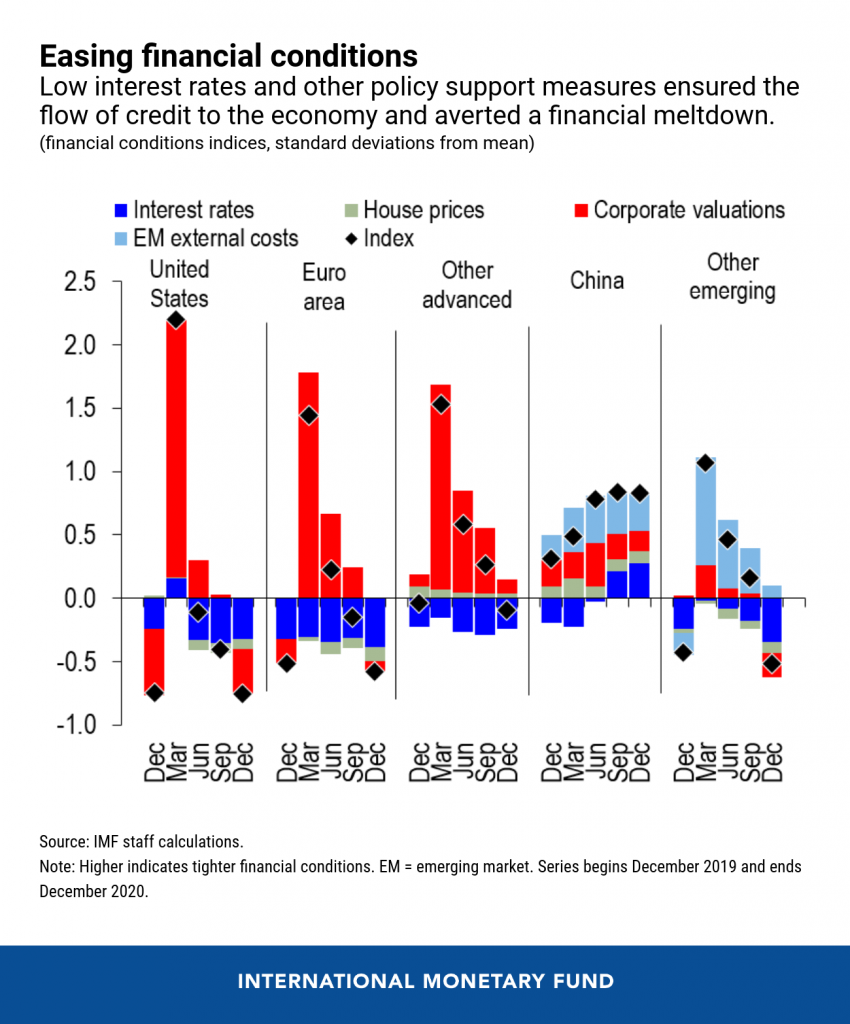
The pandemic has also weighed on the long-term profitability outlook for banks in the euro area, depressing their valuations. From around 6% in February of this year, the euro area median banks’ return on equity had declined to slightly above 2% by June. The decline in profitability is being driven mainly by higher loan loss provisions and weaker income-generation capacity linked to the ongoing compression of interest margins. Looking ahead, bank profitability is expected to remain weak and not to recover to pre-pandemic levels before 2022. This profitability outlook is reflected in rock-bottom bank valuations, with the stock prices of euro area banks recovering less than the overall market over the summer.
Non-performing loans (NPL) are likely to present a further challenge to bank profitability. But there is typically a lag between a contraction in economic activity and the formation of new NPLs. The policy support provided to borrowers through moratoria and public guarantees may imply that this lag will be longer than in past downturns, and NPLs may start to materialise in the course of next year. Banks have already anticipated some future credit losses by increasing their provisions. This is in response to a doubling in the value of loans where credit risk has significantly increased since origination, also known as Stage 2 assets. And despite these efforts, loan loss provisions of euro area banks, could still be below needs suggested by fundamentals. Newly originated loans have also tended to have greater credit risk, with banks reporting a higher probability of default according to their internal ratings-based portfolios in the second quarter of the year. This is in line with results of the ECB’s vulnerability analysis. Under the baseline scenario, credit losses would continue increasing and the solvency position of the significant euro area banks would deteriorate by mid 2022.
Moving on, the non-bank financial sector continued to be an important source of financing for companies and thereby helped support the economic recovery. Non-banks have absorbed the vast majority of the new debt securities issued by non-financial corporates in the euro area this year – notably also from sectors more sensitive to the economic fallout from the pandemic.
At the same time, non-banks also played a more negative role in amplifying the market turmoil this spring. Investment funds, including money market funds, experienced outflows of a magnitude last seen during the global financial crisis. This only stopped once the ECB launched its pandemic emergency purchase programme (PEPP). The PEPP indeed proved to be a turning point in financial markets. Flows into investment funds turned positive again in the subsequent months, quickly compensating for all the redemptions experienced in February and March. However, these flow dynamics imply that investment funds shed large volumes of assets procyclically, in the first quarter of the year, before becoming a net buyer again once market valuations started to recover.
One major reason why investment funds are particularly liable to amplify adverse market dynamics is their structurally low liquidity buffers. Low cash holdings force investment funds to sell relatively illiquid assets in the event of outflows, which serves to depress asset prices. Although funds temporarily increased their holdings of liquid assets in response to this year’s market stress, their cash positions have already returned to pre-pandemic levels. This again leaves the sector vulnerable to large redemptions in the event of any renewed stress in the financial markets. Moreover, financial vulnerabilities were aggravated by investment funds continuing to increase their exposure to credit risk. More than three-quarters of the bonds purchased by funds after March 2020 were rated BBB or below.
Policy considerations for the banking sector
Starting in March 2020, European and national prudential authorities took swift and extraordinary policy measures to address the impact of the pandemic on the euro area banking sector. Thanks to this prompt policy reaction, coupled with the forceful fiscal and monetary support measures that have been put in place and the stronger capital positions that banks have built since the global financial crisis, banks have contributed to absorb the shock of the pandemic by meeting increased demand for credit.
Looking ahead, it will be essential for banks to be willing to make use of the available capital buffers to absorb losses without excessive deleveraging. Over the medium term, a rebalancing between structural and cyclical capital requirements is desirable to create macroprudential policy space. A greater share of releasable buffers would enhance macroprudential authorities’ ability to act countercyclically.
But we must not lose sight of key structural weaknesses in the European banking sector that were evident even before the crisis hit. For quite some time now, European bank valuations have been depressed by very low profitability caused by excess capacity, limited revenue diversification and low cost efficiency. The need to tackle these structural issues is now more urgent than ever.
Although banks have stepped up cost-cutting efforts in the wake of the pandemic, they need to push even harder for greater cost efficiency. Consolidation via mergers and acquisitions is another potential avenue for reducing overcapacity in the sector. The planned domestic mergers in some countries are an encouraging sign in this regard.
Furthermore, a comprehensive approach at national and EU level will be needed if distressed assets on bank balance sheets increase significantly. Market-based solutions should take a leading role, and actions at the European level to make secondary markets for NPLs more efficient and transparent would be desirable. Further actions might include guidance on best practices for government-sponsored securitisation schemes, or new solutions that would help troubled but viable firms to restructure outstanding debts and raise new equity.
Finally, we also need to make progress on the banking union, which unfortunately remains unfinished. Renewed efforts are urgently required to improve its crisis management framework. This includes finalising the agreement on the European Stability Mechanism as a backstop to the Single Resolution Fund and ensuring an orderly and efficient exit of small and medium-sized banks in particular, by harmonising the powers to transfer assets and liabilities in liquidation with the support of deposit guarantee funds. We also need to facilitate the flow of capital and liquidity within banking groups, subject to adequate financial stability safeguards and establish the third pillar of banking union – the European deposit insurance scheme.
Policy considerations for the non-bank sector
The developments in the investment fund sector highlight the fact that the current policy framework relies to a large extent on ex post liquidity management tools such as suspensions or gating, which asset managers can use at their discretion. However, we saw that these tools were not enough to alleviate the liquidity strains from a system-wide perspective and can have adverse effects on investors scrambling for liquidity. Only the decisive policy action by central banks helped stabilise financial markets and improve liquidity conditions across a broad range of markets and institutions.
This suggests that a comprehensive macroprudential approach for non-banks needs to be devised. Policies should address system-wide risk and reflect the fact that the sector comprises a diverse set of entities and activities. This would ensure that the non-bank sector is better able to absorb shocks in the future. Authorities should be equipped with a range of policies to effectively mitigate the build-up of risks during periods of exuberance.
In particular, the liquidity of investment funds’ assets should be closely aligned with redemption terms. Funds should also be required to hold a sufficiently large share of cash and highly liquid assets to manage increased liquidity needs stemming from outflows or margin calls in periods of stress. During the spring turmoil, increasing margin calls helped to ensure that the extraordinary market volatility did not result in concerns about counterparty risk. At the same time, it contributed to amplify the liquidity pressures in the system for non-bank financial intermediaries in particular. This warrants further analysis to assess whether adjustments to margining practices and the related regulatory approaches are needed to reduce excessive procyclicality in initial margins.
As money market funds also demonstrated significant vulnerabilities during the recent market turmoil further work should focus on enhancing liquidity requirements and reconsidering the share of their liquid assets.
Conclusion
Let me conclude.
As I’ve outlined, the banking sector has weathered the crisis to date fairly well, despite a number of risks and vulnerabilities. It has helped to absorb the shock and avoided a credit crunch that would have been detrimental to the economy. Going forward, it is urgent to tackle structural weaknesses in the European banking sector, by reducing overcapacity and enhancing cost-efficiency to address its persistently low profitability. Furthermore, it will be important for banks to be willing to use their capital buffers to absorb losses and continue to support lending. On the non-bank side, investment funds continue to be vulnerable to sudden outflows during periods of market stress due to their relatively small liquidity buffers. A review of the liquidity requirements for money market funds and their portfolio composition is also necessary. This calls for the timely roll-out of a comprehensive macroprudential framework for non-banks.
Compliments of the European Central Bank.
The post ECB | The euro area financial sector in the pandemic crisis first appeared on European American Chamber of Commerce New York [EACCNY] | Your Partner for Transatlantic Business Resources.

EACC

EU Commission launches new complaints system to fight trade barriers and violations of sustainable trade commitments

The European Commission has today launched a new complaints system for reporting market access barriers and breaches of Trade and Sustainable Development commitments in the EU’s trade agreements and under the Generalised Scheme of Preferences.
The new complaints system reflects the Commission’s increased efforts to strengthen the enforcement and implementation of trade agreements. It follows the Commission’s appointment in July of its first Chief Trade Enforcement Officer (CTEO) to oversee its tougher action on enforcing trade policy, as well as the Commission’s 15-point Trade and Sustainable Development (TSD) Action Plan of 2018. This Plan reflects the consensus of promoting close long-term TSD engagement, on the one hand, and of stepping up monitoring efforts – and more assertive enforcement – on the other hand. Complaints will be channelled through a new centralised Single Entry Point system in DG Trade to allow for a responsive, focussed and structured process.
Executive Vice-President and Commissioner for Trade Valdis Dombrovskis said: “The Commission has made enforcement a top priority, along with a sharper focus on implementing trade agreements. Under this new system, complaints relating to sustainable development commitments will be given the same level of focus and attention as market access barriers. It is a real step forward because stakeholders now will play a direct role in ensuring that EU trade policy delivers both on trade opportunities and on raising labour and environmental standards. The complaints system will be accessible to all relevant parties and businesses and Commission services will assess each complaint and take action as needed.”
The complaints procedure is open to Member States, individual companies, business/trade associations, civil society organisations and citizens from the EU. The complaint forms – one for market access barriers and one for violations of sustainable development commitments – will be accessible online for EU-based stakeholders on the ‘Access2Markets’ portal on DG TRADE’s website. Complainants will be required to provide a detailed factual description of the issue at stake and to list any actions already taken to address it.  For market access issues, the complainant will need to describe the alleged barrier’s potential economic impact. For sustainable development issues, the complainant must give details of the impact and seriousness of the alleged breach.
After launching the complaint, the complainant will be informed as to whether it leads to an enforcement action. The Commission services will inform the complainant about the content of the action plan, which may identify the steps suitable for tackling the issues subject to the complaint but also indicate to the extent possible timelines of specific actions. The Commission services could also provide periodic updates on specific actions undertaken to address the issue, depending on the sensitivity and confidentiality of each of the steps undertaken.
The entry into operation of the new complaints system is accompanied, on the website of DG Trade, by a notice containing operating guidelines for the system and a notice on the broader working approaches to enforcement and implementation work of DG Trade under the CTEO.
EU action to tackle barriers facing European companies around the world has been successful, with the Commission’s work to remove barriers between 2014 and 2018 generating at least €8 billion additional exports in 2019.
Compliments of the European Commission.
The post EU Commission launches new complaints system to fight trade barriers and violations of sustainable trade commitments first appeared on European American Chamber of Commerce New York [EACCNY] | Your Partner for Transatlantic Business Resources.

EACC

New Consumer Agenda: European Commission to empower consumers to become the driver of transition

Today, the European Commission launched the New Consumer Agenda to empower European consumers to play an active role in the green and digital transitions. The Agenda also addresses how to increase consumer protection and resilience during and after the COVID-19 pandemic, which brought significant challenges affecting the daily lives of consumers. More concretely, the Agenda puts forward priorities and key action points to be taken in the next 5 years together with Member States at European and national levels. This will, among other things, include a new legal proposal aiming to provide better information on sustainability to consumers, adapting existing legislation to the digital transformation as well as an action plan on product safety with China.
Vice-President for Values and Transparency, Věra Jourová, said: “We want to empower consumers to play their role in the green and digital transitions. At the same time we must ensure that our rules to protect consumer rights remain up to speed with today’s digital reality – especially through vigorous enforcement and increased responsibility of online platforms.”
Commissioner for Justice, Didier Reynders, said: “European consumers are at the core of a global change. Their actions can make a significant difference. Consumers need to be empowered to make sustainable choices and be reassured that their* rights will be protected in all circumstances. The new Agenda introduces measures that will promote a fair digital and green society, taking into account that consumer behaviour transcends borders of individual Member States.”
Consumer rights in COVID-19 crisis
Whether online scams or cancelled travel arrangements, the COVID-19 pandemic has affected many areas of consumers’ lives. The Commission will continue to tackle consumer scams, in cooperation with the Consumer Protection Cooperation network and in dialogue with the platforms and all relevant actors. In addition, the Commission will continue to ensure the protection of travellers and passengers EU rights in case of cancelled trips*. The Commission will analyse the longer-term impact of COVID-19 on the consumption patterns of Europeans, which will serve as a basis for future policy initiatives.
Empowering consumers and ensuring better protection
The New Consumer Agenda presents a vision for EU consumer policy from 2020 to 2025 focusing on five key priority areas:

Green transition – The Commission aims to ensure that sustainable products are available to consumers on the EU market and that consumers have better information to be able to make an informed choice. Next year, the Commission will present a proposal to equip consumers with better information on the sustainability of products and to fight practices, such as greenwashing or early obsolescence. The Commission will also promote repair and encourage more sustainable and “circular” products. The green transition cannot happen without companies – the Commission is determined to work with economic operators to encourage their pledges in support of sustainable consumption, beyond what is required by law.

Digital transformation – The digital transformation is radically changing consumers’ lives offering new opportunities but also presenting them with challenges. The Commission aims to tackle online commercial practices that disregard consumers’ right to make an informed choice, abuse their behavioural biases or distort their decision-making processes, such as dark patterns and hidden advertising. In addition, consumers’ interests need to be duly taken into account when setting rules governing the digital economy and requirements for Artificial Intelligence (AI). To adapt current rules to the ongoing digitalisation and the increase of connected products, the Commission will also review the directive related to product safety. As there is a need to reinforce consumer protection regarding digitalisation of retail financial services, the directives for consumer credit and marketing of financial services will be reviewed.

Effective enforcement of consumer rights – While enforcement of consumer rights is the responsibility of Member States, the Commission has a coordinating and supporting role. The Commission will assist Member States in the timely implementation and enforcement of consumer law, including through the Consumer Protection Cooperation network. The Commission will also support national authorities, such as by deploying a toolbox of innovative e-tools to strengthen national authorities’ capacity to tackle illegal online commercial practices and identify unsafe products.

Specific needs of certain consumer groups – Certain groups of consumers in certain situations can be particularly vulnerable and need specific safeguards, for instance children, older people or those with disabilities. The Commission will look into requirements for childcare product standards. In relation to those with financial vulnerabilities, exacerbated by COVID-19 crisis, the Commission will increase funding for improved debt advice in Member States. The Commission will also support initiatives providing local advice on how to access information – online and offline.

International cooperation – In a globalised world in which online purchases transcend borders, cooperation with international partners has become crucial. The Commission will develop an Action Plan with China in 2021 to enhance the safety of products sold online. As of 2021, the Commission will also develop regulatory support, technical assistance and capacity building for EU partner regions including in Africa.

Next steps
The Commission will come forward with the initiatives announced in the agenda and looks forward to a wide-ranging dialogue with all interested parties on the priorities and actions as well as the cooperation methods to promote consumer protection together in the years ahead.
Background
The EU has a solid consumer protection framework developed over many years and recently enhanced through several legislative initiatives from which consumers in the EU will benefit in the years to come including the 2018 New Deal for Consumers
The New Consumer Agenda, builds on 2012 Consumer Agenda and is the product of intensive preparations and discussions with interested parties. In June 2020, the Commission launched an EU-wide open public consultation on the new European consumer policy for the next period. The public consultation has provided valuable input for setting up the new Consumer Agenda, and showed general support for its main priorities, including the need to respond to the COVID-19 pandemic. The agenda complements other Commission initiatives such as the Green Deal and the Circular Economy Action Plan, and it will also ensure that the implementation of the Multi-Annual Financial Framework will take consumer priorities into account.
Compliments of the European Commission.
The post New Consumer Agenda: European Commission to empower consumers to become the driver of transition first appeared on European American Chamber of Commerce New York [EACCNY] | Your Partner for Transatlantic Business Resources.