
EACC

ECB | Interview: Fiscal and monetary support are crucial

Interview with Isabel Schnabel, Member of the Executive Board of the ECB, conducted by Ingūna Ukenābele on 22 February 2021 |

How would you describe the current economic situation in the euro area?
In the course of the pandemic, we have experienced the deepest economic downturn since World War II. After the strong decline in economic activity following the first wave of infections in the spring of 2020, we saw a strong rebound, supported by the decisive fiscal and monetary policy response. This positive development was interrupted by increasing infection numbers towards the end of last year, also affecting economic activity at the start of 2021. With respect to the health situation, we continue to face substantial uncertainty due to the new variants of the virus, which is posing some downside risks to the short-term outlook.
That being said, it seems that we are now much better able to deal with lockdowns than the first time around. There has been some adaptation, which means that the second lockdown will have less severe economic consequences than the first one.
Moreover, we are seeing quite a few encouraging signs. First of all, we now have a vaccine. The vaccination is progressing slowly, but steadily. The world economy is recovering more quickly than we had anticipated. And the sizeable fiscal package envisaged by the Biden administration will likely have positive spillover effects in the euro area. So we are seeing light at the end of the tunnel.
Looking ahead, fiscal and monetary policy support will remain crucial and must not be withdrawn prematurely. As regards monetary policy, we will ensure that there is no unwarranted tightening of financing conditions. A too abrupt increase in real interest rates on the back of improving global growth prospects could jeopardise the economic recovery. Therefore, we are monitoring financial market developments closely.
Once the pandemic starts to decline, can we expect to see a recovery as fast as the one we saw last summer?
It was encouraging to see how quickly the economy rebounded last year, and there is potential for a comparably quick recovery once the health crisis has been broadly contained. But the risk of scarring increases with the duration and frequency of lockdowns. This means that containing the virus must take absolute priority. Moreover, we should use the crisis as an opportunity for structural change. For example, we have seen a push towards a more digital economy. These shifts could support productivity growth in the future. That is why the efficient use of public funds, especially those of the “Next Generation EU” instrument, is so important. These funds should be used to foster the transition to a greener and more digital economy.
By how much will the euro area grow this year? When might it see a return to pre-crisis levels?
In our latest staff projections in December, we projected economic growth for the euro area to reach 3.9% in 2021. Due to the continued lockdowns, economic growth in the first quarter of 2021 may be somewhat weaker than expected. But in light of the positive developments to which I have alluded, the historically favourable financing conditions and an expansionary fiscal policy, annual growth is likely to be in the same ballpark as projected in December.
Based on our current projections, the euro area economy should be back at its pre-crisis level by mid-2022.
Is there a risk that the crisis caused by the pandemic could lead to greater inequalities in development within the euro area since wealthy economies have invested more in aid and development programmes than their less wealthy counterparts?
At the beginning of the pandemic, one of the fears was that those countries hardest hit by the pandemic would not respond appropriately due to a lack of fiscal space. Contrary to these expectations, this has not been a general pattern during the crisis. The fiscal support package at European level plays an important role in this.
But at the end of the day, what matters most is how public funds are used. Will they be channelled into productive investments? Will they be used to foster innovation? This is the best way to counter any potential divergence. Therefore, European funds need to be paid out quickly and then be used wisely.
Does the ECB pay attention to Member States’ programmes? In Latvia, for example, there has been a lot of criticism about the programme drafted by the Ministry of Finance.
These discussions are taking place in every country, and it is the European Commission’s role to evaluate these programmes. Overall, the policy response that we have seen in the euro area has been well-suited to counter the pandemic shock. Job retention schemes, which have kept around ten million people all over the euro area in work, have been crucial to prevent a sharp increase in unemployment. Another important component has been the support to corporates to avoid that firms that would be viable in normal times would be forced to file for bankruptcy. These were some of the most important steps taken and they have worked very well, particularly in combination with monetary policy, which has provided favourable financing conditions for firms, households and governments – thereby reinforcing the fiscal response.
Are there differences in how the crisis is being overcome by euro area countries and non-euro area EU countries?
Overall, the response to the crisis has been quite similar. EU countries outside the euro area have faced a serious second wave of infections, resulting in renewed lockdowns. As EU members, they also have access to the “Next Generation EU” programme. Monetary policy in those countries has responded to mitigate the consequences of the pandemic. And the ECB has supported this response by providing euro liquidity through swap and repo lines.
Baltic states are some of the youngest members of the euro area. Is it easier for them to go through this crisis as euro area members given that some people still have their doubts about the single currency?
The Baltic states have also experienced a severe economic downturn due to the pandemic. But compared to the euro area as a whole, they have performed better: the decline in real GDP in 2020 has been among the smallest in the euro area. It is of course worth mentioning that their starting position was relatively good.
The ECB has provided crucial support to all euro area countries. During the financial market turbulence in March 2020, the ECB’s reaction was essential in order to prevent a severe financial crisis. Systemic risk indicators were at levels comparable to those observed at the time of the global financial crisis. Due to our swift policy response, the ECB was able to calm financial markets relatively quickly.
Since then, the focus of monetary policy has shifted to providing favourable financing conditions in order to bring inflation back to a level that is consistent with our medium-term aim. The pandemic has put downward pressure on inflation, which we have countered through the introduction of various crisis measures, particularly through our new asset purchase programme, the pandemic emergency purchase programme (PEPP), and our longer-term refinancing operations.
The Baltic states have benefited substantially from all these measures. The euro has provided stability at a time of great uncertainty.
How long can the era of low interest rates last in your view? What will be the preconditions for this to change?
The low interest rate environment is driven by long-term structural trends such as demographics, which play an important role in the Baltic states, globalisation and a decline in productivity growth. There is a relatively strong desire to save and a subdued willingness to invest, which is putting downward pressure on interest rates not just in Europe, but across all advanced economies. These trends can of course reverse. For example, ageing societies may start to consume more, for example when it comes to medical services or long-term care. We may also see innovation, for example in green technologies. Such innovation could push up productivity growth, which would also boost investment. Whether this happens depends to a considerable extent on government policies, namely on structural policies and public investment.
We do not expect these long-term macroeconomic trends to reverse in the short term, but we shouldn’t think that it will not happen at all. Anyone who has studied economic history knows that such trends can reverse. However, the timing is difficult to predict.
Do you see money being invested in the economy? In Latvia there is a feeling that low interest rates are not enough to lift the bank credit market, for example.
The pandemic is a time of exceptionally high uncertainty. In times like these, people typically save more. This could be forced saving due to the lockdowns, but of course part of these savings are precautionary because people are uncertain about the economic outlook. So there is typically more saving, and at the same time there is less investment because of high uncertainty. For the recovery, it is very important that consumers start consuming and firms start investing again. Confidence is key here, and both fiscal and monetary policy can help restore lost confidence and thereby stimulate demand.
How would you describe what is happening in financial markets, including the banking sector? How stable are eurozone banks at the moment? In many people’s minds, the word “crisis” means that there are problems with banks and their savings.
This crisis is very different from the global financial crisis. Banks entered this crisis in relatively good shape. That is also true for the Baltic banks. In particular, banks were relatively well capitalised, which meant that they could be part of the solution to this crisis rather than being the cause of the problem.
This rather benign development was supported by fiscal, supervisory and monetary policy.
On the fiscal side, we saw loan moratoria and guarantees, while supervisors relaxed their requirements. Both types of measures played a decisive role in supporting the banking sector. On the monetary policy side, central bank measures provided ample liquidity at highly favourable terms, which enabled banks to continue lending.
Due to the support measures, the number of insolvencies is currently very low. The critical point will be reached when these measures are phased out. There is the risk of a cliff effect that could spill over to the financial sector, and we could see an increase in non-performing loans. Our analysis shows that euro area banks should be able to cope with this as long as the support is not withdrawn too early and too abruptly, and as long as the overall conditions remain favourable, including the financing conditions provided by the ECB. But we should expect many firms to come out of this crisis with much higher debt levels.
How do the Baltic banks look in terms of this risk of non-performing loans?
The Baltic states are facing the same risk of a cliff effect. Many firms are experiencing rising indebtedness, and not all of them are going to survive. The pandemic creates challenges in all euro area countries.
In the Baltic and Nordic countries, preventing money laundering was a very hot topic before the pandemic. There were a number of scandals and strict rules were adopted. What is your assessment of the fight against money laundering in the euro area as a whole? Where are the biggest problems now?
The fight against money laundering and terrorist financing is crucial to preserve the integrity of the financial sector and public trust in financial institutions. This is primarily the responsibility of national authorities, while the ECB is responsible for supervising significant banks in the euro area. Of course, we collaborate and exchange information.
However, when it comes to cross-border issues, national responsibilities may not be sufficient. If there is limited enforcement in any single country, this can lead to negative spillover effects to the entire euro area. So I think a more European approach may be needed. This starts with further harmonising national rules. Moreover, it should be considered whether the fight against money laundering could not be conducted more efficiently at the European level. These ideas are also included in the European Commission’s action plan on anti-money laundering.
Don’t you think the European Commission is being too slow here? We have been talking about these issues for years.
There are good reasons to argue that these issues should be tackled quickly. But elevating powers and responsibilities to the European level is a difficult political issue and takes time. Regarding harmonisation, some progress could be achieved more quickly.
When can we expect a digital euro?
The introduction of a digital euro is still an open issue. In October 2020, the ECB published its first report on a digital euro. This report served as the foundation for a public consultation process, which generated a lot of interest. We will most likely take a decision by the middle of the year as to whether we will launch a digital euro project, starting with an investigation phase. Of course, we are closely coordinating our plans with the European Commission. There are also important technical aspects that still need to be clarified. Let me stress that these discussions are still ongoing. No formal decision has been taken yet. The whole process will take several years.
Will there be public trust in a digital currency?
Public trust in a digital currency will be determined by the public trust in the central bank that issues it. There is a very high level of trust in the euro, and I have no doubt that we can generate the same level of trust in a digital euro.

Compliments of the European Central Bank.
The post ECB | Interview: Fiscal and monetary support are crucial first appeared on European American Chamber of Commerce New York [EACCNY] | Your Partner for Transatlantic Business Resources.
EACC

OECD calls on countries to crack down on the professionals enabling tax and white collar crimes

Countries should increase efforts to better deter, detect and disrupt the activities of professionals who enable tax evasion and other financial crimes, according to a new OECD report.
Ending the Shell Game: Cracking down on the Professionals who enable Tax and White Collar Crimes explores the different strategies and actions that countries can take against those professional service providers who play a crucial part in the planning and pursuit of criminal activity, referred to in the report as “professional enablers.” White collar crimes like tax evasion, bribery and corruption are often hidden through complex legal structures and financial transactions facilitated by lawyers, notaries, accountants, financial institutions and other professional enablers.
The report notes that the majority of professional service providers are law-abiding, and play an important role in assisting businesses and individuals understand and comply with the law. The aim of the new OECD report is to assist countries in dealing with the small subset that use their specialised skills and knowledge to enable clients to defraud the government and evade their tax obligations.
Professional enablers often play a critical role in the concealment of the commission of tax and other financial crimes perpetrated by their clients. Those who facilitate the concealment of such crimes undermine the rule of law and public confidence in the legal and financial system, as well as the level playing field between compliant and non-compliant taxpayers. Highly publicised recent tax scandals have highlighted the cross-border nature of these practices, further undermining public trust in the integrity of the tax system.
“Professional enablers often hold the key to the successful commission of white collar crimes like tax evasion, bribery and corruption, which depend on ensuring anonymity and hiding the financial trail,” said Grace-Perez Navarro, Deputy Director of the OECD’s Centre of Tax Policy and Administration. “Professional enablers help criminals conceal their identities and activities through shell companies, complex legal structures and financial transactions, relying on their specialised knowledge and veneer of legitimacy. Our ongoing work is intended to help countries develop and strengthen national strategies and international co-operation to crack down on the so-called professionals, whose actions are undermining government revenue, public confidence and economic growth.”
The report calls on countries to establish or strengthen national strategies to deal with professional enablers more effectively. Such strategies should:

ensure that tax crime investigators are equipped to identify the types of professional enablers operating in their jurisdiction, and to understand the risks posed by how they devise, market, implement and conceal tax crime and financial crimes;
ensure the law provides investigators and prosecutors with sufficient authority to identify, prosecute and sanction professional enablers, both to deter and penalise;
implement multi-disciplinary prevention and disruption strategies, notably through engagement with supervisory, industry and professional bodies, to prevent abusive behaviour, incentivise early disclosure and whistle-blowing and take a strong approach to enforcement;
ensure relevant authorities proactively maximise the availability of information, intelligence and investigatory powers held by other domestic and international agencies to tackle sophisticated professional enablers operating across borders;
appoint a lead person and agency in the jurisdiction with responsibility for overseeing the implementation of the professional enablers strategy, undertake a review of its effectiveness over time and devise further changes as necessary.

The report will be presented during a dedicated session at the virtual OECD Global Anti-Corruption and Integrity Forum on 24 March at 16:45 to 17:45 (CET). The Forum will be open to the public and interested participants are invited to register to attend.

Download the report
Access the FAQs
More on the OECD’s work on Tax and Crime

Contacts:

Grace Perez-Navarro, Deputy Director of the OECD Centre for Tax Policy and Administration | Grace.Perez-Navarro@oecd.org
Achim Pross, Head of the International Co-operation and Tax Administration Division | Achim.Pross@oecd.org
Lawrence Speer in the OECD Media Office | Lawrence.Speer@oecd.org

Compliments of the OECD.
The post OECD calls on countries to crack down on the professionals enabling tax and white collar crimes first appeared on European American Chamber of Commerce New York [EACCNY] | Your Partner for Transatlantic Business Resources.

Read More
EACC

IMF | The Great Divergence: A Fork in the Road for the Global Economy

As G20 finance ministers and central bank governors meet virtually this week, the world continues to climb back from the worst recession in peacetime since the Great Depression.
The IMF recently projected global GDP growth at 5.5 per cent this year and 4.2 per cent in 2022. But it is going to be a long and uncertain ascent. Most of the world is facing a slow rollout of vaccines even as new virus mutations are spreading—and the prospects for recovery are diverging dangerously across countries and regions.
Indeed, the global economy is at a fork in the road. The question is: will policymakers take action to prevent this Great Divergence?

‘There is a major risk that most developing countries will languish for years to come.’

As our note to the G20 meeting points out, there is a major risk that as advanced economies and a few emerging markets recover faster, most developing countries will languish for years to come. This would not only worsen the human tragedy of the pandemic, but also the economic suffering of the most vulnerable.
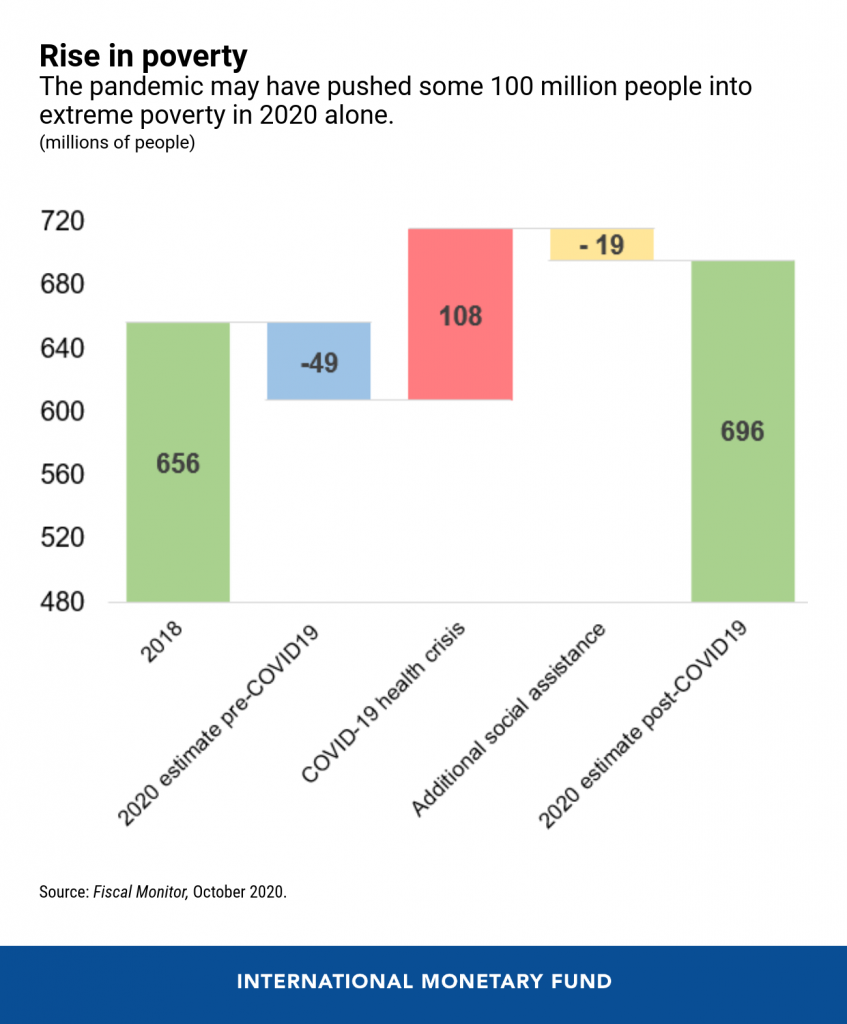
We estimate that, by the end of 2022, cumulative per capita income will be 13 percent below pre-crisis projections in advanced economies—compared with 18 percent for low-income countries and 22 percent for emerging and developing countries excluding China. This projected hit to per capita income will increase by millions the number of extremely poor people in the developing world.
In other words, the convergence between countries can no longer be taken for granted. Before the crisis, we forecast that income gaps between advanced economies and 110 emerging and developing countries would narrow over 2020–22. But we now estimate that only 52 economies will be catching up during that period, while 58 are set to fall behind.
This is partly because of the uneven access to vaccines. Even in the best-case scenario, most developing economies are expected to reach widespread vaccine coverage only by end-2022 or beyond. Some are especially exposed to hard-hit sectors such as tourism and oil exports, and most of them are held back by the limited room in their budgets.
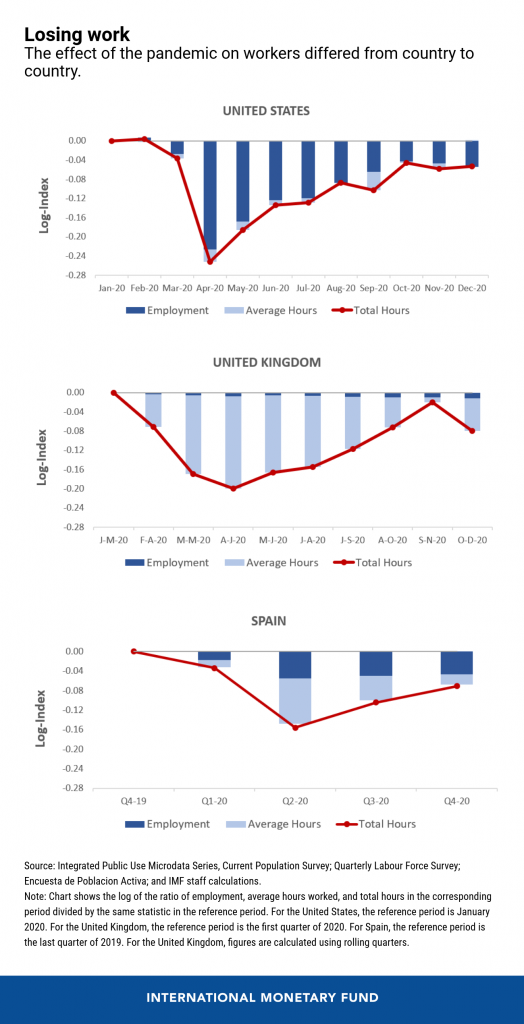
Last year, advanced economies on average deployed about 24 percent of GDP in fiscal measures, compared with only 6 percent in emerging markets and less than 2 percent in low-income countries. Cross-country comparisons also show how more sizable crisis support was often associated with a smaller loss in employment.
And it is not just divergence across countries. We also see an accelerated divergence within countries: the young, the low-skilled, women, and informal workers have been disproportionately affected by job losses. And millions of children are still facing disruptions to education. Allowing them to become a lost generation would be an unforgiveable mistake.
It would also deepen the long-term economic scars of the crisis, which would make it even more difficult to reduce inequality and boost growth and jobs. Think of the challenges ahead: for G20 economies alone (excluding India and Saudi Arabia due to data limitations), total employment losses are projected at more than 25 million this year and close to 20 million in 2022, relative to pre-crisis projections.
So again, we stand at a fork in the road—and if we are to reverse this dangerous divergence between and within countries, we must take strong policy actions now. I see three priorities:
First, step up efforts to end the health crisis.
We know that the pandemic is not over anywhere until it is over everywhere. While new infections worldwide have recently declined, we are concerned that multiple rounds of vaccinations may be needed to preserve immunity against new variants.
That is why we need much stronger international collaboration to accelerate the vaccine rollout in poorer countries. Additional financing to secure doses and pay for logistics is critical. So, too, is timely reallocation of excess vaccines from surplus to deficit countries, and a significant scaling up of vaccine production capacity for 2022 and beyond. Insuring vaccine producers against the downside risks of overproduction may be an option worth considering.
We also need to ensure greater access to therapies and testing, including virus sequencing, while steering clear of restrictions on exports of medical supplies. The economic arguments for coordinated action are overwhelming. Faster progress in ending the health crisis could raise global income cumulatively by $9 trillion over 2020–25. That would benefit all countries, including around $4 trillion for advanced economies—which beats by far any measure of vaccine-related costs.
Second, step up the fight against the economic crisis.
Led by G20 countries, the world has taken unprecedented and synchronized measures, including nearly $14 trillion in fiscal actions. Governments need to build on these efforts by continuing to provide fiscal support—appropriately calibrated and targeted to the stage of the pandemic, the state of their economies, and their policy space.
The key is to help maintain livelihoods, while seeking to ensure that otherwise viable companies do not go under. This requires not just fiscal measures, but also maintaining favorable financial conditions through accommodative monetary and financial policies, which support the flow of credit to households and firms.
The considerable monetary easing by major central banks has also enabled several developing economies to regain access to global capital markets and borrow at record-low rates to support spending, despite their historic recessions. Given the gravity of the crisis, there is no alternative to continued monetary policy support. But there are legitimate concerns around unintended consequences, including excessive risk-taking and market exuberance.
One risk going forward—especially in the face of diverging recoveries—is the potential for market volatility in response to changing financial conditions. Major central banks will need to carefully communicate their monetary policy plans to prevent excess volatility in financial markets, both at home and in the rest of the world.
Third, step up support to vulnerable countries.
Given their limited resources and policy space, many emerging market and low-income nations could soon be faced with an excruciating choice between maintaining macroeconomic stability, tackling the health crisis, and meeting peoples’ basic needs.
Their increased vulnerability not only affects their own prospects for recovery from the crisis, but also the speed and scale of the global recovery; and it can be a destabilizing force in a number of already fragile areas. Vulnerable countries will need substantial support as part of a comprehensive effort:
The first step begins at home, with governments raising more domestic revenue, making public spending more efficient, and improving the business environment. At the same time, international efforts are critical to further scale up concessional financing and leverage private finance, including through stronger risk-sharing instruments.
Another option under consideration is a new SDR allocation to help address the global long-term need for reserves. This could add a substantial, direct liquidity boost to countries, without adding to debt burdens. It could also expand the capacity of bilateral donors to provide new resources for concessional support, including for health spending. An SDR allocation served the world well in tackling the global financial crisis in 2009—it could serve us well again now.
Following a comprehensive approach also means dealing with debt. The G20’s debt service suspension initiative (DSSI) quickly freed up vital resources. And the new Common Framework can go even further: facilitating timely and orderly debt treatments for DSSI-eligible countries, with broad creditor participation including the private sector. These treatments should involve debt service reprofiling to help countries facing large financing needs, and deeper relief where debt burdens have become unsustainable. With the first requests in, the Common Framework should be swiftly operationalized by all creditors—official and private.
For its part, the IMF has stepped up in an unprecedented manner by providing over $105 billion in new financing to 85 countries and debt service relief for our poorest members. We aim to do even more to support our 190 member countries in 2021 and beyond.
That includes supporting efforts to modernize international corporate taxation. We need a system that is truly fit for the digital economy and that is more attuned to the needs of developing countries. Here multilateral efforts will be essential to help ensure that highly profitable firms pay tax in markets where they do business and thereby strengthen public finances.
These policy measures can help address the Great Divergence. Given their resources, advanced economies will continue to invest in human capital, digital infrastructure, and the transition to the new climate economy. It is vital that poorer countries have the support they need to make similar investments, especially in the job-rich climate adaptation measures that will be essential as our planet gets warmer.
The alternative—to leave poorer countries behind—would only entrench abject inequality. Even worse, it would represent a major threat to global economic and social stability. And it would rank as a historic missed opportunity.
We can take inspiration from the spectacular international cooperation that has given us effective vaccines in record time. That spirit is now more important than ever to overcome this crisis and secure a strong and inclusive recovery.
Author:

Kristalina Georgieva, Managing Director of the IMF

Compliments of the IMF.
The post IMF | The Great Divergence: A Fork in the Road for the Global Economy first appeared on European American Chamber of Commerce New York [EACCNY] | Your Partner for Transatlantic Business Resources.

Read More
EACC

International trade statistics: trends in fourth quarter 2020

Final quarter of 2020 shows continued recovery in G20 international merchandise trade |
Download the entire news release (including graphs and tables PDF)
23 Feb 2021 – G20 international merchandise trade continued to rebound in the fourth quarter of 2020 (exports up 7.2% and imports up 6.8%), following the sharp falls seen in the first half of 2020, as lockdown measures affected trade globally. Although growth in the fourth quarter of 2020 was strong, it shows a reduction compared to the unprecedented expansion observed in the third quarter, when exports and imports increased by 20.6% and 16.8%, respectively.
With the exception of Argentina, hampered by strikes in their wheat export supply chain, all G20 economies experienced international trade growth in the fourth quarter of 2020. In general, quarterly levels of international merchandise trade were somewhat above those in 2019. Limited provisional data available for January 2021 show international trade growth continuing.
A strong driver of 2020 merchandise trade growth in the G20 was China, which already experienced a rebound in the second quarter of 2020 and has seen solid international trade growth continue in the last two quarters of 2020 (exports up 7.0% and 6.1%; and imports up 7.6% and 3.1%, for the third and fourth quarter, respectively). Elsewhere in the Asia-Pacific region, Australia (exports up 11.6% and imports up 7.9%) and Japan (9.7% and 6.5%) saw strong trade growth in the fourth quarter of 2020, while growth in Indonesia (6.2% and 1.7%) and Korea (5.0% and 4.5%) was more moderate.
The EU27 as a whole (exports up 7.7% and imports up 6.4%), as well as France (9.4% and 3.1%), Germany (8.0% and 7.3%) and Italy (8.6% and 7.8%) all recorded strong growth in the fourth quarter of 2020, reinforcing the rebound observed in the third quarter. The United Kingdom recorded double-digit growth in both exports (10.0%) and imports (16.0%) in the fourth quarter of 2020. The strong growth number for imports could be linked to anticipation of the withdrawal from the EU single market and may also have supported the strong export numbers for the G20 EU economies (i.e. France, Germany and Italy).
G20 economies in the Americas also continued to gain ground in the fourth quarter of 2020. Brazil exports were up 2.8%, while imports increased by 25.8% (largely as the result of the purchase of oil extraction equipment). Canada recorded steady international trade growth (exports up 4.8% and imports up 4.7%), while the United States saw stronger growth numbers (8.6% and 6.1%).

G20 total international merchandise tradeSeasonally adjusted, in current prices and current US dollars billion

Visit the interactive OECD Data Portal to explore these data further
Source: OECD (2020), Monthly International Merchandise Trade (IMTS) (Database)‌‌
Compliments of the OECD.
The post International trade statistics: trends in fourth quarter 2020 first appeared on European American Chamber of Commerce New York [EACCNY] | Your Partner for Transatlantic Business Resources.

EACC

EU to set up new European Partnerships and invest nearly €10 billion for the green and digital transition

The Commission proposed today to set up 10 new European Partnerships between the European Union, Member States and/or the industry. The goal is to speed up the transition towards a green, climate neutral and digital Europe, and to make European industry more resilient and competitive. The EU will provide nearly €10 billion of funding that the partners will match with at least an equivalent amount of investment. This combined contribution is expected to mobilise additional investments in support of the transitions, and create long-term positive impacts on employment, the environment and society.
The proposed Institutionalised European Partnerships aim to improve EU preparedness and response to infectious diseases, develop efficient low-carbon aircraft for clean aviation, support the use of renewable biological raw materials in energy production, ensure European leadership in digital technologies and infrastructures, and make rail transport more competitive.
The ten Partnerships, some of which are building on existing joint undertakings, are the following:

Global Health EDCTP3: This partnership will deliver new solutions for reducing the burden of infectious diseases in sub-Saharan Africa, and strengthen research capacities to prepare and respond to re-emerging infectious diseases in sub-Saharan Africa and across the world. By 2030, it aims to develop and deploy at least two new technologies tackling infectious diseases, and support at least 100 research institutes in 30 countries to develop additional health technologies against re-emerging epidemics.

Innovative Health Initiative: This initiative will help create an EU-wide health research and innovation ecosystem that facilitates the translation of scientific knowledge into tangible innovations. It will cover prevention, diagnostics, treatment and disease management. The initiative will contribute to reaching the objectives of Europe’s Beating Cancer Plan, the new Industrial Strategy for Europe and the Pharmaceutical Strategy for Europe.

Key Digital Technologies: They encompass electronic components, their design, manufacture and integration in systems and the software that defines how they work. The overarching objective of this partnership is to support the digital transformation of all economic and societal sectors and the European Green Deal, as well as support research and innovation towards the next generation of microprocessors. Together with the Declaration on a European Initiative on processors and semiconductor technologies signed by 20 Member States, an upcoming Alliance on microelectronics, and a possible new Important Project of Common European Interest under discussion by Member States to foster breakthrough innovation, this new partnership will help boost competitiveness and Europe’s technological sovereignty. More information is available here.

Circular Bio-based Europe: This partnership will contribute significantly to the 2030 climate targets, paving the way for climate neutrality by 2050, and will increase the sustainability and circularity of production and consumption systems, in line with the European Green Deal. It aims to develop and expand the sustainable sourcing and conversion of biomass into bio-based products as well as to support the deployment of bio-based innovation at regional level with the active involvement of local actors and with a view to reviving rural, coastal and peripheral regions.

Clean Hydrogen: This partnership will accelerate the development and deployment of a European value chain for clean hydrogen technologies, contributing to sustainable, decarbonised and fully integrated energy systems. Together with the Hydrogen Alliance, it will contribute to the achievement of the Union’s objectives put forward in the EU hydrogen strategy for a climate-neutral Europe. It will focus on producing, distributing and storing clean hydrogen and, on supplying sectors that are hard to decarbonise, such as heavy industries and heavy-duty transport applications.

Clean Aviation: This partnership puts aviation en route to climate neutrality, by accelerating the development and deployment of disruptive research and innovation solutions. It aims to develop the next generation of ultra-efficient low-carbon aircraft, with novel power sources, engines, and systems, improving competitiveness and employment in the aviation sector that will be especially important for the recovery.

Europe’s Rail: This partnership will speed up the development and deployment of innovative technologies, especially digital and automation ones, to achieve the radical transformation of the rail system and deliver on the European Green Deal objectives. By improving competitiveness, it will support European technological leadership in rail.

Single European Sky ATM Research 3: The initiative aims to accelerate the technological transformation of air traffic management in Europe, aligning it to the digital age, to make the European airspace the most efficient and environmentally friendly sky to fly in the world and to support the competitiveness and recovery of Europe’s aviation sector following the coronavirus crisis.

Smart Networks and Services: This partnership will support technological sovereignty for smart networks and services in line with the new industrial strategy for Europe, the new EU Cybersecurity Strategy and the 5G Toolbox. It aims to help resolve societal challenges and to enable the digital and green transition, as well as support technologies that will contribute to the economic recovery. It will also enable European players to develop the technology capacities for 6G systems as a basis for future digital services towards 2030. More information is available here.

Metrology: This partnership aims to accelerate Europe’s global lead in metrology research, establishing self-sustaining European metrology networks aimed at supporting and stimulating new innovative products, responding to societal challenges and enabling effective design and implementation of regulation and standards underpinning public policies.

Members of the College said:
Margrethe Vestager, Executive Vice-President for a Europe fit for the Digital Age, said: “We are at our best in Europe when we work together. This is particularly important when it comes to mastering the challenges of the digital transformation. It affects us all, and does not stop at national borders. Just like climate change. The partnerships proposed today will mobilise resources, so that we can jointly make the most of digital technologies, not least in the interest of our green transition.”
Mariya Gabriel, Commissioner for Innovation, Research, Culture, Education and Youth said: “The challenge of the coronavirus pandemic added urgency to our long-standing endeavours to better use research and innovation to tackle health emergencies, climate change and digital transformation. European Partnerships are our opportunity to work together to respond and shape the profound economic and social transformations, for the benefit of all EU citizens.”  
Thierry Breton, Commissioner for Internal Market, added: “Investing in innovation is investing in our ability to be at the forefront of technological developments and develop strategic capacities. We must seize the opportunities brought by key developing technologies such as microprocessors or semiconductors so that Europe can be at the forefront of digital innovation on a global scale. These new joint approaches will be instrumental in supporting our industry for achieving our digital and green ambitions.”
Adina Vălean, Commissioner for Transport, said: “EU partnerships will have a central role to drive the twin green and digital transition for the mobility and transport sector. To make our ambitions come true, we need to develop disruptive technologies bringing zero-emission vessels and aircraft to the market, we need to develop and deploy cooperative, connected and automated mobility, and we need to enable a more efficient and modern traffic management.”
Next steps
The proposal for a Regulation, the Single Basic Act, establishing nine joint undertakings based on Article 187 of the Treaty on the Functioning of the European Union (TFEU) will be adopted by the Council of the European Union, following consultation with the European Parliament and the Economic and Social Committee. The separate proposal for the Metrology partnership based on Article 185 TFEU will be adopted by a decision of the European Parliament and the Council, following consultation with the Economic and Social Committee.
Background
The European Partnerships are approaches provided by Horizon Europe, the new EU research and innovation programme (2021-2027). They aim to improve and accelerate the development and uptake of new innovative solutions across different sectors, by mobilising public and private resources. They will also contribute to the objectives of the European Green Deal and strengthen the European Research Area. Partnerships are open to a wide range of public and private partners, such as industry, universities, research organisations, bodies with a public service mission at local, regional, national or international level, and civil society organisations, including foundations and NGOs.
Compliments of the European Commission.
The post EU to set up new European Partnerships and invest nearly €10 billion for the green and digital transition first appeared on European American Chamber of Commerce New York [EACCNY] | Your Partner for Transatlantic Business Resources.

EACC

Data protection: European Commission launches process on personal data flows to UK

On February 19, the Commission launched the process towards the adoption of two adequacy decisions for transfers of personal data to the United Kingdom, one under the General Data Protection Regulation and the other for the Law Enforcement Directive. The publication of the draft decisions is the beginning of a process towards their adoption. This involves obtaining an opinion from the European Data Protection Board (EDPB) and the green light from a committee composed of representatives of the EU Member States. Once this procedure will have been completed, the Commission could proceed to adopt the two adequacy decisions.
Over the past months, the Commission has carefully assessed the UK’s law and practice on personal data protection, including the rules on access to data by public authorities. It concludes that the UK ensures an essentially equivalent level of protection to the one guaranteed under the General Data Protection Regulation (GDPR) and, for the first time, under the Law Enforcement Directive (LED).
Věra Jourová, Vice-President for Values and Transparency, said: “Ensuring free and safe flow of personal data is crucial for businesses and citizens on both sides of the Channel. The UK has left the EU, but not the European privacy family. At the same time, we should ensure that our decision will stand the test of time. This is why we included clear and strict mechanisms in terms of both monitoring and review, suspension or withdrawal of such decisions, to address any problematic development of the UK system after the adequacy would be granted.”
Didier Reynders, Commissioner for Justice, said: “A flow of secure data between the EU and the UK is crucial to maintain close trade ties and cooperate effectively in the fight against crime. Today we launch the process to achieve that. We have thoroughly checked the privacy system that applies in the UK after it has left the EU. Now European Data Protection Authorities will thoroughly examine the draft texts. EU citizens’ fundamental right to data protection must never be compromised when personal data travel across the Channel. The adequacy decisions, once adopted, would ensure just that.”
Compared to other non-EU countries where convergence is developed through the adequacy process between often divergent systems, EU law has shaped the UK’s data protection regime for decades. At the same time, it is essential that the adequacy findings are future proof now that the UK will no longer be bound by EU privacy rules. Therefore, once these draft decisions are adopted they would be valid for a first period of four years. After four years, it would be possible to renew the adequacy finding if the level of protection in the UK would continue to be adequate.
Until then data flows between the European Economic Area and the UK continue and remain safe thanks to a conditional interim regime that was agreed in the EU-UK Trade and Cooperation Agreement. This interim period expires on 30 June 2021.
Next steps
After taking the opinion of the European Data Protection Board into account, the European Commission will request the green light from Member States’ representatives in the so-called comitology procedure. Following that, the European Commission could adopt the final adequacy decisions for the UK.
Background
Articles 45(3) of the GDPR and Article 36(3) of the Law Enforcement Directive grant the Commission the power to decide, by means of an implementing act, that a non-EU country ensures “an adequate level of protection”, i.e. a level of protection for personal data that is essentially equivalent to the level of protection within the EU. If a non-EU country has been found “adequate”, transfers of personal data from the EU to the respective non-EU country can take place without being subject to any further conditions.
In the UK, the processing of data is governed by the so-called “UK GDPR” and the Data Protection Act 2018, which are based on the EU GDPR and the LED. They provide similar safeguards, individual rights, obligations for controllers and processors, rules on international transfers, supervision system and redress avenues to those available under EU law. The draft decisions also include a detailed assessment of the conditions and limitations as well as the oversight mechanisms and remedies applicable in case of access to data by UK public authorities, in particular for law enforcement and national security purposes.
It also worth noting that the UK is – and has committed to remain – party to the European Convention of Human Rights and to “Convention 108” of the Council of Europe, the only binding multilateral instrument on data protection. This means that, while it has left the EU, the UK remains a member of the European “privacy family”. Continued adherence to such international conventions is of particular importance for the stability and durability of the proposed adequacy findings.
The draft adequacy decisions sent to the EDPB today concern the flow of data from the EU to the UK. Data flows in the other direction – from the UK to the EU – are regulated by UK legislation, which applies since 1 January 2021. The UK decided that the EU ensures an adequate level of protection and that therefore data can flow freely from the UK to the EU.
Compliments of the European Commission.
The post Data protection: European Commission launches process on personal data flows to UK first appeared on European American Chamber of Commerce New York [EACCNY] | Your Partner for Transatlantic Business Resources.

EACC

IMF | Solidarity and Cooperation: Europe’s Response to the Crisis

Keynote Speech by IMF Managing Director Kristalina Georgieva at the EU Parliamentary Conference
*As prepared for delivery*
Thank you for the opportunity to address you today.  As EU Commissioner I benefitted from interactions with this Conference and am honored to join you again at this critical time.
Jean Monnet once said: “People only act in a state of necessity and usually only recognize necessity in a situation of crisis.”
We are in a crisis and it is time for action.  In 2020, 90 percent of the countries finished the year with a smaller economy than at the start of it — the worst performance the world has had during peace time.  But it could have been much worse.  Exceptionally strong and coordinated actions by central banks and by finance authorities have played a critical role in mitigating the human and economic impacts.
I want to pay tribute to Christine Lagarde and the ECB for reacting swiftly with extraordinary policy accommodation, and to all the governments of the EU for putting in place massive fiscal support of over 3 trillion euros for firms and households, including job-retention schemes that helped over 54 million workers. And the Next Generation EU initiative is a remarkable achievement in joint mobilization of funds.
These actions—together with unprecedented scientific advances on vaccines and treatments (many home-grown in Europe) and progress in applying masks, social distancing, testing and contact tracking—have helped stabilize the economy and move the world and the EU towards recovery.
Currently, we are projecting global growth of 5.5 percent and 4.2 percent in the EU this year. But the path to recovery is highly uncertain and, most importantly, uneven.  Uncertain because of the ongoing race between the virus and the vaccines.  Uneven because of the difference in starting positions, economic structure and capacity to respond – causing inequalities to grow both across and within countries.
The latter is my deepest concern: that the Great Lockdown of 2020 could morph into a Great Divergence in 2021.
Divergence is most profound in the developing world where half of the countries that used to catch up in income levels with their wealthier peers are now falling further behind. But it is a risk for the EU as well.  Traditional tourist destinations have experienced much sharper contractions—more than 9 percent last year in Spain, Greece, and Italy—compared to an average contraction of 6.4 percent across the EU.
And we project that by the end of 2022, per capita income for the emerging markets of Central and Eastern Europe will be 3.8 percent below pre-crisis projections, compared to a shortfall of just 1.3 percent for the EU’s advanced economies—a negative impact almost three times larger that will slow the pace of convergence.
We also see increasing divergence within countries, in the form of worsening inequality.
Regions with lower GDP per capita went into the crisis with lower productivity, larger contact-intensive sectors, and fewer jobs that allow for remote working—so they have been hit all the harder. Millions of jobs have been lost, with women and young people suffering the most, especially those with lower incomes and savings.
So: the big question facing EU policymakers is: how can we ensure a strong recovery and tackle this threat of divergence?
First—end the health crisis. This year, vaccine policy is at the heart of economic policy, in Europe and around the world. Until we defeat the pandemic everywhere, we risk new mutations that threaten our progress. 
Scaling up production and distribution of vaccines is critical. So too, is additional financing to secure doses and pay for logistics, as well as timely reallocation of excess supplies. This requires cooperation. 
Second—fight the economic crisis. Until the pandemic is defeated, support for firms and households should continue.  Gradual withdrawal has to follow, not precede, a durable exit from the health crisis. It matters internally, and also in terms of spillovers – a premature tightening of policy when worse-hit economies are still deeply fragile could exacerbate divergence between countries.
While now is not the time to withdraw support, it is the time to ascertain the strength of insolvency regimes.  Massive support in 2020 led to lower than average bankruptcies.  Once support declines and with structural change accelerating, the risk of a higher rate of debt defaults will go up.  Insolvency arrangements and greater emphasis on equity support could help prevent debt overhangs and ratcheting bankruptcies.
Third—and most important over the long run—harness the response to the crisis to spur structural shifts to digitalization and greening, and power up Europe’s convergence engine.
A coordinated green infrastructure investment push is a must. Our analysis shows that this could boost global GDP over a 15-year period by about 0.7 percent each year, creating millions of new jobs. Carbon pricing can help repair fiscal balances, channel private investments into green sectors, and deliver substantial emissions reductions.  Increased access to high-speed internet in rural and underserved areas would raise productivity.  Education spending and job training programs would build the skills needed for a digital and green age.
And Europe can step up reforms to address persistent structural challenges. The Next Generation EU can be more than a catalyst for economic transformation: it is a forerunner to new shared fiscal tools to complement the ECB’s single monetary policy.  The EU can take further steps towards banking and capital market union to spur growth and integration.  And efforts to make international corporate taxation fit for the digital age can help boost revenues and address inequality.
Let me finish with a word of thanks for your support to the work of the IMF in this crisis.
From the outset we swiftly recalibrated policy advice.  Our message “Spend but keep the receipts” was unusual for the Fund, but appropriate for this crisis.  And we put our money where our mouth is.  We provided over $105 billion in new financing to 85 countries—including in Europe, to Albania, Bosnia and Herzegovina, Kosovo, Moldova, Montenegro, North Macedonia, and Ukraine. 
We adjusted our capacity development work to the needs and modalities of work during the pandemic. We strengthened focus on inclusive growth—especially with our European partners—on issues like progressive taxation and social spending.
And we have stepped up work on climate change — which is not only a threat to economic and financial stability, but also an opportunity for green growth and jobs.  Our analysis of policies to reach the EU’s ambitious carbon emission reduction goals shows our commitment to put climate change at the heart of our work.
We are working closely with the EU to do more for low-income countries—they face painful choices between tackling the health crisis, meeting peoples’ basic needs, and fostering macroeconomic stability and boosting public investment that are essential for sustainable growth.
EU citizens can be proud of their assistance to vulnerable countries during this crisis. You have backed up all our efforts and have contributed to our debt relief and concessional lending capacity.  And you are seeking ways for us to do more, including through a new SDR allocation to boost reserves without compounding debt burdens.  I greatly appreciate EU finance ministers’ support in this regard.
You can count on us. As we count on you.
The European Union was one of the best inventions of the 20th century.  Its values of solidarity and inclusion remain the 21st century’s best hope.
Compliments of the IMF.
The post IMF | Solidarity and Cooperation: Europe’s Response to the Crisis first appeared on European American Chamber of Commerce New York [EACCNY] | Your Partner for Transatlantic Business Resources.

EACC

EU industry: EU Commission takes action to improve synergies between civil, defence and space industries

Today, the Commission presents an Action Plan on Synergies between civil, defence and space industries to further enhance Europe’s technological edge and support its industrial base. The Action Plan is devised against the background that, for the first time, EU funding presents opportunities to reinforce European innovation by exploring and exploiting the disruptive potential of technologies at the interface between defence, space and civil uses, such as cloud, processors, cyber, quantum and artificial intelligence.
Margrethe Vestager, Executive Vice-President for ‘a Europe fit for the Digital Age’, said: “With the European Defence Fund we have a strong potential for synergies between innovation in space, defence and civil research & innovation. We need this for a number of critical technologies. This action plan is a systematic and methodological approach to synergies in critical technologies across the three worlds. The idea is for innovations to systematically reach multiple uses by design. And to allow tapping into the huge innovation potential of researchers and start-ups.”
Thierry Breton, Commissioner for Internal Market, said: “Making the most of the European Defence Fund and ensuring strong synergies between defence, space and civil technologies will generate disruptive innovations and allow Europe to remain a global standard setter. It will also reduce our dependencies in critical technologies and boost the industrial leadership we need to recover from the crisis.”
The main goals of the Action Plan are to:

Enhance the complementarity between relevant EU programmes and instruments covering research, development and deployment to increase efficiency of investments and effectiveness of results (the synergies);
Promote that EU funding for research and development, including on defence and space, has economic and technological dividends for European citizens (the spin-offs) and;
Facilitate the use of civil industry research achievements and of civil-driven innovation in European defence cooperation projects (the spin-ins).

With these goals in mind, the Commission announces eleven targeted actions that focus on the interplay between civil, defence and space industries. In particular, they:

Create a framework that enhances synergies and cross-fertilisation among all relevant EU programmes and instruments, for example in the field of digital, cloud and processors;
Frame in a systematic and consistent way the development of critical technologies with first the identification of critical technologies and future capability requirements and then the development of technology roadmaps. Finally, the launch of flagship projects aims to reduce dependencies, foster standardisation and interoperability, stimulate cross-border cooperation, create new value chains and answer to societal and EU strategic needs;
Support, throughout the Union, innovation from start-ups, Small and Medium Businesses (SMEs) and Research and Technology Organisations (RTOs), by facilitating their access to new opportunities, including by setting up an ‘innovation incubator’ network;
Prepare for the launch of three flagship projects with the potential to become game changers: drone technologies, enhancing the competitiveness of EU industry in this critical technology area with a strong defence dimension, a space-based secure connectivity that should provide for a resilient connectivity system and high-speed connectivity for everyone in Europe based on quantum encryption; and space traffic management, required to avoid collision events that may result from the proliferation of satellites and space debris, while ensuring an autonomous access to space.

While the remit of this Action Plan is limited to EU programmes and instruments, it may also trigger similar positive synergetic effect at national level due to co-funding by Member states of EU projects. The transatlantic partnership and cooperation with other like-minded countries can support EU efforts in this area.
Background
Upon taking office, President von der Leyen tasked her Commission to “ensure cross-fertilisation between civil, defence and space industries” and “focus on improving the crucial link between space and defence and security”. To this end, in March 2020, the Industrial Strategy announced “an Action Plan on synergies between civil, defence and space industries, including at the level of programmes, technologies, innovation and start-ups”.
The Council of the EU, in its Conclusions on Security and Defence of 17 June 2020 “welcomed the call for more synergies between civil, and defence industries, including space, in EU programmes, while respecting the different natures and legal bases of respective EU programmes and initiatives, including the civilian nature of European space programmes, with a view to making more effective use of resources and technologies and create economies of scale.”
At a time when Europe faces unprecedented global competition in a changing geo-political context and new opportunities arise from the emergence of rapidly evolving technologies and new business models, the increased size of investments in technologies of civil, defence or space application can help Europe maintain its industrial base, respond to the geopolitical competition and strengthen its technological sovereignty.
Compliments of the European Commission.
The post EU industry: EU Commission takes action to improve synergies between civil, defence and space industries first appeared on European American Chamber of Commerce New York [EACCNY] | Your Partner for Transatlantic Business Resources.

EACC

ECB | Investing in our climate, social and economic resilience: What are the main policy priorities?

Speech by Christine Lagarde, President of the ECB, at the opening plenary session of the European Parliamentary Week 2021 in virtual format
I would like to thank you warmly for inviting me to speak to you today. It is a privilege to have an opportunity to talk to the citizens’ representatives at the heart of European democracy.
Events like this one allow us to consider national debates in discussions about our common challenges as Europeans.
For all of us, the past year of the pandemic has been an extraordinary challenge. And, at all levels, the public policy response has been truly impressive. National responses have spearheaded the policy effort, with fiscal measures amounting to, on average, 4.5% of euro area GDP.
Yet the response to this crisis stands out from previous ones in that the level of policy alignment achieved has been truly unprecedented. The strength of Europe’s crisis response has crucially depended on the strength of national and European responses across all areas: monetary, fiscal, supervisory and regulatory.
But the pandemic is not over yet. Policy alignment will continue to be imperative for what lies ahead. So I would like to look at the ways in which our policies can keep reinforcing each other in addressing two common challenges: shielding the economy and subsequently transforming it.
Shielding the economy
While people are drawing hope from the start of vaccination campaigns, the first challenge – “shielding” – calls for us to continue to bridge the gap until widespread immunity is achieved. Across Europe, people are still grappling with the economic and social consequences of the pandemic. And it is still highly uncertain how the next stages of the pandemic will unfold.
In this context, our pandemic emergency purchase programme (PEPP) has been tailored to the pandemic, helping to stabilise markets and ease our policy stance to support the recovery. It will continue to be a crucial tool. The PEPP envelope of €1.85 trillion gives us considerable firepower and flexibility in conducting purchases.
Moreover, our targeted longer-term refinancing operations will remain an attractive source of funding for banks, supporting the flow of credit to households and firms. SMEs tend to benefit disproportionately from abundant and cheap credit, and smaller firms have been able to borrow at the lowest rates ever recorded.
The ECB will continue to support all sectors of the economy by preserving favourable financing over the pandemic period, as it has done since the start of the crisis. This commitment implies looking at indicators along the whole transmission chain of our monetary policy – from risk-free rates to government borrowing costs to capital markets to bank lending for firms and households.
Within the broad-based set of indicators that we monitor to assess whether financing conditions are still favourable, risk-free overnight indexed swap (OIS) rates and sovereign yields are particularly important, because they are good early indicators of what happens at downstream stages of monetary policy transmission, since banks use those yields as a reference when setting the price of their loans to households and firms. Accordingly, the ECB is closely monitoring the evolution of longer-term nominal bond yields.
The overall policy mix, however, remains essential. While the pandemic persists – and lockdowns and heightened uncertainty continue – firms and households will only be able to take full advantage of favourable financing conditions if national policy measures are deployed to help monetary policy unfold its full potential.
By continuing to take the lead in protecting the firms and sectors most exposed to the crisis, fiscal policy can help brighten economic prospects for firms and households, thereby strengthening monetary policy transmission. The ECB’s Consumer Expectations Survey demonstrates this: people who consider government support to be more adequate display less precautionary behaviour. Those people are in turn more likely to respond to favourable financing conditions and increase their consumption.
In the euro area, the budget balance is expected to be -6.1% of GDP in 2021. With monetary and fiscal policies working in tandem, we hope that we will finally cross the bridge and reach the other side of the pandemic.
Transforming the economy
The second policy challenge will arise as the economy gradually reopens. And this second challenge will be quite a different one.
It won’t be about returning to the pre-pandemic status quo. It will be about bringing the economy rapidly back to potential, while using the thrust of the recovery to transform our economies.
The focus will then be on reducing the damage caused by the pandemic, such as permanent job reductions, which one in five firms are considering. At the same time, it will be crucial to harness the potential offered by the pandemic, which has spurred a multi-year leap in digital progress and has brought a new focus on sustainability. Digital and green technologies present massive possibilities for more vibrant, inclusive and sustainable growth. In the energy sector alone, scaling up green investment to the necessary levels could create an estimated 1.1 million jobs across Europe by 2030.[1]
Europe is leading the way in addressing this double policy challenge. Its Next Generation EU (NGEU) recovery package is designed to support demand today and generate growth potential tomorrow through investment and reforms. Indeed, NGEU is expected to provide, on average, around 1% of GDP in grants and loans per year over the next three years, while committing 37% of funds to green investment, and 20% to digital.
Next to EU policies, national policy action will have to play a vital enabling role in smoothing the transition and promoting change.
First, by ensuring that NGEU funds can be fully operational when the decisions on own resources are ratified in all Member States, which in many cases involves national parliaments.
And second, by creating the right economic environment to boost the impact of NGEU. This means improving the quality of government spending and ensuring that NGEU is firmly rooted in sound structural policies conceived and implemented at the national level. If used for productive public investment, NGEU funds could increase real output in the euro area by around 1.5% of GDP over the medium term.[2] So these must be priority areas if we are to reform, modernise and come out of this crisis with renewed vigour.
Conclusion
Let me conclude by emphasising that all of us, across all policy levels, must pull together to meet our shared challenges and ensure that Europe can emerge stronger from the pandemic.
Today, 22 February, is the birthday of Lord Robert Baden-Powell, the pioneer of scouting. The scout’s motto, “be prepared” is apt for us too. For Europe to be prepared and bring about positive change in 2021 and beyond, national and European decision-makers need to uphold our team effort. The ECB will continue to play its part.
Compliments of the European Central Bank.
The post ECB | Investing in our climate, social and economic resilience: What are the main policy priorities? first appeared on European American Chamber of Commerce New York [EACCNY] | Your Partner for Transatlantic Business Resources.

EACC

EU doubles contribution to COVAX to €1 billion to ensure safe and effective vaccines for low and middle-income countries

The European Union has announced today an additional €500 million for the COVAX Facility, doubling its contribution to date for the global initiative that is leading efforts to secure fair and equitable access to safe and effective COVID-19 vaccines in low and middle-income countries. This new pledge brings us closer to achieving COVAX’s target to deliver 1.3 billion doses for 92 low and middle income countries by the end of 2021. Team Europe is one of the lead contributors to COVAX with over €2.2 billion, including another €900 million pledged today by Germany.
Announcing the new contribution at the G7 virtual leaders’ meeting, President of the European Commission, Ursula von der Leyen, said: “Last year, as part of our Coronavirus Global Response, we committed to ensuring universal access to vaccines everywhere on Earth, for everyone who would need them. COVAX is best placed to help us reach this goal. This is why we decided to double the European Commission’s contribution to COVAX, to €1 billion. With this new financial boost we want to make sure vaccines are soon delivered to low and middle-income countries. Because we will only be safe if the whole world is safe.”
Jutta Urpilainen, Commissioner for International Partnerships, added: “We are in a race against the virus and COVAX is our best hope that all our partners, in Africa and elsewhere, have access to safe and effective COVID-19 vaccines. The EU has been leading efforts in international fora, such as the G20 and G7, to guarantee that collectively we ensure that COVID-19 vaccines become a global public good. This is why today we are doubling our support to COVAX.”
Stella Kyriakides, Commissioner for Health and Food Safety, stressed: “Humanism and solidarity are essential values for Europe. These values have been our compass since the onset of the pandemic. The EU has invested close to €3 billion to pre-finance the production of safe and effective vaccines, which will benefit not only the EU but citizens across the world.  Vaccines produced in Europe are now going all over the world and we as Team Europe are working to share doses secured under our advanced purchase agreements preferably through COVAX with the Western Balkans, Neighborhood and Africa – benefitting above all health workers and humanitarian needs.”
The contribution announced today is composed of a new €300 million EU grant and €200 million in guarantees by the European Fund for Sustainable Development plus (EFSD+) that will back a loan by the European Investment Bank. This is subject to the adoption of the Neighbourhood, Development and International Cooperation Instrument (NDICI) by the Council and the European Parliament. The EIB loan to be guaranteed by EFSD+ is subject to the approval of the EIB’s Board of Directors. These funds will complement a previous €100 million grant and €400 million in guarantees from the EU budget.
To date, a total of 191 countries participate in the COVAX Facility, 92 of them low and middle-income economies eligible to get access to COVID-19 vaccines through Gavi COVAX Advance Market Commitment (AMC). Most of these are in Africa. Through these contributions, the Commission and its partners will secure purchase options for future COVID-19 vaccines for all the participants in the Facility.
Vaccines will be procured and delivered to countries by the UNICEF Supply Division and the PAHO’s Revolving Fund for Access to Vaccines. The fast arrival of safe and effective COVID-19 vaccines has shown that multilateralism and multi-actor partnerships work to solve the most pressing problems of our time.
Background
COVAX is the vaccines pillar of the Access to COVID-19 Tools (ACT) Accelerator, a global collaboration to accelerate the development, production, and equitable access to COVID-19 tests, treatments, and vaccines.
The COVAX Facility aims to purchase 2 billion doses by the end of 2021, including at least 1.3 billion doses for low and middle-income country. It will help to develop a diversified portfolio of vaccines, negotiated with different suppliers, and covering different scientific technologies, delivery times and prices. The COVAX Facility is a risk-sharing mechanism: it reduces the risk for manufacturers who invest without being sure about future demand, and it reduces the risk that countries would fail to secure access to a viable vaccine.
The European Commission is committed to ensuring that everyone who needs a vaccine gets it, anywhere in the world, and to promote global health. This is why together with partners it has helped raised almost €16 billion since 4 May 2020 under the Coronavirus Global Response, the global action in support of universal access to tests, treatments and vaccines against coronavirus and for the global recovery. Team Europe’s contribution was as follows: EU Member States (€3.1 billion), European Commission (over €1.4 billion) and EIB (almost €2 billion pledged in May and €4.9 billion pledged in June).
The EU’s efforts to develop and produce an effective vaccine will benefit all in the global community. The EU investment in scaling up manufacturing capacity will be to the service of all countries in need. Through its Advanced Purchase Agreements, it requires manufacturers to make their production capacity available to supply all countries and calls for the free flow of vaccines and materials with no export restrictions. For instance, the pharmaceutical company Sanofi-GSK, with whom the Commission concluded an Advanced Purchase Agreement in September, will endeavour to provide a significant portion of their vaccine supply through the COVAX facility.
Building on the EU Vaccines Strategy, the EU is in the process of setting up vaccine sharing mechanism to allow EU Member States to redirect some of the doses procured under the advanced purchased agreement, preferably through COVAX.
Compliments of the European Commission.
The post EU doubles contribution to COVAX to €1 billion to ensure safe and effective vaccines for low and middle-income countries first appeared on European American Chamber of Commerce New York [EACCNY] | Your Partner for Transatlantic Business Resources.