EACC

EU and WTO members strike major deal to simplify trade in services

A group of 67 World Trade Organization (WTO) members, including the EU, have today concluded negotiations on a landmark agreement to cut red tape in services trade. The so-called Joint Initiative on Services Domestic Regulation will simplify unnecessarily complicated regulations and ease procedural hurdles faced by SMEs in particular. This agreement will help reduce the costs of global services trade by more than USD 150 billion every year.
This is the first WTO deliverable in the area of trade in services in a very long time. Good regulatory practices are crucial for the functioning of today’s economy. The clear rules on transparency and authorisation in the area of services agreed as part of this initiative will facilitate trade in services significantly. Especially for small and medium-sized enterprises who do not have the same resources and experience to cope with complex processes as do their larger competitors.
Moreover, the agreement will help the EU with regard to the digital agenda, since sectors such as telecommunications, computer services, engineering, and commercial banking stand to benefit from it. It is also the first time a WTO text includes a binding provision on non-discrimination between men and women.”
Executive Vice-President and Commissioner for Trade, Valdis Dombrovskis said: “This is a major achievement. Today’s agreement covers 90% of global trade in services and it will unlock billions of euros of growth thanks to clearer rules, more transparency and less red tape. This will help our SMEs in particular to thrive on the global stage. We have been at the forefront of this initiative, which is also a priority under our renewed EU trade strategy.”
Services represent the largest and fastest growing sector of today’s economy, but complicated rules and procedures have limited the amount of trade in services significantly. This initiative will align qualification requirements and procedures, technical standards, licensing requirements and procedures for services providers.
Next steps
The WTO members participating in this Initiative will make specific commitments by the end of 2022 to facilitate trade in services in their markets, for example by simplifying authorisation procedures or ensuring transparency. The adoption and implementation of the disciplines of the reference paper will reduce trade costs for service suppliers substantially and thus help the sector in its post-COVID-19 recovery. It is a sector where women entrepreneurs often play an important role. The reference paper recognises this role by ensuring non-discrimination between men and women in authorisation processes. This is the first rule of this kind in the WTO.
These new commitments will be included in each member’s so-called GATS Schedules. Every WTO member has such Schedules submitted to the WTO, which form the complete set of all the commitments WTO members make to allow foreign services suppliers in their markets. The new commitments made as part of this initiative will apply to service suppliers from any other WTO member, based on the so-called most favoured nation principle.
For More Information
Link to the declaration
Compliments of the European Commission.
The post EU and WTO members strike major deal to simplify trade in services first appeared on European American Chamber of Commerce New York [EACCNY] | Your Partner for Transatlantic Business Resources.

Read More
EACC

IMF | Addressing Inflation Pressures Amid an Enduring Pandemic

With inflationary pressures intensifying and Omicron generating new uncertainties, monetary policymakers are facing new and challenging tradeoffs.
The resurgence of the pandemic and the latest variant, Omicron, have sharply increased uncertainty around global economic prospects. This comes as several countries grapple with inflation well above their monetary policy targets. It is however evident that the strength of the economic recovery and magnitude of underlying inflationary pressures vary significantly across countries. Accordingly, policy responses to rising prices must be calibrated to the unique circumstances of individual economies.

‘Inflation is likely to be higher for longer than previously thought.’

We see grounds for monetary policy in the United States—with gross domestic product close to pre-pandemic trends, tight labor markets, and now broad-based inflationary pressures—to place greater weight on inflation risks as compared to some other advanced economies including the euro area. It would be appropriate for the Federal Reserve to accelerate the taper of asset purchases and bring forward the path for policy rate increases.
Over time, if inflationary pressures were to become broad-based in other countries, more may need to tighten earlier than currently expected. In this environment it is essential for major central banks to carefully communicate their policy actions so as not to trigger a market panic that would have deleterious effects not just at home but also abroad, especially on highly leveraged emerging and developing economies. Needless to say, given the extremely high uncertainty, including from Omicron, policymakers should remain agile, data-dependent, and ready to adjust course as needed.
The global inflation landscape
Rising energy and food prices have fueled higher inflation in many countries. These global factors may continue to add to inflation in 2022, especially high commodity food prices. This has particularly negative consequences for households in low-income countries where about 40 percent of consumption spending is on food.
A measure of inflation which strips out volatile fuel and food inflation, so-called core consumer price inflation has also risen but exhibits significant variation across countries. Some of the increase in core inflation in countries reflects reversals of price falls in 2020, such as from the unwinding of VAT tax cuts in Germany. It therefore helps to focus on annualized cumulative inflation since pre-pandemic. By this measure, core inflation among advanced economies has risen most sharply in the United States, followed by the United Kingdom and Canada. In the euro area the increase is much less so. There are also limited signs of core inflationary pressures in Asia, including in China, Japan and Indonesia. Among emerging markets, core is dramatically elevated in Turkey.
Median inflation, a measure that is not affected by exceptionally large or small price changes in a few categories of goods and therefore conveys the breadth and likely persistence of price pressures, similarly varies across countries. The recent rise in median inflation for the United States to around 3 percent in October is also higher than for other Group of Seven countries.

While inflation is likely to remain elevated well into 2022 in several countries, measures of inflation expectations for the medium and long-term remain close to policy targets in most economies. This reflects, in addition to expectations of waning inflationary forces, that policy actions can bring inflation back to target.
In the United States, long-term inflation expectations have increased but remain close to historic averages and thus appear well-anchored. Euro area expectations have increased but from levels well below target to now close to it, which suggests long-term expectations may have become better anchored to the European Central Bank’s 2 percent objective. For Japan, inflation expectations remain well below the target.
For several emerging markets, including India, Indonesia, Russia, and South Africa, expectations show signs of being anchored. Exceptions include Turkey, where the risk of inflation expectations becoming unmoored is apparent as monetary policy is eased despite rising inflation.
Sources of price pressures
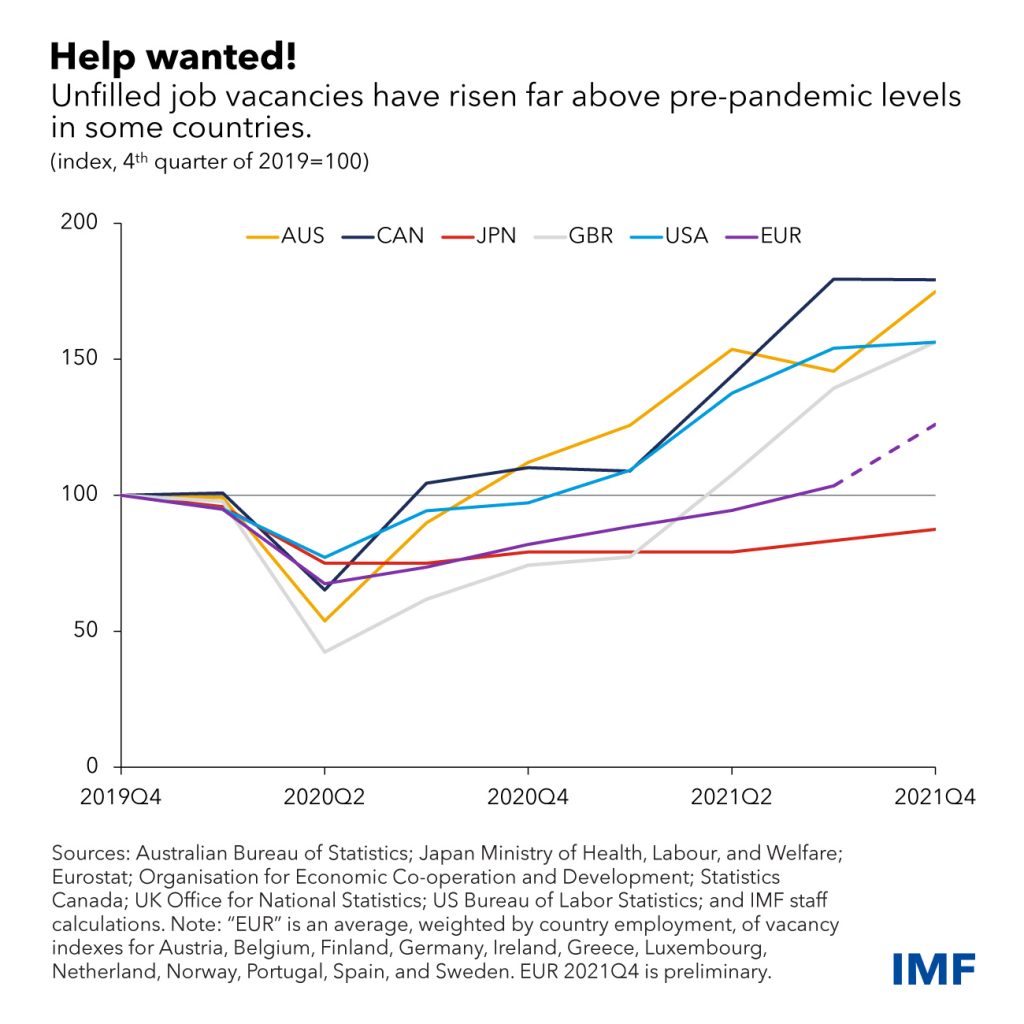
The rise in core inflation reflects multiple factors. Demand has rebounded strongly supported by exceptional fiscal and monetary measures, especially in advanced economies. In addition, supply disruptions caused by the pandemic and climate change, and a shift in spending toward goods over services have increased price pressures. Furthermore, wage pressures are apparent in some segments of labor markets. The United States has experienced a more prolonged reduction in labor-force participation relative to other advanced economies, further adding to wage and inflationary pressures.
We expect the mismatch in supply and demand to attenuate over time reducing some price pressures in countries. Under the baseline, shipping delays, delivery lags, and semiconductor shortages will likely improve in the second half of 2022. Aggregate demand should soften as fiscal measures come off in 2022.
That said, it’s important to keep in mind that economic activity has rebounded quickly in several countries, with the United States experiencing the fastest recovery among large, advanced economies. It is in such countries, where economic activity has rebounded more quickly to pre-pandemic trends, that core inflation has risen sharply relative to levels before the crisis. This relationship between recovery strength and core inflation, while far from perfect, suggests stronger underlying inflationary pressures in countries where demand has recovered the fastest.
Varied policy action
At the onset of the pandemic, policymakers around the world were synchronized in dramatically easing monetary policy and expanding fiscal policy. These actions helped prevent a global financial crisis, despite lockdowns and health shocks causing a historic recession. The confluence of very low inflation and weak demand provided a strong rationale for easy monetary policies.
Earlier this year, when inflation picked up sharply, it was driven by exceptionally high inflation in a few sectors such as energy and autos, much of which was expected to reverse by the end of the year as pandemic related disruptions declined. Central banks, with a long track record of keeping inflation low and stable could appropriately “look through” the runup in inflation and keep interest rates low to support the economic recovery.
However, risks of a further acceleration of inflation previously flagged in our global publications and country-specific reports are materializing, with supply disruptions and elevated demand lasting longer than expected. Inflation is likely to be higher for longer than previously thought, which means that real rates are even lower than before, implying an increasingly expansionary stance of monetary policy.
While we still anticipate that supply-demand imbalances will wane next year, a singular focus of monetary policy on supporting recovery may well fuel substantial and persistent inflationary pressures, with some risk of de-anchoring inflation expectations. Accordingly, in countries where economic recoveries are further along and inflationary pressures more acute it would be appropriate to accelerate the normalization of monetary policy.
Potentially challenging spillovers
The challenge of addressing large and persistent supply shocks is even greater for emerging market central banks. Given the greater risk to de-anchoring of inflation expectations relative to advanced economies, they see the need to get ahead of inflationary pressures and some—such as Brazil and Russia—have raised policy rates sharply. Such tightening comes amid large COVID-related output shortfalls and could further depress output and employment. Emerging markets face potentially challenging spillovers if tightening by advanced economies causes capital outflows and exchange rate pressures that could require them to tighten even more.
Lastly, there remains tremendous uncertainty around the evolution of the pandemic and on its economic consequences. A variant that significantly reduces vaccine efficacy could lead to further supply chain disruptions and contractions in labor supply pushing up inflationary pressures, while lower demand could have opposing effects. The sharp fall in oil prices following the discovery of Omicron and the rapid imposition of travel restrictions by countries is a sign of the volatility ahead.
In sum, policymakers must carefully calibrate their response to incoming data. Varying inflation conditions and strength of recoveries across countries show why the policy response needs to be tailored to country specific circumstances, given sharply higher uncertainty associated with Omicron. Clear central bank communication, too, is key to fostering a durable global recovery.
As we warned in recent reports such as the World Economic Outlook, a more frontloaded Fed response to dampen inflation risks could result in market volatility and create difficulties elsewhere—especially in emerging and developing economies. To avoid that, policy shifts need to be telegraphed well, as has so far been the case. Emerging market and developing economies should also prepare for increases in advanced economy interest rates through debt maturity extensions where feasible, thereby reducing their rollover needs, and regulators should also focus on limiting the buildup of currency mismatches on balance sheets.
Authors:

Tobias Adrian is the Financial Counsellor and Director of the IMF’s Monetary and Capital Markets Department

Gita Gopinath is the Chief Economist of the International Monetary Fund

Compliments of the IMF.
The post IMF | Addressing Inflation Pressures Amid an Enduring Pandemic first appeared on European American Chamber of Commerce New York [EACCNY] | Your Partner for Transatlantic Business Resources.

EACC

Modernising judicial cooperation: EU Commission paves the way for further digitalisation of EU justice systems

Today, the European Commission has adopted several initiatives to digitalise EU justice systems, making them more accessible and effective. The overarching aim of the measures is to make digital communication channels the default channel in cross-border judicial cases, thus translating one of the priorities set out in last year’s Communication on the Digitalisation of Justice into action.
In the EU’s internal market today, many legal disputes between citizens and businesses take place across borders. Also, to fight cross-border crime more effectively, different Member States and judicial systems need to work hand in hand. Investigative authorities and courts of different Member States need to cooperate and support each other in the investigation and prosecution of crimes and exchange information and evidence securely and swiftly.
Věra Jourová, Vice-President for Values and Transparency, said: “Crime does not stop at a border; neither should justice. Today’s proposals will help prosecutors and judges to cooperate faster and more effectively. We must make the best use of digital technologies to provide judicial authorities, citizens and businesses with swift and secure means of exchange of information. This is key for easier and faster access to justice.”
Didier Reynders, Commissioner for Justice, said: “Effective and quality justice systems require effective tools. We already have many instruments to facilitate EU cross-border judicial cooperation. However, not all of them are up-to-date and we urgently need to modernise them. Justice systems also need to be more resilient to crises. Courts should be able to function in all circumstances. This is a principle of rule of law. Equipping justice systems with the appropriate tools can support this objective.  Today, we are delivering on the Commission’s ambitions for creating a truly efficient and resilient European area of freedom, security and justice.”
Digitalisation of EU justice systems
The Commission has adopted the following initiatives today:
Digitalisation of cross-border judicial cooperation
The proposals on digitalisation of EU cross-border judicial cooperation and access to justice in civil, commercial and criminal matters will address two main problems: inefficiencies affecting cross-border judicial cooperation and barriers to access to justice in cross-border civil, commercial and criminal cases.
This Regulation will:

Enable parties to communicate with competent authorities electronically or to initiate legal proceedings against a party from another Member States.

Allow the use of videoconferencing in oral hearings in cross-border civil, commercial and criminal matters, which will result in speedier proceedings and less traveling.
Ensure the possibility of digital transfer of requests, documents and data between national authorities and courts.

Shifting communications, which are still exclusively paper-based today, to the electronic channel would not only have a positive environmental impact, but it would also save time, as well as up to approximately €25 million per year across the entire EU in postage and paper costs.
Digital information exchange in terrorism cases
There will be two proposals to effectively fight terrorism and other forms of serious cross-border crime. Currently Member States send information on judicial cases related to terrorism to Eurojust via various, often unsecure channels, for example via emails or CD-ROMs. In addition, Eurojust has an outdated information system, which is not able to crosscheck information properly. The initiative’s objective is to modernise these practices.
The Regulation will:

Digitalise the communication between Eurojust and the Member States’ authorities and provide secure communication channels.

Enable Eurojust to effectively identify links between prior and ongoing cross-border terrorism cases and other forms of serious cross-border crimes.
Based on the identification of such links, Member States will be able to coordinate their investigation measures and judicial responses.

Development of the JITs Collaboration Platform
This is a proposal for a establishing a collaboration platform for Joint Investigation Teams (JITs). These teams are set up for specific criminal investigations by two or more States. Although these teams have proven to be successful, practice shows that they face several technical difficulties. Exchanges are currently overly slow and burdensome. A dedicated IT platform would allow JITs to more easily share information and evidence and to more safely communicate with each other so that they can jointly manage their operations.
Next steps
The European Parliament and the Council of Ministers of the EU will now negotiate the Commission’s proposals.
Background
In December 2020, the Commission adopted initiatives to modernise the EU Justice Systems, proposing a set of measures towards furthering the digitalisation at both the national and EU level. The two main pillars of this package were the Communication on the digitalisation of justice in the EU, and the Strategy on European judicial training. This digital justice toolbox aimed at further supporting Member States to move ahead their national justice systems towards the digital era and at improving EU cross-border judicial cooperation between competent authorities.
Today’s initiatives are a follow-up to last year’s Communication. The measures aim to digitalise interactions between justice related authorities, harnessing the efficiency of the modern communication tools where civil and criminal procedures, combating terrorism and investigations in general, require it.
Compliments of the European Commission.
The post Modernising judicial cooperation: EU Commission paves the way for further digitalisation of EU justice systems first appeared on European American Chamber of Commerce New York [EACCNY] | Your Partner for Transatlantic Business Resources.
EACC

Global Gateway: up to €300 billion for the European Union’s strategy to boost sustainable links around the world

Today, the European Commission and the High Representative for Foreign Affairs and Security Policy launch the Global Gateway, the new European Strategy to boost smart, clean and secure links in digital, energy and transport and strengthen health, education and research systems across the world. It stands for sustainable and trusted connections that work for people and the planet, to tackle the most pressing global challenges, from climate change and protecting the environment, to improving health security and boosting competitiveness and global supply chains. Global Gateway aims to mobilise up to €300 billion in investments between 2021 and 2027 to underpin a lasting global recovery, taking into account our partners needs and EU’s own interests.
President of the European Commission, Ursula von der Leyen, said: “COVID-19 has shown how interconnected the world we live in is. As part of our global recovery, we want to redesign how we connect the world to build forward better. The European model is about investing in both hard and soft infrastructure, in sustainable investments in digital, climate and energy, transport, health, education and research, as well as in an enabling environment guaranteeing a level playing field. We will support smart investments in quality infrastructure, respecting the highest social and environmental standards, in line with the EU’s democratic values and international norms and standards. The Global Gateway Strategy is a template for how Europe can build more resilient connections with the world.”
High Representative/Vice-President, Josep Borrell, said: “Connections across key sectors help to build shared communities of interest and reinforce the resilience of our supply chains. A stronger Europe in the world means a resolute engagement with our partners, firmly grounded in our core principles. With the Global Gateway Strategy we are reaffirming our vision of boosting a network of connections, which must be based on internationally accepted standards, rules and regulations in order to provide a level-playing field.”
The EU has a long track record as a trusted partner to deliver sustainable and high quality projects, taking into account the needs of our partner countries and ensure lasting benefits for local communities, as well as the strategic interests of the European Union.
Global Gateway is about increasing investments promoting democratic values and high standards, good governance and transparency, equal partnerships, green and clean, secure infrastructures and that catalyse private sector investment.
Through a Team Europe approach, Global Gateway will bring together the EU, Member States with their financial and development institutions, including the European Investment Bank (EIB), and the European Bank for Reconstruction and Development (EBRD) and seek to mobilise the private sector in order to leverage investments for a transformational impact. The EU Delegations around the world, working with Team Europe on the ground, will play a key role to identify and coordinate Global Gateway projects in partner countries.
Global Gateway draws on the new financial tools in the EU multi-annual financial framework 2021-2027. The Neighbourhood, Development and International Cooperation Instrument (NDICI)-Global Europe, the Instrument for Pre-Accession Assistance (IPA) III, as well as Interreg, InvestEU and the EU research and innovation programme Horizon Europe; all allow the EU to leverage public and private investments in priority areas, including connectivity. In particular, the European Fund for Sustainable Development+ (EFSD+), the financial arm of NDICI-Global Europe will make available up to €135 billion for guaranteed investments for infrastructure projects between 2021 and 2027 up to €18 billion will be made available in grant funding from the EU budget and European financial and development finance institutions have up to €145 billion in planned investment volumes.
Further adding to its financial tool kit, the EU is exploring the possibility of establishing a European Export Credit Facility to complement the existing export credit arrangements at Member State level and increase the EU’s overall firepower in this area. The Facility would help ensure a greater level playing field for EU businesses in third country markets, where they increasingly have to compete with foreign competitors that receive large support from their governments, and thus facilitate their participation in infrastructure projects.
The EU will offer not only solid financial conditions for partners, bringing grants, favourable loans, and budgetary guarantees to de-risk investments and improve debt sustainability – but also promote the highest environmental, social and strategic management standards. The EU will provide technical assistance to partners to enhance their capacity to prepare credible projects ensuring value for money in infrastructure.
Global Gateway will invest in international stability and cooperation and demonstrate how democratic values offer certainty and fairness for investors, sustainability for partners and long-term benefits for people around the world.
This is Europe’s contribution to narrowing the global investment gap, that requires a concerted effort in line with the June 2021 commitment of the G7 Leaders to launch a values-driven, high-standard, and transparent infrastructure partnership to meet global infrastructure development needs.
The EU is committed to working with like-minded partners to promote sustainable connectivity investments. Global Gateway and the US initiative Build Back Better World will mutually reinforce each other. This commitment to working together was reaffirmed at COP26, the 2021 United Nations Climate Change Conference, where the EU and the United States brought together like-minded partners to express their shared commitment to addressing climate crisis through infrastructure development that is clean, resilient and consistent with a net-zero future.
Global Gateway builds on the achievements of the 2018 EU-Asia Connectivity Strategy, the recently concluded Connectivity Partnerships with Japan and India, as well as the Economic and Investment Plans for the Western Balkans, the Eastern Partnership, and the Southern Neighbourhood. It is fully aligned with the UN’s 2030 Agenda and its Sustainable Development Goals (SDGs) and the Paris Agreement.
Next steps
Global Gateway projects will be developed and delivered through Team Europe Initiatives. The EU institutions, Member States, and European financial institutions will work together with European businesses as well as governments, civil society and the private sector in partner countries.
Under the overall steer of the President of the Commission, the High Representative/Vice-President of the Commission, the Commissioners for International Partnerships and Neighbourhood and Enlargement will take forward the implementation of Global Gateway, and promote coordination among all actors.
Members of the College said
Commissioner for International Partnerships, Jutta Urpilainen, stated: “The Global Gateway Strategy is Europe’s offer to build partnerships of equals, which reflect Europe’s long-term commitment to the sustainable recovery in each of our partner countries. With the Global Gateway we want to create strong and sustainable links, not dependencies- between Europe and the world and build a new future for young people.”
Commissioner for Neighbourhood and Enlargement, Olivér Várhelyi, added: “Global connectivity for the EU starts with its neighbourhood. The Economic and Investment Plans we have recently launched for the Western Balkans, the Eastern and Southern Neighbourhood are all built around connectivity. Connectivity with Europe, connectivity within these regions. Developed in close cooperation with our partners, these Plans will start to deliver the Global Gateway Strategy in our neighbouring regions still within the mandate of this Commission.”
Compliments of the European Commission.
The post Global Gateway: up to €300 billion for the European Union’s strategy to boost sustainable links around the world first appeared on European American Chamber of Commerce New York [EACCNY] | Your Partner for Transatlantic Business Resources.
Read More
EACC

FSB | Good Practices for Crisis Management Groups (CMGs)

Crisis Management Groups (CMGs) of Global Systemically Important Banks (G-SIBs) have been in place for over 10 years as a core part of the post global financial crisis coordination infrastructure.

This report sets out good practices that have helped CMGs to enhance their preparedness for the management and resolution of a cross-border financial crisis affecting a Global Systemically Important Bank (G-SIB) as per the FSB Key Attributes. It draws on a stocktake carried out by the FSB in 2020 and CMG members’ experience during the COVID-19 pandemic.
The focus is on CMG activities that seek to enhance crisis preparedness rather than on cooperation during a actual itself. The good practices identified in this report are organised along 16  desired outcomes that CMGs seek to achieve and relate to:

the structure and operation of CMGs;
resolution policy, strategy and resolvability assessments;
coordination on enhancing firm’s resolvability; and
enhancing home-host coordination arrangements for crisis preparedness.

A shared understanding of these practices can help lean against fragmented approaches and help to enhance the effectiveness of CMGs.. While many of these practices have been well established, others are emerging or developing.
As CMGs continue to evolve, the FSB will continue to monitor the development of their practices and consider any future work to promote consistency and effective operation of CMGs.
Compliments of the Financial Stability Board.
The post FSB | Good Practices for Crisis Management Groups (CMGs) first appeared on European American Chamber of Commerce New York [EACCNY] | Your Partner for Transatlantic Business Resources.
EACC

FSB Statement to Support Preparations for LIBOR Cessation

Completion of the steps laid out in the FSB’s Global Transition Roadmap is now critical and market participants need to act urgently to ensure they are fully prepared for LIBOR cessation by the end of this year.
Most LIBOR panels will cease at the end of this year, with certain key USD settings continuing until end-June 2023 to support the rundown of legacy contracts, executed before January 1 2022, only.
Continued reliance of global financial markets on LIBOR poses risks to global financial stability. With only a few weeks remaining to the end of 2021, it is now critical that market participants act urgently to complete any remaining steps set out in the FSB’s Global Transition Roadmap, with global and national financial regulators closely monitoring progress. The FSB emphasises that the continuation of some key USD LIBOR tenors through to 30 June 2023 is intended only to allow legacy contracts to mature, as opposed to supporting new USD LIBOR activity.
The key points covered in the statement are as follows:

Significant progress has been made in transitioning to Risk-Free Rates (RFRs), but market participants still need to finalise preparations to cease new use of LIBOR by end-2021.
Transition should be primarily to overnight RFRs, the most robust benchmarks available, to avoid reintroducing the weaknesses of LIBOR.
Active transition of legacy contracts remains the best way for market participants to have control and certainty over their existing arrangements.

The report notes that the FSB will continue to monitor the final steps in completing LIBOR transition over the coming months. Post end-2021, the FSB will monitor the effort to continue reducing the stock of legacy contracts which are using synthetic LIBOR rates, any continuing new issuance of USD LIBOR contracts post end-2021, and the size and resolution of legacy contracts referencing USD LIBOR that are due to mature after end-June 2023. The FSB will review these issues in mid-2022 and assess the implications for any further supervisory and regulatory cooperation that may be required.
Compliments of the Financial Stability Board.
The post FSB Statement to Support Preparations for LIBOR Cessation first appeared on European American Chamber of Commerce New York [EACCNY] | Your Partner for Transatlantic Business Resources.

Read More
EACC

IMF | Global Financial Safety Net—A Lifeline for an Uncertain World

When economic crises hit, such as the one caused by the pandemic, countries have a number of financial resources—both internal and external—to draw on. The global financial safety net is a set of institutions and mechanisms that provide insurance against crises and financing to mitigate their impact.
This safety net has four main layers: countries’ own international reserves; bilateral swap arrangements whereby central banks exchange currencies to provide liquidity to financial markets; regional financial arrangements by which countries pool resources to leverage financing in a crisis; and the IMF.
As our chart of the week shows, this global financial safety net has expanded significantly in the past decade and its sources have become more diverse.
The chart, drawn from the recent IMF Special Series on COVID-19, shows that since the global financial crisis, the total stock of international reserve holdings more than doubled, reaching about $14 trillion by end-2020. Other layers of the safety net increased about tenfold, to about $4 trillion.
This increase reflects the expansion of the bilateral swap arrangements during the global financial crisis and the recent pandemic, as well as the establishment of new regional financial arrangements, especially in Europe (e.g., the European Stability Mechanism) and in South East Asia (the Chiang Mai Initiative Multilateralization). The IMF also more than doubled available resources in the aftermath of the global financial crisis.
This reinforced insurance helped effectively cushion the shock during the first year of the COVID-19 crisis. The increased bilateral swap arrangements, primarily the US Federal Reserve swaps, provided prompt liquidity support, helping to stabilize the global financial markets and capital flows to emerging market economies.
Financing from the regional financing arrangements remained low, as demand was contained by supportive macroeconomic policies in advanced economies, and timely financing from other global financial safety net sources.
For its part, the IMF remained the linchpin of the safety net, approving debt service relief and providing financial assistance to an unprecedented number of countries, including low-income and emerging market economies that did not benefit from bilateral or regional arrangements.
As countries continue to grapple with the fallout from the pandemic and face increased risks of tighter financial conditions, the continued use of the global financial safety net will likely be needed until the crisis is over.
Authors:

Alina Iancu is the mission chief for Bosnia and Herzegovina and Deputy Unit Chief in the European Department

Seunghwan Kim  is an economist in the Strategy, Policy, and Review Department of the IMF

Alexei Miksjuk is an economist in the Strategy, Policy, and Review Department

Compliments of the IMF.
The post IMF | Global Financial Safety Net—A Lifeline for an Uncertain World first appeared on European American Chamber of Commerce New York [EACCNY] | Your Partner for Transatlantic Business Resources.

EACC

U.S. FED | Testimony by Chair Powell on coronavirus and CARES Act

Chair Jerome H. Powell before the Committee on Banking, Housing, and Urban Affairs, U.S. Senate, Washington, D.C. |
Chairman Brown, Ranking Member Toomey, and other members of the Committee, thank you for the opportunity to testify today.
The economy has continued to strengthen. The rise in Delta variant cases temporarily slowed progress this past summer, restraining previously rapid growth in household and business spending, intensifying supply chain disruptions, and, in some cases, keeping people from returning to work or looking for a job. Fiscal and monetary policy and the healthy financial positions of households and businesses continue to support aggregate demand. Recent data suggest that the post-September decline in cases corresponded to a pickup in economic growth. Gross domestic product appears on track to grow about 5 percent in 2021, the fastest pace in many years.
As with overall economic activity, conditions in the labor market have continued to improve. The Delta variant contributed to slower job growth this summer, as factors related to the pandemic, such as caregiving needs and fears of the virus, kept some people out of the labor force despite strong demand for workers. Nonetheless, October saw job growth of 531,000, and the unemployment rate fell to 4.6 percent, indicating a rebound in the pace of labor market improvement. There is still ground to cover to reach maximum employment for both employment and labor force participation, and we expect progress to continue.
The economic downturn has not fallen equally, and those least able to shoulder the burden have been the hardest hit. In particular, despite progress, joblessness continues to fall disproportionately on African Americans and Hispanics.
Pandemic-related supply and demand imbalances have contributed to notable price increases in some areas. Supply chain problems have made it difficult for producers to meet strong demand, particularly for goods. Increases in energy prices and rents are also pushing inflation upward. As a result, overall inflation is running well above our 2 percent longer-run goal, with the price index for personal consumption expenditures up 5 percent over the 12 months ending in October.
Most forecasters, including at the Fed, continue to expect that inflation will move down significantly over the next year as supply and demand imbalances abate. It is difficult to predict the persistence and effects of supply constraints, but it now appears that factors pushing inflation upward will linger well into next year. In addition, with the rapid improvement in the labor market, slack is diminishing, and wages are rising at a brisk pace.
We understand that high inflation imposes significant burdens, especially on those less able to meet the higher costs of essentials like food, housing, and transportation. We are committed to our price-stability goal. We will use our tools both to support the economy and a strong labor market and to prevent higher inflation from becoming entrenched.
The recent rise in COVID-19 cases and the emergence of the Omicron variant pose downside risks to employment and economic activity and increased uncertainty for inflation. Greater concerns about the virus could reduce people’s willingness to work in person, which would slow progress in the labor market and intensify supply-chain disruptions.
To conclude, we understand that our actions affect communities, families, and businesses across the country. Everything we do is in service to our public mission. We at the Fed will do everything we can to support a full recovery in employment and achieve our price-stability goal.
Thank you. I look forward to your questions.

Summary of Section 13(3) Facilities Using CARES Act Funding

(Billions of Dollars)

Facility
Announced
Closed
Maximum capacity1

Peak amount of assets2

Current amount of assets2

Treasury equity remaining3

Corporate Credit Facilities
Mar. 23, 2020
Dec. 31, 2020
750
14.3
0
0

Main Street Lending Program
Apr. 9, 2020
Jan. 8, 2021
600
16.6
13.5
15.7

Municipal Liquidity Facility
Apr. 9, 2020
Dec. 31, 2020
500
6.4
4.2
4.2

TALF
Mar. 23, 2020
Dec. 31, 2020
100
4.1
1.4
1.4

Note: The data are current as of November 24, 2021.

1. The maximum authorized amount of facility asset purchases. Return to text

2. Current and peak outstanding amounts of facility asset purchases:

For the Corporate Credit Facilities (consisting of the Primary Market Corporate Credit Facility and the Secondary Market Corporate Credit Facility), includes exchange-traded funds at fair value and corporate bonds at book value. Asset balances from trading activity are reported with a one-day lag after the transaction date.

For the Main Street Lending Program, includes loan participations at principal amount outstanding, net of an allowance for loan losses, updated as of September 30, 2021.

For the Municipal Liquidity Facility, includes municipal notes at book value.

For the TALF (Term Asset-Backed Securities Loan Facility), includes loans to holders of eligible asset-backed securities at book value. Return to text

3. The amount of the Treasury contribution to the credit facilities. Return to text

Source: For the amount of assets and Treasury equity remaining, see Federal Reserve Board (2021), Statistical Release H.4.1, “Factors Affecting Reserve Balances of Depository Institutions and Condition Statement of Federal Reserve Banks” (November 26), https://www.federalreserve.gov/releases/h41; the peak amounts of assets for each facility are based on the H.4.1 from the start of the corresponding facility until November 24.
Compliments of the U.S. Federal Reserve.

The post U.S. FED | Testimony by Chair Powell on coronavirus and CARES Act first appeared on European American Chamber of Commerce New York [EACCNY] | Your Partner for Transatlantic Business Resources.

EACC

Capital Markets Union: EU Commission proposes new measures to boost Europe’s capital markets

The European Commission has today adopted a package of measures to improve the ability of companies to raise capital across the EU and ensure that Europeans get the best deals for their savings and investments. One year on from the 2020 Capital Markets Union Action Plan, the Commission is delivering on its commitments, proposing measures to boost European capital markets. This will help Europe’s economic recovery from the COVID-19 crisis, as well as the digital and green transitions. In addition, the Commission has put forward a Communication setting out the actions it will take next year to spur the market.
Today’s proposals will ensure that investors have better access to company and trading data. The measures will also encourage long-term investment and make it easier and safer for investment funds to be sold cross-border. Overall, today’s proposals will better connect EU companies with investors, improving companies’ access to funding, broadening investment opportunities for retail investors, and further integrating EU capital markets.
The legislative proposals adopted today are:
1. The European Single Access Point (ESAP): putting data at investors’ fingertips
The ESAP will offer a single access point for public financial and sustainability-related information information about EU companies and EU investment products. This will give companies more visibility towards investors, opening up more sources of financing. This is particularly important for small companies in small capital markets, as they will more easily be on the radar screen of EU, but also international investors. The ESAP will also contain sustainability-related information published by companies, which will support the objectives of the European Green Deal. As a common data space, the ESAP is a cornerstone of the EU’s Digital Strategy and the Digital Finance Strategy.
2. Review of the European Long-Term Investment Funds (ELTIFs) Regulation: encouraging long-term investment, including by retail investors
Today’s review will increase the attractiveness of ELTIFs for investors and their role as a complementary source of financing for EU companies. It will also make it easier for retail investors to invest in ELTIFs, in particular by removing the minimum €10,000 investment threshold, while ensuring strong investor protection. Since ELTIFs are designed to channel long-term investments, they are well placed to help finance the green and digital transitions.
3. Review of the Alternative Investment Fund Managers Directive (AIFMD)
Today’s changes will enhance the efficiency and integration of the Alternative Investment Funds market. The proposal harmonises the rules related to funds that give loans to companies. This will facilitate lending to the real economy, while better protecting investors and ensuring financial stability. The review also clarifies the rules on delegation. EU rules on delegation allow fund managers to source expertise from third countries. Today’s review will ensure that there is adequate information and coordination among EU supervisors, better protecting investors and financial stability.
4. Review of the Markets in Financial Instruments Regulation (MiFIR): enhancing transparency by introducing a “European consolidated tape” for easier access to trading data by all investors
Today’s adjustments to EU trading rules will ensure more transparency on capital markets. They will introduce a “European consolidated tape”, which will give investors access to near real-time trading data for stocks, bonds and derivatives across all trading venues in the EU. So far, this access has been limited to a handful of professional investors. Today’s review will also enhance the level playing field between stock exchanges and investment banks. In addition, it will promote the international competitiveness of EU trading venues by removing the open access rule.
Building on the actions announced in the 2020 Capital Markets Union (CMU) Action Plan, the Commission will follow up in 2022 with more CMU actions, including a proposal on listing, an open finance framework, an initiative on corporate insolvency and a financial literacy framework.
Members of the College said:
Valdis Dombrovskis, Executive Vice-President for an Economy that Works for People, said: “Europe needs vibrant and integrated capital markets to boost the real economy and bounce back after the COVID-19 crisis. Today’s proposals take us a significant step closer towards creating the Capital Markets Union. This is important for the growth of the EU economy. We achieve this by improving access to company and trading data, and gearing investments towards our sustainability and digital priorities. Today’s package has a strong focus on helping small companies in small capital markets, making it easier for SMEs to find and access different sources of funding. It will also enhance the international competitiveness of the EU as a place to trade.”
Mairead McGuinness, Commissioner responsible for financial services, financial stability and Capital Markets Union said, “Capital markets play an essential role, alongside banks, in financing our economy but more progress is needed to move towards the completion of the Capital Markets Union.  We are today taking action at various levels: making our capital markets more transparent, facilitating access to financial and sustainability-related data, and making investment products such as ELTIFs and other alternative investment funds more attractive to investors and fund managers. This will better serve the needs of companies seeking finance to grow their business, which is crucial for the recovery and in meeting our green and digital objectives. But we are not stopping here; we are also announcing today more ambitious CMU initiatives to come in 2022 on access for companies to public markets, open finance, financial education and insolvency.”
Next steps
All elements of the legislative package will now be discussed by the European Parliament and the Council. Time is of essence and we invite the co-legislators to start work on these proposals as soon as possible.
Background
The goal of the Capital Markets Union (CMU) is to create a truly single market for capital across the EU. It aims to get investment and savings flowing across all Member States, benefitting citizens, investors and companies, no matter where in the European Union they are based. This is all the more urgent in light of the COVID-19 crisis and the financing needed to support the recovery, sustainable growth and the twin green and digital transitions.
Deepening the CMU is a complex task and there is no single measure that will complete it. Therefore, we need to make progress in all areas where barriers to the free movement of capital still exist. The four legislative proposals adopted today are an important step in the implementation of the Commission’s 2020 CMU Action Plan. They tackle problems across a broad range of capital market services and help achieve the core objectives of the CMU.
Compliments of the European Commission.
The post Capital Markets Union: EU Commission proposes new measures to boost Europe’s capital markets first appeared on European American Chamber of Commerce New York [EACCNY] | Your Partner for Transatlantic Business Resources.

EACC

Christine Lagarde Speech | Change and continuity in law

Keynote speech by Christine Lagarde, President of the ECB, at the ECB Legal Conference 2021 | Frankfurt am Main, 26 November 2021 |

Introduction
Ladies and gentlemen,
The first President of the European Commission, Walter Hallstein, famously said that the European Union is a “community of law”[1] – an expression which was then picked up by the European Court of Justice in its judgments. The rule of law is one of the basic principles of our Union, and one we have to defend – especially at times when it is put at risk of being attacked.[2]
This principle means that EU law is the cement that keeps the European construction together. It is the precondition for the very existence of the EU institutions, including the ECB, and for the policies that they are mandated to carry out. But there is an ever-present tension between the role of law as an immutable anchor of society and its need to adapt as the world changes.
Europe’s reaction to the coronavirus (COVID-19) crisis has led to a number of institutional innovations, leading some to deem it a “Hamiltonian moment for Europe”. This epithet primarily reflects Alexander Hamilton’s guiding role in creating the US fiscal and monetary institutional set-up. But there is also a second reason why the description fits. Hamilton – a lawyer – was one of the first to introduce the question of the relationship between change and law, and of the role that interpretation – in particular the authoritative interpretation by judges – can have in this context.
This issue has developed into a decades-long debate between “originalism” and “realism” in US scholarship. The same question has also shaped the way in which the notion of an ever-closer Union, the foundation of the EU Treaties, has been developed by the jurisprudence of the Court of Justice. And it continues to shape Europe’s future direction today.
In my remarks this morning, I would like to review the evolution of this debate in US law, starting with Hamilton himself. I will then turn to EU law and ask whether the lessons we can draw from legal history can help give us a sense of direction for the challenges of today and tomorrow.
Hamilton and the Constitution
Hamilton is nowadays credited for having been the father of the US fiscal union, and – as further proof of how these two things go hand in hand – he was also the father of the first central bank of the United States. The US legislature then abolished and re-established a nationwide central bank twice before finally settling on the Federal Reserve System in 1913.
Change is the result of a process of trial and error, and one which can easily end up back at square one – as happened with the repeated attempts to do away with the institution of a central bank altogether to create a new monetary system. To cater for the right balance between the aspiration to experiment and the need to limit errors, legal frameworks include provisions of constitutional rank. These rules[3] provide an element of continuity which anchors the whole system and to which “regular” laws are hierarchically subordinated: laws can be passed by the majorities of the time, but the Constitution is typically very difficult to amend.
However, change in law is pursued not only through the enactment of new laws, but also in the way law is interpreted and applied. And, because they are difficult to amend, this is particularly important for legal provisions having a constitutional rank. Factual contexts can change, and the question then arises whether there is scope for the interpretation of such provisions to change as well, which may be better suited to new social or economic circumstances.
This question is primarily for courts to decide, which have been tasked with interpreting provisions with a constitutional rank. But it also applies to other institutions which have to apply those provisions.
Hamilton famously wrote that judges, in order to preserve the people’s rights and privileges, must have authority to check legislation and acts of the executive for constitutionality. But at the same time, the judiciary, by the very nature of its functions, will always be “the least dangerous” branch of government, for judges hold neither the sword nor the purse of the community; ultimately, they must depend upon the political branches to effectuate their judgments[4].
Hamilton was pointing to the very delicate balance which must be struck between the political legitimation of democratic bodies, which relies on the people, and the authority of independent institutions such as the judiciary – or even central banks – which relies on the law. Since the law is the only source of legitimation of these institutions, the exact meaning and scope of the law – in other words, its interpretation – becomes an issue of crucial importance.
The original meaning of the law in US legal scholarship: continuity and change
If the authority of courts – and the powers of other independent institutions – indeed relies on the law, a question that may be asked is “which law”?
Nobody would disagree with the law narrowly defined, i.e. the provisions under a certain legal framework, having been approved by a certain authority which is entrusted with this power, and following a certain procedure. But the answer becomes more complicated if one considers a broader interpretation, such as the adjudication of the law by the courts.
According to a traditional view, judges are just “the living voice of the Law”[5], while others deem that the idea of law should be stretched to include judicial adjudication[6]. This fascinating debate has been at the centre of legal scholarship for most of the last century, and in the United States it has become the cleavage in the US Supreme Court across which contentious wedge issues have spanned.
The more traditional, “formalist” approach posits that the legal system is composed of a hierarchical system of norms where each level is validated by a superior one. The prevalent view in US legal scholarship in the first part of the last century, which is still represented in the Supreme Court today, is that the aim of interpretation should be to find out the original meaning of the law as drafted by the legislators – or alternatively, the original intention of these drafters. The Constitution should not only be lex legum, a law of laws, but also lex immutabilis, unalterable law, unless explicitly changed via the amendment process. This school of thought is known as “originalism”.
In the 1930s, an opposing movement – the “realist movement” – arose in US legal scholarship. This movement challenged the understanding and very meaning of the concept of law, which in its view should have a much broader scope than legislation alone. That concept should include, inter alia, decision-making by judicial authorities, since “judges do and must legislate” – although only to the extent of filling gaps between positive norms by way of interpretation[7].
This debate between the originalist and realist schools of thought has animated US legal doctrine during the last century, and in more recent times has been personified in the amicable dissent between Supreme Court Justices Scalia and Ginsburg[8]. According to the realists, the very high bar to amend the US Constitution means that the originalist approach introduces an element of rigidity into the legal framework. And this becomes increasingly burdensome as time goes by and the world changes more and more from that which existed when the US Constitution was originally drafted. This is why the realist school has advocated using interpretation to make the legal framework more dynamic, allowing society to adapt to evolving circumstances.
The 14th Amendment, one of the amendments adopted after the War of Secession extending citizenship and civil rights, has been the battlefield par excellence for this debate. And it has been an extremely concrete debate for those people who did not originally benefit from constitutional rights and protections. Indeed, the first part of US constitutional history was defined by the extension of these rights and safeguards to once-excluded groups, such as people from ethnic minorities (including those who were formerly enslaved), men without property, and women[9].
Yet these important changes – which sound obvious to us today – happened to a large extent without changes to the text of the Constitution, so much so that originalist scholars rebelled against what they saw as an abusive use of powers by the Court[10]. In her Madison Lecture, Justice Ginsburg recalled that many of the framers of the Constitution spoke publicly against extending even voting rights to women or black people, who they explicitly saw as a danger.[11]
However, the US Constitution, which does not speak about “equality” with regard to individual rights, had within it the potential to become the foundation on which the rights of women and minorities could be grounded. Remarkably, Justice Ginsburg herself mentioned in the same Madison Lecture that “with prestige to persuade, but not physical power to enforce, with a will for self-preservation and the knowledge that they are not “a bevy of Platonic Guardians,” the Justices generally follow, they do not lead, changes taking place elsewhere in society”.[12]
The Treaty as a new step in the process of creating an ever-closer Union
This debate has shown that there is an inherent tension in law, between change on the one hand and the preservation of the legacy of the past on the other. Cutting across the ideals of change and continuity are the roles of legislation and interpretation in law. It should be no surprise that this tension also exists in EU law.
On the one hand, several elements can be used to argue in favour of the immutable nature of the Treaties as drafted by the Herren der Verträge: above all, the principle of conferral and, to a lesser extent, the principle of subsidiarity and the reference to constitutional identities. The burdensome process for introducing amendments also points in this direction.
On the other hand, the very wording of the Treaties lends itself to a dynamic interpretation, most tellingly when they refer to a “process of creating an ever-closer Union”, of which the Treaties themselves are only “a new step”. Indeed, there are several Treaty provisions that explicitly cater for the need to adapt to changes.
First, there is the general enabling clause, which foresees that the EU Council can unanimously adopt the measures necessary to attain one of the objectives of the Treaties when the Treaties themselves have not provided the necessary powers.[13] Second, there are other more specific provisions which allow the expansion of the tasks and powers assigned to the EU and its institutions. These include the provision on the basis of which the prudential supervision of banks was assigned to the ECB in 2014, without a Treaty change.[14]
There are also several provisions which, in a changing world, can be interpreted to cover new developments. Consider the digital euro or climate change: in both cases the provisions are already there but need to be interpreted to apply to new phenomena. To be the source of authoritative interpretation of EU law, including its founding Treaties, this role is assigned by the Treaties specifically to the European Court of Justice.
The discussions in the EU today on upholding the rule of law are a clear example of how a legal basis in the Treaties has been reinterpreted as the foundation of a whole new framework – a framework which had not been expressly provided for by the drafters of the Treaties, but which the Treaties had the potential to express, and which is in itself providing the basis for the independence of the judiciary in the national context. Even concepts such as the direct effect and primacy of EU law do not stem from the Treaties directly, but from their interpretation in early ground-breaking judgments such as Van Gend en Loos[15] and Costa Enel[16], respectively.
The jurisprudential origin of these concepts has been used by some Member States to challenge the legitimacy of the Court’s role and of the primacy of EU law itself. These challenges have taken place in the alleged defence of the real intentions of the Herren der Verträge when they signed the Treaties.
Proponents of change often call for new legislation to make change happen – most of the time because it is thought that only legislation can provide the necessary degree of clarity and certainty. However, pursuing the route of legislative change can serve as a way to resist reforms which would otherwise be possible in a context of the continuity of existing rules and their adapted interpretation. This is particularly true in a multilateral context like that of the EU, where a double majority in the European Parliament and EU Council is required to adopt legislation. The bar becomes even higher in the case of changes to the Treaties themselves, where the unanimity of Member States is required, including national ratification procedures which sometimes require referendums.
Member States provide important – although often silent – testimonials to the possibility of using the flexibility in the Treaties to adapt to change without amending the text itself. If Member States do not oppose an interpretation of the law which is developed in view of changed circumstances, it can be seen as a validation mechanism for the interpretative change. Indeed, since the Treaty of Lisbon entered into force, there have been almost no changes to the text of the Treaties[17], yet in this period the EU went through the global financial crisis, the migration crisis and more recently the COVID-19 crisis. The evolutive nature of EU law has allowed it to expand and refine the profile and type of intervention that the EU can propose in reaction to a crisis. Today, many measures are possible which 15 years ago would not have even seemed plausible.
Proponents of a careful scrutiny of the action of EU institutions to avoid them overstepping their mandates stress that an evolutive interpretation is not the law that was written in the Treaties, and that this represents undue interference by the Court of Justice in the sovereign decisions of Member States. At the same time, one has to observe that Treaty amendments are nowadays invoked as being required for changes which are often of a technical nature and relatively narrow in scope. This stands in contrast to the incremental evolution which took place in EU law during the first decades and in the absence of any change to the founding Treaties.
In a complex, multi-layered institutional framework such as the EU, one should not see this issue as being limited to a looming conflict between independent courts and Member States. Courts can rightly argue among themselves about different interpretations of the law, and even about the extent to which another court has been given a mandate by the law to give a binding interpretation.
Yet we have challenges that our US friends do not, because within a single system with a single ultimate jurisdictional authority, reconciliation is possible at the top. The language of legal pluralism has been useful to keep everything together, but there is a limit at which the presence of multiple voices, which claim for themselves the role of ultimate deciders, turns from being a resource into a risk – that is, the risk of perennial standstill, where no move is possible without Treaty change.
While this may be seen as a virtue by some – the EU version of the originalists – it is a risk insofar as such a system is inflexible and the idea that change is possible in continuity is denied. It is therefore increasingly becoming apparent that only discontinuity can deliver change. As institutions devoted to continuity, central banks should question if this is what we want.
Conclusion
Let me conclude.
Change can be pursued in many ways, and it is not necessarily true that those which are more eye-catching are also the most effective. Particularly effective are those changes which take place in continuity. One particular case is that of the law, which can be interpreted in a way that makes sense and adapts to societal changes, while remaining coherent with the fundamental principles of the legal system. This ensures continuity in the meaning of the law, in the sense that the text of the law has not changed at all.
Against this background, events like this conference are extremely important, because they offer an occasion to foster discussions, new ways of thinking and possible new ways of interpreting the law, without changing it, in a way that better suits the needs of today.
Following the lesson of Justice Ginsburg, independent institutions which ground their legitimation in the law should stand ready to adapt to the changes which happen in society. And they should interpret and apply the law consequentially, in the way that best serves the needs of the societies and polities which these institutions are meant to serve.
Compliments of the European Central Bank.

Hallstein, W. (1962), “Die EWG—Eine Rechtsgemeinschaft. Rede anlässlich der Ehrenpromotion”, University of Padua, 12 March, in Hallstein, W., Europäische Reden, pp. 343-44.

The programme of the ECB Legal Conference is available on the ECB’s website.

Which may or may not be referred to as a constitution, like in the case of the Treaties in the EU legal framework.

Hamilton, A., The Federalist Papers, No 78.

“Les juges … ne sont que la bouche qui prononce les paroles de la loi, des êtres inanimés qui n’en peuvent modérer ni la force ni la rigueur.” See Montesquieu (1748), De l’esprit des lois.

For some, even interpretation as such, and the factual context insofar as it influences such interpretation (and thereby judicial adjudication).

Southern Pac. Co. v Jensen, 244 U.S. 205, 221 (1917) (Holmes, J., dissenting). Even the father of the Reine Rechtslehre, Hans Kelsen, admitted that in applying the law to an individual case some margins for interpretation by judicial authorities are inevitable. See von Bernstorff, J., “Hans Kelsen’s Judicial Decisionism versus Carl Schmitt’s Concept of the One ‘Right’ Judicial Decision: Comments on Stanley L Paulson, ‘Metamorphosis in Hans Kelsen’s Legal Philosophy’ (2017) 80(5) MLR 860-894”, Modern Law Review.

Monaghan, H.P. (2004), “Doing Originalism”, Scholarship Archive, Columbia Law School.

Morris, R.B. (1987), The Forging of the Union, 1781-1789, Harper & Row, New York, pp. 162-163.

Berger, R. (1977), Government by Judiciary: The Transformation of the Fourteenth Amendment, Harvard University Press.

Ginsburg, R. (1992), “Speaking in a judicial voice”, New York University Law Review, Vol. 67, No 6, pp. 1185-1209.

In doing so, Justice Ginsburg referred to a piece of scholarship by Archibald Cox, tellingly entitled “The Role of the Supreme Court: Judicial Activism or Self-Restraint?” (Cox, A. (1987), “The Role of the Supreme Court: Judicial Activism or Self-Restraint?”, Maryland Law Review, Vol. 47, No 1, pp. 118-138).

Article 352 TFEU.

Article 127(6) TFEU.

Judgment of the Court of 5 February 1963, NV Algemene Transport- en Expeditie Onderneming van Gend & Loos v Netherlands Inland Revenue Administration, C-26/62, ECLI:EU:C:1963:1.

Judgment of the Court of 15 July 1964, Flaminio Costa v E.N.E.L., C-6/64, ECLI:EU:C:1964:66.

With the important exception of the addition of a new paragraph to Article 136 TFEU.

The post Christine Lagarde Speech | Change and continuity in law first appeared on European American Chamber of Commerce New York [EACCNY] | Your Partner for Transatlantic Business Resources.