EACC

COVID-19: 90 Day Postponement of Payment for the Deposit of Certain Estimated Duties, Taxes, and Fees

“On April 20, 2020, the Secretary of the Treasury and U.S. Customs and Border Protection (CBP) will be postponing for 90 calendar days the deadline for payment for the deposit of certain estimated duties, taxes, and fees for importers experiencing a significant financial hardship due to the coronavirus disease (COVID-19). This temporary postponement applies to formal entries of merchandise entered, or withdrawn from warehouse, for consumption (including entries for consumption from a Foreign Trade Zone) in March 2020 or April 2020. CBP will not return deposits of estimated duties, taxes, and fees that have already been paid….”
CONTINUE READING: COVID-19 – 90 Day Postponement of Paymentfor the Deposit of Certain Estimated Duties, Taxes, and Fees
Compliments of Fracht, USA. 

EACC

ECB takes steps to mitigate impact of possible rating downgrades on collateral availability

April 22, 2020 |
• ECB to grandfather until September 2021 eligibility of marketable assets used as collateral in Eurosystem credit operations falling below current minimum credit quality requirements
• Appropriate haircuts will apply for assets that fall below the Eurosystem minimum credit quality requirements
• Decision reinforces broader package of collateral easing measures adopted by the Governing Council on 7 April 2020, which will also remain in place until September 2021
• ECB may decide further measures, if needed, to continue ensuring the smooth transmission of its monetary policy in all jurisdictions of the euro area
The Governing Council of the European Central Bank (ECB) today adopted temporary measures to mitigate the effect on collateral availability of possible rating downgrades resulting from the economic fallout from the coronavirus (COVID-19) pandemic. The decision complements the broader collateral easing package that was announced on 7 April 2020. Together these measures aim to ensure that banks have sufficient assets that they can mobilise as collateral with the Eurosystem to participate in the liquidity-providing operations and to continue providing funding to the euro area economy.
Specifically, the Governing Council decided to grandfather the eligibility of marketable assets and the issuers of such assets that fulfilled minimum credit quality requirements on 7 April 2020 in the event of a deterioration in credit ratings decided by the credit rating agencies accepted in the Eurosystem as long as the ratings remain above a certain credit quality level. By doing so, the Governing Council aims to avoid potential procyclical dynamics. This would ensure continued collateral availability, which is crucial for banks to provide funding to firms and households during the current challenging times.
The following decisions have been taken:
• Marketable assets and issuers of these assets that met the minimum credit quality requirements for collateral eligibility on 7 April 2020 (BBB- for all assets, except asset-backed securities (ABSs)) will continue to be eligible in case of rating downgrades, as long as their rating remains at or above credit quality step 5 (CQS5, equivalent to a rating of BB) on the Eurosystem harmonised rating scale. This ensures that assets and issuers that were investment grade at the time the Governing Council adopted the package of collateral easing measures remain eligible even if their rating falls two notches below the current minimum credit quality requirement of the Eurosystem.
• To be grandfathered, the assets need to continue to fulfil all other existing collateral eligibility criteria.
• Future issuances from grandfathered issuers will also be eligible provided they fulfil all other collateral eligibility criteria.
• Currently eligible covered bond programmes will also be grandfathered, under the same conditions.
• Currently eligible ABSs to which a rating threshold in the general framework of CQS2 applies (equivalent to a rating of A-) will be grandfathered as long as their rating remains at or above CQS4 (equivalent to a rating of BB+).
• Assets that fall below the minimum credit quality requirements will be subject to haircuts based on their actual ratings.
Non-marketable assets are not part of the scope of the temporary grandfathering. All measures will enter into effect as soon as the relevant legal acts enter into force. The measures will apply until September 2021 when the first early repayment of the third series of targeted longer-term refinancing operations (TLTRO-III) takes place. The same end date will also apply to the collateral easing measures announced on 7 April 2020.
The ECB may decide, if and when necessary, to take additional measures to further mitigate the impact of rating downgrades, particularly with a view to ensuring the smooth transmission of its monetary policy in all jurisdictions of the euro area.
Compliments of the European Central Bank.

EACC

COVID-19: More flexibility for deploying EU budget money

April 22, 2020 |
The EU is taking further urgent measures to make the best use of cohesion policy money to help tackle the COVID-19 pandemic.
The Council today adopted a second legislative act in less than a month amending the rules on the use of EU structural funds, which underpin EU cohesion policy. These changes allow member states to refocus resources on crisis-related operations.
The act, known as the Coronavirus Response Investment Initiative Plus, was adopted by written procedure less than three weeks after the European Commission put forward the proposal. The European Parliament gave its approval on 17 April.
With the urgent and swift adoption of the Coronavirus Response Investment Initiative Plus (CRII Plus), all EU member states have once again confirmed their unity, solidarity and effective coordination in this time of severe COVID-19 crisis. The second set of economic measures introduces extraordinary flexibility to allow a full mobilisation of all non-utilised support from the European Structural and Investment Funds. It is designed to help member states activate and channel more resources for SMEs, short-time work schemes and healthcare sectors. Thus, at this critical moment, Cohesion Policy has proved pivotal in responding to the pandemic by mitigating economic shocks, securing businesses and supporting jobs. The example of the CRII Plus is yet another confirmation that Cohesion Policy can make a real difference on the ground and that member states can overcome the ongoing crisis with their shared efforts. – Marko Pavić, Croatian Minister of Regional Development and EU Funds
The changes temporarily suspend some of the rules defining the scope and priorities of national programmes that can be financed by the various funds, as well as the conditions under which regions are entitled to receive support.
This gives member states exceptional flexibility to transfer money between funds and between regions to meet their particular needs in mitigating the social and economic damage of the pandemic.
This means that all existing reserves in the structural funds for 2020 can be deployed to tackle the effects of the outbreak.
In addition, member states will be able, for the period between 1 July 2020 and 30 June 2021, to request 100% financial support from the EU budget. In normal circumstances, cohesion policy programmes are financed jointly by the EU budget and contributions from member states.
These unprecedented measures will help alleviate the burden on national budgets by providing targeted investment in healthcare, struggling SMEs, and temporary employment schemes.
Farmers can also benefit in the form of favourable loans and guarantees of up to €200,000 to help them with liquidity or compensation for losses.
The act is due to enter into force on 24 April 2020.
Compliments of the European Council of the European Union.

EACC

Coronavirus: Commission proposes €3 billion macro-financial assistance package to support ten neighbouring countries

The Commission has adopted a proposal for a €3 billion macro-financial assistance (MFA) package to ten enlargement and neighbourhood partners to help them to limit the economic fallout of the coronavirus pandemic. The proposal comes on top of the ‘Team Europe‘ strategy, the EU’s robust and targeted response to support partner countries’ efforts in tackling the coronavirus pandemic. It represents an important demonstration of the EU’s solidarity with these countries at a time of unprecedented crisis.
The proposal, following a preliminary assessment of financing needs, provides for the MFA funds to be distributed as follows: the Republic of Albania (€180 million), Bosnia and Herzegovina (€250 million), Georgia (€150 million), the Hashemite Kingdom of Jordan (€200 million), Kosovo (€100 million), the Republic of Moldova (€100 million), Montenegro (€60 million), the Republic of North Macedonia (€160 million), the Republic of Tunisia (€600 million) and Ukraine (€1.2 billion).
Valdis Dombrovskis, Executive Vice-President for An Economy that Works for People said: “Supporting our neighbours is essential during this time of crisis to keep the entire region stable. As part of the EU’s global response to the coronavirus pandemic, we need to help our neighbouring countries to cushion the worst of its economic impact. These ‘crisis MFA programmes’ will assist 10 countries in ensuring macro-economic stability and protecting their people and companies during the crisis.”
Paolo Gentiloni, Commissioner for Economy, said: “European solidarity must not stop at the borders of our Union. Because in this global crisis, we stand or fall together. Today the European Commission is taking a decisive step to help ten of our neighbours in their fight against the Coronavirus. I call on the European Parliament and the Council to swiftly agree this important package.”
The MFA funds will be made available for 12 months in the form of loans on highly favourable terms to help these countries cover their immediate, urgent financing needs. Together with the International Monetary Fund’s support, the funds can contribute to enhancing macroeconomic stability and creating space to allow resources to be allocated towards protecting citizens and mitigating the coronavirus pandemic’s negative socio-economic consequences. This instrument also remains available for other eligible countries experiencing balance-of-payments difficulties.
The Commission’s proposal is subject to adoption by the European Parliament and the Council of the EU. Given the urgent need for this support, the Commission counts on the cooperation of the co-legislators to ensure swift adoption of the proposal.
Following the adoption of the proposal, the Commission stands ready to disburse the first instalment as swiftly as possible after the adoption of the MFA decision and upon the agreement on a Memorandum of Understanding with each partner country. The second instalment could be disbursed in the fourth quarter of 2020 or in the first half of 2021, provided that the policy measures attached to it have been implemented in a timely manner.
Background
Team Europe
The EU’s response follows a ‘Team Europe‘ approach, aimed at saving lives by providing quick and targeted support to our partners to face this pandemic. It combines resources from the EU, its Member States and financial institutions, in particular the European Investment Bank and the European Bank for Reconstruction and Development, to support partner countries and address their short-term financing needs, as well as the longer-term structural impacts on societies and the economy. The overall figure of the ‘Team Europe’ package reaches more than €20 billion. The first Team Europe packages are already being implemented in the EU’s immediate neighbourhood: the Western Balkans, in the East and to the South.
The EU, as global actor and major contributor to the international development system, promotes a coordinated multilateral response, in partnership with the United Nations, International Financial Institutions, as well as the G7 and the G20.
Macro-Financial Assistance
MFA is part of the EU’s wider engagement with neighbouring and enlargement countries and is intended as an exceptional EU crisis response instrument. It is available to enlargement and EU neighbourhood countries experiencing severe balance-of-payments problems with policy conditionality. To benefit from an MFA, countries should meet certain political pre-conditions in terms of respect of democratic principles, human rights and rule of law. They should also benefit from an IMF financial assistance programme. In the implementation of the assistance, the Commission will ensure consistency with recent and ongoing MFA operations.
In addition to MFA, the EU supports the Neighbourhood and Western Balkans through several other instruments, including humanitarian aid, budget support, thematic programmes, technical assistance, blending facilities and guarantees from the European Fund for Sustainable Development to support investment in sectors most affected by the coronavirus pandemic.
Compliments of the European Commission.

EACC

Coronavirus: Commission announces exceptional measures to support the agri-food sector

April 22, 2020 |
The Commission is taking swift action and proposes additional exceptional measures to further support agricultural and food markets most affected. The EU agri-food sector is showing resilience in these unprecedented times, following the outbreak of the coronavirus. Still, some markets have been hit hard by the consequences of this public health crisis.
Today’s package includes measures for private storage aid (PSA) in the dairy and meat sectors, the authorisation of self-organisation market measures by operators in hard hit sectors and flexibility in fruits and vegetables, wine and some other market support programmes.
Agriculture Commissioner Janusz Wojciechowski said: ”The consequences of the coronavirus crisis are increasingly being felt in the agri-food sector and this is why we have decided to take swift action, in addition to the measures already taken since the outbreak of the crisis. The measures proposed are, in the present state of market developments, intended to send a signal aimed at stabilising markets and are considered to be the most appropriate for providing stability to future prices and production and thus stable food supplies and food security. Today we are announcing a new and exceptional package of measures to support the most affected agri-food sectors by addressing already observed disturbances as well as future risks. I am confident that these measures will relieve markets, and show concrete results rapidly.”
Exceptional measures announced as a further response to the Coronavirus crisis include:
• Private storage aid: the Commission proposes to grant private storage aid for dairy (skimmed milk powder, butter, cheese) and meat (beef, sheep and goat meat) products. This scheme will allow the temporary withdrawal of products from the market for a minimum of 2 to 3 months, and a maximum period of 5 to 6 months. This measure will lead to a decrease of available supply on the market and rebalance the market on the long-term.
• Flexibility for market support programmes: the Commission will introduce flexibility in the implementation of market support programmes for wine, fruits and vegetables, olive oil, apiculture and the EU’s school scheme (milk, fruits and vegetables). This will allow the reorientation of funding priorities towards crisis management measures for all the sectors.
• Exceptional derogation from EU competition rules: applicable to the milk, flowers and potatoes sectors, the Commission will authorise the derogation from certain competition rules under Article 222 of the Common Markets Organisation Regulation, that allows operators to adopt self-organisation market measures. Concretely, these sectors will be allowed to collectively take measures to stabilise the market. For example, the milk sector will be allowed to collectively plan milk production and the flower and potatoes sector will be allowed to withdraw products from the market. Storage by private operators will also be allowed. Such agreements and decisions would only be valid for a period of maximum six months. Consumer price movements will be monitored closely to avoid adverse effects.
The Commission aims to have these measures adopted by the end of April. Beforehand Member States will need to be consulted, and vote on these measures. They are therefore subject to change. The full detail of these proposals will be unveiled at the time of their final adoption.
The package announced today follows a comprehensive package of other measures adopted early on by the Commission to support the agri-food sector in the current crisis, such as increased amounts for state aid, higher advanced payments, and extended deadlines to submit payment requests. The increased flexibility regarding Common Agricultural Policy rules aims to alleviate the administrative burden on farmers and national administrations.
For more information
Supporting the agriculture and food sectors amid coronavirusEU response amid coronavirusCommon Agricultural Policy’s market measures
Compliments of the European Commission

EACC

The EU’s corona marathon: moving on all tracks

April 19, 2020 | Blog post by EU High Representative Josep Borrell
It is now more than a month that the corona virus has Europe in its grip. While every day we work flat out to address the crisis in all its aspects, it is good to step back and reflect on what living with COVID19 means, for our daily lives, for Europe, for the wider world and how it will affect our society.
“These are testing times. We need to practice solidarity among us Europeans and globally. After a shaky start, we are now moving on all tracks.” – Josep Borrell
Like so many others, I have spent these weeks locked inside, at home or in deserted offices in Brussels, going from one video conference or phone call to another. They are better than nothing but also frustrating as phone calls and even video conferences miss a key ingredient to make diplomacy work: human interaction. To forge deals, you need to look people in the eye, to engage directly and have a quiet word in a corner. Multilateral diplomacy, inside EU and globally, is difficult at the best of times. Now this is especially true as trust – that magic and necessary ingredient for people to compromise – is harder to build over a video line with poor audio. On the other hand, for some meetings, video conferences can be good enough. And for sure we save a lot of time and money.
Testing times
There is no point denying, these are testing or even existential times for the EU. As such, it is vital that Europeans see and feel the added value added of their union. We know this has not always been the case and for it happen, the European institutions have to touch people’s hearts as well as their minds. President Ursula von der Leyen did well when this week she presented apologies on the EU’s behalf in the European Parliament to all those, mainly in Italy and Spain, that felt abandoned, with hospitals overcrowded, medical and protective equipment that was scarce and the number of dead reaching almost 1000 a day in each country.
Given the way the EU is set up, it was not surprising that national decisions prevailed at the very beginning of the crisis. Health has been a national responsibility and the capacity for rapid, executive action is much greater at the national level than the European level. But for many Europeans this was nonetheless disappointing. It gave the impression that the EU was not just slow and divided, but offering little concrete solidarity to people at the hour of maximum need. These perceptions may be unfair or incomplete. But they are real in their consequences. Some of Europe’s detractors, inside and outside, pounced on these first-phase dynamics, with some not shy in fanning the flames.  
The EU internal response
But then, quite soon, a second phase started, with joint decisions on keeping goods flowing across border that were closed and joint procurement of medical equipment. When people talk about or criticise “the EU”, we have to be clear about who is meant. The Commission has done everything possible with the instruments at its disposal, suspending immediately the application of the Stability and Growth Pact rules and increasing possibilities for Member States to use state aid. The European Central Bank also reacted very quickly, much more quickly than during the euro crisis, providing over €750 billion for debt purchases and directing its acquisitions where they are most needed. The Commission has also proposed to offer €100 billion of loans to Member States to help them finance job protection schemes. This is not yet a complementary unemployment insurance at the European level but it is an important step when we risk mass unemployment.
These days, many talk about the need for a “Marshall plan”, as a source of inspiration. But we know of course there is no George Marshall coming from the other side of the Atlantic. Besides, his plan was historically aimed at rebuilding a continent destroyed by war. Even if some compare the pandemic to a war, there is no destruction of physical capital. After an earthquake, you rebuild infrastructures and production capacity. But this is not the case here. Now we have to focus on the immediate needs of health systems, of providing revenues for those who cannot work and extending guarantees and payment deferrals to firms to avoid bankruptcies.
The European Investment Bank (EIB) will offer €200 billion in loans especially to small and medium enterprises. In addition, the European Stability Mechanism (ESM) will make loans available, with interest rates that are close to zero and long repayment terms, to finance expenses that are directly or indirectly caused by the pandemic, without specific conditionality. Beyond that, we are faced with the question of devising new, additional instruments.  The heart of the matter is how Europeans organise solidarity amongst them and which are the limits of this solidarity. Here, it is important we do not only talk about solidarity at the macro, policy level. But that we also point out concrete cases of intra-EU solidarity: millions of masks have gone from France, Austria, Czechia and others to Italy and Spain. These were many more than the ones sent by Russia or China, even if all help is welcome. Patients are being treated in each other’s hospitals, with medical teams flying in from Romania and elsewhere. So this is a pan-European crisis in how people experience it, also on social media, sharing positive stories. It shows a European consciousness exists even if we have to build this narrative and explain more and better what we are doing.  
The EU external response
On the external side, through video conferences with EU ministers of Foreign Affairs, Defence and Development, we agreed joint actions along several tracks: working with Member States on the largest ever repatriation operation, bringing over half a million stranded Europeans back home. We agreed to make full use of our military to combat the virus and its consequences and to counter disinformation together.
A top priority has been to work out a joint European approach to helping the vulnerable and worst-affected, especially in Africa, our neighbourhood and elsewhere. Even if the needs at home are massive, it is vital that we help others. Not only out of solidarity, but also because it is in our own interest that the fight against COVID-19 is successful worldwide. We can only be safe from the virus if our neighbours are safe too.
That’s why we have reoriented funds from the EU budget which together with EIB and EBRD loans and contributions from Member States forms a package of €20 billion for the purpose of assisting our partners to handle the pandemic. This is not fresh or new money. But it is a way of giving priority to the most urgent needs. And we have done it with a new framing using the label ‘Team Europe’, meaning Member States and European institutions working together. This has to be used in the future.
The deeper consequences of COVID-19
The first weeks of the crisis have left policymakers struggling. With everything complex, urgent and uncertain, they needed to take 100% decisions based on 50% information. What is positive is that we see respect for science and expertise and people searching for quality journalism. Populists still tap into fear and push their nationalist slogans. However, facts-based policies and collaboration are demonstrably the best way to keep people safe.
With every day that passes, we know more about the virus and our response is getting better. There is an enormous loss of lives but the measures are starting to work. Hospital admissions and intensive care cases are going down. Slowly, but they are. After the immediate crisis management phase, next up will be how we can exit from the lockdown and begin the economic recovery. The road will be long and difficult, but we have more knowledge than when the crisis started. And the next phase needs a coordinated response – in Europe and globally.
The fight against the corona virus has entailed a lot of debate on the merits of different models in different countries and regions. Dani Rodrik has written that the crisis is amplifying trends with countries and regions becoming ‘exaggerated versions of themselves(link is external)’. We have certainly seen many projecting their own ideologies onto the crisis.
Most likely, the crisis is accelerating history by strengthening pre-existing trends. This means more geopolitical competition overall and greater US-China tensions. This in turn will influence how much of a cooperative and multilateral response will be possible with the UN and G20 at its heart. It will largely fall to Europe and other like-minded to lead this effort: to push, cajole and forge the multilateral response that is badly needed. Mobilising all existing multilateral instruments, reforming them where needed and being ready to build new and better ones.
As we head into the next phase, it is important to pose deeper questions. What role will there be for the state, for intervention and protection in the post-crisis recovery? What does the crisis mean for the previous system of economic globalisation? A complete ‘de-globalisation’ seems unlikely but for sure we need more emphasis on security – and health included in that category – meaning building reserves of strategic materials and creating shorter and more diversified supply chains. All this is a new impetus to get serious about Europe’s strategic autonomy.
We also need to think deeply about the consequences for our democratic systems. The crisis could be used to centralise powers and weaken democratic controls – and we should guard against it. We should be clear that the most resilient form of government is the one with checks and balances, where citizens are empowered not ordered. It will be a balancing act to ensure we safeguard democratic values, individual rights and freedoms with the necessary measures to combat the virus and phase-out lockdowns. In this context, it is encouraging to see European scientists collaborating on tracking technology that is privacy compliant.
Europe fully mobilised now
Handling the corona crisis is a marathon, not a sprint. Those who looked like ‘winners’ early on, may lose their footing later on. And the reverse is also true. After a shaky start, the EU is now fully mobilised on all tracks. The need for solidarity and joint action are recognised across the continent. And our principled choices for multilateralism and partnership are finding echo around the world.
The world after the pandemic is bound to be more fragmented. With many threats that will still be there. My second month of living with the corona crisis will go to addressing those, hopefully with some good old-fashioned personal diplomacy restored.
Compliments of the European Union External Action Service.

Read More
EACC

OECD and donor countries working to focus development efforts on Covid-19 crisis, building on a rise in official aid in 2019

April 16, 2020 |
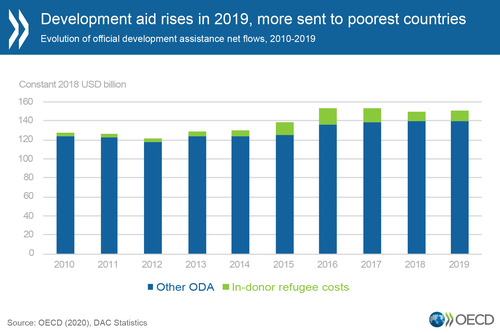
The OECD and member countries that provide foreign aid are exploring how they can work to help the most vulnerable countries to weather the Covid-19 crisis, as new data showed a rise in Official Development Assistance (ODA) in 2019, particularly to the poorest countries.
ODA from members of the OECD’s Development Assistance Committee (DAC) totalled USD 152.8 billion in 2019, a rise of 1.4% in real terms from 2018, according to preliminary data collected from official development agencies. Bilateral ODA to Africa and least-developed countries rose by 1.3% and 2.6% respectively. Excluding aid spent on looking after refugees within donor countries – which was down 2% from 2018 – ODA rose by 1.7% in real terms.
“This increase in the global development effort is an important first step, particularly as we now have an additional duty to step up support to those countries facing the harshest impacts of all from the coronavirus crisis,” said OECD Secretary-General Angel Gurría. “The response of development providers in the weeks and months ahead will be a critical force in the global battle against Covid-19. ODA has proved to be recession-proof in the past, including during the 2008 financial crisis, and I am confident it can be again.”

Total ODA in 2019 was equivalent to 0.30% of DAC countries’ combined gross national income, down from 0.31% in 2018 and below a target ratio of 0.7% of ODA to GNI. Five DAC members – Denmark, Luxembourg, Norway, Sweden and the United Kingdom – met or exceeded the 0.7% target (the same five countries as in 2018.) Among non-DAC donors, which are not counted in the DAC total, Turkey provided ODA equivalent to 1.15% of its GNI.
ODA rose in 18 DAC countries, with the largest increases in Austria, Finland, Greece, Hungary, Japan, Korea, Norway and Slovenia.  It fell in 11 countries, most notably in Poland, Portugal and Sweden, in some cases because of lower spending on refugees. Net ODA has risen for the most part steadily in volume terms from just below USD 40 billion in 1960. Despite the 2008 crisis, ODA rose by 69% in real terms between 2000, when the Millennium Development Goals were agreed, and 2010, as donors committed to increases.
On April 9, the DAC issued a joint statement acknowledging the importance of ODA to help developing countries through the Covid-19 crisis, and saying members would “strive to protect” ODA budgets.
“It’s good news that ODA is increasing and that more of it is going to Africa and the poorest countries. We must build on this positive trend, because this global crisis demands strong global cooperation. Least developed countries will be the hardest hit by COVID-19. DAC members are already using ODA to help them respond to the double hit of health and economic crises. We will need to keep doing so throughout 2020 and beyond,” said DAC Chair Susanna Moorehead.
DAC members are sharing what they are doing to help developing countries combat the health crisis and economic fallout of the pandemic, with some donor countries already announcing reallocation of ODA money to support basic living conditions, build emergency health facilities and provide liquidity to developing country banks.
Mr. Gurría, in a joint statement with Mr. Achim Steiner, UN Development Programme Administrator, called on the international community and DAC members to act urgently to support those most vulnerable in the face of the crisis, including by increasing and sustaining ODA commitments. Ms Moorehead and OECD Development Co-operation Director Jorge Moreira da Silva urged DAC members to stand by their ODA commitments in March, to target efforts to health systems and vulnerable people and to ensure optimal coordination of humanitarian and development aid. To help them, the OECD is tracking the spread of Covid-19 in the world’s most fragile and insecure places on its States of Fragility platform.
The OECD is also working to analyse debt relief and other financial mechanisms for developing countries, donor support for women who make up the majority of health and care workers, support for global public goods – including research for new medicines or vaccines – and on longer-term analysis and guidance to help developing countries mitigate social and economic impacts. All official direct Covid19-related support to ODA-eligible countries, whether to invest in health systems or to protect and rebuild livelihoods will count as ODA.
Defined since 1969 as “government aid that promotes and specifically targets the economic development and welfare of developing countries”, ODA makes up over two thirds of external finance for least-developed countries. The OECD’s aid statistics track official flows from DAC donors. The OECD also monitors flows from some non-DAC providers and private foundations. Preliminary data each April is followed by final statistics at the end of each year with a detailed geographic and sectoral breakdown.
The 2019 total comprised USD 149.4 billion in the form of grants, loans to sovereign entities and contributions to multilateral institutions; USD 1.9 billion to development-oriented private sector instrument (PSI) vehicles, USD 1.4 billion in net loans and equities to private companies operating in ODA-eligible countries and USD 149 million of debt relief. Bilateral sovereign loans increased by 5.7% in real terms from 2018, suggesting some donors may be providing more concessional lending to low-income countries.
As in 2018, the 2019 data is expressed on a “grant equivalent” basis, offering a more realistic comparison between grants and loans, which account for around 17% of gross bilateral ODA, and a fairer measure of donor effort. Until 2018, loans were expressed on a “cash basis”, meaning their full face value was included then repayments were subtracted as they came in. The grant-equivalent methodology means only the “grant portion” of the loan, i.e. the amount “given” by lending below market rates, counts as ODA.
Compliments of the OECD.

EACC

Only four EU countries lead the US in digitalisation – EIB launches new report on digitalisation in the EU and US

• U lags the US in digitalisation
• Digital businesses outperform non-digital ones in growth and job creation
In the fight against the Coronavirus, digital technology is playing an unprecedented role in the maintenance of daily life and economic and social activities, as well as in the recovery of industry and business. The Coronavirus pandemic is becoming a tipping point for digitalisation – the dawn of a new era – by accelerating the maturity of digital technology: what was once a ‘nice to have’ could now become a ‘crucial to have’. For businesses and organisations to thrive and become more resilient in the medium and longer term, it may be more relevant than before to revisit digital transformation plans in order to stay competitive in the ‘new normal’.
In this context, the new EIB report “Who is prepared for the new digital age? Evidence from the EIB Investment Survey” takes a look at the state of digitalisation in the EU and United States from a unique business perspective. The report shows, based on a company-level survey, that EU firms in most sectors are falling behind the US. It also spells out the key concerns of firms when it comes to the adoption of, and investment in, digital technologies. In particular, it highlights how access to management, skilled labour and the regulatory environment affect the digitalisation of European as well as US firms.
“If European policymakers want European firms to become more digital they need to address structural barriers to investment in digitalisation,” said Debora Revoltella, EIB Chief Economist. “Policy action should develop measures to fast-track the adoption of digitalisation. These include more advanced managerial skills and practices, improving the skills of workers through training and making it easier to finance investments in intangibles and digital technologies. The current Covid-19 economic crisis can be an opportunity to frontload some of those initiatives.”
The EU lags the US in digitalisation
The EIB Digitalisation Index, introduced in the report and based on firm-level data and perception, shows that the EU falls short of the US. Only four EU countries are ahead of the US in terms of digitalisation: Denmark, the Netherlands, the Czech Republic and Finland.
On average, European firms are less often fully digital and invest and adopt digital technologies less than their US peers. The difference between the US and the EU is particularly large in the construction sector, where the share of digital firms is 40% in the EU and 61% in the US. The difference in adoption rates between EU and US firms is 13 percentage points in services and 11 percentage points in the infrastructure sector. With regard to manufacturing, only 66% of firms in the EU, compared to 78% in the US, report having adopted at least one digital technology.
CONTINUE READING…
Compliments of the European Investment Bank – a member of the EACCNY.

EACC

ECB supports macroprudential policy actions taken in response to coronavirus outbreak

15 April, 2020 |
• ECB supports the swift action taken by euro area macroprudential authorities to address the financial sector impact of the coronavirus outbreak by releasing or reducing capital buffers
• Macroprudential measures will free up more than €20 billion of bank capital to absorb losses and support lending
• Measures complement and reinforce microprudential measures taken by ECB
The European Central Bank (ECB) supports the measures taken by euro area macroprudential authorities to address the impact of the coronavirus (COVID-19) outbreak on the financial sector. The ECB has assessed the notifications submitted by national macroprudential authorities for each proposed measure provided for in the Capital Requirements Regulation and Directive and has issued a non-objection decision, thereby endorsing the measures taken to reduce capital requirements, including the countercyclical capital buffer.
The measures announced by national macroprudential authorities since 11 March 2020 will free up more than €20 billion of Common Equity Tier 1 capital held by euro area banks. They include releases or reductions of the countercyclical capital buffer, systemic risk buffer and buffers for other systemically important institutions. In addition, some authorities have postponed or revoked earlier announced measures to avoid placing pressure on banks to accumulate capital buffers in a downturn.
These macroprudential actions complement and reinforce the measures announced by ECB Banking Supervision since 12 March 2020.
The ECB, in the exercise of the macroprudential tasks conferred by the Single Supervisory Mechanism Regulation[1], is responsible for assessing macroprudential measures considered by national authorities in the countries subject to ECB Banking Supervision. Moreover, the ECB has the power to apply, when necessary, higher requirements or more stringent measures than those adopted nationally to address risks to financial stability.
The ECB has today published an overview of the macroprudential measures taken by euro area authorities (including central banks and banking supervisors) in response to the coronavirus outbreak and their impact on banks’ regulatory capital.
[1]Council Regulation (EU) No 1024/2013 of 15 October 2013 conferring specific tasks on the European Central Bank concerning policies relating to the prudential supervision of credit institutions.
Compliments of the European Central Bank.

EACC

Is the United States reneging on international financial standards?

April 15, 2020 | Blog post by Nicolas Véron, with prior publication by PIIE and Bruegel.
The new Fed rule is a material breach of Basel III, a new development as the US had hitherto been the accord’s main champion. This action undermines the global order without being ostensibly justified by narrower considerations of US national interest.
The financial shock surrounding the COVID-19 pandemic has prompted the US Federal Reserve to temporarily loosen an important capital-to-asset ratio requirement for American banks. In so doing, the US is walking away from a decade-long commitment to global financial reform that it made in the wake of the global economic meltdown of 2008-10.
This breach, together with other recent US government actions, might signal a broader departure from the Trump administration’s general adherence in its first three years to international financial standards, an area in which it had so far not acted against the global rules-based order. The motives for the breaches are not compelling enough to offset the downsides for the global financial system and for the United States itself.
The new Fed rule breaches the Basel III Accord
On 1 April, the Federal Reserve announced a temporary change to a regulatory requirement on banks, known as the supplementary leverage ratio (or simply the leverage ratio). The leverage ratio, calculated as regulatory capital (or own funds) divided by unweighted assets, supplements the more refined ratios of capital to risk-weighted assets, which are the mainstay of bank capital regulation. While a crude measure of capital strength, the leverage ratio is an apt response to the incentives banks have to underestimate risk-weights. It acts as a simple sanity check, thus the epithet ‘supplementary.’
The new change, which the Fed adopted unanimously, exempts banks’ holdings of US sovereign debt (Treasuries) and deposits at the Fed from the assets total in the ratio calculation, until end-March 2021. This exemption reduces the denominator, making it easier for banks to meet their minimum-ratio requirements during that period. By exempting sovereign exposures, the rule deviates from the internationally agreed definition of the leverage ratio that is part of the Basel III accord, initially published in 2010 by the Basel Committee of Banking Supervision on the back of a mandate given by the G20 in 2008-09.
The Fed’s decision echoes separate congressional action in the Coronavirus Aid, Relief, and Economic Security (CARES) Act, which was signed into law on 27 March 2020. Section 4014 of CARES gives banks the option of ignoring an accounting obligation known as current expected credit loss (CECL) provisioning. Most banks started implementing this obligation in January 2020. CECL was introduced in response to a 2009 mandate from the G20, which was implemented in 2016 by the US Financial Accounting Standards Board (FASB), and separately earlier in 2014 by the International Accounting Standards Board (IASB), whose standards are applied in most jurisdictions other than the United States. By opting out of CECL, banks can avoid booking losses that are expected from the dramatic deterioration in the economic outlook from the pandemic and can thus make their capital positions look correspondingly more flattering.
The Fed’s rule change and the Congress’s action in the CARES Act suggest an incipient trend of US departures from the comprehensive package of global financial standards enacted by various bodies under the G20’s authority since 2008. One earlier signal of this came in November 2019, when the Fed and other federal bank regulators made a change – also in breach of Basel III – to an arcane rule on measuring counterparty credit risk in certain transactions.
To be sure, the United States is far from the only offender, let alone the worst. Most notoriously, in 2014, the Basel Committee found the European Union “materially non-compliant” with Basel III, the only jurisdiction in that category – partly for similar counterparty-credit-risk shenanigans as with the US rule of November 2019. Nor are the recent American breaches wholly unprecedented, if one goes far enough back. In the years before the 2008-10 financial crash, US authorities were reluctant to adopt the previous Basel II accord, for prudential reasons that the subsequent crisis experience largely vindicated. But from the first G20 summit in late 2008 up to recent months, the United States was the leading champion of G20 financial reform, and that compliant stance was maintained under the first few years of the Trump administration. Even as some financial rules were relaxed, they were kept above the minimum levels set in international accords. Indeed, the final bits of Basel III were agreed in December 2017 after Randal Quarles, a Trump appointee, replaced his Obama-era predecessor Daniel Tarullo as the Fed’s point person in Basel Committee discussions.
The motivations for these changes are unconvincing
The US departures from global standards respond to specific demands from the US banking industry and some federal agencies, but whether they are in the US national interest is questionable. The experience so far of the COVID-19 crisis is precisely that strong capital standards, such as Basel III, are helpful protections against unforeseen events. Globally-applied minimum prudential standards ensure a degree of international financial stability from which the United States benefits. Standards also prevent the most blatant competitive distortions in international banking markets – a key driver of the first Basel accord in the 1980s. It is not clear that the leverage ratio breach has benefits that offset the loss of such advantages.
The motivations for the Fed’s new rule appear to include the fact that the pandemic-induced volatility has disrupted the Treasuries market and has also resulted in a sudden influx of deposits into US banks. If banks are less constrained by the leverage ratio limit, so the thinking appears to go, they can buy more Treasuries and thus contribute to more orderly markets. But it is doubtful that leverage-ratio-related constraints played any role in the recent Treasuries market turmoil. As for the incoming deposits, banks can place them into deposits at the Federal Reserve, rather than Treasuries. A temporary exemption for such central bank deposits from the leverage ratio would not have breached Basel III in its current form. Moreover, the exemption for US sovereign exposures creates a highly problematic precedent that other jurisdictions with less creditworthy sovereign issuers might now be tempted to emulate, against the Basel Committee’s efforts to move its members towards consensus on a more rigorous recognition of the risks that such exposures might carry. Similarly, concerns about procyclical impacts of CECL could and should have been addressed by using the standard’s embedded flexibilities, similar to what was recommended outside the United States by the IASB and implemented by the euro area and the United Kingdom, among others.
By breaching G20 standards, these decisions contribute to institutional erosion at the global level and domestically. The breaches of Basel III are especially galling since Quarles now chairs the Financial Stability Board, an umbrella body whose permanent secretariat is located in the same building in Basel as the Basel Committee. On the domestic front, the Fed also acted alone, as the other federal banking regulators, including the Office of the Comptroller of the Currency and the Federal Deposit Insurance Corporation, did not endorse its new rule as is customary. The congressional override of FASB (and, in the same move, of the US Securities and Exchange Commission, which delegates to the FASB standard-setting authority), also is without precedent in nearly half a century.
The United States would lose from abandoning global financial standards
Possibly the recent breaches are one-offs, not the start of a broader trend of divergence. In a formal sense, both the Fed’s action on leverage ratio and Congress’s on accounting are temporary measures, even though they could be extended. They could, however, mirror a broader current pattern of the United States undermining the global rules-based order, from which the financial services area has been somehow ring-fenced until now. Be that as it may, these breaches are bad news for the authority of the G20, the Financial Stability Board and the Basel Committee, but are probably not crippling. Just as US agencies did not implement Basel II, and the FASB has declined to converge its standards with the IASB’s global standards, global financial standard-setting bodies can probably live with US lapses of compliance, at least for some time. It remains to be seen, however, how the implementation of the final piece of Basel III, which the Basel Committee has recently decided to delay by a year because of the COVID-19 pandemic, will be ultimately affected by an eclipse of US leadership in that area.
If the noncompliance trend is confirmed, the most damaging consequences could be to the United States itself. The chair of the foundation that hosts and oversees the FASB, in a letter that unsuccessfully attempted to persuade Congress not to pass Section 4014 of the CARES Act, argued that the action “fundamentally undermines the longstanding and time-tested approach in the U.S. to transparent, rigorous and independent accounting standard-setting, which market participants rely upon and that plays a critical role in supporting our capital markets and broader economy.”
The United States has benefited immensely from upholding best-in-class financial standards and regulations. If these standards are lowered, US economic achievements, all things equal, might be undermined as well.
Compliments of Nicolas Véron.