EACC

European Commission | Commission Opens Proceedings to Assist Google in Complying With Interoperability and Online Search Data Sharing Obligations Under the Digital Markets Act

Today, the European Commission has started two sets of specification proceedings to assist Google in complying with its obligations under the Digital Markets Act (‘DMA’). The specification proceedings formalise the Commission’s regulatory dialogue with Google on certain areas of its compliance with two DMA obligations.
The first set of proceedings concerns Google’s obligation under Article 6(7) of the DMA to provide third-party developers with free and effective interoperability with hardware and software features controlled by Google’s Android operating system. Today’s proceedings focus on features used by Google’s own Artificial Intelligence (‘AI’) services, such as Gemini. The Commission intends to specify how Google should grant third-party AI service providers equally effective access to the same features as those available to Google’s own services. The aim is to ensure that third-party providers have an equal opportunity to innovate and compete in the rapidly evolving AI landscape on smart mobile devices.
The second set of proceedings concerns Google’s obligation under Article 6(11) of the DMA to grant third-party providers of online search engines access to anonymised ranking, query, click and view data held by Google Search on fair, reasonable and non-discriminatory (‘FRAND’) terms. These proceedings focus on the scope of data, the anonymisation method, the conditions of access, and the eligibility of AI chatbot providers to access the data. Effective compliance and access to a useful dataset will allow third-party providers of online search engines to optimise their services and offer users genuine alternatives to Google Search.
Next steps
The Commission will conclude the proceedings within six months of their opening. Within the upcoming three months the Commission will communicate its preliminary findings to Google setting out the draft measures it intends to impose on Google to effectively comply with the DMA. Non-confidential summaries of preliminary findings and the envisaged measures will be published to enable third parties to provide comments.
These proceedings, which by their nature do not take a position on compliance with the DMA, are without prejudice to the powers of the Commission to adopt a decision finding non-compliance with any of the obligations laid down in the DMA by a gatekeeper, including the possibility to impose fines or periodic penalty payments.
Background
The DMA aims to ensure contestable and fair markets in the digital sector. It regulates gatekeepers, which are large digital platforms that provide an important gateway between business users and consumers, whose position can grant them the power to create a bottleneck in the digital economy.
On 6 September 2023, the European Commission designated Google Inc.’s Google Search, Google Play, Google Maps, YouTube, Google Android operating system, Google Chrome, Google Shopping and its online advertising services as core platform services. Google has had to fully comply with all applicable DMA obligations in respect of the designated services since 7 March 2024.
The Commission has published an annual report on the implementation of the DMA and the progress made towards achieving its objectives.
 
 
Compliments of the European Commission The post European Commission | Commission Opens Proceedings to Assist Google in Complying With Interoperability and Online Search Data Sharing Obligations Under the Digital Markets Act first appeared on European American Chamber of Commerce New York [EACCNY] | Your Partner for Transatlantic Business Resources.

EACC

European Commission | EU and India Conclude Landmark Free Trade Agreement

The EU and India concluded negotiations today for a historic, ambitious and commercially significant free trade agreement (FTA), the largest such deal ever concluded by either side. It will strengthen economic and political ties between the world’s second and fourth largest economies, at a time of rising geopolitical tensions and global economic challenges, highlighting their joint commitment to economic openness and rules-based trade.
European Commission President, Ursula von der Leyen, said: “The EU and India make history today, deepening the partnership between the world’s biggest democracies. We have created a free trade zone of 2 billion people, with both sides set to gain economically. We have sent a signal to the world that rules-based cooperation still delivers great outcomes. And, best of all, this is only the start – we will build on this success, and grow our relationship to be even stronger.”
The EU and India already trade over €180 billion worth of goods and services per year, supporting close to 800,000 EU jobs. This deal is expected to double EU goods exports to India by 2032 by eliminating or reducing tariffs in value of 96.6% of EU goods exports to India. Overall, the tariff reductions will save around €4 billion per year in duties on European products.
This is the most ambitious trade opening that India has ever granted to a trade partner. It will give a significant competitive advantage for key EU industrial and agri-food sectors, granting companies privileged access to the world’s most populous country of 1.45 billion people and fastest growing large economy, with an annual GDP of €3.4 trillion.
Opportunities for European businesses of all sizes
India will grant the EU tariff reductions that none of its other trading partners have received. For example, tariffs on cars are gradually going down from 110% to as low as 10%, while they will be fully abolished for car parts after five to ten years. Tariffs ranging up to 44% on machinery, 22% on chemicals and 11% on pharmaceuticals will also be mostly eliminated.
A dedicated chapter will also help small EU businesses take full advantage of the new export opportunities. For instance, both sides will put in place dedicated contact points to provide SMEs with relevant information on the FTA and help them with any specific issue they would face when trying to use the FTA’s provisions. In addition to this, SMEs will particularly benefit from the tariff reductions, removal of regulatory barriers, transparency, stability and predictability provided by the Agreement.
Reducing agri-food tariffs
The agreement removes or reduces often prohibitive tariffs (over 36% on average) on EU exports of agri-food products, opening a massive market to European farmers. For example, Indian tariffs on wines will be cut from 150% to 75% at entry into force and eventually to levels as low as 20%, tariffs on olive oil will go down from 45% to 0% over five years, while processed agricultural products such as bread and confectionary will see tariffs of up to 50% eliminated.
Sensitive European agricultural sectors will be fully protected, as products such as beef, chicken meat, rice and sugar are excluded from liberalisation in the agreement. All Indian imports will continue to have to respect the EU’s strict health and food safety rules.
In parallel, the EU and India are currently negotiating a separate agreement on Geographical Indications (GIs), which will help traditional iconic EU farming products sell more in India, by removing unfair competition in the form of imitations.
Privileged access to services markets and protected Intellectual Property
The agreement will grant EU companies privileged access to the Indian services market, including key sectors such as financial services and maritime transport. It has the most ambitious commitments on financial services by India in any trade agreement, going beyond what they have given to other partners.
The agreement provides a high level of protection and enforcement of Intellectual Property (IP) rights, including copyright, trademarks, designs, trade secrets and plant variety rights. It builds upon existing international IP treaties and brings Indian and EU intellectual property laws closer. This will make it easier for EU and Indian businesses that rely on IP to trade and invest in each other’s markets.
Enhancing sustainability commitments
The agreement has a dedicated trade and sustainable development chapter, which enhances environmental protection and addresses climate change, protects workers’ rights, supports women’s empowerment, provides for a platform for dialogue and cooperation on trade related environmental and climate issues and ensures effective implementation.
The EU and India will also sign a Memorandum of Understanding that intends to establish an EU-India platform for cooperation and support on climate action. The platform will be launched in the first half of 2026. Furthermore, subject to the EU’s budgetary and financial rules and procedures, €500 million in EU support over the next two years is envisaged to help India’s efforts to reduce greenhouse gas emissions and accelerate its long-term sustainable industrial transformation.
Next steps
On the EU side, the negotiated draft texts will be published shortly. The texts will go through legal revision and translation into all official EU languages. The Commission will then put forward its proposal to the Council for the signature and conclusion of the agreement. Once adopted by the Council, the EU and India can sign the agreements. Following the signature, the agreement requires the European Parliament’s consent, and the Council’s decision on conclusion for it to enter into force. Once India also ratifies the Agreement, it can enter into force.
Background
The EU and India had first launched negotiations for a free trade agreement in 2007. The talks were suspended in 2013 and then relaunched in 2022. The 14th and last formal negotiating round took place in October 2025, followed by intersessional discussions at technical and political level.
At the same time as FTA negotiations were relaunched, the EU and India also launched negotiations for a Geographical Indications Agreement and an Investment Protection Agreement. Negotiations for these agreements are still ongoing.


Compliments of the European CommissionThe post European Commission | EU and India Conclude Landmark Free Trade Agreement first appeared on European American Chamber of Commerce New York [EACCNY] | Your Partner for Transatlantic Business Resources.

EACC

European Council | Oral Conclusions Drawn by President António Costa Following the Informal Meeting of the Members of the European Council of 22 January 2026

Oral Conclusions by President António Costa following the Informal meeting of the members of the European Council, 22 January 2026
The European Union and the United States have long been partners and allies. We have built a transatlantic community forged by history, anchored in common values, and dedicated to the prosperity and security of our peoples.
We believe that relationships between partners and allies should be managed in a cordial and respectful way.
Europe and the United States have a shared interest in the security of the Arctic region, notably working through NATO. The European Union will also play a stronger role in this region.
In this context, I want to be very clear: the Kingdom of Denmark and Greenland have the full support of the European Union. Only the Kingdom of Denmark and Greenland can decide on matters concerning Denmark and Greenland.
This is a reflection of our firm commitment to the principles of international law, territorial integrity and national sovereignty, which are essential for Europe and for the international community as a whole. These principles will continue to guide our action.
Against this backdrop, yesterday’s announcement that there will be no new US tariffs on Europe is positive. The imposition of additional tariffs would have been incompatible with the EU-US trade deal. Our focus must now be on moving forward on the implementation of that deal. The goal remains the effective stabilization of the trade relations between the European Union and the US.
At the same time, the European Union will continue to stand up for its interests and will defend itself, its member states, its citizens and its companies, against any form of coercion. It has the power and the tools to do so and will do so if and when necessary.
Looking ahead, we remain ready to continue engaging constructively with the United States on all issues of common interest, including on creating the conditions for a just and lasting peace in Ukraine.
We have serious doubts about a number of elements in the charter of the Board of Peace related to its scope, its governance and its compatibility with the UN Charter.
We are ready to work together with the US on the implementation of the comprehensive Peace Plan for Gaza, with a Board of Peace carrying out its mission as a transitional administration, in accordance with UN Security Council Resolution 2803.
Let me conclude by recalling that the European Union is focused on delivering an ambitious agenda for our citizens: on defense, on competitiveness, on building a more strategically autonomous Europe.
That is why the next Leaders’ meeting, on the 12th of February, will be a strategic brainstorming dedicated to strengthening the Single Market in a new geoeconomic context.

Visit the meeting page

Compliments of the European Council The post European Council | Oral Conclusions Drawn by President António Costa Following the Informal Meeting of the Members of the European Council of 22 January 2026 first appeared on European American Chamber of Commerce New York [EACCNY] | Your Partner for Transatlantic Business Resources.
EACC

ECB | ECB and ESRB Issue Joint Report Analysing Financial Stability Risks From Geoeconomic Fragmentation

22 January 2026

Geoeconomic fragmentation and geopolitical risk have become key sources of macro-financial uncertainty, which can affect financial stability
Geopolitical shocks can amplify financial stress and dampen economic growth
Report sets out new monitoring framework integrating geopolitical indicators into financial stability analysis

The European Central Bank (ECB) and the European Systemic Risk Board (ESRB) today published a joint report entitled “Financial stability risks from geoeconomic fragmentation” with technical annex, which examines how rising geopolitical risks and heightened uncertainty can affect financial stability in the euro area and across the European Union. The report identifies the key transmission channels through which geopolitical shocks can propagate to the financial system.
The following findings indicate that geopolitical shocks and policy uncertainty tend to lead to tighter financial conditions, financial market stress, increased risk premia and reduced loan growth.

Geopolitical risks and policy uncertainty have risen markedly since the mid‑2010s, with notable increases in 2024 and 2025. At the same time, financial market volatility has remained contained or short-lived.
Estimates suggest that geopolitical risks lower expected growth outcomes, with significant downside tail risks for the real economy, accompanied by heightened financial stress. Geopolitical events can significantly alter the interconnectedness between bonds, commodities, equities and exchange rates.
The impact of geopolitical shocks is heterogeneous across EU Member States, whereby more open economies and those with higher public debt ratios tend to be more vulnerable to amplification effects.
In response to geopolitical shocks, banks and non-banks adjust their balance sheets by reducing lending, especially cross-border exposures. While this reduces the financial system’s exposure to external shocks, it also limits international diversification.

At a time of accelerating geoeconomic fragmentation and persistent geopolitical uncertainty, the ECB and the ESRB stress the importance of enhanced, more harmonised datasets, as well as complementary scenario analyses, for preserving financial stability and increasing economic resilience.[1]The report’s insights can help policymakers and financial institutions to better detect and evaluate geopolitical risks for the financial sector and calibrate macroprudential policy responses.
Notes

The report was prepared by financial stability experts under a joint workstream of the ECB’s Macroprudential Analysis Group and the ESRB’s Analysis Working Group.

Geopolitical risk is an important consideration for European banks and supervisors as they navigate global risks. In view of this, ECB Banking Supervision made geopolitical risk the focus of the adverse scenario in the 2025 stress test of euro area banks (see Box 6) and will assess banks on their geopolitical risk management in the context of the 2026 reverse stress test.


Compliments of the European Central Bank The post ECB | ECB and ESRB Issue Joint Report Analysing Financial Stability Risks From Geoeconomic Fragmentation first appeared on European American Chamber of Commerce New York [EACCNY] | Your Partner for Transatlantic Business Resources.

Read More
EACC

IMF | Global Economy Shakes Off Tariff Shock Amid Tech-Driven Boom

Blog Post by  Tobias Adrian and Pierre-Olivier Gourinchas
Global Economy Shakes Off Tariff Shock Amid Tech-Driven Boomrisks are rising, including from the concentration of tech investment and the negative effects of trade disruptions, which may build over time.
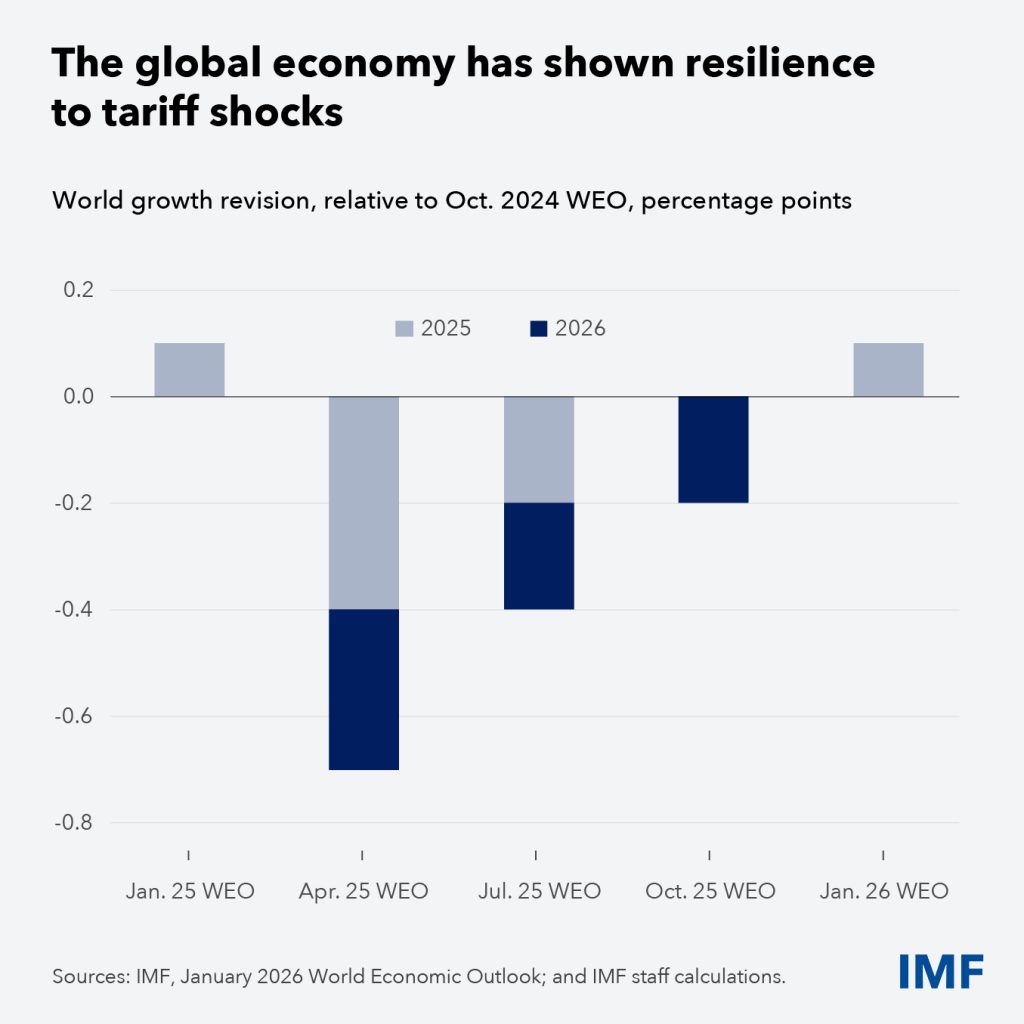
Global economic growth continues to show notable resilience despite significant US-led trade disruptions and heightened uncertainty. Our latest projections indicate that global growth will hold steady at 3.3 percent this year, an upward revision of 0.2 percentage points compared to October estimates, with most of the improvement accounted for by the United States and China. Remarkably, current projections are broadly unchanged from a year earlier, as the global economy shakes off the immediate impact of the tariff shock.

This surprising strength reflects a confluence of factors, including easing trade tensions, higher-than-expected fiscal stimulus, accommodative financial conditions, the agility of the private sector in mitigating trade disruptions and improved policy frameworks especially in emerging market economies.
Another key driver of this resilience is the continued surge in investment in the information technology sector—especially in artificial intelligence. While manufacturing activity remains subdued, IT investment as a share of US economic output has surged to the highest level since 2001, providing a major boost to overall business investment and activity. Although this IT surge has been concentrated in the United States, it is also generating positive spillovers globally, most notably to Asia’s technology exports.

Financial conditions fuel expansion
The IT investment boom reflects businesses and markets’ optimism about the transformative potential of recent tech innovations—in automation and AI—to deliver sizable productivity gains and to lift profits. Since late 2022, coinciding with the introduction of the first widely used generative-AI tools, stock prices have risen sharply.
Favorable financial conditions and robust earnings­­ have supported rising stock prices and helped fund new capital spending. But as the expansion accelerates, debt financing is becoming more prevalent, increasing leverage. This shift introduces notable risks: higher leverage could amplify shocks if returns fail to materialize, or if broader financial conditions tighten, adversely impacting firms and raising concerns about spillovers to the broader financial system.
Moreover, profitability could become sensitive to assumptions around depreciation schedules for advanced processors. Frequent equipment upgrades will squeeze profit margins, weigh on earnings, and require significant additional debt financing. These factors underscore the importance of monitoring leverage accumulation and its potential to amplify vulnerabilities.
Lessons from the dot-com era
The comparison with the dot-com boom of 1995-2000 is instructive. Even though IT investment as a share of gross domestic product is broadly similar to levels then, the recent rise has been more gradual, accelerating markedly only last year. Furthermore, while market valuations relative to economic output have expanded at a similar pace in both episodes, the rise in price-earnings ratios has been more modest in the current boom given more robust earnings.
Overall, our analysis suggests that potential overvaluation for the broad equity index in the United States is only about half that of the dot-com episode. That said, the overall vulnerability of global macroeconomic growth to a repricing of technology stocks may be substantial for three reasons.

First, rising stock prices over the past few years have been driven predominantly by the technology sector, in particular AI-related stocks, and this narrow group has become a major driver of the index. Second, many critical AI-related firms are not currently listed on stock markets. Their debt borrowings could have consequences that were not seen during the dot-com era. Third, market capitalization is now much higher relative to output, from 132 percent in 2001 to 226 percent now for the United States; so even a more modest correction could have a sizable effect on overall consumption.

Risks to the outlook
Looking ahead, the current tech boom raises important upside and downside risks for the global economy. On the upside, AI could start to deliver on its productivity promises, raising US and global activity by 0.3 percent this year, relative to the baseline.
On the downside, AI firms could fail to deliver earnings commensurate with their lofty valuations, and investor sentiment could sour. For reference, a scenario in our October 2025 World Economic Outlook—which included a moderate correction in AI stock valuations with a tightening of financial conditions—reduces global growth by 0.4 percent relative to the baseline. This could have far-reaching consequences if real investment in technology sectors declines more sharply, triggering a costly reallocation of capital and labor. Combined with lower-than-expected total factor productivity gains, and a more significant correction in equity markets, global output losses could increase further, concentrated in tech-heavy regions such as the United States and Asia.
Given the decade-long increase in foreign ownership of US equities, this sharp correction could also trigger sizable wealth losses outside the United States and exert a drag on consumption, spreading the downturn more globally. Even economies that have little exposure to technology, including many high-debt and low-income countries, would be buffeted by negative external demand spillovers and higher external borrowing costs.
Such downside risks arise at a time of heightened geopolitical uncertainty, increased use of export controls on critical inputs and trade-related restraints, and eroded fiscal space in many countries. This could interact with any reassessment of AI-related productivity growth and repricing of risky asset valuations in a self-reinforcing manner.
Policy for stability, discipline, inclusion
With asset valuations stretched, debt financing on the rise, and uncertainty elevated, strong prudential oversight is essential to safeguard financial stability. Supervision and regulation should ensure robust underwriting standards by banks and nonbanks especially those exposed to the technology sector. Internationally agreed standards on bank capital and liquidity should be adhered to. Policymakers must be ready to deploy contingency plans for diverse risks.
Monetary policy faces a delicate balancing act. If the tech boom continues, it may push real neutral interest rates higher—as occurred during the dot-com era—calling for a monetary policy tightening. This would contract fiscal space, especially in countries that do not get a growth boost from AI.
Should the downside scenario materialize, the rapid decline in aggregate demand will call for a speedy reduction in policy rates.
Proper diagnosis and calibration of the monetary policy to achieve price stability requires that central banks operate within their mandate. Central bank independence remains paramount for monetary and financial stability and economic growth, protecting the credibility of monetary policy and anchoring inflation expectations.
On the fiscal side, governments should renew efforts to reduce public debt and restore fiscal space where needed.
AI’s uneven impact on workers is another important consideration. While innovation drives growth, it risks displacing jobs and depressing wages for certain segments of the workforce. Policies should focus on lowering barriers to adoption, helping workers to invest in the right skills, supporting job mobility through targeted programs, and maintaining competitive markets to facilitate entry and ensure that innovation benefits are broadly shared.
Balancing act
Global growth has been impressively resilient amid trade disruptions, but this masks underlying fragilities tied to the concentration of investment in the tech sector. And the negative growth effects of trade disruptions are likely to build up over time.
AI-driven investment offers transformative potential—but also introduces financial and structural risks that demand vigilance. The challenge for policymakers and investors alike is to balance optimism with prudence, ensuring that today’s tech surge translates into sustainable, inclusive growth rather than another boom-bust cycle. This is especially relevant in an environment marked by intensifying geopolitical strains and growing threats to institutional frameworks which make the implementation of good policies more challenging.
 
 
Compliments of the IMFThe post IMF | Global Economy Shakes Off Tariff Shock Amid Tech-Driven Boom first appeared on European American Chamber of Commerce New York [EACCNY] | Your Partner for Transatlantic Business Resources.

EACC & Member News

AKD: Competition law update January 2026: rulings by the Court of Justice on the application of the Bronner criteria and vertical margin squeeze and more

December saw a number of important developments in the field of competition law. This month, we highlight rulings by the Court of Justice on the application of the Bronner criteria and vertical margin squeeze, the abuse of a dominant position in connection with fees charged by collective management organisations for copyrights, and the ACM’s response to the critical opinion of the Council of State on the bill concerning the ACM’s power of intervention.

Read more

EACC & Member News

Taylor Wessing: New legislative proposal: legal protection in public procurement

We informed you about the critical advice of the Advisory Division of the Council of State (Advisory Division) on the draft text of the legislative proposal on Legal Protection in Public Procurement (legislative proposal). On 22 December 2025, the Minister of Economic Affairs (the Minister) published an amended legislative proposal. This amended legislative proposal will be debated in the House of Representatives.

Read more

EACC

European Commission | EU Supports Digital Connectivity with Simpler and Harmonised Rules in Digital Networks Act

The European Commission proposed the Digital Networks Act (DNA) to modernise, simplify and harmonise EU rules on connectivity networks. The current rules must be updated to create the conditions for operators to invest into rolling out advanced fibre and mobile networks. High-capacity networks enable innovative tech, like Artificial Intelligence and Cloud. The widespread availability of advanced connectivity for people and businesses across the EU is the foundation of Europe’s competitiveness.
Strengthening the single market for connectivity
The proposal aims at creating an effective EU single market by harmonising rules and facilitating cross-border business to incentivise operators to scale up, grow and innovate. To enable this, the Digital Networks Act proposal aims to:

facilitate companies to provide services across the EU while having to register in only one Member State;

incentivise the creation of pan-European satellite communication services by establishing an EU-level, as opposed to national level, spectrum authorisation framework;
increase regulatory consistency in national spectrum authorisation, by giving operators longer spectrum licences and by making licences renewable by default to increase predictability;
ensure that all available spectrum is being used by making spectrum sharing among operators more common (‘use it or share it’); and
introduce a voluntary cooperation mechanism between connectivity providers and other players, such as content application and cloud providers.

Transition to advanced connectivity networks
Legacy copper networks do not fit the ambition of making innovative technologies widely available across the EU. The DNA introduces mandatory national transition plans to ensure the phase out of copper networks and the transition to advanced networks between 2030 and 2035. Member States must present their national plans in 2029. The process is accompanied by safeguards to protect all consumers, such as providing clear and timely information about switch-offs and ensuring service continuity.
Simplification and investment
The Digital Networks Act modernises the regulatory framework, reducing administrative burden and reporting obligations, so companies can focus their resources on investment and innovation. The DNA also allows more flexibility for business-to-business relations, while keeping a high level of consumer protection.
Secure and resilient connectivity
The DNA enhances network security and resilience by limiting dependencies in the connectivity ecosystem and promoting EU-level cooperation. The proposal introduces an EU-level Preparedness plan to tackle the rising risks of crises including natural disasters and foreign interference in networks. In addition, the common mechanism for selecting pan-EU satellite communications will incorporate criteria focused on security and resilience.
Protecting net neutrality in innovative services
The DNA fully keeps the principles of net neutrality. It introduces a mechanism to clarify Open Internet rules for innovative services to increase legal certainty and a voluntary ecosystem cooperation mechanism on IP interconnection, traffic efficiency, and other emerging areas.
Next steps
The proposal will be presented to the European Parliament and the Council for approval.
Background
The DNA proposal will replace the 2018 EU Electronic Communications Code.
In February 2024, the Commission’s White Paper “How to master Europe’s digital infrastructure needs?” aimed to explore scenarios and gather insights to shape policy actions for the Union’s digital infrastructure sector.
In her 2025 State of the Union Address, President von der Leyen stressed advancing the Single Market for connectivity by 2028 and encouraged investment in transformative technologies.
 
 
Compliments of the European CommissionThe post European Commission | EU Supports Digital Connectivity with Simpler and Harmonised Rules in Digital Networks Act first appeared on European American Chamber of Commerce New York [EACCNY] | Your Partner for Transatlantic Business Resources.

EACC & Member News

Bird & Bird: Global trends in anti-corruption and anti-bribery

In this article, we look back at trends and enforcement developments in anti-corruption and anti-bribery in 2025 and we look ahead to what we can expect to shape this rapidly evolving landscape in 2026. What emerges from our review is a picture of institutional reform and a sharpening of enforcement tools, with anti-corruption and anti-bribery compliance as a strategic priority.

Read more

EACC & Member News

Loyens & Loeff: Dutch Supreme Court curbs excessive tax interest rate (corporate income tax)

On 16 January 2026, the Dutch Supreme Court ruled that the 8% tax interest rate applicable to corporate income tax assessments is disproportionate and violates the principle of equality. As a result, the applicable tax interest rate is reduced to 4%. As the State Secretary for Finance has included all similar objections in a mass objection procedure, the judgment has direct effect on all taxpayers that have filed objections against the amount of tax interest included in the CIT assessment.