

EACC

The White House | Fact Sheet: President Donald J. Trump Imposes a Temporary Import Duty to Address Fundamental International Payment Problems

PROTECTING THE U.S. ECONOMY AND NATIONAL INTERESTS: Today, President Donald J. Trump signed a Proclamation imposing a temporary import duty to address fundamental international payments problems and continue the Administration’s work to rebalance our trade relationships to benefit American workers, farmers, and manufacturers.

President Trump is invoking his authority under section 122 of the Trade Act of 1974, which empowers the President to address certain fundamental international payment problems through surcharges and other special import restrictions.

By taking this action, the United States can stem the outflow of its dollars to foreign producers and incentivize the return of domestic production. By increasing its domestic production, the United States can correct its balance-of-payments deficit, while also creating good paying jobs, and lowering costs for consumers.

The Proclamation imposes, for a period of 150 days, a 10% ad valorem import duty on articles imported into the United States.

The temporary import duty will take effect February 24 at 12:01 a.m. eastern standard time.

Some goods will not be subject to the temporary import duty because of the needs of the U.S. economy or in order to ensure the duty more effectively addresses the fundamental international payments problems facing the United States, including:

certain critical minerals, metals used in currency and bullion, energy, and energy products;

natural resources and fertilizers that cannot be grown, mined, or otherwise produced in the United States or grown, mined, or otherwise produced in sufficient quantities to meet domestic demand;

certain agricultural products, including beef, tomatoes, and oranges;

pharmaceuticals and pharmaceutical ingredients;

certain electronics;

passenger vehicles, certain light trucks, certain medium and heavy-duty vehicles, buses, and certain parts of passenger vehicles, light trucks, heavy-duty vehicles, and buses;

certain aerospace products; and

informational materials (e.g., books), donations, and accompanied baggage.

In addition, the following goods will not be subject to the temporary import duty:

all articles and parts of articles that currently are or later become subject to section 232 actions;

USMCA compliant goods of Canada and Mexico; and

textiles and apparel articles that enter duty-free as a good of Costa Rica, the Dominican Republic, El Salvador, Guatemala, Honduras, or Nicaragua under the Dominican Republic-Central America Free Trade Agreement.

In a separate Executive Order, President Trump also reaffirmed and continued the suspension of duty-free de minimis treatment for low-value shipments, including goods shipped through the international postal system, which will also be subject to the temporary import duty imposed under section 122.
In addition to today’s actions, the President has directed the Office of the United States Trade Representative to use its section 301 authority to investigate certain unreasonable and discriminatory acts, policies, and practices that burden or restrict U.S. commerce.

ADDRESSING FUNDAMENTAL INTERNATIONAL PAYMENT PROBLEMS: The United States faces fundamental international payment problems, in particular a large and serious balance-of-payments deficit.

As a result of its loss of domestic production, the United States must import much of what it consumes, sending U.S. dollars out of our own economy and overseas.
A measurement for the U.S. balance-of-payments is the current account, which tracks the three ways a country can make money: (1) selling goods and services overseas, or the “trade balance of goods and services”; (2) return on investment or labor, or the “balance on primary income”; and (3) voluntary transfers, like remittances, or the “balance on secondary income.”
The United States not only runs an overall current account deficit, but also a deficit in each component of the current account.

The annual U.S. goods trade deficit exploded by over 40% during the Biden Administration, reaching $1.2 trillion in 2024.

In 2024, for the first time in more than 60 years, the United States made less on the capital and labor it deployed abroad than foreigners made on the capital and labor they deployed in the United States.

At present, more money is transferred out of the United States through remittances than money is transferred in.

The situation is getting worse.

In 2024, the United States maintained a current account deficit of -4.0% of gross domestic product (GDP), almost double the current account deficit of approximately -2.0% that prevailed between 2013 and 2019, and larger than 2019 to 2024.

As a share of GDP, the 2024 current account deficit represented the biggest annual current account deficit since 2008.

Compounding these challenges is the decline in the U.S. net international investment position.

At the end of 2024, the U.S. net international investment position was $26 trillion, which was 89% of U.S. GDP. This means that if all of the obligations to foreigners that the United States has incurred were to come due today, and even if all of the foreign assets that the U.S. owns could be instantly deployed as payment, the United States would still end up needing to make payments equal to 89% of its annual economic output in order to meet its obligations. This represents the most negative net international investment position of any country on Earth.

If left unaddressed, these fundamental international payment problems can, among other things, endanger the ability of the United States to finance its spending, erode investor confidence in the economy, distress the financial markets, and endanger U.S. economic and national security.

CONTINUING TO UTILIZE TARIFFS TO PROTECT U.S. INTERESTS: Tariffs will continue to be a critical tool in President Trump’s toolbox for protecting American businesses and workers, reshoring domestic production, lowering costs, and raising wages.

The Supreme Court’s disappointing decision today will not deter the President’s effort to reshape the long-distorted global trading system that has undermined the economic and national security of our country, and contributed to fundamental international payment problems.
Since Day One, President Trump has challenged the assumption that the United States must tolerate the distorted and imbalanced global trading system.
The President’s trade policy brought the world to the negotiating table on our terms.

As a result of the President’s tariffs, major U.S. trading partners covering more than half of global GDP have agreed to historic trade and investment deals to open new markets for U.S. exports, promote manufacturing reshoring, and bring reciprocity and balance to our trade relations.

These deals are creating high-paying American jobs, boosting U.S. manufacturing and technological leadership, and will deliver massive returns for American workers and families for decades to come.

In particular, the United States will continue to honor its legally binding Agreements on Reciprocal Trade. The United States expects the same commitment from its trading partners. While the domestic legal authorities to impose future tariffs will change, the overall direction of travel for the United States—reshoring domestic production and expanding market access abroad through a combination of tariffs and deals—will not.

Today’s action will continue to protect the national interests of the United States by addressing the balance-of-payments deficit to further usher in America’s Golden Age.


Compliments of The White HouseThe post The White House | Fact Sheet: President Donald J. Trump Imposes a Temporary Import Duty to Address Fundamental International Payment Problems first appeared on European American Chamber of Commerce New York [EACCNY] | Your Partner for Transatlantic Business Resources.
EACC

European Parliament | EU–US Trade Legislation: Legislative Work on Hold Following US Supreme Court Ruling

Bernd Lange, chair of Parliament’s International Trade Committee and standing rapporteur for the US, issued the following statement.

Following a meeting of the committee’s shadow rapporteurs (i.e. political group representatives), Bernd Lange (S&D, DE) said:
“The ruling by the Supreme Court of the United States of 20 February 2026 on the use of the International Emergency Economic Powers Act (IEEPA) is clear and unequivocal. Its implications cannot be ignored, and business as usual is not an option.
A key instrument used on the US side to negotiate and implement the Turnberry Deal is no longer available.
The situation is now more uncertain than ever. This runs counter to the stability and predictability we sought to achieve with the Turnberry Deal.
The proposed replacement for IEEPA, Section 122, applies indiscriminately to all countries exporting to the United States and is imposed on top of the Most Favoured Nation (MFN) rate. As a result, imports from the EU into the US would be subject to an applied rate exceeding the 15% threshold. This, in itself, constitutes a clear departure from the terms of the Turnberry Deal.
Shadow rapporteurs, representing a majority of Members, have agreed that under the current circumstances work on the two Turnberry files should be put on hold until clarity, stability and legal certainty in EU–US trade relations are re-established.
Consequently, the scheduled votes in committee tomorrow will not take place as planned and the shadow rapporteurs will reassess the situation next week.”


Compliments of the European ParliamentThe post European Parliament | EU–US Trade Legislation: Legislative Work on Hold Following US Supreme Court Ruling first appeared on European American Chamber of Commerce New York [EACCNY] | Your Partner for Transatlantic Business Resources.

EACC

European Commission | European Commission Statement on the Recent Judgment of the Supreme Court of the United States

The European Commission requests full clarity on the steps the United States intends to take following the recent Supreme Court ruling on the International Emergency Economic Powers Act (IEEPA).
The current situation is not conducive to delivering “fair, balanced, and mutually beneficial” transatlantic trade and investment, as agreed to by both sides and spelled out in the EU-U.S. Joint Statement of August 2025.
The Commission will always ensure that the interests of the European Union are fully protected. EU companies and exporters must have fair treatment, predictability, and legal certainty.
A deal is a deal. As the United States’ largest trading partner, the EU expects the U.S. to honour its commitments set out in the Joint Statement – just as the EU stands by its commitments.
In particular, EU products must continue to benefit from the most competitive treatment, with no increases in tariffs beyond the clear and all-inclusive ceiling previously agreed.
Tariffs are taxes, driving up costs for both consumers and businesses, as recent studies clearly confirm.
When applied unpredictably, tariffs are inherently disruptive, undermining confidence and stability across global markets and creating further uncertainty across international supply chains.
The Commission is in close and continuous contact with the U.S. Administration. On Saturday, 21 February, EU Trade Commissioner Maroš Šefčovič spoke with U.S. Trade Representative Jamieson Greer and Commerce Secretary Howard Lutnick.
We will continue to work towards lowering tariffs, as provided for in the Joint Statement. The EU’s priority is to preserve a stable, predictable transatlantic trading environment, while also acting as a global anchor for rules-based trade.
The EU continues to expand our network of comprehensive and ambitious “zero tariff” trade agreements worldwide, and efforts to strengthen the open, rules-based trading system.
 
Compliments of the European CommissionThe post European Commission | European Commission Statement on the Recent Judgment of the Supreme Court of the United States first appeared on European American Chamber of Commerce New York [EACCNY] | Your Partner for Transatlantic Business Resources.

EACC

United States Census Bureau | Monthly U.S. International Trade in Goods and Services, December 2025

FEBRUARY 19, 2026

CB 26-31, BEA 26-09

The U.S. Census Bureau and the U.S. Bureau of Economic Analysis announced today that the goods and services deficit was $70.3 billion in December, up $17.3 billion from $53.0 billion in November, revised.
December exports were $287.3 billion, $5.0 billion less than November exports. December imports were $357.6 billion, $12.3 billion more than November imports.
The December increase in the goods and services deficit reflected an increase in the goods deficit of $15.7 billion to $99.3 billion and a decrease in the services surplus of $1.6 billion to $29.0 billion.
For 2025, the goods and services deficit decreased $2.1 billion, or 0.2 percent, from 2024. Exports increased $199.8 billion or 6.2 percent. Imports increased $197.8 billion or 4.8 percent.


Compliments of the United States Census Bureau

The post United States Census Bureau | Monthly U.S. International Trade in Goods and Services, December 2025 first appeared on European American Chamber of Commerce New York [EACCNY] | Your Partner for Transatlantic Business Resources.

EACC

ECB | Global Trade Redirection: Tracking the Role of Trade Diversion from US Tariffs in Chinese Export Developments

Global trade flows were reshaped in 2025 following the introduction of new US tariffs. US import growth weakened sharply, reflecting a strong decline in imports from China. Meanwhile, Chinese exports have surprised to the upside overall, with broad-based growth across destinations outside the United States. A key question is whether this resilience reflects trade diversion in response to the US tariffs, i.e. the reallocation of exports originally destined for one market towards alternative markets, or other adjustment mechanisms, such as rerouting through intermediary countries. However, it may still be too early to assess the full extent of tariff-induced trade redirection, as anticipatory behaviour, implementation lags at customs, shipping delays and other factors can all affect how long it takes for tariff changes to be reflected in observed trade flows. This box reviews developments in Chinese exports in 2025 and provides initial empirical evidence on whether US tariffs have triggered trade diversion.
Chinese export performance remained strong in 2025, although with marked divergence across destination markets. The value of Chinese exports grew by 5.5% in 2025, compared with 4.6% in 2024. While exports to the United States declined by 20%, export growth to all other regions remained robust, increasing by 8% for the euro area, 13% for countries in the Association of Southeast Asian Nations (ASEAN), 7% for Latin America, and 26% for Africa (Chart A, panel a). In value terms, China’s exports to the United States in 2025 were USD 104 billion lower than in 2024 (Chart A, panel b). This decline was broadly comparable with the increase in exports to ASEAN countries. Exports to the euro area rose more moderately, by about USD 32 billion, while exports to Africa expanded by USD 46 billion, a sizeable increase relative to the region’s GDP.

Chart A
China’s nominal exports

a) Annual growth rate
(annual percentage changes; percentage point contributions)

b) 2025 vis-à-vis 2024
(year-on-year changes in USD billions)

Sources: General Administration of Customs of the People’s Republic of China and ECB staff calculations.
Notes: The charts are based on nominal trade data measured in US dollars. The latest observation is for December 2025.

We assess whether US tariffs have led to trade diversion of Chinese exports by capturing variations in tariff exposure across products in a product-level panel model with fixed effects. We carry out a panel regression relating the year-on-year growth rate of Chinese exports at the product level to product-level tariff variation, while controlling for an extensive set of fixed effects that capture product-specific and destination-specific trends.[1] The model is estimated using data on global imports of Chinese products over the period January-September 2025.[2]
Although the US tariffs imposed on Chinese goods had a strong negative direct effect on China’s exports to the United States, evidence of broad-based trade diversion remains limited. Empirical analyses of the 2025 tariff episode are still scarce, and existing assessments rely on early evidence. Our model estimates suggest that the tariffs reduced US imports from China by around 9% (Chart B, panel a), while the observed year-on-year decline in the trade data reached approximately 17% over the first nine months of 2025.[3] This gap suggests that factors other than tariffs, such as heightened policy uncertainty, frontloading of imports ahead of tariff increases, weaker US demand or the slight appreciation of the renminbi against the US dollar, also contributed to the contraction in Chinese exports to the United States. At the same time, evidence of trade diversion effects to other markets is limited. A statistically significant positive effect is identified only for African and ASEAN countries, while the estimated impact on the euro area is modest and statistically insignificant. Disaggregating by product category, the negative effects of US tariffs are most pronounced for capital goods, followed by consumer goods and intermediate goods (Chart B, panel b). At this more granular level, some evidence of trade diversion emerges, particularly for consumer goods, where higher US tariffs on Chinese products are associated with increased exports to other markets.

Chart B
Impact of the 2025 US tariffs on Chinese exports

a) By destination
(percentage deviation between December 2024 and September 2025)

b) By category
(percentage deviation between December 2024 and September 2025)

Sources: Trade Data Monitor and ECB staff calculations.
Notes: The charts show the percentage changes of Chinese exports as a result of the 2025 US tariffs. The impact is calculated by applying the average tariff rate increase observed between the end of 2024 and September 2025, expressed in percentage point differences, to the estimated elasticity of exports with respect to tariffs. On average, US tariffs on Chinese exports rose by 37 percentage points over this period. The grey bars represent 95% confidence intervals around the estimated coefficients, while (*), (**) and (***) denote 10%, 5% and 1% significance levels respectively. The sample of estimation includes data on global imports of Chinese goods between January and September 2025. The latest observation is for September 2025.

The limited but significant Chinese trade diversion toward ASEAN countries following tariffs may reflect broader trade rerouting patterns. Trade rerouting occurs when exports are redirected through intermediary countries but ultimately reach the original destination market. Notably, Chinese exports to ASEAN countries have surged, particularly in intermediate goods used for further processing or assembly (Chart C, panel a). This trend aligns with the increase in US imports from ASEAN countries, which is the only region that contributed positively to US import growth in 2025 overall. Sectoral data also indicate a sharp rise in Chinese export volumes to ASEAN countries, accompanied by declining unit values for most sectors – a pattern consistent with a greater integration of lower-value intermediate inputs into regional production chains (Chart C, panel b). Taken together, these developments suggest that ASEAN-centred supply chains played a role in the adjustment, although the evidence remains preliminary.

Chart C
Chinese export developments, January-November 2024 to January-November 2025

a) By category
(changes in USD billions)

b) By trading partner and sector
(percentage changes)

Sources: Trade Data Monitor and ECB staff calculations.
Notes: Panel a) reflects the changes in total Chinese exports during the first 11 months of 2025 compared with the same period in 2024. Panel b) shows the changes in Chinese export volumes and export unit values (in US dollars) during the first 11 months of 2025 for each trading partner and each sector. The size of the bubbles is proportional to the average corresponding trade value during the same months from 2022 to 2024. The high-tech goods list is based on the European Commission’s definition. The latest observation is for November 2025.

Overall, trade diversion accounts for only a limited role in recent Chinese export dynamics, with other factors playing a more prominent role. While part of the decline in Chinese exports to the United States can be attributed to the new tariffs, thus far there is little evidence that these measures have led to substantial trade diversion towards other markets. Any tariff-related diversion appears modest and confined to a narrow set of products, indicating limited spillovers from US tariffs to third destinations. Instead, the recent strength of Chinese exports to other markets seems to have been driven by trends that predate the latest tariff measures, as evidenced by broad-based export growth across major regions. Several factors underpin these trends. Weak domestic demand has pushed Chinese firms to channel excess capacity abroad, supported by falling export prices, competitiveness gains reinforced by a weak currency, and state-led expansion of manufacturing capacity.[4] Deeper supply chain integration within Asia has also supported exports to regional partners.
References
Al-Haschimi, A., Dvořáková, N., Le Roux, J. and Spital, T. (2025), “China’s growing trade surplus: why exports are surging as imports stall”, Economic Bulletin, Issue 7, ECB.
Amiti, M., Redding, S. J. and Weinstein, D. E. (2019), “The Impact of the 2018 Tariffs on Prices and Welfare”, Journal of Economic Perspectives, Vol. 33, No 4, pp. 187-210.
Cigna, S., Meinen, P., Schulte, P. and Steinhoff, N. (2022), “The impact of US tariffs against China on US imports: Evidence for trade diversion?”, Economic Inquiry, Vol. 60, No 1, pp. 162-173.

We use product data based on the six-digit level of Harmonized System (HS) codes, and combine it with tariff assumptions at the same level of disaggregation. Products exempted from tariffs are retained in the sample.

We replicate the approach by taken Cigna et al. (2022), which builds on that of Amiti et al. (2019). Click here to see the equation that was used.

Trade tensions between the United States and China escalated sharply in early 2025. The United States imposed 10% tariff increases on all Chinese goods in February and March, followed by further hikes that culminated in a peak rate of 125% in April. Following bilateral agreements, tariffs were partially rolled back in May and October. The current effective tariff rate on US imports of Chinese goods stands at 34%.
For details on recent Chinese export developments, see Al-Haschimi et al. (2025).

 
Authors:
• Tajda Spital, Economist, ECB
• Julien Le Roux
 
Compliments of the European Central Bank The post ECB | Global Trade Redirection: Tracking the Role of Trade Diversion from US Tariffs in Chinese Export Developments first appeared on European American Chamber of Commerce New York [EACCNY] | Your Partner for Transatlantic Business Resources.

Read More
EACC

IMF | Stock-Bond Diversification Offers Less Protection From Market Selloffs

Blog 
Diversification has become harder since 2020 as stocks and bonds tend to move in tandem during sharp selloffs, adding to financial stability concerns
Spreading investments across asset classes can reduce risk and smooth returns. The classic diversification between stocks and bonds worked historically because they moved in opposite directions. When stocks fell, investors sought safety in bonds. Bonds rallied, cushioning losses and stabilizing portfolios.
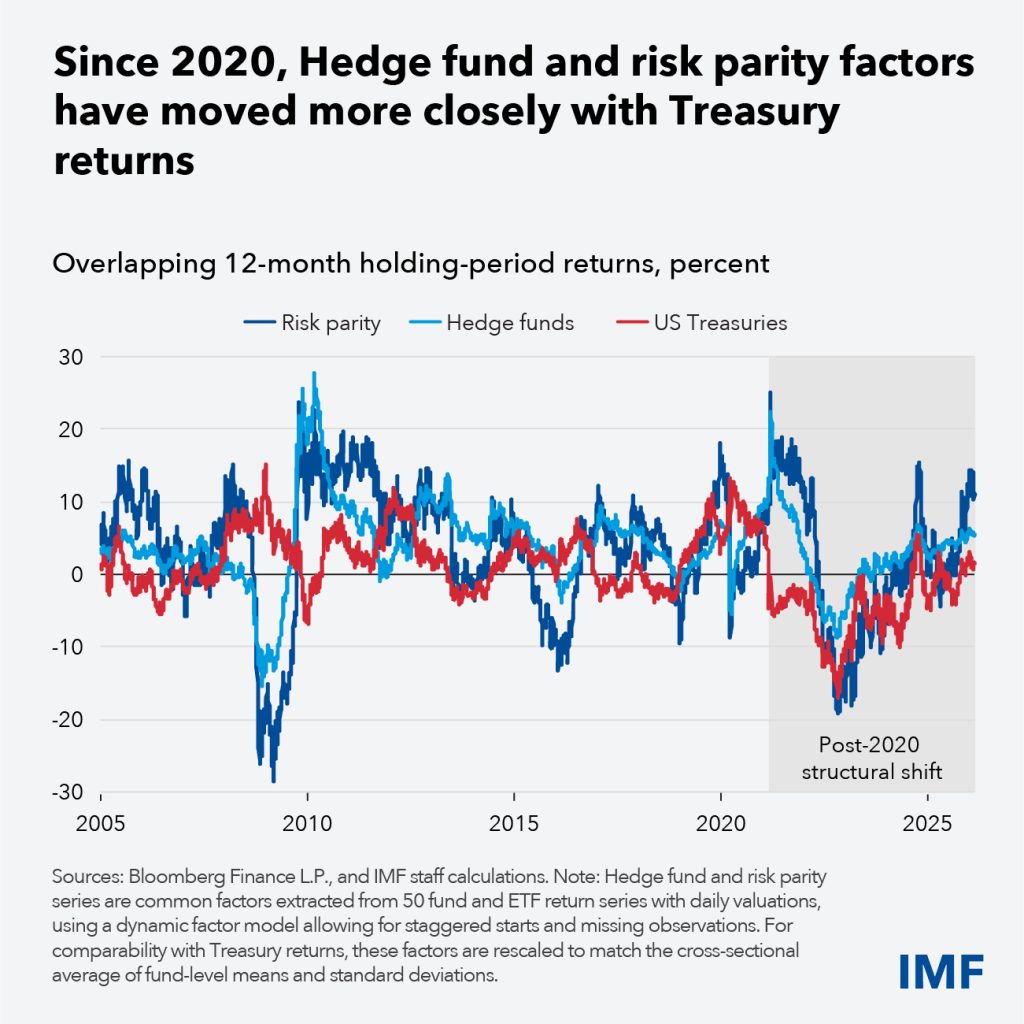
Since the start of the pandemic period—with supply shocks that fueled inflation—bonds have become less effective in cushioning volatility in stocks. Instead of offsetting equity risk, bonds are increasingly moving in tandem with stocks. This shift is particularly pronounced during sharp market selloffs, with profound implications for investors and policymakers alike.

The breakdown of this historical relationship makes diversification—such as the classic portfolio, of 60 percent stocks and 40 percent bonds, or risk parity strategies—vulnerable to shocks. Hedge fund and risk parity investment strategies that employ leverage based on the historical relationship are now increasingly moving in tandem with Treasury returns, which could make them vulnerable to forced deleveraging. Even conservative institutional investors like pension funds and insurers could be exposed to greater portfolio volatility during market corrections.
Corrections tend to be sharp, accompanied by a surge in stock market volatility. This amplifies systemic vulnerabilities as volatility can feed into selloff dynamics by worsening investors’ funding constraints and forcing deleveraging.

Looking back, our analysis shows that the turning point for correlations came around the end of 2019. With the onset of the pandemic the following year, the historical relationship changed significantly, resulting in sharp selloffs of both stocks and bonds to occur more frequently together.
From 2000 to 2019, the inverse relationship between expected stock and bond returns helped investors effectively manage risk. Tracing standardized expected returns for stocks and bonds against the VIX shows a clear divergence: As volatility rises, expected returns for equities increase as stock prices fall, while expected returns for bonds decline as bond prices rise. This was the foundation of diversification strategies.

 
The changed relationship since 2020—with both asset classes tending to sell off concurrently in response to rising market stress—reinforces equity risk in the United States as well as, to varying degrees, Germany, Japan, and the United Kingdom.
This breakdown may explain the severity of recent market selloffs: losses compound when both assets fall together.
The diminished hedging properties are increasingly evident in the sharp rallies in gold, silver, platinum and palladium, as well as currencies such as the Swiss franc. Gold, for example, has more than doubled since the start of 2024 as investors sought alternative safe havens in recent months. Platinum and palladium jumped in the final quarter of last year, reflecting diversification shifting toward non-sovereign stores of value.
Diminished protection 
Amid the hedging breakdown, higher volatility coincides with higher expected bond returns, with prices declining steeply in the current period as investors reprice term premiums.
Over the past few years, expanding bond supply to finance widening fiscal deficits across most advanced economies, which we also explored in the October 2025 Global Financial Stability Report,has heightened investor concerns. At the same time, gross issuance of bonds has outpaced central bank balance-sheet runoff, that is, bonds maturing without reinvestment.
With central banks reducing holdings via runoff, a larger share of bond supply must be absorbed by price sensitive private investors. This gap has become more evident since late 2023 as central banks’ balance sheet runoff slowed while issuance stayed elevated. Overall, the supply absorbed is many times larger than the reduction in central bank holdings over the past few years in the four largest advanced economies.
With inflation still above target in many economies, fiscal concerns increasingly raise term premiums as investors see bonds as riskier, eroding their suitability for hedging. Investors may demand higher compensation for holding longer maturities, reinforcing upward pressure on term premiums and further eroding hedges.
With fiscal expansion expected to continue, this upward pressure may be reinforced if corporate capital investment is increasingly financed by debt issuance. These effects could be reduced by greater productivity growth, bringing down inflation and allowing government to issue bonds with shorter maturities.
Policy challenges
Central banks will undoubtedly intervene to stabilize bond markets during periods of extreme stress, but this has limits. Relying on emergency measures can lead to excessive risk-taking and undermine market discipline.
A more durable solution, restoring the hedging properties of sovereign bonds, requires fiscal discipline. High debt levels globally and uncertain fiscal trajectories weaken the safe-haven status of government securities. Without credible fiscal frameworks, bonds cannot serve as reliable anchors in turbulent markets.
Central banks also must commit to ensuring price stability. The unexpected rise of inflation since 2020 has been a key contributor to the reversal in stock-bond correlations.
Regulators should also incorporate correlation breakdown scenarios into stress tests. Financial institutions need to prepare for traditional diversification to fail, as models calibrated on historical correlations may underestimate new risks.
Rethinking risk
With diminished diversification, investors must build portfolios that account for the shift in correlations. Alternative strategies—such as incorporating commodities or private assets—may offer partial solutions, but they come with their own complexities and risks.
Policymakers face even greater challenges. Maintaining financial stability amid high correlation risk requires credible fiscal and monetary policy frameworks, robust stress testing, and clear communication to anchor expectations. If diversification fails, volatility can cascade into broader financial instability. Investors and policymakers must rethink risk management for a new era where traditional hedges fail.
 
Authors:
• Tobias Adrian, Financial Counsellor and Director of the Monetary and Capital Markets Department, IMF
• Johannes Kramer, Senior Financial Sector Expert in the International Monetary Fund (MCM Global Markets Analysis), IMF
• Sheheryar Malik, Deputy Chief in the IMF’s Monetary and Capital Market Department, Global Markets Analysis Division, IMF
 
 
Compliments of the International Monetary FundThe post IMF | Stock-Bond Diversification Offers Less Protection From Market Selloffs first appeared on European American Chamber of Commerce New York [EACCNY] | Your Partner for Transatlantic Business Resources.

EACC

OECD | The Organisation for Economic Co-operation and Development appoints Stefano Scarpetta as Chief Economist

Stefano Scarpetta has been appointed as the next Chief Economist of the OECD. He will take up his duties on 1 April 2026.
Mr Scarpetta brings an outstanding international reputation as a leading economist, built over more than three decades of distinguished service. Since 2013, he has led the OECD Directorate for Employment, Labour and Social Affairs, where he oversaw landmark initiatives including the OECD Jobs Strategy and strengthened the Organisation’s capacity to assess the impact of major structural transformations — including demographic change, digitalisation and artificial intelligence — on labour markets and public services. He also served as sous-sherpa to the G7 and G20 on employment and social policy issues.
As Chief Economist, Mr Scarpetta will lead the OECD Economics Department in delivering rigorous, evidence-based analysis, international benchmarking and country-specific policy advice. The Department’s work supports policymakers in fostering sustainable economic growth, expanding employment opportunities and improving living standards across more than 100 countries worldwide.
“Over three decades at the OECD, Stefano has consistently demonstrated exceptional leadership, deep expertise in economic analysis and policy with a commitment to advancing the OECD’s mission and the collective interests of its members and partners,” OECD Secretary-General Mathias Cormann said.
Mr Scarpetta began his career at the OECD in 1991 and became a Senior Economist in the Economics Department in 1995. From 2002 to 2006, he served at the World Bank as labour market advisor and lead economist before returning to the OECD’s Economics Department in 2006. There, he led a division of the Department’s country studies branch before taking up successively senior positions in the Directorate he now leads.
An Italian national, Stefano holds a PhD in Economics from the École des Hautes Études en Sciences Sociales (EHESS), a Master of Science in Economics from the London School of Economics and Political Science and a Laurea Summa cum Laude from the University of Rome.

Working with over 100 countries, the OECD is a global policy forum that promotes policies to preserve individual liberty and improve the economic and social well-being of people around the world.

Compliments of the Organisation for Economic Co-operation and DevelopmentThe post OECD | The Organisation for Economic Co-operation and Development appoints Stefano Scarpetta as Chief Economist first appeared on European American Chamber of Commerce New York [EACCNY] | Your Partner for Transatlantic Business Resources.

EACC

ECB | Opening remarks by Christine Lagarde, President of the ECB, at a roundtable discussion on “Chain Reaction: Navigating Geoeconomic Shifts and Dependencies” at the Munich Security Conference, Germany

Munich, 14 February 2026
It is a mark of how much our world has changed that a central banker speaks at the Munich Security Conference on supply chains.
A decade ago, this would have seemed like a category error. Today, everyone in this room recognises that trade is as much a security issue as an economic one.
Economic interdependence has deepened substantially in recent decades, creating intricate webs of cross-border trade flows. Where this was once seen as a source of stability, it is now a source of vulnerability: to global disruptions like the pandemic and to deliberate weaponisation of dependencies.
Eurosystem staff have mapped products that are hard to diversify and difficult to substitute – and we can stress test the implications of suddenly cutting off supply.
Our analysis suggests that a sudden 50% drop in supply from geopolitically distant suppliers would reduce manufacturing value added by 2-3% – with the impact concentrated in electrical equipment, chemicals and electronics.[1]
This shift matters profoundly for Europe. We are the most open of the major economies. Now we must make the transition to strategic autonomy.
But what does that actually mean?
We hear many terms – reshoring, friendshoring, coalitions of the willing – but they distill into three distinct strategies:

Independence: rebuilding supply chains at home in critical technologies and inputs to reduce dependence.
Indispensability: building strengths in critical “indispensable” areas of those supply chains.
Diversification: spreading supply chains across partners so that no single disruption can paralyse our economy.

Each strategy is legitimate. But they are not the same – and without clarity, they can work at cross purposes.
If we pursue independence in sectors where we are lagging far behind, we risk imposing costs that erode competitiveness downstream.
For example, pursuing full autonomy in chip making could produce what one study calls “hollow champions” – firms unable to compete globally, supplying substandard technology to industries that are themselves strategic.[2]
Yet relying solely on trade – even within alliances – also carries risks. Trusted partners do not always remain so.
In some critical sectors, we need to build domestic capacity, even when it is temporarily more expensive. In 2023, the US conducted 114 orbital launches. Europe conducted three.[3]
Broad-brush strategies will not work. They may create unnecessary costs or miss real chokepoints. We need a targeted approach: understanding our strengths and weaknesses at a granular level, and evaluating costs and benefits.[4]
What does this mean from the ECB’s perspective? Let me focus on one key initiative.
The ECB needs to be prepared for a more volatile environment. As industrial policy becomes more assertive, geopolitical tensions rise and supply chains are disrupted, financial market stress is likely to become more frequent.
We must avoid a situation where that stress triggers fire sales of euro-denominated securities in global funding markets, which could hamper the transmission of our monetary policy. And this means we have to give partners who want to transact in euros the confidence that euro liquidity will be available if they need it.
That is why, last week, the Governing Council decided to expand our EUREP facility – our standing facility that offers euro liquidity against high-quality collateral.
This expanded facility provides permanence: central banks outside the euro area can now rely on continuous access to liquidity in euros, not just temporary lines.
It extends scope: we move from a regional to a global perimeter. Any central bank that meets basic criteria can request access, with flexibility on usage.
And it ensures agility: access is granted by default unless there is a reason to restrict it, speeding up the provision of liquidity.
This facility also reinforces the role of the euro. The availability of a lender of last resort for central banks worldwide boosts confidence to invest, borrow and trade in euros, knowing that access will be there during market disruptions.
In a world where supply chain dependencies have become security vulnerabilities, Europe must be a source of stability – for ourselves and for our partners.
That, too, is part of European security. And that is how the ECB plays its part.

Attinasi, M.G. et al. (2024), “Navigating a fragmenting global trading system: insights for central banks”, Occasional Paper Series, No 365, ECB.
Institut Montaigne (2025), “Autonomy or Indispensability? Identifying the EU’s Semiconductor Lodestar“, Policy Paper, December.
European Space Agency (2024), Report on the Space Economy, December.
Attinasi et al. (2024), op. cit.


Compliments of the European Central Bank The post ECB | Opening remarks by Christine Lagarde, President of the ECB, at a roundtable discussion on “Chain Reaction: Navigating Geoeconomic Shifts and Dependencies” at the Munich Security Conference, Germany first appeared on European American Chamber of Commerce New York [EACCNY] | Your Partner for Transatlantic Business Resources.

EACC

European Commission | Speech by President von der Leyen at the European Parliament Plenary Debate on Urgent Actions to Revive EU Competitiveness, Deepen the EU Single Market and Reduce the Cost of Living – from the Draghi Report to Reality

Thank you, Madam President, dear Roberta,
Deputy-Minister Raouna, dear Marilena,
Honourable Members,
In the last plenary, we focused on the geopolitical shockwaves that Europe is facing and on our united response. But our power on the global stage depends greatly on our strength on the economic front. Competitiveness is not just the foundation of our prosperity but of our security, and ultimately of our democracies too. This is why competitiveness has been at the top of our agenda from day one. At the very start of the mandate, we turned the Draghi and Letta reports into a plan for change, the Competitiveness Compass. And since then, it has been a year of action. With the Clean Industrial Deal. AI Factories and Gigafactories. Five new trade deals. Ten simplification omnibuses. The Grids Package. Tailor-made action plans for the automotive, steel and chemicals industries. The Savings and Investment Union. The greatest surge in defence investment in our history – with SAFE and the Roadmap 2030. And so much more. This is the urgency mindset we need, and we will relentlessly stay the course until we get it all done.
Today, I would like to focus on progress and next steps in three key areas. First, trade. Second, the Single Market. And third, simplification.
To the first topic: trade. A competitive Europe can only be an independent Europe. Today, dependencies are at risk to become weapons of coercion. Therefore, we must eliminate the bottlenecks in our most strategic value chains. And we can do this by stepping up production in Europe – and by expanding our network of reliable partners. This is why trade is so important. We must be laser-focused on opening growth opportunities and new markets to our companies. We need more rules-based, reliable trade with like-minded partners. Therefore, in 2025 we concluded trade agreements with Mexico, Indonesia and Switzerland. Last month, I signed our trade agreement with Mercosur. And two weeks ago, I was in India to sign the largest free trade agreement ever. The mother of all deals. It has a market of 2 billion people. 25% of global GDP. It grants Europe unique access to the fastest growing large economy – a clear ‘first-mover’ advantage for our businesses. Not only is this a breath of fresh air for European exporters, this will also create alternative supply chains in strategic sectors – from chips to clean tech. And more trade deals are on their way with Australia, Thailand, the Philippines, the UAE, etc. This is the European way to independence. And Europe’s independence moment is now.
Let me continue with the Single Market. The IMF says that interstate barriers in our Union are three times higher than interstate barriers in the US. So how can we compete on an equal footing? We have the second-largest economy in the world, but we are driving it with the handbrake on. The good news is: This can be fixed. But we need single-minded focus on the Single Market. And we need to tear down barriers one by one. That is why, next month, we will propose the 28th regime. We call it EU Inc, a single and simple set of rules that will apply seamlessly all over our Union so that business can operate across Member States much more easily. Our entrepreneurs will be able to register a company in any Member State within 48 hours – fully online. EU Inc will ease access to finance in the start-up and scale-up phases. EU Inc enables smooth cross-border operations, and it allow rapid wind-down – if a company fails. This is the speed we need. And this is ‘Europe made easy’.
The same is true for capital markets. Let me take the US example again. One financial system, one capital market, and a handful of other financial centres. Here in Europe, we do not only have 27 different financial systems, each with its own supervisor. But also, more than 300 trading venues across our Union. That is fragmentation on steroids. We need one large, deep and liquid capital market. And this is the goal of our Savings and Investment Union. We have made proposals on market integration and supervision. And now we need you to get them over the finish line. Our companies need capital right now. So let us get this done this year. And thank you for your support, because my plan A is to move by 27. But if this is not possible, the Treaty allows for enhanced cooperation. We have to make progress, one way or the other, to tear down the barriers that prevent us from being a true global giant.
Honourable Members,
Completing our Single Market also means completing our Energy Union. And this is vital to bring prices down even further. Prices remain too high and too volatile. And we know why. It is because of lack of interconnection and grids and our reliance on fossil fuels. The data is as clear as daylight. In 2025, electricity from gas cost on average more than EUR 100 per megawatt-hour. The price of electricity from solar? EUR 34. Electricity from nuclear? EUR 50 to EUR 60 per megawatt-hour. The figures are telling. Low-carbon energies are not only homegrown and clean. They give us more independence, more security and they bring costs down. This is why today, we are investing heavily in low-carbon energy. Last year, for the first time ever, we produced more electricity from solar and wind than from all fossil fuels combined. And nuclear keeps rising year on year. But we need more than that. To lower and stabilise costs, we need the infrastructure for a true Energy Union. This is why we introduced the European Grids package. It will speed up permitting and fast-track the construction of Energy Highways across our Union. Just last month, we reached an agreement on the first such project. The Bornholm Energy Island. It will create a new bridge between Denmark and Germany, connecting both countries to 3 gigawatts of offshore wind energy. It will transform the Baltic wind from a national resource into shared European power. The goal is simple. Clean energy must flow freely all across our Union.
Finally, on European preference. I believe that in strategic sectors, European preference is a necessary instrument that will contribute to strengthen Europe’s own production base. It can help create lead markets in those sectors and support the scaling-up of European production capabilities. But I want to be clear – it is a fine line to walk. There is no ‘one-size-fits-all’. That is why every proposal must be underpinned by robust economic analysis and be in line with our international obligations.
Honourable Members,
In all of this in the Single Market, we must be driven by the greatest sense of urgency. We need a clear timetable and everyone’s commitment to get things done. This is why we need a Joint Single Market Roadmap to be completed by 2028. I will propose that, together with the Parliament and the Council, we endorse such a roadmap at the March European Council. It will include a commitment to swiftly adopt some key proposals, all by end of next year. Because time is of the essence.
Honourable Members,
My final point is simplification. We know why it is vital. European companies tell us they spend almost as much on bureaucracy as on research and development. This cannot be. We have made simplification a core focus. And in one year, we have delivered more than in the previous decade. We have already proposed to slash bureaucratic costs for companies by EUR 15 billion every year. But all the omnibuses must reach their destination. But we do not only need to look at the omnibuses at the European level. We must also look at the national level. There is too much gold-plating – the extra layers of national legislation that just make businesses’ life much more complicated and create new barriers in our Single Market. Let me give an example. A truck in Belgium can weigh up to 44 tonnes. But if you cross the border with France, it can only carry up to 40 tonnes. In June 2023, we proposed legislation to harmonise this. Almost two years later, it is still under discussion by the co-legislators. Another example. Shipping waste from one Member State to another should be efficient, easy and quick. But with gold-plating, there are different national practices in every Member State. Some Member States for instance only accept correspondence by fax. It is true. It can take several months for traders to get green light from the authorities depending on the different rules in different Member States. If we are serious about simplification, we must crack down on gold-plating and fragmentation. It is time for a deep regulatory housecleaning – at all levels.
So what matters now is speed of delivery. So we need everyone to play their part. This is the moment for unity and for urgency. This is how we make Europe move faster – and this is how we make Europe stronger.
Thank you, and long live Europe.
 
 
Compliments of the European Commission The post European Commission | Speech by President von der Leyen at the European Parliament Plenary Debate on Urgent Actions to Revive EU Competitiveness, Deepen the EU Single Market and Reduce the Cost of Living – from the Draghi Report to Reality first appeared on European American Chamber of Commerce New York [EACCNY] | Your Partner for Transatlantic Business Resources.

EACC

European Council | Council Gives Final Green Light to New Customs Duty Rules for Small Parcels

The Council today formally approved new customs duty rules for items contained in small parcels entering the EU, largely via e-commerce. The new rules respond to the fact that such parcels currently enter the EU duty free, leading to unfair competition for EU sellers.
“As global e-commerce booms, EU customs rules must keep pace. Abolishing the out-of-date exemption for small parcels will help support EU business and shut down avenues for unscrupulous sellers. Now, we need to move forward decisively on the overall customs reform which is a key part of the puzzle in making the EU more competitive and more secure.”
– Makis Keravnos, Minister of Finance of the Republic of Cyprus
Today’s agreement abolishes the threshold-based customs duty relief for parcels valued at under €150 entering the EU. Customs tariffs will therefore start applying to all goods entering the EU once the EU customs data hub – under discussion as part of a broader fundamental reform of the customs framework – is operational. This is currently expected in 2028.
Until that time, EU member states have agreed to introduce an interim flat rate customs duty of €3 on items contained in small parcels valued at less than €150 sent directly to consumers in the EU. As of 1 July 2026, the duty will be levied on each different category of item, identified by their tariff sub-headings, contained in a parcel.

Example:
A parcel contains 1 blouse made of silk and 2 blouses made of wool.
Therefore, due to their different tariff sub-headings, the parcel contains two distinct items and €6 in customs duty should be paid.

The new system will have a positive impact both for the EU budget as well as for national public finances, as customs duties constitute a traditional own resource of the Union, and member states retain part of those amounts by way of collection costs. The measure is distinct from the proposed so-called ‘handling fee’ currently under discussion in the context of the customs reform package.
Next steps
The interim flat rate customs duty of €3 will be levied on each item category contained in a small parcel entering the EU from 1 July 2026 to 1 July 2028 and may be extended as appropriate. Once the new EU customs data hub is operational, this interim duty will be replaced by normal customs tariffs.
Background
According to the European Commission, the volume of small packages arriving into the EU has doubled every year since 2022. In 2024, 4.6 billion such packages entered the EU market. 91% of small shipments arrive from China.
More broadly, the EU is currently working to reform its customs system so that it can deal with the significant pressure arising from increased trade flows, fragmented national systems, the rapid rise of e-commerce and shifting geopolitical realities. Negotiations between the Council and the European Parliament on the reform – including on the establishment of the customs data hub, overseen by a new EU customs authority – are ongoing.
 
 
Compliments of the European Council
 The post European Council | Council Gives Final Green Light to New Customs Duty Rules for Small Parcels first appeared on European American Chamber of Commerce New York [EACCNY] | Your Partner for Transatlantic Business Resources.