

EACC

European Commission | Questions and Answers on the EU ETS Market Stability Reserve

What is the Commission proposing to change in the EU ETS Market Stability Reserve?

The Commission is proposing to stop the automatic invalidation of ETS allowances held in the Market Stability Reserve (MSR) above 400 million. Instead of being cancelled, these allowances will be retained in the reserve.
This strengthens the MSR’s role as a buffer, improving its ability to respond to future market developments, including situations of supply tightness or excessive price volatility, while preserving the system’s rules-based design.

Why is the Commission proposing updates to the Market Stability Reserve now?

The EU Emissions Trading System(EU ETS) is delivering: it is reducing emissions, cutting Europe’s dependence on imported fossil fuels and driving investment in clean, homegrown energy. At the same time, as recently highlighted by President von der Leyen at the March European Council, it needs to be modernised to remain effective, flexible and responsive to changing market conditions.
The proposed update to the MSR reflects this need. Stopping the invalidation of allowances will strengthen the system’s capacity to act as a buffer and ensure stability in the years ahead. The comprehensive review of the EU ETS, planned for July 2026, will contain that assessment and include any relevant adjustment to keep the MSR fit for purpose in the next decade.
This measure is part of a broader effort to keep the EU ETS fit for purpose, maintaining its core design while strengthening its ability to deliver decarbonisation, competitiveness and energy security.

How will this change affect carbon prices and the functioning of the EU carbon market?

The Commission does not speculate on carbon price developments or make projections on the price impacts of legislative proposals. The EU ETS remains a market-based system where prices are determined by supply and demand.
The proposed change does not have an immediate impact on the market balance. Under the proposal, allowances in the MSR would only be released into the market at times of market tightness or excessive price increases.
A comprehensive review of the EU ETS will follow in July 2026.

How will the proposal support Europe’s competitiveness while delivering on its climate targets?

Mainly thanks to the ETS, domestic emissions in the EU dropped by 39%, while the economy grew by 71% between 1990 and 2024. The proposal strengthens the EU ETS, so it continues to drive emissions reductions while providing the stability and predictability that industry needs to invest in the transition.
At the same time, strengthening the Market Stability Reserve improves the system’s ability to respond to market imbalances and reduces the risk of excessive price volatility. A more stable and predictable carbon market provides greater certainty for businesses planning long-term investments in clean technologies.
 
 
Compliments of the European Commission The post European Commission | Questions and Answers on the EU ETS Market Stability Reserve first appeared on European American Chamber of Commerce New York [EACCNY] | Your Partner for Transatlantic Business Resources.
EACC

OECD | Global Economic Outlook Remains Robust but has Weakened Amid Energy Shock and Geopolitical Risks

The resilience of the global economy is being tested by the evolving conflict in the Middle East, which has generated new inflationary pressures while creating significant uncertainty, according to the OECD’s latest Interim Economic Outlook.
Global growth was steady heading into 2026, supported by the strength of technology-related production, lower effective tariffs on US imports and the momentum carried over from 2025. The energy supply shock following the onset of the conflict in the Middle East is expected to significantly weigh on global growth while putting new upward pressure on inflation.
As a result of these developments, the Outlook projects global growth of 2.9% in 2026 and 3.0% in 2027. The evolution of the conflict in the Middle East is highly uncertain and poses considerable risks to these baseline projections. A more long-lasting disruption, with energy prices remaining elevated beyond mid-2026, would further reduce growth prospects.
GDP growth in the United States is projected at 2.0% in 2026, before moderating to 1.7% in 2027. In the euro area, growth is projected to be 0.8% in 2026 and 1.2% in 2027. China’s growth is projected to slow to 4.4% in 2026 and 4.3% in 2027.
Inflation pressures will persist for a longer period, with inflation now expected to be higher in 2026 than previously projected, reflecting the surge in global energy prices. Headline inflation in G20 countries is projected to be 4.0% in 2026, easing to 2.7% in 2027. Click here to see the projections

“The energy supply shock from the evolving conflict in the Middle East is testing the resilience of the global economy. We project global growth will remain robust, but it will be slower than the pre-conflict trajectory, with significantly higher inflation,” OECD Secretary-General Mathias Cormann said. “Any policy measures adopted to cushion the impact of the energy price shock should be targeted towards those most in need, temporary, and ensure incentives to save energy are preserved. Increasing renewable energy generation and energy efficiency can enhance economic security while boosting resilience to future price shocks.”
The Outlook highlights a range of risks. The expected decline in future energy prices is based on assumptions that current disruptions to supply will ease over time, and be limited in 2027. Longer-lasting closure of oil and gas production facilities in the region or persistent disruptions to exports through the Strait of Hormuz would likely have more significant adverse consequences on energy prices, inflation expectations and future growth.
The Outlook points out that higher energy and fertiliser prices could spur increases in food prices, particularly affecting vulnerable households. Higher energy prices could also increase the cost for European countries carrying out necessary annual replenishing of natural gas stocks. Financial markets may experience additional volatility while rising long-term sovereign yields increase fiscal risks.
Given these challenges, the Outlook highlights key priorities for policymakers. Central banks should remain vigilant and ensure expectations are well-anchored. Stronger efforts are needed to safeguard the sustainability of public finances. Any measures to cushion the economic impact of the energy shock will need to be targeted, temporary and take into account limited fiscal space facing most governments. Lowering trade barriers would boost output and reduce inflationary risks. Over the medium term, improving energy efficiency and reducing dependency on fossil fuel imports can lower exposure to future supply shocks.
For the full report and more information, consult the Interim Economic Outlook online. Media queries should be directed to the OECD Media Office (+33 1 45 24 97 00).
Watch the live webcast of the press conference

Working with over 100 countries, the OECD is a global policy forum that promotes policies to preserve individual liberty and improve the economic and social well-being of people around the world.


Compliments of the Organisation for Economic Co-operation and DevelopmentThe post OECD | Global Economic Outlook Remains Robust but has Weakened Amid Energy Shock and Geopolitical Risks first appeared on European American Chamber of Commerce New York [EACCNY] | Your Partner for Transatlantic Business Resources.

Read More
EACC

IMF | How the War in the Middle East is Affecting Energy, Trade, and Finance

Energy prices, supply chains, and financial markets are the main transmission channels, but the regional effects will vary significantly.
The world faces yet another shock. The war in the Middle East is upending lives and livelihoods in the region and beyond. It is also dimming the outlook for many economies that had only just shown signs of a sustained recovery from previous crises.
The shock is global, yet asymmetric. Energy importers are more exposed than exporters, poorer countries more than richer ones, and those with meager buffers more than those with ample reserves.
Beyond its painful human toll, the war has caused serious disruption to the economies of the most directly affected countries, including damage to their infrastructure and industries that could become long-lasting. Although these countries are resilient, their short-term growth prospects will be negatively affected.
Meanwhile, large energy importers in Asia and Europe are bearing the brunt of higher fuel and input costs: about 25 to 30 percent of global oil and 20 percent of liquefied natural gas pass through the Strait of Hormuz, feeding demand not only in Asia but also in parts of Europe. Economies heavily dependent on oil imports in Africa and Asia are finding it increasingly hard to access the supplies they need, even at inflated prices.
Parts of the Middle East, Africa, Asia-Pacific, and Latin America face the added strain of higher food and fertilizer prices and tighter financial conditions. Low-income countries are especially at risk of food insecurity; some may need more external support—even as such assistance has been declining.

Although the war could shape the global economy in different ways, all roads lead to higher prices and slower growth. A short conflict might send oil and gas prices soaring before markets adjust, while a long one could keep energy expensive and strain countries that rely on imports. Or the world may settle somewhere in between—tensions linger, energy stays costly, and inflation proves hard to tame—with ongoing uncertainty and geopolitical risk. Much depends on how long the conflict lasts, how far it spreads, and how much damage it inflicts on infrastructure and supply chains.
We are closely monitoring these developments and will provide a fuller assessment in our World Economic Outlook and Global Financial Stability Report, to be published on April 14, followed by our Fiscal Monitor on April 15.
Energy prices
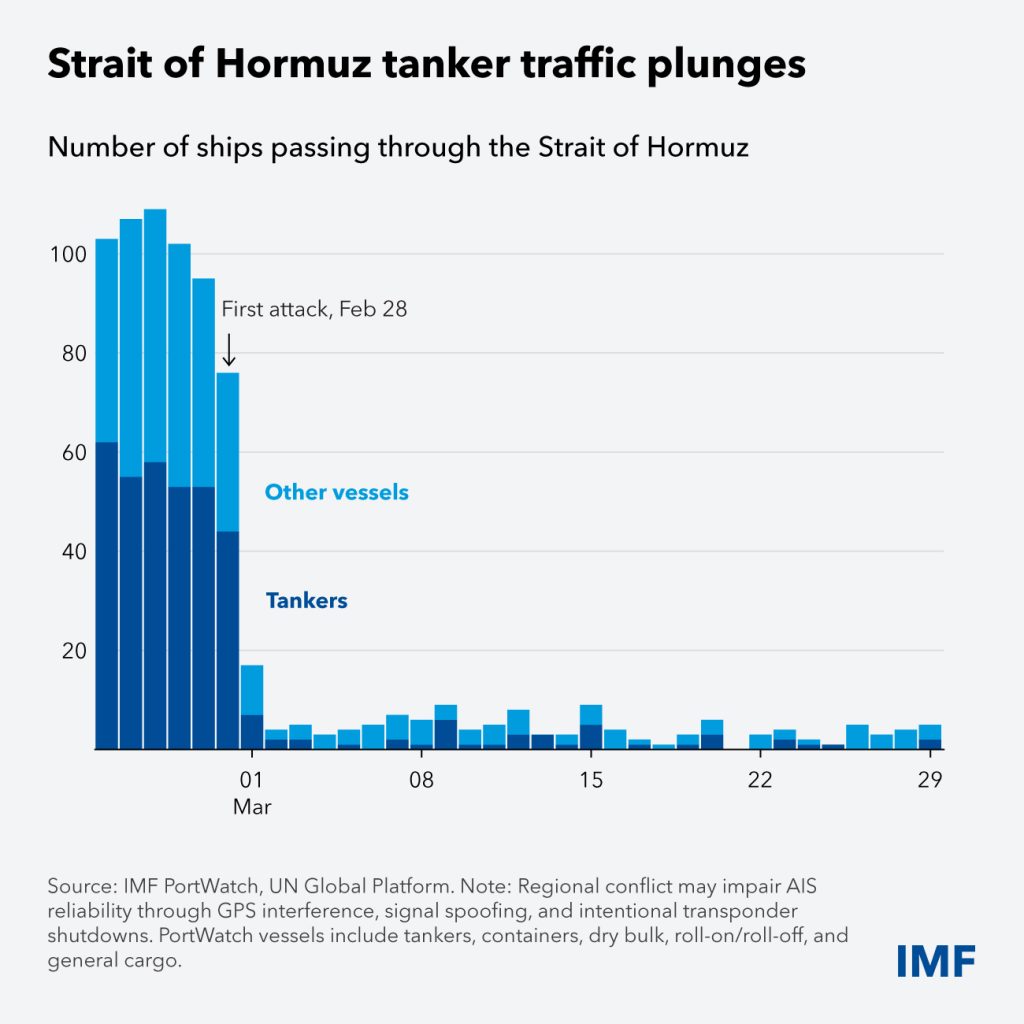
Energy is the main transmission channel. The de facto closure of the Strait of Hormuz and damage to regional infrastructure have produced the largest disruption to the global oil market in its history, according to the International Energy Agency. For fuel‑importing economies, the effect is that of a large, sudden tax on income.

The multi-regional impact is apparent. Energy‑importing economies in Africa, the Middle East and Latin America are feeling the strain from higher import bills on top of already limited fiscal space and external buffers.
In Asia’s large manufacturing economies, higher fuel and power bills are raising production costs and squeezing people’s purchasing power; in some, balance‑of‑payments pressures are already weighing on currencies. In Europe, the shock is reviving the specter of the 2021–22 gas crisis, with countries such as Italy and the United Kingdom especially exposed by their reliance on gas‑fired power, while France and Spain are relatively protected by their greater nuclear and renewables capacity.
By contrast, oil‑exporting countries in the Middle East, parts of Africa, and Latin America that can still get their barrels to market have a prospect of stronger fiscal and external positions from higher prices. Producers whose exports are constrained or curtailed—including several Gulf Cooperation Council members—can expect much less upside. Even after transit resumes, higher risk premia and uncertainty may curb investment and growth.
Supply chains
The war is also reshaping supply chains for non-energy and critical inputs. Rerouting tankers and container ships raises freight and insurance costs and lengthens delivery times. Air‑traffic disruptions around key Gulf hubs impact global tourism while adding another layer of complexity to trade.
In addition to higher commodity prices, countries, companies, and consumers already face the effects of these supply‑chain complications. With shipments of fertilizer—of which about one-third passes through the Strait of Hormuz—disrupted, concerns about food prices are mounting. The interruption of crop-nutrient supplies from the Gulf comes just as planting season begins in the Northern Hemisphere, threatening yields and harvests through the year and pushing food prices higher.
The most vulnerable will bear the heaviest burden. People in low‑income countries are most at risk when prices rise because food accounts for about 36 percent of consumption on average, compared with 20 percent in emerging market economies and 9 percent in advanced economies. That makes any spike in fertilizer and food prices not just an economic problem but a socio-political one, especially where fiscal resources to cushion the blow are limited.
There could also be shortages or price surges of other materials used in manufacturing. The Gulf supplies a large share of the world’s helium, used in a vast array of products from semiconductors to medical imaging devices. Indonesia, which provides roughly half of global nickel—a key component in electric‑vehicle batteries—could face a shortage of sulfur needed to process the metal. Eastern African economies that depend on trade links with and remittances from Gulf countries face weaker demand for their services exports, logistical bottlenecks and reduced remittances.
Inflation and inflation expectations
If elevated energy and food prices persist, they will fuel inflation worldwide. Historically, sustained oil‑price spikes have tended to push inflation higher and growth lower. Over time, higher transport and input costs work their way into the prices of manufactured goods and services. For many countries that had only just brought inflation closer to target, and even more so those with stickier inflation, this risks a renewed period of uncomfortable price pressures.
Here, too, the pattern is uneven. In much of Asia and parts of Latin America, where inflation had been relatively low, higher energy and food costs will test the resilience of expectations, particularly in economies with weaker currencies and large energy imports. In Europe, another energy‑driven spike in prices would come on top of existing cost‑of‑living strains, raising the risk of more persistent wage demands. In low‑income countries where people spend a large share of their income on food, especially in Africa and parts of the Middle East, and Central America higher food prices carry acute social and economic costs.
If people and businesses in any of these regions believe inflation will remain higher for longer, they may build this into wages and prices, making it harder to contain the shock without a sharper slowdown. The war thus raises not only current inflation but also a risk of expectations becoming less firmly anchored.
Financial conditions
Finally, the war has unsettled financial markets. Global stock prices have declined, bond yields have risen across major advanced economies and many emerging markets, and volatility has increased. The market sell-off has so far been contained compared with past global shocks. Nonetheless, these moves have tightened financial conditions worldwide.
Again, effects vary. In Europe and many emerging markets, higher yields and wider credit spreads raise debt‑service burdens and complicate refinancing for governments and firms alike. In sub‑Saharan Africa and some low‑income economies in the Middle East and South Asia, already meager reserves and limited market access make external shocks to financing conditions more dangerous—especially as higher import bills for fuel, fertilizer, and food widen trade deficits and put pressure on currencies. In the Middle East and elsewhere, high levels of debt and tighter financial conditions may further raise debt financing costs.
By contrast, advanced economies with deep domestic capital markets and some commodity exporters with ample buffers—such as Saudi Arabia and United Arab Emirates, or Latin American commodity producers like Brazil and Ecuador—can better absorb market stress, even if they are not immune to higher risk premia.
The IMF’s role
These channels show why the war’s economic impact is both global and highly uneven. They help explain why the same shock can look like a terms‑of‑trade windfall for some countries, a balance‑of‑payments strain for others, and a renewed cost‑of‑living squeeze across many economies.
Such complex spillovers confront us at a time when many economies have limited room to absorb shocks. Many countries were already facing record-high debt levels, raising concerns about fiscal sustainability.
To manage the shock and maintain resilience, it is therefore more important than ever that countries adopt appropriate policies. Measures need to be carefully calibrated to country-specific needs. Countries with limited reserves and little fiscal room to maneuver should be especially cautious.
At this pivotal moment, the IMF is stepping up as well. We are supporting our members—especially the most vulnerable—with policy advice, capacity development and, where needed and in coordination with the international community, financial assistance. As Managing Director Kristalina Georgieva has said: “In an uncertain world, more countries are needing more of our support. We are there for them.”
 
 
Compliments of the International Monetary FundThe post IMF | How the War in the Middle East is Affecting Energy, Trade, and Finance first appeared on European American Chamber of Commerce New York [EACCNY] | Your Partner for Transatlantic Business Resources.

EACC

ECB | Where do the Costs of Higher US Tariffs Fall?

Understanding the impact of tariffs on inflation is a complex task as it involves analysing responses along the pricing chain, including those by foreign exporters, distributors, producers and retailers. At different stages of this pricing chain, domestic firms could respond to tariff announcements by building up inventories before tariffs are implemented, shifting the sourcing of their imports from countries facing higher tariffs to countries facing lower tariffs (trade diversion) and adjusting the pricing of their products to accommodate the impact of tariffs. This analysis is made all the more intricate by exchange rate developments and exemptions for goods in transit at the time of tariff implementation. In this box, we estimate the impact of recently imposed US tariffs on the prices exporters are charging for products delivered to the United States and explore differences in the pricing behaviour of exporters across countries and sectors observed to date. We show that the costs of tariffs are falling mostly on US firms and consumers and only 5% of costs are borne by foreign firms.
Following a series of tariff increases imposed by the United States, both the prices (net of tariffs) and the volumes of goods it imports have been declining. From January to November 2025, the announced statutory effective tariff rate increased significantly from 3% to over 18%.[1] The annual change in the prices of goods imported into the United States, measured as unit values and reported net of tariffs, has been slightly negative since April. Volumes of imported goods have declined sharply. However, the magnitude of the adjustments in prices and quantities varies across major trading partners, such as China, Canada, Mexico and the EU, which were targeted by higher tariffs. These differences could reflect variations in tariff rates and scope, shifts in the composition of imports and country-specific dynamics.
Exporters to the United States are absorbing only a small fraction of higher tariff-related costs. In aggregate, unit values of imported goods reported net of tariffs show an average pass-through coefficient of 0.95 (Chart A, panel a).[2] This means that a 10% increase in tariffs implies only a 9.5% increase in prices. Therefore, only a small fraction of the increased tariffs is being absorbed by exporters.[3] The pass-through coefficient is significantly lower when looking at specific sectors.[4] However, no significant differences are evident in the estimated tariff pass-through by major trading partners.

Chart A
Impact of tariffs on unit values and volumes of imported goods

a) Unit values of imported goods
(elasticity; complete pass-through = 1)

b) Volumes of imported goods
(elasticity)

Source: ECB staff calculations.
Notes: The reported estimates are based on a panel regression analysis of six-digit product categories of the harmonised system (HS6) import unit values, following the methodology of Amiti et al. (2019). Estimated on a sample from January 2024 to October 2025. The upper part of panel b) reports estimates of the aggregate elasticity (extensive and intensive margin) obtained from a regression where product categories, including those subject to higher tariffs, are no longer imported into the United States. The lower part of panel b) reports estimates obtained from a regression on those product categories which are still traded under tariffs.

The estimated impact of tariffs on import volumes is large. The estimated aggregate elasticity of imports for all product categories stands at -3.7. This means that a 10% increase in tariffs would result in a 37% decline in import volumes. If, by contrast, we focus on only those product categories which are still traded under tariffs, the estimated coefficient declines markedly, albeit remaining economically relevant at ‑0.43. This means that a 10% increase in tariffs would result in a 4.3% decline in import volumes. This difference in estimated elasticity for import volumes suggests that the observed decline is largely associated with products which, in response to tariffs, are no longer traded – meaning they undergo an adjustment through the extensive margin (Chart A, panel b, upper graph). However, volumes also decline markedly for products which are still being traded under tariffs (trade adjustment through the intensive margin; Chart A, panel b, lower graph).
Zooming in on the automotive sector highlights how tariffs triggered significant changes in trade structures, particularly within regional supply chains. In the automotive sector, the results point to a clear decoupling of the United States from China and the EU in favour of Canada and Mexico (Chart B). The surge in car imports from Canada and Mexico reflects a strengthening of existing trade relationships.[5] This stands in sharp contrast to the results reported for the EU and Japan, which saw both a contraction in the unit value of exported cars and a strong decline in the volume of products subject to tariffs and still exported to the United States.[6]

Chart B
Impact of tariffs on unit values and volumes of cars imported to the United States

a) Unit values of imported cars

b) Volumes of imported cars

(elasticity; complete pass-through = 1)

(aggregate elasticity)

Source: ECB staff calculations.
Notes: The reported estimates are based on a panel regression analysis of six-digit product categories of the harmonised system (HS6) import unit values, following the methodology of Amiti et al. (2019). Estimated on a sample from January 2024 to October 2025.

While tariffs are reshaping the geography of trade relations with the United States, their costs are falling mostly on domestic importers and consumers. We find that costs associated with higher tariffs are passed down the pricing chain, with consumers currently bearing around a third of the tariff burden (Chart C). And if the higher tariffs are expected to stay in place for a longer period, the available survey evidence from US firms suggests that they will pass a larger share of tariff-related costs on to consumers. Over the longer term, this share could rise to over half as US firms exhaust their ability to absorb costs. Additionally, if the extent to which exporters absorb tariffs remains limited in scope, as reported above, this implies that US firms would absorb around 40% of higher tariff costs in the longer term.

Chart C
Distribution of tariff-implied costs along the pricing chain

(coefficient estimates)

Source: ECB staff calculations.
Notes: The chart shows how tariff costs are distributed across the pricing chain, based on empirical analyses using data available up to August 2025 (dark blue). The grey bars represent residual attributions, with hashed sections indicating survey results from Andrade et al. (2025), which suggest that the tariff pass-through to consumers increases to 0.55 when in place over longer time horizons. The figure for consumers is derived from a panel regression of tariffs on personal consumption expenditures PCE components, while the figure for exporters is based on a panel regression analysis of six-digit product categories of the harmonised system (HS6) import unit values, following the methodology of Amiti et al. (2019). “Firms” refers to distributors, producers and retailers.

References
Amiti, M., Redding, S.J. and Weinstein, D.E. (2019), “The Impact of the 2018 Tariffs on Prices and Welfare”, Journal of Economic Perspectives, Vol. 33, No 4, pp. 187-210.
Amiti, M., Flanagan, C., Heise, S. and Weinstein, D.E. (2026), “Who Is Paying for the 2025 U.S. Tariffs?”, Liberty Street Economics, Federal Reserve Bank of New York, 12 February.
Andrade, P., Dietrich, A.M., Leer, J., Lin, X., Schoenle, R.S., Tang, J. and Zakrajšek, E. (2025), “Who Will Pay for Tariffs? Businesses’ Expectations about Costs and Prices”, Current Policy Perspectives, No 25-13, Federal Reserve Bank of Boston, 29 September.
Hinz, J., Lohmann, A., Mahlkow, H. and Vorwig, A. (2026), “America’s Own Goal: Who Pays the Tariffs?”, Kiel Policy Brief, No 201, Kiel Institute for the World Economy.
Le Roux, J. and Spital, T. (2026), “Global trade redirection: tracking the role of trade diversion from US tariffs in Chinese export developments”, Economic Bulletin, Issue 1, ECB.

There is a difference between statutory and actual effective tariff rates. The statutory effective tariff rate is calculated based on tariff announcements and a usually fixed trade structure, whereas the actual tariff rate is derived from customs data and is typically lower. The World Trade Organization reports in its tariff tracker that the statutory effective tariff rate on goods for the United States was 18.2% in November 2025, whereas the actual effective tariff rate on goods for the same month was 9.8%. For economic analysis, the statutory effective tariff rate is typically used as the explanatory variable as the implementation date is judged to be more relevant compared with customs reports data, which often suffer from reporting lags and endogeneity bias caused by changing trade volumes triggered by tariffs.

Aggregate effects are captured through time fixed effects, while product-level characteristics are controlled for by including item fixed effects following Amiti et al. (2019). The tariff effect is identified by the common movement of the dependent price variable in response to tariff changes within all items across time.

This finding is broadly consistent with the evidence from the 2018-19 period as documented in Amiti et al. (2019). It is also in line with the available estimates for the current tariffs (Hinz et al., 2026), suggesting that the United States possesses limited terms-of-trade leverage over its global suppliers in the short term. While Amiti et al. (2026) report a similar tariff pass-through (elasticity) of 0.94 for the period from January to August 2025, they find it declined to 0.86 in November.

Steel and aluminium, cars and car parts were targeted early on by the US Administration and faced significant tariffs ranging from 25% to 50%, with few exemptions.

Rerouting of Chinese car exports via these countries may have contributed to these developments, although recent analyses suggest that Chinese exports may have been rerouted through countries in the Association of Southeast Asian Nations. For further details, see Le Roux and Spital (2026).

The estimated elasticity on the trade volume at the intensive margin is 0.84 for Canada and Mexico and ‑1.26 for the EU.


Compliments of the European Central BankThe post ECB | Where do the Costs of Higher US Tariffs Fall? first appeared on European American Chamber of Commerce New York [EACCNY] | Your Partner for Transatlantic Business Resources.

EACC

European Council | EU customs: Council and Parliament Agree on Landmark Reform

The Council and the Parliament today agreed to overhaul the EU customs framework, giving the Union a more modern toolbox to deal with trends such as huge increases in trade volumes, especially in e-commerce, a fast-growing number of EU standards that must be checked at the border and challenging geopolitical realities.
The reform establishes innovative new instruments to facilitate global trade, collect customs duties more efficiently and to tighten controls on non-compliant, dangerous or unsafe goods. Overall, the new system will allow for more robust controls without excessive burden for authorities and traders.

“Today’s agreement marks the greatest reform since the creation of the Customs Union in 1968. The new Union customs code will allow us to deal with the multiple challenges prompted by the new geopolitical realities, while ensuring economic security. Once adopted, this modern toolbox will facilitate trade and ensure the proper collection of duties, in a simplified manner, and with the required legal certainty.” – Makis Keravnos, Minister of Finance of the Republic of Cyprus

The co-legislators have agreed on legislation to:

create a single, state-of-the-art EU customs data hub: one central platform for importers and exporters to interact with customs in the EU, strengthening data integrity, traceability and customs controls
introduce enhanced customs simplifications for the most trusted traders, saving them time and money
implement a new EU-wide handling fee for items contained in small parcels entering the EU
establish a new decentralised agency for customs – the EU customs authority – which will oversee the EU customs data hub while supporting the risk management work of national customs authorities.

The EU customs authority
The new decentralised EU agency for customs will coordinate governance of the EU customs union in certain areas.
To support the work of national offices, the EU customs authority will analyse the constantly updated import and export data contained in the new EU customs data hub, helping to identify the riskiest cargo entering the EU which should be prioritised for inspection.
The authority will also help establish priority control areas and risk criteria. Finally, it will coordinate EU-level crisis management in the area of customs.
The customs authority will be located in Lille, France. It will be established on the day that the overarching regulation enters into force.
The EU customs data hub
The EU customs data hub will be the single online environment designed to collect and analyse customs data to ensure the smooth flow of goods in and out of the EU. It will also support the EU-wide risk management carried out by the EU customs authority.
To fulfil their customs obligations, businesses importing to and exporting from the EU will only need to submit customs information once to this single portal, rather than to up to 27 individual customs authorities. They can enter the same information to cover multiple consignments, saving time and money.
National customs authorities will gain a full overview of trade flows and supply chains. With the support of the EU customs authority, member states will have access to the same real-time data and will be able to pool information to respond to risks more quickly, consistently and effectively.
Under the terms of the agreement, the data hub will become operational for e-commerce goods on 1 July 2028. A phased rollout will bring all movements of goods into its scope by 1 March 2034.
Trust and check traders
The updated legislation creates a new category of the most transparent businesses – trust and check traders.
Under this scheme, companies providing comprehensive information on the movement and compliance of goods, along with other stringent criteria, will enjoy more streamlined customs obligations, such as simplified procedures for temporary storage and transit.
The most reliable companies will be able to release their goods into circulation in the EU without any active customs intervention at all.
Other companies will still be able to enjoy the already existing simplifications available to trusted traders under the current authorised economic operator scheme.
Managing the influx of small parcels
To help cover rising costs from monitoring the growing number of small parcels entering the EU via e-commerce, the agreed text introduces a new handling fee to be collected by customs authorities on small consignments sold through distance selling.
The level of the fee will be decided by Commission delegated act before it starts being applied by EU member states no later than 1 November 2026.
The new rules also clarify that platforms and those selling into the EU by distance sale, e.g. via e-commerce, are considered the goods’ importer and responsible for ensuring that all customs formalities and payments are taken care of, rather than the final EU consumer.
Finally, the legislation will include a new system of financial penalties for e-commerce operators that systematically fail to comply with their customs obligations.
Next steps
The Council and the European Parliament will continue work to finalise the technical elements of the package before final adoption by the co-legislators. The new customs legislation will come into full application 12 months following publication in the EU’s official journal.
Background
For over 50 years, the EU customs union has been operating efficiently across national borders, managed by national customs offices working together. As one of the world’s largest trading blocs, the EU customs union manages trade worth over €4.3 trillion, accounting for around 14% of global trade.
In 2024, 2,140 customs offices, working 24 hours a day and 365 days a year, collected almost €27 billion as customs duties and handled the import, export and transit of more than 1,370 million items. In the same year, EU customs authorities detected 64,000 cases of goods presenting a risk for consumers in terms of health and detained 112 million counterfeit items.
 
 
Compliments of the European Council The post European Council | EU customs: Council and Parliament Agree on Landmark Reform first appeared on European American Chamber of Commerce New York [EACCNY] | Your Partner for Transatlantic Business Resources.

EACC

European Parliament | EU US Trade Deal: MEPs Set Conditions for Lowering Tariffs on US Products

Suspension clause in case the US introduces new tariffs
Sunrise clause: tariff preferences only effective if the US respects its commitments
Sunset clause: tariff preferences set to expire by 31 March 2028, unless renewed

On Thursday, MEPs adopted their position on two proposals implementing the tariff aspects of the EU-US Turnberry trade deal.

The texts, if agreed with EU member states, will eliminate most tariffs on US industrial goods and provide preferential market access for a wide range of US seafood and agricultural goods, in line with the commitments made in summer 2025 between the EU and the US.
Suspension clause
MEPs strengthened the proposed suspension clause, which would allow the tariff preferences with the US to be suspended under a number of conditions. For instance, the Commission would be able to propose suspending all or some trade preferences if the US were to impose additional tariffs exceeding the agreed 15% ceiling, or any new duties on EU goods. The suspension clause could also be activated if the US, for example, undermined the objectives of the deal, discriminated against EU economic operators, threatened member states’ territorial integrity, foreign and defence policies, or engaged in economic coercion.
Sunrise clause
MEPs have introduced a “sunrise clause” that would mean that the new tariffs would only become effective if the US respects its commitments. These conditions include the US lowering its tariffs on EU products with a steel and aluminium content below 50%, to a tariff of maximum 15%.
Furthermore, for EU products with a steel and aluminium content of above 50%, unless the US reduces its tariffs to a maximum of 15%, EU tariff preferences for US exports of steel, aluminium and their derivative products would cease to apply six months after the entry into application of the regulation.
Sunset clause
Members also agreed on an expiry date for the main regulation on 31 March 2028. This could only be extended via a new legislative proposal, to be submitted following a thorough impact assessment of the effects of the regulation.
Safeguard mechanism
The Commission would be tasked with monitoring the impact of the new rules and would be able to suspend the new tariffs temporarily, should US imports reach a level that could cause serious harm to EU industry, for instance in the event of a 10% increase in imports of a particular group of products.
Quote
Rapporteur Bernd Lange (S&D, DE) said: “With today’s vote, we have a strong mandate for negotiations with the Council and we intend to make the most of it. MEPs will only be able to sign up to the trade terms of the deal if the regulation contains very strong and clear safeguards, and only after the US has fully respected the terms of the deal. I intend to defend this mandate firmly in the negotiations.
The conditions are clearly defined in Parliament’s position. They include a sunrise clause requiring full US compliance before the regulation can take effect, and a sunset clause ensuring full parliamentary oversight of any extension of the concessions, all the while remaining WTO-compliant. Any further tariff threat, or the failure of the deal to deliver for EU producers and consumers, will lead to the expiry of the legislation.”
Next steps
The two legislative acts were adopted by 417 votes in favour and 154 against, with 71 abstentions (adjustment of customs duties and opening of tariff quotas for the import of certain goods originating in the US); and 437 votes in favour and 144 against, with 60 abstentions (non-application of customs duties on imports of certain goods). MEPs are now ready to start negotiations with EU governments on the final shape of the legislation.
Background
On 27 July 2025, in Turnberry, Scotland, US President Donald Trump and European Commission President Ursula von der Leyen reached a deal on tariff and trade issues, outlined in a joint statement published on 25 August. On 28 August, the Commission published two legislative proposals aimed at implementing the tariff aspects of the statement. The first provides preferential access for US goods to the EU; the second extends the existing zero-tariff regime on imports of certain types of lobster.


Compliments of the European ParliamentThe post European Parliament | EU US Trade Deal: MEPs Set Conditions for Lowering Tariffs on US Products first appeared on European American Chamber of Commerce New York [EACCNY] | Your Partner for Transatlantic Business Resources.

EACC

ECB | Navigating Energy Shocks: Risks and Policy Responses

Keynote speech by Christine Lagarde, President of the ECB, at “The ECB and Its Watchers” conference organised by the Institute for Monetary and Financial Stability at Goethe University Frankfurt 
It is a pleasure to be back at the ECB Watchers Conference.
If this event had been held a few weeks ago, my speech would have been very different. The euro area economy ended the year with solid growth momentum. Inflation stood at 1.9% in February. And domestic growth engines looked to be strengthening, particularly private consumption, investment in digitalisation and defence spending.
In all likelihood, we would have revised up our March forecasts for growth and revised them down for inflation.
But we find ourselves yet again in a different world, whose contours are not yet clear. We are facing profound uncertainty about the path of the economy.
None of us can resolve the uncertainty about how the war in Iran will play out. But what I can do is set out how we will approach this shock.
The main message I want to convey is that our response will be rooted in our monetary policy strategy, which is well equipped to help us navigate it.
Our strategy sets out three principles that will guide us.
First, it requires us to assess the nature, size and persistence of the shock before taking decisions on policy.
Monetary policy cannot bring down energy prices. But we must identify when higher energy costs risk spilling over into broad-based inflation – be it through indirect effects or through second-round effects via wages and inflation expectations.
Second, it requires us to focus on risks, not only the baseline.
Because the effects of significant price shocks on inflation can be non-linear, we need to work with scenarios and pay close attention to early warning signs that the shock is embedding in broader inflation dynamics.
Third, it gives us a graduated set of options for how to respond, which depend on the intensity and duration of the shock and how it propagates.
Small, one-off and short-lived supply shocks can be looked through. But as expected deviations from our inflation target grow larger and more persistent, the case for action becomes stronger.
Assessing the shock
Central banks have a long history of dealing with inflationary energy shocks, and over that time we have built up a substantial body of evidence about when they risk spilling over into generalised inflation.
In the euro area, the historical evidence suggests that the risk of broad pass-through from energy prices is the exception rather than the rule. When shocks are small in magnitude and short in duration – as has most often been the case – their inflationary impact tends to largely stay within the energy component itself.[1]
But two factors can change that picture.
The first is the intensity and duration of the shock.
ECB research shows that the relationship between energy price shocks and inflation can be non-linear: while small increases trigger no significant reaction in prices, larger shocks have disproportionately stronger effects.[2]
The second is the propagation of the shock, which depends on the macroeconomic environment in which it lands.
Firms are more likely to be able to raise prices when demand is stronger, workers are more likely to be able to bargain for higher wages when labour markets are tighter, and both are more likely when inflation is already high.
ECB research confirms that pass-through is measurably stronger when capacity utilisation is high and unemployment is low[3] – and that wages feed into prices more forcefully when inflation is already elevated.[4]
How people have experienced inflation in the recent past also matters. Research shows that lived experiences of inflation can have lasting effects on how people form expectations, with recent salient episodes carrying disproportionate weight.[5]
When the energy shock hit in 2021–22, several of these channels were operating simultaneously. But there are factors today which point to a lesser pass through.
First, the initial shock has so far still been smaller.
In 2022, the shock was exceptionally large and persistent. Even before the Russian invasion began, oil prices had increased threefold between October 2020 and March 2022 – and natural gas prices by even more as Russia gradually throttled supplies.
Thereafter, Europe was effectively cut off from a supplier that had provided around 45% of its natural gas imports and forced to find new suppliers, compete in the global LNG market and build new import infrastructure.
Oil prices peaked at around $130 per barrel in March 2022, a comparable level to today. But gas prices surged to much higher levels than we have seen so far: €340 per megawatt hour in August 2022 versus around €60 today.
Second, the macroeconomic backdrop today is more benign.
In 2022, the economy was primed for pass-through. Europe was experiencing strong pent-up demand after the post-pandemic reopening. Supply chains were still disrupted after the pandemic. There were significant labour shortages. Headline inflation at the onset of the shock stood at more than 5%.
ECB analysis confirms that this combination of factors exacerbated the inflationary effects.[6] In particular, in the absence of demand pressures, the impact of supply-side shocks on inflation would have been considerably lower.
Today, the euro area economy is in a moderate recovery, without the pronounced demand-supply imbalances that characterised 2022. Headline inflation has been close to our target for almost a year. The unemployment rate is low by historical standards but we no longer face acute labour shortages.
Third, macroeconomic policies are less supportive.
When the invasion began in 2022, monetary policy was highly accommodative, with interest rates at -0.5% and the ECB still engaged in net asset purchases. The fiscal stance was also expansionary, with an aggregate deficit of over 5%.
Interest rates today are broadly at their neutral level and the fiscal stance is neutral, too, with an aggregate fiscal deficit of around 3%.
At the same time, there are reasons for vigilance.
The International Energy Agency has described this as the largest supply disruption in the history of the global oil market[7], and with the attacks on energy infrastructure – especially the Ras Laffan facility in Qatar last week – the likelihood of a quick normalisation is diminishing.
A further cliff edge is also approaching: global oil reserves are being drawn down, and the last LNG tankers that loaded in the Gulf before the war are now reaching their destinations, meaning the full impact of lost supply is only about to be felt.
And if the shock does intensify, the response of firms and workers may be faster than last time. We have a more recent memory of high inflation, which could affect how quickly costs are passed on and compensation is sought.
During the inflation surge, firms shifted to adjusting prices significantly more frequently: the share of consumer prices changing in any given month rose from around 8% to 12%.[8] As inflation came down, that frequency returned to near-normal levels. But the operational experience of rapid repricing remains.
On the worker side, the initial response was relatively slow: after a long period of price stability, it took time for employees to seek inflation compensation. But research shows that as inflation rose, people began paying more attention to price developments, particularly when inflation was far from target.[9]
Even though the 2022 shock was brought under control, that experience has left a mark. An entire generation has now lived through its first episode of high inflation – and it may not be as slow to react a second time.
Managing uncertainty
So we face a situation where, if the current shock remains contained in energy markets, it may have a limited effect on broader inflation. But if it intensifies or persists, the pass-through could accelerate.
How can we calibrate policy under this uncertainty?
There are two key elements.
The first is agility. We have followed for some time now a meeting-by-meeting, data-dependent approach without pre-committing to a particular rate path. This was precisely because we did not want to have our hands tied in an environment where the outlook could change rapidly.
In 2022 we were still bound by forward guidance on asset purchases and rates when the energy shock hit. That pre-commitment limited our flexibility to act. Now, we are prepared, if appropriate, to make changes to our policy at any meeting.
The second element is a focus on risks.
Last year, we updated our monetary policy strategy with precisely the type of challenge we face today in mind. We judged that we were moving into a world of more frequent supply shocks – we have faced at least four major ones since 2020 – and structurally higher uncertainty.
We decided that, in this environment, we needed to take into account not only the most likely path for inflation, but also the risks and uncertainty surrounding the baseline. This emphasis on risks was embedded in our reaction function in July 2025.
Given the range of possible outcomes we face today, scenarios are an especially valuable way to capture risks. They allow us to explore what could happen if key variables were to change – in particular, if the intensity, duration and propagation of the shock differ from our baseline assumptions.
ECB staff published two such scenarios last week. These are not forecasts: they are illustrations, constructed among other things under a no-policy-change assumption. And we will review and update our scenario analysis regularly.
The adverse scenario assumes that the shock intensifies but its duration is relatively short, containing its propagation through the economy.
Relative to the baseline, annual inflation moves almost one percentage point higher this year but falls back steeply by 2028, as indirect and second-round effects are outweighed by a large energy-related base effect. Growth would be somewhat lower in 2026 and 2027, before recovering in 2028.
The severe scenario assumes greater intensity, longer duration and broader, more persistent propagation.
Relative to the baseline, annual inflation would be significantly higher across the horizon – by almost three percentage points in 2027 – and would not return to target within the projection period.
Growth would be notably weaker in 2026 and 2027, by almost one percentage point cumulatively, before rebounding in 2028.
These scenarios highlight a crucial feature of the current environment: the non-linearity of the risks to inflation. As the shock grows in size and persistence, the response of prices and wages accelerates. The deviation from target widens disproportionately unless monetary policy steps in.
Because of these non-linearities, it is essential to identify as early as possible when the shock is at risk of broadening. That means tracking closely the indicators that can signal ahead of time the size and timing of indirect and second-round effects.
This will depend, naturally, on developments in commodity markets, because a sufficiently large shock will always spread beyond the energy component.
But it will also depend on how the burden of the shock is shared. As a net energy importer, a spike in energy prices creates a terms-of-trade tax for the euro area, which must be absorbed by some combination of workers, firms and governments.
If firms increase their selling prices disproportionately – as we saw in 2022 – it could trigger an equivalent response from workers, what I have called in the past tit-for-tat inflation.[10] We will therefore watch carefully firms’ selling price expectations and micro evidence on price changes, as well as paying close attention to wage trackers.
We will also monitor the demand side, as the risks to growth are on the downside. A negative supply shock weighs on demand, which can reduce the ability of firms to pass on costs and of workers to bargain for higher wages.
So far, consumer confidence has fallen more sharply in Europe than following the 9/11 attacks and the war in Kuwait in 1990, but not as steeply as following the Russian invasion of Ukraine. If households increase precautionary saving as they budget for higher energy bills, it could point to a more limited pass-through.
The fiscal response will matter. Targeted government policies can help smooth the shock by reducing energy demand and compensating lower-income households. But broad-based and open-ended measures may add excessively to demand and strengthen the pass-through.
On the appropriate policy response to supply shocks
Our strategy also helps us define how to set monetary policy appropriately.
Supply shocks are often presented as offering central banks a binary choice: either look through, or react when inflation expectations are at risk of being de-anchored. But in reality we can respond in a more graduated way.
In line with the medium-term orientation of our strategy, the appropriate response to a deviation of inflation from the target is context-specific and does not depend only on its origin – here, a supply shock – but also on its magnitude and persistence.
This points to three broad cases.
First, if the energy shock is seen to be limited in size and short-lived, the classical prescription of looking through should apply. Transmission lags mean that a monetary policy response would arrive too late and risk being counterproductive.
Second, if the shock gives rise to a large though not-too-persistent overshoot of our target, some measured adjustment of policy could be warranted. The optimal response to such a deviation is smaller when the cause is exogenous supply disruptions rather than strong demand, but it is not necessarily zero.[11]
Moreover, to leave such an overshoot entirely unaddressed could pose a communication risk: the public may find it difficult to understand a reaction function that does not react.
Third, if we expect inflation to deviate significantly and persistently from target, the response must be appropriately forceful or persistent. Otherwise, self-reinforcing mechanisms would kick in and the risk of de-anchoring would become acute.
Our updated strategy is explicit on this point: large, sustained deviations call for forceful monetary policy action, shifting to persistence as the tightening cycle matures, to prevent those deviations from becoming entrenched.
It is too early to say where on this spectrum we will need to be. Fortunately, we can assess the situation carefully, because we are entering this shock from a good starting point. The policy stance is broadly neutral, inflation has been on target for around a year and longer-term inflation expectations are well-anchored.
In the period ahead, incoming information will give us greater clarity on how the conflict is likely to evolve and how the economy is responding. We will monitor developments closely and set monetary policy as appropriate to deliver on our target.
Conclusion
Let me conclude.
Four years ago at this conference, as the energy shock from Russia’s invasion of Ukraine was unfolding, I borrowed a line from Bertrand Russell: that the challenge we face is learning “how to live without certainty, and yet without being paralysed by hesitation.”
Those words capture our challenge today just as precisely. But we are not in the same position as we were four years ago.
We have a strategy that is built for a world of higher uncertainty, with risks and scenarios at its core. We have a graduated set of options for responding. And we are starting from a better place should we need to act.
We will not act before we have sufficient information on the size and persistence of the shock and its propagation. But we will not be paralysed by hesitation: our commitment to delivering 2% inflation over the medium term is unconditional.
 
 
Compliments of the European Central Bank The post ECB | Navigating Energy Shocks: Risks and Policy Responses first appeared on European American Chamber of Commerce New York [EACCNY] | Your Partner for Transatlantic Business Resources.

EACC

European Commission | EU and Australia strengthen relations with Security and Defence Partnership and Trade Agreement

The EU and Australia have today announced the adoption of a groundbreaking Security and Defence Partnership. They have also concluded negotiations for an ambitious and balanced free trade agreement (FTA) and agreed to launch formal negotiations for the association of Australia to Horizon Europe, the world’s largest funding programme for research and innovation. With these steps, the EU and Australia are delivering mutually beneficial outcomes and further reinforcing their already close relations in a time of geopolitical uncertainty.
The FTA final text was agreed during a leaders’ meeting in Canberra between European Commission President Ursula von der Leyen and Prime Minister of Australia Anthony Albanese. The Security and Defence Partnership (SDP) was signed virtually by High Representative/Vice President Kaja Kallas and Australian Deputy Prime Minister and Minister of Defence, Richard Donald Marles, and Minister for Foreign Affairs, Penny Wong on 18 March 2026.
President von der Leyen said:  “The EU and Australia may be geographically far apart but we couldn’t be closer in terms of how we see the world. With these dynamic new partnerships on security and defence, as well as trade, we are moving even closer together. These agreements put in place lasting, trust-based structures to support peace and security through strength; driving prosperity through rules-based trade, and working together to uphold global institutions. We are committed to building a cleaner, more digital future for our citizens, workers and businesses. And we are sending a strong signal to the rest of the world that friendship and cooperation is what matters most in times of turbulence.”
Security and Defence Partnership
The EU and Australia are already long-standing allies and partners, whose global outlook is aligned in terms of defending multilateralism and the rules-based international order.
As the interconnection between security in Europe and the strategically important Indo-Pacific region becomes clearer, the value of deeper partnership is abundantly clear for both sides.
Building on the strong existing interaction at leaders’ and ministerial level, backed up by a solid network of expert level cooperation, the SDP will put in place a robust institutional framework, helping to ensure maximum efficiency in addressing current geopolitical challenges:

Security and Defence Dialogues will enable closer coordination on strategic priorities, translating shared values and interests into practical cooperation;
Strengthening cooperation on crisis management and Common Security and Defence Policy missions and operations, including exercises, training and education;
Enhancing cooperation on maritime security, cyber security, countering hybrid threats and foreign information manipulation and interference, reflecting the evolving nature of contemporary security challenges;
Facilitating close coordination on emerging and disruptive technologies, including artificial intelligence, as well as on space security, non-proliferation and disarmament;
Reinforcing exchanges on situational awareness, across different regions;
Supporting capacity building for partners, including in the Indo-Pacific, and strengthening coordination in multilateral and regional fora; and
Allowing the EU and Australia to deepen cooperation over time in response to evolving security challenges, through a flexible and forward-looking approach.

A balanced and ambitious free trade agreement
With the conclusion of negotiations for an ambitious and balanced free trade agreement (FTA), the EU is opening the market to one of the world’s fastest-growing developed economies and thereby bringing significant economic opportunities to European companies, consumers and farmers.
EU exports are expected to grow by up to 33% over the next decade, with export value reaching up to €17.7 billion annually. Key sectors with strong growth potential include dairy (expected to increase by up to 48%) motor vehicles (52%), and chemicals (20%). EU investment into Australia has the potential to grow by over 87%.
With this deal the EU also reinforces its strategic interests in the area of critical raw materials, making EU supply chains stronger and more resilient against geopolitical shocks. The FTA also includes strong sustainability commitments, which will contribute to greener and fairer trade, and ensures that imports into the EU are more aligned with the EU’s own production standards on climate, environmental and animal welfare.
Following recently concluded deals with Indonesia and India, this agreement further diversifies the EU’s network of trade partners in the strategically important Indo-Pacific region and strengthens Europe’s position on the global stage.
Opening business opportunities for European companies
The agreement will give EU exporters privileged access to the Australian market, including:

Removing over 99% of tariffs on EU goods exports to Australia, thus cutting some €1 billion a year in duties for companies of all sizes;
Opening of the Australian services market in key sectors, including financial services and telecommunications;
Providing greater access for EU companies to Australian government procurement contracts;
Setting ambitious rules on data flows prohibiting data localisation requirements; and
Securing supply chains of critical raw materials (CRMs) by lowering tariffs on imports and opening investment opportunities.

In addition, to ensure that small businesses also benefit from the agreement, it contains a dedicated chapter on small and medium sized enterprises to help them increase their exports.
The agreement will also make it easier for EU professionals to work in Australia, while entry quotas for engineers and researchers will boost European and Australian innovation.
Boosting EU agri-food exports and protecting EU sensitivities  
The EU has a positive trade balance for agri-food products with Australia, worth €2.3 billion in 2024. The agreement will   eliminate tariffs on major EU exports such as cheeses, meat preparations, wine and sparkling wine, some fruits and vegetables including preparations, chocolate, and sugar confectionary.
The agreement takes into account the interests of EU agricultural producers. For sensitive agricultural sectors such as beef, sheep & goat meat, sugar, some dairy products and rice, the agreement will allow zero or lower tariff imports from Australia only in limited amounts, through carefully calibrated Tariff Rate Quotas.
In addition, the agreement includes a bilateral safeguard mechanism allowing the EU to take measures to protect sensitive European products and their producers in the unlikely event of a surge in imports from Australia causing injury to the EU market.   As an additional layer of protection for farmers, the bilateral safeguard mechanism will be operationalised in a self-standing EU regulation that will see swift and effective protections kick into gear, in the unlikely event of an unforeseen and harmful surge in imports or an undue decrease in prices for EU producers.
Moreover, the Agreement will protect 165 agricultural and food Geographical Indications (‘GIs’) and 231 spirit drink GIs including some of the most renowned ones such as Comté, Irish Whiskey, Queso Manchego, Salam de Sibiu, Istarski pršut ham, Lübecker Marzipan and Masticha Chiou.
The EU and Australia have also agreed on a modernised bilateral wine agreement, updating the full list of EU wine GIs and traditional terms protected in Australia. Building on the previous successful agreement, it will offer protection for all EU wine GIs (representing 1,650 names), including the addition of 50 new wine GIs from 12 different Member States.
Securing critical raw materials access  
Australia is a major producer of raw materials, including aluminium, lithium and manganese, which are vital for the EU’s overall economic security and competitiveness. The demand for critical raw materials (CRMs) is projected to increase substantially, and the EU remains heavily reliant on imports.
The deal facilitates EU access to Australian CRMs, with dedicated provisions making the market more predictable and reliable for EU businesses. In addition, special environmental and safety provisions will ensure that these CRMs are extracted sustainably.
Trade in CRMs is currently easily disrupted by sudden economic or geopolitical shocks, therefore trade agreements with reliable partners are essential for stabilising the EU’s supply.
Ambitious sustainability commitments  
The FTA fully integrates the EU’s high standards on trade and sustainable development (TSD), including ambitious commitments on workers’ rights, gender equality, environment and climate.
All TSD commitments in the deal will be enforceable via the agreement’s general dispute settlement mechanism. The deal includes binding commitments on core labour principles and the Paris Climate Agreement, as well as a dedicated sustainable food systems chapter.
The deal also liberalises trade in green goods and services, such as renewable energy and energy efficient products.
Next steps on the FTA
On the EU side, the negotiated draft texts will be published shortly. The texts will go through the necessary internal procedures before the Commission will put forward its proposal to the Council for the signature and conclusion of the agreement. Once adopted by the Council, the EU and Australia can sign the agreement. Following the signature, the agreement requires the European Parliament’s consent, and the Council’s decision on conclusion for it to enter into force. Once Australia also ratifies the Agreement, it can enter into force. 
Background
Negotiations for an FTA with Australia started in July 2018. The 15th and last formal negotiating round was held in April 2023, followed by intersessional discussions at technical and political level, leading up to the conclusion of the negotiations on 24 March 2026. The deal is the latest addition to the EU’s agreements with the strategic Indo-Pacific region, following the conclusion of FTA negotiations with Indonesia in September 2025, and India in January 2026.
 
 
Compliments of the European CommissionThe post European Commission | EU and Australia strengthen relations with Security and Defence Partnership and Trade Agreement first appeared on European American Chamber of Commerce New York [EACCNY] | Your Partner for Transatlantic Business Resources.

EACC

IMF | America’s Perilous Fiscal Path

It’s easier to explain how the US got into its fiscal difficulties than how it will get out of them.

In 1990, US public debt stood at 43 percent of gross national product (GNP). The economy was growing only slowly, the unemployment rate exceeded 5 percent, and the Congressional Budget Office forecast that deficits would fall over the following five years, from 4.0 percent to 1.8 percent of GNP.
And yet President George H.W. Bush was so concerned about mounting national debt that he hammered out a deal with a Democratic-controlled Congress to shore up public finances. The president had campaigned on a promise to impose no new taxes, so the agreement, which comprised tax increases and spending cuts projected to save nearly $500 billion over five years, posed a clear political risk. Voters threw him out of office two years later.
In July 2025, with US debt approaching 100 percent of gross domestic product (now the preferred measure of the economy’s overall size and only slightly smaller than GNP), unemployment just over 4 percent, and deficits projected to rise from 5.5 percent to 5.9 percent of GDP by 2030, President Donald J. Trump and a Republican-controlled Congress pushed through the One Big Beautiful Bill Act, at a cost of about $2 trillion over the next five years.
The contrast between these two episodes, 35 years apart, spotlights a remarkable shift in US attitudes toward national debt. The world’s largest economy is in a precarious fiscal position, with a debt-GDP ratio poised to breach its historic post–World War II high. But unlike in 1946, there is no large peace dividend from reduced defense spending to rescue public finances. Demographic factors are pushing spending even higher through the continuing expansion of old-age entitlements, and there seems little prospect of avoiding large deficits and higher debt, even if economic conditions remain favorable.
Major economic shocks
How did we get here? First, national debt has increased sharply because of two major economic shocks, the global financial crisis and the COVID-19 pandemic. Revenues went down and spending went up automatically as the economy weakened and government sought to offset declining incomes with large fiscal stimulus packages. Two very large shocks in little more than a decade are highly unusual. It’s almost a century since the US last experienced a shock as large as the global financial crisis, during the Great Depression. But the US government then was a fraction of its current size, and its capacity to incur debt was much smaller.
A second explanation for the perilous US fiscal position is political polarization. Cutting deficits does not provide tangible short-term benefits. Politicians do not become popular by asking voters to pay higher taxes or put up with reduced transfer payments or government services. As in 1990, the key to fiscal consolidation is bipartisan agreement: Neither party can then blame the other for short-term outcomes voters may not like. Indeed, this was the philosophy behind the 2010 establishment of the National Commission on Fiscal Responsibility and Reform, more commonly known as the Simpson-Bowles Commission, cochaired by a Republican and a Democrat.
With the parties now further apart, it’s more difficult for them to come to an agreement. The tax increases that Democrats want are unacceptable to Republicans, and Democrats are just as opposed to the spending cuts that Republicans want. Even though the fiscal picture is much worse than in 2010, when policymakers ultimately ignored the Simpson-Bowles Commission’s recommendations, today there is no prospect of another bipartisan attempt to solve the fiscal problem.

No observable damage
Another explanation for the loss of concern about deficits is the lack of observable damage. Policymakers traditionally make the case to voters for fiscal consolidation by arguing that higher national debt raises interest rates. This imposes a heavier debt-service burden on the government itself but also raises costs for households when they borrow to buy a home or a car. Empirical evidence confirms that higher national debt does indeed increase interest rates, but other factors have until very recently pushed interest rates steadily lower, continually defying predictions.
In the two decades from 2001 to 2021, as the US debt-GDP ratio more than tripled, debt service actually fell as a share of GDP, from 2.0 percent to 1.5 percent. The decline in interest rates was so pronounced that it more than offset the huge debt increase. Today politicians rarely warn of the effects of debt on interest rates—just as debt service has begun growing sharply again. And even without higher interest rates, the sharp rise in debt has already caused economic damage, notably by increasing the US external imbalance and potentially crowding out productive domestic private investment. But these costs are more subtle and harder to communicate.
Unfortunately, it’s easier to explain how we got into the present fiscal situation than how we will get out of it. Some project that the US debt-GDP ratio will nearly double in size over the next three decades. This may compromise access to capital markets—even for a traditional safe haven economy. Before then, the ability of the government to incur massive debt over a short period of time, as it did during the global financial crisis and the COVID pandemic, is questionable. We don’t know if we will still have the fiscal space to act forcefully.
Distinct fiscal futures
In Ernest Hemingway’s novel The Sun Also Rises, a character is asked how he went bankrupt. “Two ways,” he answers. “Gradually, then suddenly.” One can imagine two distinct scenarios in which the US follows similar fiscal paths.
On the gradual path, national debt and interest rates continue to rise and debt service accounts for an ever-increasing share of government revenues. As this squeezes out other spending, the political opposition to fiscal reform might eventually weaken so that a compromise can be found. But the government could also simply speed up borrowing to stave off budget cuts.
Further impetus to act might come from the impending exhaustion of the Social Security and Medicare trust funds, projected to occur within the next decade, which will require some sort of action to avoid large, legally mandated benefit reductions. The response could include tax increases, benefit cuts, or both, as happened in 1983, the last time trust fund exhaustion was imminent. But the trust funds could also be bailed out simply through additional borrowing. The latter may be more likely this time, given the change in political climate.
Unless an agreement to act is reached in the coming years, the sudden path would follow the current trajectory until it is simply too expensive to borrow. Such an outcome seems far away at this point. The problem of unsustainable debt currently plagues many leading economies, and in this environment, the US may remain a safer haven for some time, providing an ever-larger supply of the assets world investors demand.
The US has a strong economy that could accommodate reforms to taxes and spending to achieve fiscal sustainability. There is no shortage of ideas to help shape such reforms. For the immediate future, though, it’s hard to bet against a long, steady worsening of fiscal problems without a political realignment and restoration of the possibility of bipartisan action.


Compliments of the International Monetary Fund The post IMF | America’s Perilous Fiscal Path first appeared on European American Chamber of Commerce New York [EACCNY] | Your Partner for Transatlantic Business Resources.

EACC

European Parliament | MEPs Back the Lowering of Tariffs on US Agricultural and Industrial Products

Suspension clause in case of new US tariffs

Sunrise clause: tariff preferences only effective when the US respects commitments

Stronger protection regarding steel imports

The International Trade committee adopted its position on Thursday on two proposals implementing certain tariff aspects of the EU-US Turnberry trade deal.

The International Trade committee adopted its position on Thursday on two proposals implementing certain tariff aspects of the EU-US Turnberry trade deal.

MEPs in the International Trade Committee adopted their position on two legislative proposals that eliminate most tariffs on industrial and agricultural goods from the US, by 29 votes in favour, 9 against and 1 abstention.
Parliament’s rapporteur for the file Bernd Lange (S&D, DE), said: “Today we have reached a broad majority behind a strong text that aims to provide a dose of stability, fairness and firmness in our trade relationship with the United States. Our message is clear: we will not be taking any final decision without clarity. Parliament intends to remain in the driving seat and have the last word on the application of the deal.
“With this in mind, we have agreed to a clear, multi-tiered safety net addressing key shortcomings of the Commission proposal.
Suspension and sunrise clauses
“First, we have made clear that any tariff imposed on the EU or one of its member states because of their foreign policy decisions is unacceptable. In that regard we updated and strengthened the suspension clause. If tariffs were to materialise, we would immediately suspend the legislative work implementing tariff preferences on US products. Tariff threats against one of us are a threat against all of us.
“Secondly, we have agreed to a sunrise clause, meaning that whilst we would be able to adopt legislation implementing the deal, the tariff preferences for US products would only become effective when the commitments agreed at Turnberry are effectively respected by the US side”.
Conditions on EU products containing steel
“Another criteria that will need to be fulfilled before the regulation takes effect is the lowering of tariffs on EU products that contain less than 50% steel or aluminium, from 50% to 15%,” Lange said.
“This new set of conditions complement the text already negotiated and agreed by Parliament’s negotiators, covering the so-called five “S’s”: a dedicate solution for steel and aluminium, a sunset clause, a standstill provision, a safeguard mechanism and a strengthened suspension article.
“It is also clear that should the US decide to increase the current Section 122 tariffs from 10% to 15% across the board, most EU products would be subject to an effective tariff higher than the 15% ceiling due to the addition of the Most Favoured Nation tariff. This would also be unacceptable and would lead to the suspension of our work on the files.
“We were ready to vote in January, but the US threats against Greenland and the uncertainty caused by the US administration’s response to the ruling by the US supreme court have twice forced us to postpone our vote.
“I do hope that with this vote we are launching a positive dynamic of trade cooperation where mutual interests converge, where tariff threats disappear, and where business and consumer can plan ahead to increase our shared prosperity and affordability”.
Next steps
The two legislative proposals will now be voted by the whole Parliament at the next plenary session, on 26 March, before negotiations with EU governments can start on the final shape of the legislation.
Background
In July 2025, the EU and the US reached a political agreement on tariff and trade issues (Turnberry Deal). These were outlined in detail in an August 2025 joint statement announcing an EU-US Framework Agreement. The Commission then published two legislative proposals aimed at implementing certain tariff aspects of the EU-US Framework Agreement.
The International Trade Committee is responsible for steering the legislation through Parliament and for leading negotiations with EU governments on the final shape of the customs duties on goods imports from the US.


Compliments of the European Parliament The post European Parliament | MEPs Back the Lowering of Tariffs on US Agricultural and Industrial Products first appeared on European American Chamber of Commerce New York [EACCNY] | Your Partner for Transatlantic Business Resources.