The Council approved conclusions today endorsing the new priorities for the 2022-2024 period under the UN-EU strategic partnership on peace operations and crisis management.
The Council reiterates the firm commitment made by the EU and its member states to uphold the multilateral rules-based global order with the United Nations at its core, and it commends the achievements and recognises the mutually beneficial nature of the longstanding UN-EU cooperation on peacekeeping and civilian, police and military crisis management.
The Council welcomes the extended scope of the priorities, which aim to respond more effectively to the evolving threat landscape and cross-cutting challenges such as climate change, disruptive technologies and misinformation, and the consequences of the global COVID-19 pandemic. Additionally, the Council welcomes the inclusion of the matter of children and armed conflict as a cross-cutting priority, as well as the increased attention to the Youth, Peace and Security agenda and the enhanced joint UN-EU efforts on the Women, Peace and Security agenda and gender equality.
The conclusions stress that partnering with the UN helps the EU play its role as a security provider and a global peace and security actor in support of effective multilateralism.
The EU provides the UN with political support as well as expertise, financial backing and political leverage to deliver on UN mandates. Close cooperation helps UN and EU missions and operations act more effectively to ensure they have an impact on the ground. It has a multiplier effect and enables the EU to deliver on its integrated approach.
Council Conclusions on taking the UN-EU strategic partnership on peace operations and crisis management to the next level: Priorities 2022-2024
Reinforcing the EU-UN Strategic Partnership on crisis management, EEAS website
The European Union at the United Nations – Factsheet
Compliments of the Council of the EU.
The post UN-EU strategic partnership on peace operations and crisis management: EU Council conclusions on priorities for 2022-2024 first appeared on European American Chamber of Commerce New York [EACCNY] | Your Partner for Transatlantic Business Resources.
The European Commission has today disbursed €271 million to Finland in pre-financing, equivalent to 13% of the country’s financial allocation under the Recovery and Resilience Facility (RRF). The pre-financing payment will help kick-start the implementation of the crucial investment and reform measures outlined in Finland’s recovery and resilience plan.
The Commission will authorise further disbursements based on the implementation of the investments and reforms outlined in Finland’s recovery and resilience plan. The country is set to receive €2.1 billion in total, fully consisting of grants, over the lifetime of its plan.
Since June 2021, the Commission has raised €71 billion for NextGenerationEU via long-term EU Bonds – €12 billion of which through the first-ever NextGenerationEU green bond issuance. On 14 December, the Commission published its funding plan for the first semester of 2022. The plan foresees the issuance of €50 billion of long-term EU Bonds between January and June 2022, to be complemented by short-term EU-Bills. In addition, the Commission currently has around €20.5 billion in EU-Bills outstanding.
The RRF is at the heart of NextGenerationEU which will provide €800 billion (in current prices) to support investments and reforms across Member States. Finland’s plan is part of the unprecedented EU response to emerge stronger from the COVID-19 crisis, fostering the green and digital transitions and strengthening resilience and cohesion in our societies.
Supporting transformative investments and reform projects
The RRF in Finland finances investments and reforms that are expected to have a deeply transformative effect on Finland’s economy and society. Here are some of these projects:
Securing the green transition: Finland’s plan supports the green transition through investments of €319 million in decarbonisation of the energy sector, namely in energy transmission and distribution and in new energy technologies. €156 million will be invested in low-carbon hydrogen along the hydrogen value chain as well as in carbon capture, storage and recovery. The objective of the investments is to contribute to Finland’s goal to achieve carbon neutrality by 2035 by stimulating the introduction of new clean technologies for energy production and use.
Supporting the digital transition: The plan supports the digital transition with investments and reforms amounting to €50 million in high-speed broadband infrastructure across Finland. It increases the quality and availability of communication connections in areas where such connections are not provided based on market mechanisms alone. Digital innovations for social welfare and health care servicesare supported with €100 million.
Reinforcing economic and social resilience: The plan reinforces economic and social resilience by allocating €90 millionto the reform of the Public Employment Services to increase the employment rate. The plan invests €260 million in streamlining healthcare service processes and providing faster and more equal access to social and health services as well as to promote prevention and early identification of health issues.
Members of the College said:
President of the European Commission, Ursula von der Leyen, said: “This first disbursement under NextGenerationEU is great news for Finland and the Finnish people. This is European solidarity at its best, part of the €2.1 billion Finland will receive for its digital transition and helping the country to further prosper and grow while respecting the boundaries of our planet. Therefore the EU supports Finland’s investments in clean energy and decarbonising industry. We will stand by Finland in the years ahead to ensure that the plan delivers on its full potential.”
Johannes Hahn, Commissioner for Budget and Administration, said: “Our NextGenerationEU funds raised on the financial market continue to support the digital and green transition in EU Member States, as just now with the disbursement of the pre-financement to Finland. I am sure that the Finnish citizens, businesses and the society as a whole will profit from the transformative investments and projects.”
Paolo Gentiloni, Commissioner for Economy, said: “Today Finland receives €271 million in pre-financing for its recovery and resilience plan. The Finnish plan is strongly focused on the green transition, with no less than 50% of its total allocation set to support climate objectives. This will help to speed the country towards its ambitious target of carbon neutrality by 2035. The plan also contains an array of measures to boost Finland’s already strong digital competitiveness. I particularly welcome the Finnish plan’s strong social elements, with measures to raise the employment rate, tackle youth unemployment and facilitate access to social and healthcare services.”
Compliments of the European Commission.
The post NextGenerationEU: European Commission disburses €271 million in pre-financing to Finland first appeared on European American Chamber of Commerce New York [EACCNY] | Your Partner for Transatlantic Business Resources.
Today, the EU is requesting consultations with Russia at the World Trade Organization (WTO) concerning export restrictions placed by Russia on wood products. The export restrictions consist of significantly increased export duties on certain wood products and a drastic reduction in the number of border crossing points through which exports of wood products can take place.
The Russian restrictions are highly detrimental to the EU wood processing industry, which relies on exports from Russia, and create significant uncertainty on the global wood market. The EU has repeatedly engaged with Russia since Moscow announced these measures in October 2020, without success. They entered into force in January 2022.
Specifically, the EU is challenging:
The increase of export duties on certain wood products:
At the WTO, Russia committed to applying export duties at rates of maximum 13% or 15% for certain quantities of exports. By withdrawing these tariff-rate quotas, Russia now applies export duties at a much higher rate of 80%, and thereby does not respect its commitments under WTO law.
The reduction of the number of border-crossing points for Russian exports of wood products into the EU:
Russia has reduced the number of border crossing points handling wood exports to the EU, from more than 30 to only one (Luttya, in Finland). By prohibiting the use of existing border crossing points that are technically capable of handling such exports, Russia is violating a WTO principle forbidding such restrictions.
Next steps
The dispute settlement consultations that the EU has requested are the first step in WTO dispute settlement proceedings.
If they do not lead to a satisfactory solution, the EU can request that the WTO set up a panel to rule on the matter.
For more information
WTO Dispute Settlement in a Nutshell
Compliments of the European Commission.
The post EU challenges Russian export restrictions on wood at WTO first appeared on European American Chamber of Commerce New York [EACCNY] | Your Partner for Transatlantic Business Resources.
On the 22th of December, the European Commission (hereinafter: ‘EC’) has presented an initiative to combat the misuse of shell entities for improper tax purposes (‘ATAD 3’). This proposal will ensure that shell companies in the EU with no- or minimal economic activity are unable to benefit from any tax advantages, consequently discouraging their use. Furthermore, the Commission Ter Haar published a report on ‘doorstroomvennootschappen’ in the Netherlands last October.
Shell companies can be used for aggressive tax planning or tax evasion purposes. Businesses can direct financial ‘flows’ through these shell entities towards tax friendly jurisdictions. Similar with this, some individuals can use shell entities to shield assets – more specific real estate – from taxes, either in their respective home country or in the country where the property is located. The main purpose of this proposal is therefore to address the abusive use of so-called shell companies, being referred to as legal entities with no, or only minimal, substance and economic activity.
History intermediary holding companies
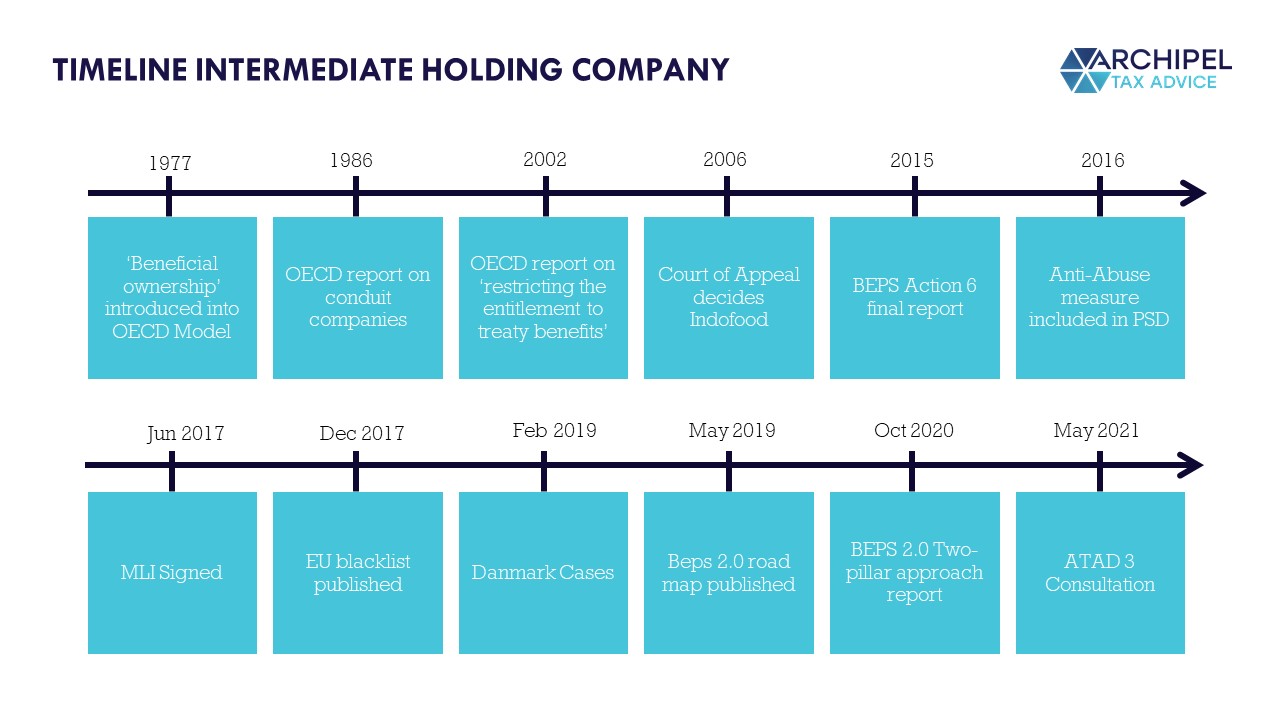
International groups often use intermediate holding companies to hold shares in subsidiaries organized on a regional or divisional basis. Furthermore, holding companies are often used as the vehicle for investing in portfolio companies in a private equity context. In past times, it was not particularly controversial that holding companies were entitled to the potential benefits of tax treaties and potential directives in their country of residence. This would frequently restrict the right of investee jurisdictions to tax dividends and gains derived by the holding company from its local subsidiaries. As shown in the timeline underneath, the perception and position of these companies has changed, with an accumulation of measures that potentially restrict the access to the benefits and directives.
This all started with the introduction of the term “beneficial ownership” into the OECD’s Model Tax Convention in 1977. The question was asked: who does actually benefit from this/these payment(s)? Whilst being slightly controversial in the 70’s, the term now appears in most tax treaties and intents to prevent treaty shopping by ensuring that the benefits of the dividends, royalties and interest articles are only accessible to residents of the contracting state that are the beneficial owners of the payment. After this, the OECD’s report on the use of conduit companies in 1986 ruled conduit companies out of the beneficial ownership regard. Nevertheless, there was no generally agreed definition of the term ‘beneficial ownership’ in tax treaties and the interpretation would follow the domestic law of the contracting states. The first hint of an international fiscal meaning of this term stems from the Indofood case (Indofood International Finance Ltd. V JP Morgan Chase Bank NA, 2006). To prevent falling foul of the beneficial ownership test, certain groups reviewed their holding structure(s) and looked to eliminate fully back-to-back financing arrangements. Furthermore, some structures which involved payment chains were set up with an “equity gap”. These structures reflected a widespread view that beneficial ownership was an objective test that was indifferent to the motives behind these holding company arrangements.
Whilst having a long history, reverting back to said changes in the OECD model treaty in the 70’s, the real challenge to the treaty status of holding companies began in 2015, when the Base Erosion and Profit Shifting project (‘BEPS’) recommended measures to restrict inappropriate usage of tax treaties. The bar is consequently set higher and higher for the criteria that holding companies need to meet in order to benefit from relief from withholding taxes and exemptions to non-resident capital gains tax. The high apex for this approach is the just published proposal to end the misuse of shell entities. Some of the statements suggest that it may never be appropriate for an intermediate holding company (using the term ‘shell entity’) to benefit from reductions in withholding taxes under tax treaties and EU directives.
Click on the image for a bigger version
The Dutch government already set up a commission that investigated the use of the so-called shell companies and their potential misuse of the Dutch tax system. This report was published last October.
Dutch investigation on shell companies (Commission Ter Haar)
‘Doorstroomvennootschappen’ (as they’re often referred to in Dutch) provide little benefit to the Dutch economy, disadvantage developing countries disproportionately through loss of tax revenue for developing countries in particular, and the phenomenon damages the reputation of the Netherlands. These are the main conclusions of the Committee on Flow-through Companies, chaired by Mr. Ter Haar, which presented its final report recently.
The committee describes the relevant components of the Dutch tax system that, at least until recently, have made the Netherlands attractive to flow-through companies. These include the participation exemption, the extensive treaty network, the absence of a withholding tax on interest and royalties and the ruling practice. The report describes examples of unintended use of each of these aspects of the Dutch tax system. In combination with the well-organized financial advice and services sector, this has led, according to the Committee, to a sizeable financial flow. The Committee believes that the measures already taken are expected to put an end to (part of) the tax-driven flow of interest and royalties. This does not mean that the Netherlands should be expected to lose its position as a country of establishment for empty holding companies, even though the Dutch tax system is no longer unique compared to other countries. According to the Committee there will still be a large group of (almost) empty conduits that make use of the Dutch tax infrastructure, whose contribution to the economy is small. The Committee therefore recommends further steps, but at the same time sees that far-reaching unilateral measures do not immediately offer a solution. In the first place, the Committee recommends a proactive attitude and a pioneering role with respect to international and European initiatives. These include the revision of the international tax system within the Inclusive Framework of the OECD and the announced EU Directive proposal on flow-through companies. According to the committee, the Netherlands should advocate measures that involve both the targeted exchange of information and to limit the benefits of the Interest and Royalties Directive and the Parent-Subsidiary Directive.
Click on the image for a bigger version
The advantage of this structure is that the dividends, by making use of the Dutch treaty network, without or with reduced withholding of local tax, arrive at the company in the country of residence (Country A), without or with reduced withholding of local tax, compared to the situation where the payment is made directly to the country of residence (Country A) by the source country (Country C). This is just one example of a (flow-through) structure in which the Dutch treaty network plays a role, in combination with the participation exemption and the dividend withholding tax exemption in treaty situations.
Because the Netherlands has long had a large bilateral tax treaty network, the Netherlands is an attractive country for ‘treaty shopping’. When the tax treaties are concluded, it is assumed that it is up to the source country to prevent the reduced rate of withholding tax, which is wrongly applied mostly.
Unilateral measures cannot prevent other countries from playing the role as flow through country. To avoid international tax avoidance through ‘empty entities’, international agreements are therefore necessary. The committee lastly advises also a constructive attitude by the Netherlands to the ongoing initiatives of the European Commission.
ATAD 1-2
The public perception of tax evasion has shifted in recent years, by taking a drastic turn. In particular, the credit crisis of 2008 has changed the social acceptance of tax avoidance by multinationals in particular. With government deficits and rising government debt, it was considered unfair that a number of multinationals paid (relatively) little tax on their world profits.
This all accumulated into a public hearing of officials of Amazon, Google and Starbucks organized by the Public Accounts Committee in the UK in 2012. The committee chair Ms. Hodge said (the later iconic words):
“We’re not accusing you of being illegal, we’re accusing you of being immoral”.
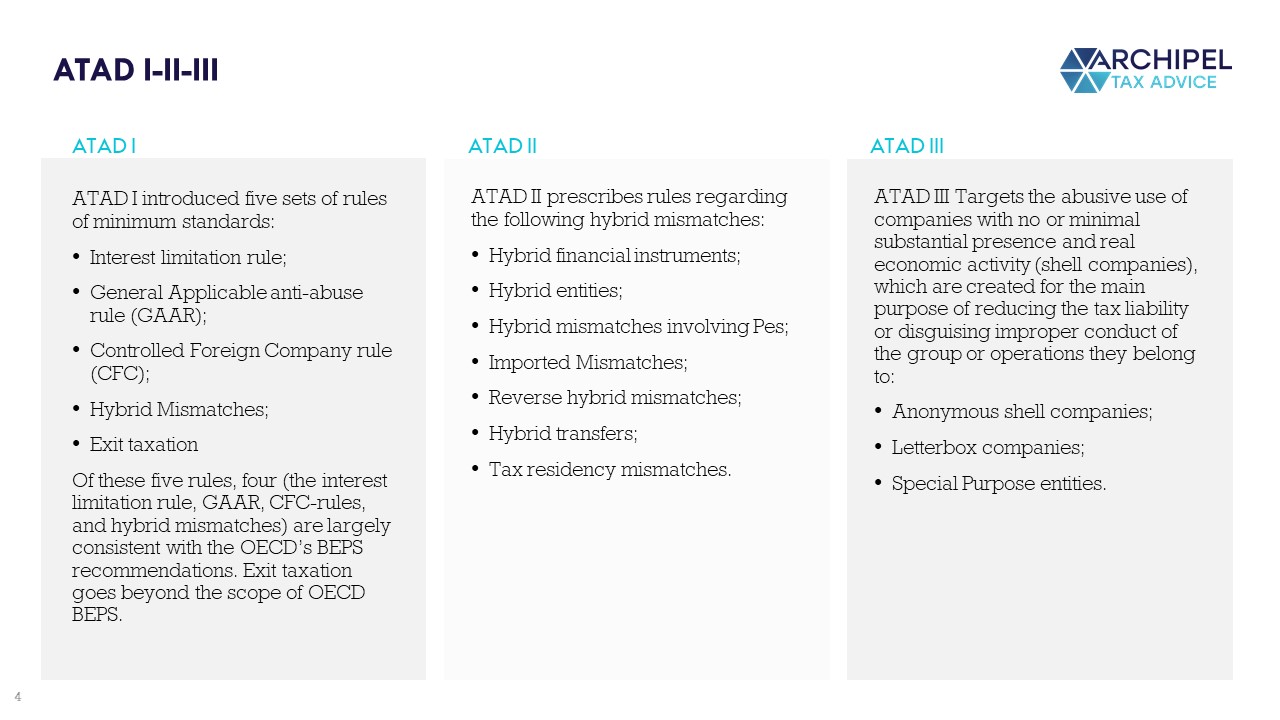
This all led to the BEPS-project and consequently ATAD. There have been 2 Anti-Tax-Avoidance-Directives already put into effect. ATAD 1 introduced 5 sets of minimum standards (interest limitation rule, GAAR, CFC rules, hybrid mismatches and exit taxation). In the second ATAD, subsequent rules relating to hybrid mismatches were finalized on 29 may 2017 when the ECOFIN accepted this directive. ATAD is based on Article 115 of the Treaty on the Functioning of the EU (‘TFEU’).
ATAD 3
Shell Companies
The definition of the widespread term ‘shell’, often interchangeably with terms such as ‘letterbox’, ‘mailbox’, ‘special purpose entity’, special purpose vehicle’ and similar, is defined differently in different contexts. For the purpose of ATAD 3, shell companies refer to three types of shell companies:
Anonymous shell companies
Letterbox companies
Special purpose entities
The main common feature of the above three types is the absence of real economic activity in the Member State of
registration, which usually means that these companies have no (or few) employees, and/or no (or little)
production, and/or no (or little) physical present in the Member State of registration
What will change?
The proposed rules will establish transparency standards around the use of shell entities, so that their abuse can be detected more easily by tax authorities. Using a number of objective indicators related to income, staff and premises, the proposal will help national tax authorities detect entities that exist merely on paper.
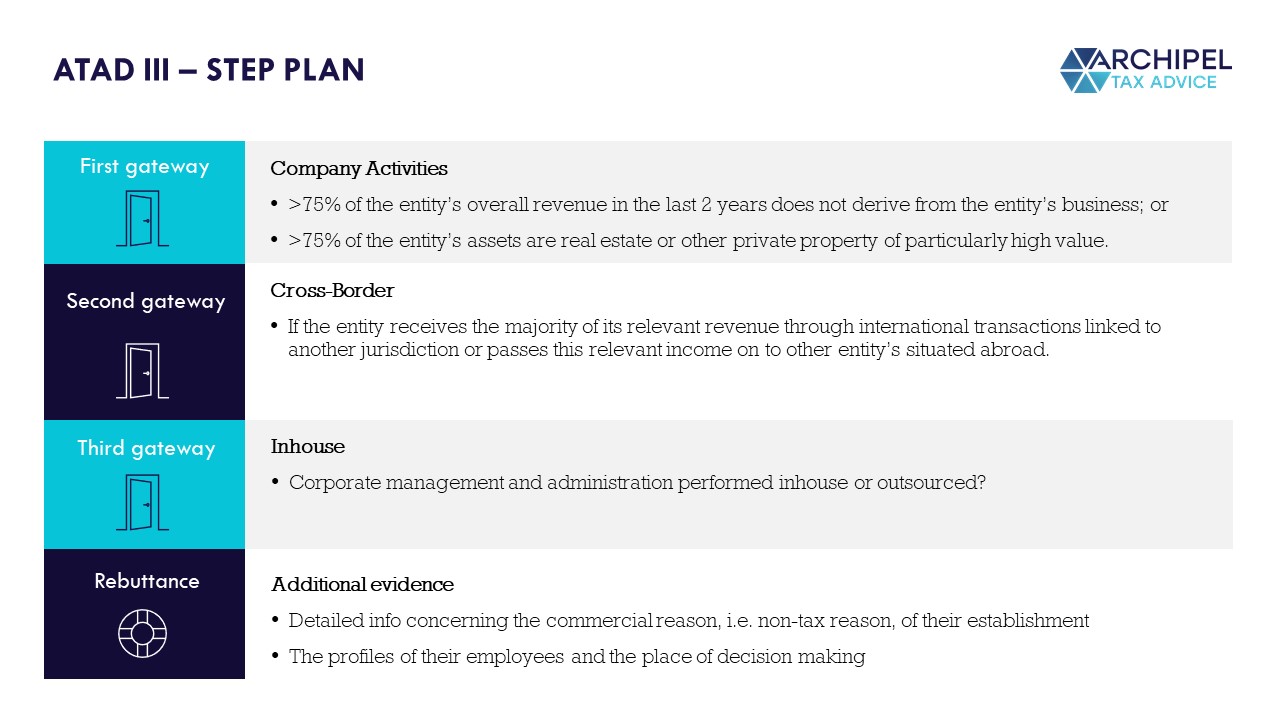
The proposal introduces a filtering system for the entities in scope, which have to comply with a number of indicators. These different levels constitute a type of gateway. This proposal sets out three gateways. If an entity crosses all three gateways, it will be required to annually report more information to the tax authorities through its tax return.
Click on the image for a bigger version
Gateways
First gateway
The first level looks at the activities of the companies based on the income they receive. This gateway is met if >75% of an entity’s overall revenue in the last two tax years does not derive from the entity’s business activity or if more than 75% of its assets are real estate or other private property of particularly high value.
Second gateway
The second level requires a cross-border element. If the entity receives the majority of its relevant revenue through international transactions linked to another jurisdiction or passes this relevant income on to other entity’s situated abroad, the entity passed to the next and last gateway.
Third gateway
The third, and last, level focuses on whether corporate management and administration services are performed in-house or are outsourced.
Crossed all gateways?
An entity crossing all levels will be obliged to report information in its tax return related to the premises of the entity, its bank accounts, the tax residency of its directors and employees etc. These are the so-called substance requirements. All declarations should be accompanied by supporting evidence. If one of the substance requirements isn’t met, the entity will be presumed to be a ‘shell company’.
When will the proposal come into force?
Once adopted by the Member States, the Directive should come into effect on 1 January 2024.
Rebuttal arrangement?
If the substance criteria are not met, entities still have the opportunity to rebut the presumption of being a shell. Additional evidence needs to be presented, such as detailed information about the commercial, non-tax reason of their establishment, the profiles of their employees and the fact that decision-making takes place in the Member State of their tax residence.
Click on the image for a bigger version
Tax Consequences
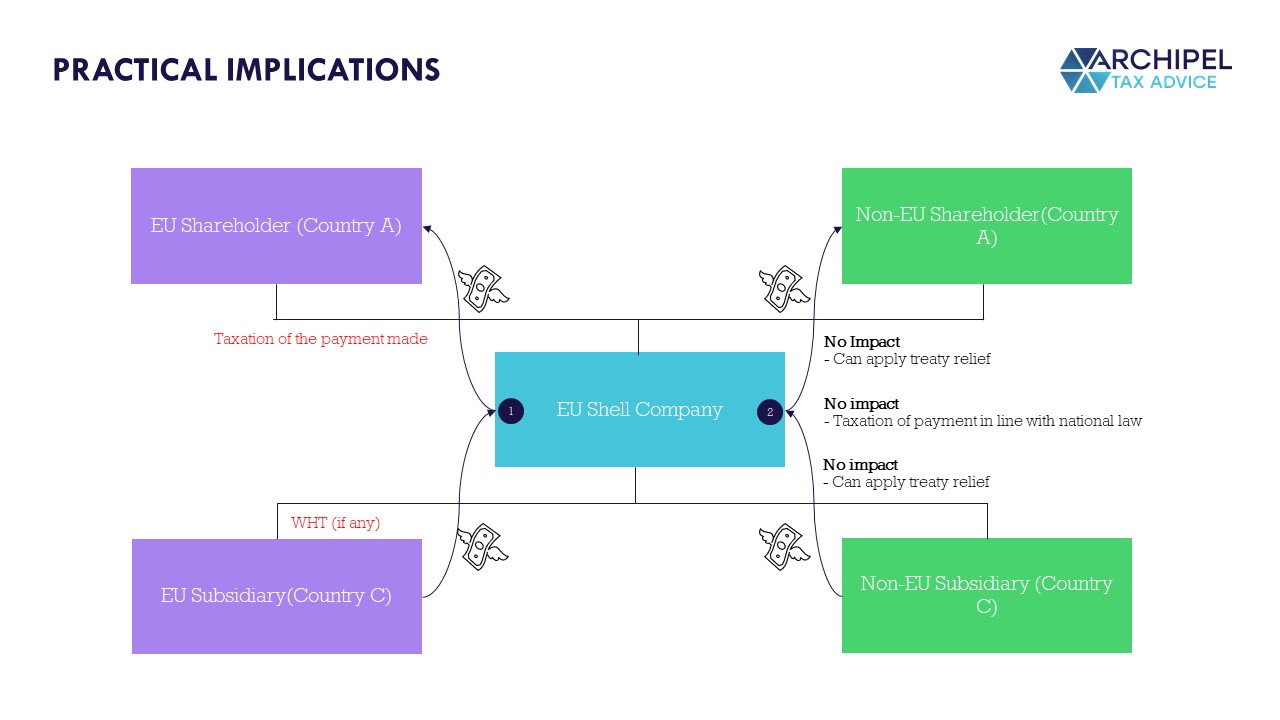
If an entity is deemed to be a shell company, the benefits and reliefs of the tax treaty network of its Member state are not applicable. Furthermore, the company will not be able to qualify for the treatment under the Parent-Subsidiary and Interest and Royalty Directives. To support the implementation of these consequences, the Member State of residence of the company will either deny the shell company a tax residence certificate or the certificate will specify that the company is a shell.
Furthermore, payments to third countries will not be treated as flowing through the shell entity, and will be subject to withholding tax at the level of the entity that paid to the shell. According with this, inbound payments will be taxed in the state of the shell’s shareholder. Relevant consequences will apply to shell companies owning real estate assets for the private us of wealthy individuals and which as a result have no income flows. Such real estate assets will be taxed by the state in which the asset is located as if it were owned directly by the individual.
Click on the image for a bigger version
Scenario 1 EU source jurisdiction of the payer – EU shell jurisdiction – EU shareholder jurisdiction
In this case, all three jurisdictions fall in the scope of the Directive and are consequently bound by ATAD3:
EU subsidiary: this entity will not have a right to tax the payment, but may apply domestic tax on the outbound payment to the extent it cannot identify whether the undertaking’s shareholder is in the EU.
EU shell: this entity will continue to be a resident for tax purposes in the respective Member State and will have to fulfil relevant obligations as per national law, including by reporting the payment received; it may be able to provide evidence of the tax applied on the payment.
EU shareholder: this entity will include the payment received by the shell undertaking in its taxable income, as per the national law and may be able to claim relief for any tax paid at the source, including by virtue of EU directives. It will also take into account and deduct any tax paid by the shell.
Scenario 2 Non-EU source jurisdiction of the payer – EU shell jurisdiction – Non-EU shareholder jurisdiction
Third country subsidiary: may apply domestic tax on the outbound payment or can decide to apply tax according to the tax treaty in effect with the third jurisdiction of the shareholder if it wishes to look through the EU shell entity as well.
EU shell: will continue to be a resident for tax purposes in a Member State and fulfil relevant obligations as per national law, including by reporting the payment received; it may be able to provide evidence of the tax applied on the payment.
Third country shareholder: while the third country shareholder jurisdiction is not compelled to apply any consequences, it may consider applying a treaty in force with the source jurisdiction in order to provide relief.
Click on the image for a bigger version
Scenario 3 Non-EU source jurisdiction of the payer – EU shell jurisdiction – EU-shareholder jurisdiction
In this case the source jurisdiction is not bound by ATAD 3, while the jurisdictions of the shell and the shareholder fall in scope.
Third country source jurisdiction: this entity may apply domestic tax on the outbound payment or may decide to apply the treaty in effect with the EU shareholder jurisdiction.
EU shell: this entity will continue to be resident for tax purposes in the respective Member State and will have to fulfil relevant obligations as per national law, including by reporting the payment received; it may be able to provide evidence of the tax applied on the payment.
EU shareholder: this entity shall include the payment received by the shell undertaking in its taxable income, as per the national law and may be able to claim relief for any tax paid at source, in accordance with the applicable treaty with third country source jurisdiction. It will also take into account and deduct any tax paid by the shell.
Scenario 4 EU source jurisdiction of the payer – EU shell jurisdiction – third country shareholder jurisdiction
In this case only the source and the shell jurisdiction are bound by ATAD3 while the shareholder jurisdiction is not.
EU subsidiary: this entity will tax the outbound payment according to the treaty in effect with the third country jurisdiction of the shareholder or in the absence of such a treaty in accordance with its national law.
EU shell: will continue to be resident for tax purposes in a Member State and will have to fulfil relevant obligations as per national law, including by reporting the payment received; it may be able to provide evidence of the tax applied on the payment.
Third country shareholder: while the third country jurisdiction of the shareholder is not compelled to apply any consequences, it may be asked to apply a tax treaty in force with the source Member State in order to provide relief.
Scenarios where shell entity’s are resident outside the EU fall outside the scope of ATAD3.
What to do?
First of all, monitoring the developments in the BEPS 2.0 and ATAD 3 proposals is advised. Also, looking at whether there are operating entities withing the group in low tax jurisdictions, entities with primarily passive income, and companies where the local substance may fall short on the types of criteria suggested by the EC. When the key risks are identified, choices may include removing problematic holding companies, using different jurisdictions, or taking steps to bolster local substance. International groups should take the appropriate measures in time to get ahead of these changes.
Do you have questions regarding the implications of ATAD 3 for your company or do you need certainty in advance? Feel free to call us! This is really dynamic work, which also gives you insight into your compliance with the changing international rules. We are happy to help.
Today, the OECD releases the 2022 edition of the OECD Transfer Pricing Guidelines for Multinational Enterprises and Tax Administrations.
The OECD Transfer Pricing Guidelines provide guidance on the application of the “arm’s length principle”, which represents the international consensus on the valuation, for income tax purposes, of cross-border transactions between associated enterprises. In today’s economy where multinational enterprises play an increasingly prominent role, transfer pricing continues to be high on the agenda of tax administrations and taxpayers alike. Governments need to ensure that the taxable profits of MNEs are not artificially shifted out of their jurisdiction and that the tax base reported by MNEs in their country reflects the economic activity undertaken therein and taxpayers need clear guidance on the proper application of the arm’s length principle.
This latest edition consolidates into a single publication the changes to the 2017 edition of the Transfer Pricing Guidelines resulting from:
The report Revised Guidance on the Transactional Profit Split Method, approved by the OECD/G20 Inclusive Framework on BEPS on 4 June 2018, and which replaced the guidance in Chapter II, Section C (paragraphs 2.114-2.151) found in the 2017 Transfer Pricing Guidelines and Annexes II and III to Chapter II;
The report Guidance for Tax Administrations on the Application of the Approach to Hard-to-Value Intangibles, approved by the OECD/G20 Inclusive Framework on BEPS on 4 June 2018, which has been incorporated as Annex II to Chapter VI;
The report Transfer Pricing Guidance on Financial Transactions, adopted by the OECD/G20 Inclusive Framework on BEPS on 20 January 2020, which has been incorporated into Chapter I (new Section D.1.2.2) and in a new Chapter X;
The consistency changes to the rest of the OECD Transfer Pricing Guidelines needed to produce this consolidated version of the Transfer Pricing Guidelines, which were approved by the OECD/G20 Inclusive Framework on BEPS on 7 January 2022.
For more information on the OECD Transfer Pricing Guidelines, visit https://oe.cd/tpg2022
Contacts:
Pascal Saint-Amans, Director of the OECD Centre for Tax Policy and Administration (CTPA) | Pascal.Saint-Amans@oecd.org
Manuel de los Santos, Acting Head of CTPA’s Transfer Pricing Unit | Manuel.DELOSSANTOS@oecd.org
Compliments of the OECD.
The post OECD releases latest edition of the Transfer Pricing Guidelines for Multinational Enterprises and Tax Administrations first appeared on European American Chamber of Commerce New York [EACCNY] | Your Partner for Transatlantic Business Resources.
A proposed $50-billion trust fund could help low-income and vulnerable middle-income countries build resilience to balance of payments shocks and ensure a sustainable recovery.
Even as countries continue to battle COVID-19, it is crucial not to overlook the longer-term challenge of transforming economies to become more resilient to shocks and achieve sustainable and inclusive growth. The pandemic has taught us that not addressing these long-term challenges in a timely manner can have significant economic consequences, with the potential for future balance of payments problems. Climate change is another long-term challenge that threatens macroeconomic stability and growth in many countries through natural disasters and disruptions to industries, job markets, and trade flows, among others.
‘It is the shared responsibility of individual countries and the international community to overcome these global public policy challenges.’
These are global public policy challenges, and it is the shared responsibility of individual countries and the international community to take timely actions. In a previous blog, we explained how the IMF is considering options for channeling some of the $650 billion SDRs issued in August 2021 from countries with strong external financial positions to vulnerable countries through a Resilience and Sustainability Trust, or RST. The RST’s central objective is to provide affordable long-term financing to support countries as they tackle structural challenges.
As we’ve continued to work toward developing the RST, our current thinking on the key design features—which we outline further below—aim to balance the needs of potential contributors and borrowing countries. With broad support from the membership and international partners, we hope that the Trust can be approved by the IMF Executive Board before the upcoming Spring Meetings and for it to become fully operational before the year’s end.
Key design features
Eligibility
About three quarters of the IMF’s membership could be eligible for RST financing. This would include all low-income countries, all developing and vulnerable small states, and all middle-income countries with per capita GNI below 10 times the 2020 IDA operational cutoff , or about $12,000.
Qualifying reforms
RST support aims to address macro-critical longer-term structural challenges that entail significant macroeconomic risks to member countries’ resilience and sustainability, including climate change, pandemic preparedness, and digitalization. That said, not all long-term structural challenges lend themselves to IMF lending. The ability to support reforms in a particular area would depend on the availability of and access to strong diagnostics, the ability to identify policy priorities, and develop the appropriate reform targets. Country ownership and strong commitment of the authorities to do the necessary reforms will be critical to catalyze the much-needed finance from multilateral development banks and the private sector. It is also critical to work in close coordination with other relevant institutions in order to leverage expertise and knowledge. The IMF and World Bank staff have worked closely to develop a coordination framework on RST operations on climate risks, building on earlier experience in supporting countries with structural reforms. Similar frameworks with relevant institutions will be developed in the coming months in this and other reform areas.
Qualification
To qualify for RST support, an eligible member would need: a package of high-quality policy measures consistent with the RST’s purpose; a concurrent financing or non-financing IMF-supported program with appropriate macroeconomic policies to mitigate risks for borrowers and creditors; and sustainable debt and adequate capacity to repay the Fund.
Financing terms
Like the IMF’s highly concessional and currently zero interest rate Trust for low-income countries (PRGT), the RST would be established under the IMF’s power to administer contributor resources, which allows for more flexible terms, notably on maturities, than the terms that apply to the IMF’s general resources. Consistent with the longer-term nature of balance of payments risks the RST seeks to address, its loans would have much longer maturities than traditional IMF financing. Specifically, staff has proposed a 20-year maturity and a 10-year grace period. A tiered interest structure would differentiate financing terms across country groups, with a high degree of concessionality for lower-income members.
Access to financing
Access to RST financing would be determined case by case, based on the strength of reforms and debt sustainability considerations, and is expected to be capped at 150 percent of IMF quota or SDR 1 billion, whichever is smaller. RST lending would be part of a broader financing strategy members would pursue to address longer-term balance of payments risks, involving a mix of multilateral, bilateral official, and private financing.
Financial architecture
Like the PRGT, the RST’s resources would be mobilized on a voluntary basis from members who wish to channel their SDRs or currencies for the benefit of poorer or vulnerable countries . The financial architecture of the RST is designed to ensure that substantial resources for low-cost long-maturity loans can be mobilized while ensuring the safety and liquidity of contributors’ claims on the Trust based on a multilayered risk management framework that maintains the reserve asset nature of channeled SDRs. To meet the projected demand, the RST would need to mobilize initially around $50 billion in total resources. A smooth functioning SDR trading market would underpin successful RST operations.
Collaboration essential for success
Mitigating economic risks from long-term structural challenges requires a consistent and deliberate approach, with strong commitment from policymakers to undertake sometimes difficult reforms. And where such commitment is evident, the international community can help with affordable financing, capacity building, and policy advice. The RST will support such a collaborative effort. We will build on our experience of working with the World Bank and other international institutions and regional development banks, complementing their lending to provide the best support to member countries.
The success of the new Trust will depend equally on economically stronger IMF members providing meaningful resources to help countries improve long-term resilience and sustainability; borrowers willing to go the extra mile to achieve the macroeconomic environment and reform framework conducive to improving balance of payments stability; other international financial institutions supporting with their expertise, knowledge, and financing where feasible. These actions would also help mobilize private sector investment.
Faced with a range of long-term structural challenges that require global action, it has never been more important to support all countries tackle these challenges at an early stage and achieve sustainable growth. The RST could help achieve this goal.
Authors:
Ceyla Pazarbasioglu is Director of the Strategy, Policy, and Review Department (SPR) of the IMF
Uma Ramakrishnan is currently Deputy Director of the IMF’s Strategy, Policy and Review Department
Compliments of the IMF.
The post IMF | A New Trust to Help Countries Build Resilience and Sustainability first appeared on European American Chamber of Commerce New York [EACCNY] | Your Partner for Transatlantic Business Resources.
Today, European society needs the contribution of universities and other higher education institutions more than ever. Europe is facing major challenges such as climate change, the digital transformation and aging population, at a time when it is hit by the biggest global health crisis in a century and its economic fall-out. Universities, and the entire higher education sector, have a unique position at the crossroads of education, research and innovation, in shaping sustainable and resilient economies, and in making the European Union greener, more inclusive and more digital.
The two new initiatives adopted today, a European strategy for universities and a Commission proposal for a Council Recommendation on building bridges for effective European higher education cooperation, will support universities in this endeavour.
Margaritis Schinas, Vice-President for Promoting the European Way of Life, said: “European Universities of excellence and inclusiveness are both a condition and a foundation for our European Way of Life. They support open, democratic and fair societies as well as sustained growth, entrepreneurship, integration and employment. With our proposals today, we seek to take transnational cooperation in Higher Education to a new level. Shared values, more mobility, broader scope and synergies to build a genuinely European dimension in our Higher Education.”
Commissioner for Innovation, Research, Culture, Education and Youth, Mariya Gabriel, said: “Today’s proposals will benefit the entire higher education sector, first and foremost our students. They need modern transnational campuses with easy access to mobility abroad to allow for a truly European study path and experience. We stand ready to join forces with the Member States and higher education institutions across Europe. Together we can bring closer education, research and innovation in service to society. The European Universities alliances are paving the way; by mid-2024 the European budget will support up to 60 European Universities Alliances with more than 500 universities across Europe.”
The European strategy for universities
Europe is home to close to 5,000 higher education institutions, 17.5 million tertiary education students, 1.35 million people teaching in tertiary education and 1.17 million researchers. This strategy intends to support and enable all universities in Europe to adapt to changing conditions, to thrive and to contribute to Europe’s resilience and recovery. It proposes a set of important actions, to support Europe’s universities towards achieving four objectives:
Strengthen the European dimension of higher education and research;
Consolidate universities as lighthouses of our European way of life with supporting actions focusing on academic and research careers, quality and relevance for future-proof skills, diversity, inclusion, democratic practices, fundamental rights and academic values;
Empower universities as key actors of change in the twin green and digital transition;
Reinforce universities as drivers of EU’s global role and leadership.
Building bridges for effective European higher education cooperation
The Commission proposal for a Council Recommendation aims to enable European higher education institutions to cooperate closer and deeper, to facilitate the implementation of joint transnational educational programmes and activities, pooling capacity and resources, or awarding joint degrees. It is an invitation to Member States to take action and create appropriate conditions at national level for enabling such closer and sustainable transnational cooperation, more effective implementation of joint educational and research activities and the European Higher Education Area (Bologna) tools. It will facilitate the flow of knowledge and build a stronger link between education, research and innovative industrial communities. The objective is notably to support the provision of high-quality life-long learning opportunities for everyone with a focus on the most needed skills and competences to face today’s economic and societal demands.
Making it happen: four flagship initiatives
The European dimension in higher education and research will be boosted by four flagships initiatives by mid-2024:
Expand to 60 European Universities with more than 500 higher education institutions by mid-2024, with an Erasmus+ indicative budget totalling €1.1 billion for 2021-2027. The aim is to develop and share a common long-term structural, sustainable and systemic cooperation on education, research and innovation, creating European inter-university campuses where students, staff and researchers from all parts of Europe can enjoy seamless mobility and create new knowledge together, across countries and disciplines.
Work towards a legal statute for alliances of higher education institutions to allow them to pool resources, capacities and their strengths, with an Erasmus+ pilot as of 2022.
Work towards a joint European degree to recognise the value of transnational experiences in the higher education qualification the students obtain and cut the red tape for delivering joint programmes.
Scale-up the European Student Card initiative by deploying a unique European Student Identifier available to all mobile students in 2022 and to all students in universities in Europe by mid-2024, to facilitate mobility at all levels.
Next Steps
Coordination of efforts between the EU, Member States, regions, civil society and the higher education sector is key to make the European strategy for universities a reality. The Commission invites the Council, Member States and universities to discuss on this policy agenda and work jointly towards future-proof universities.
The Commission proposal for a Council recommendation on building bridges for effective European higher education cooperation will be discussed with Member States. Once adopted by the Council, the Commission will support Member States and relevant partners in implementing this Council Recommendation.
Background
The Commission announced its intention to initiate the co-creation of a transformation agenda for higher education in its Communication on Achieving the European Education Area by 2025 and its Communication on a new European Research Area. The Council Conclusions on the New European Research Area, adopted on 1 December 2020, stress “that stronger synergies and interconnections between the ERA, the EHEA and the higher education related elements of the European Education Area (EEA), are to be developed”. In its Resolution of 26 February 2021 on ‘a strategic framework for European cooperation in education and training towards the European Education Area and beyond (2021-2030)’, the Council has identified the establishment of an agenda for higher education transformation as a concrete action in the priority area of higher education.
The ERA Policy Agenda annexed to the Council Conclusions on the Future Governance of the European Research Area, adopted on 26 November 2021, support actions relevant for universities including a dedicated action on empowering higher education institutions to develop in line with the European Research Area and in synergy with the European Education Area.
Compliments of the European Commission.
The post Higher education: making EU’s universities ready for the future through deeper transnational cooperation first appeared on European American Chamber of Commerce New York [EACCNY] | Your Partner for Transatlantic Business Resources.
In the US and UK, the recent labor market puzzle can be partly explained by mismatch, the pandemic’s effect on women (in the US) and older workers leaving the work force.
Almost two years after the pandemic upended labor markets, job openings are plentiful in many advanced economies, yet workers have not fully returned.
‘The broader trend of plentiful jobs and not enough workers can have major implications for growth, inequality, and inflation.’
This gap, in which the employment rate is below its pre-COVID level, is playing out in the United States and the United Kingdom. Despite tight labor markets, as reflected in high vacancy-to-unemployment ratios and job quits, the employment recovery remains incomplete and below pre-pandemic levels in both countries. Now with a possible cooling effect on labor markets caused by the Omicron wave, this trend could be longer than expected.
New IMF staff research uses granular data on employment and vacancies in the US and the UK to assess four commonly held explanations:
The effect of generous income support on willingness to seek and take up jobs.
A mismatch between the types of jobs that are available and the willingness of people to fill them.
Mothers of young children exiting the work force amid continued disruptions to school and childcare.
Older workers withdrawing from the labor force.
We found that lower participation among older workers not returning to work is the common thread, and matters most. Mismatch plays a secondary role. The fall in female participation is unique to the US, but quantitatively important.
If the broader trend of plentiful jobs and not enough workers continues, it can have major implications for growth, inequality, and inflation. A continued sluggish employment recovery amid sustained labor demand could constrain economic growth while fueling wage increases. While higher wages would be good news for workers, they could further fuel inflation.
Generosity of income support programs
The first possible explanation is that income support programs during the pandemic allowed workers to be picky, slowing job applications, acceptances and, ultimately, the employment recovery.
However, preliminary evidence reviewed in our paper, including from the recent phasing out of the US federal unemployment insurance supplement, suggests the early removal of COVID-related unemployment benefits had only a modest and temporary effect on getting people back to work.
Mismatch
A second candidate explanation is an increase in the mismatch between the industries and occupations in which the jobless are searching and those with abundant vacancies. Jobs that require in-person interactions, such as in restaurants, hotels and entertainment, have been hit exceptionally hard, while “teleworkable” jobs fared substantially better. Others, like delivery services, even boomed. Could it be that workers who lost jobs in hard-hit industries and occupations struggled to transition into new opportunities, leading to mismatch?
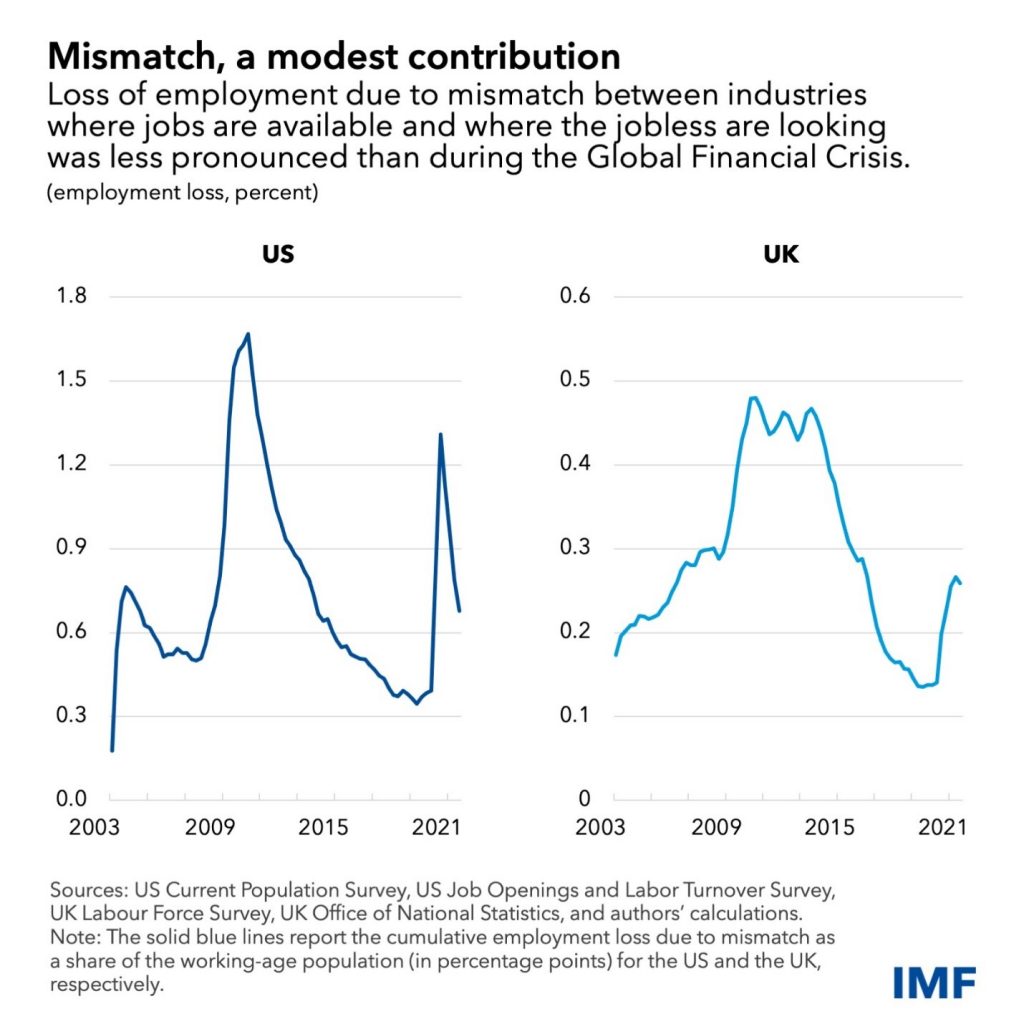
The short answer is yes, but this is just one part of the story. We find that the employment loss due to mismatch during the crisis has been modest and, to our surprise, smaller than during the Global Financial Crisis. We estimate that, as of early last fall, mismatch explains only about 18 percent and 11 percent of the outstanding employment gap versus pre-COVID levels in the US and the UK, respectively.
The She-cession
A third explanation seems more potent, at least in the US. The prolonged school closures and scarcity of childcare services put an extra burden on mothers of young children, pushing many to leave the labor force—the so-called “She-cession.”
We estimate that the excess employment contraction for mothers of children younger than 5 years old compared with other women accounted for around 16 percent of the total US employment gap with respect to pre-COVID levels as of October 2021. That was down from 23 percent in early September, thanks partly to the return to in-person schooling later that month. Meanwhile, there was no such She-cession in the UK, where employment fell less for females than for males. A potential explanation is that in the UK nurseries remained opened throughout the pandemic, easing the tradeoff between work and childcare for mothers of young children.
Withdrawal of older workers
The final and potentially largest contributor to a lag in employment recovery is an exodus of older workers from the labor force in both countries. For some, this may reflect health concerns related to the pandemic. Others may have reconsidered their need to work as housing and financial asset prices grew substantially.
As of September, the rise in inactivity among workers age 55 and up accounted for around 35 percent of the outstanding employment gap versus pre-pandemic levels in both economies. It’s unclear how many of those who retired or quit may eventually return to the labor force.
Beware of scarring
Taken together, mismatch, the She-cession and older workers’ withdrawal from the labor force may account for roughly 70 percent of the US employment gap compared with pre-COVID levels. In the UK, there has been no She-cession, but about 10 percent of the employment gap can be attributed to mismatch and 35 percent to older workers’ withdrawal from labor force.
Further, the outflow of foreign workers after Brexit—accelerated by the pandemic—entailed a progressive fall in the number of those job seekers willing and able to fill open vacancies. Our analysis leaves a potential, albeit mostly residual, role for other factors such as the effect of elevated unemployment benefits and other pandemic-related income support.
If a larger number of older workers permanently retire and a lack of affordable childcare and pre-school opportunities continue to keep some women with young children at home, the pandemic could leave persistent employment scars, notably in the US.
Whether the reason for not returning to work is early retirement or lack of childcare, one common thread exists: US and UK vacancies are highest among low-skill occupations and employment in these jobs remains below pre-2020 levels. The rise in voluntary quits—the so-called “great resignation”—are also greatest for low-skilled jobs. While it remains to be seen how widespread and persistent this phenomenon will be, these facts hint at a possible change in worker preferences triggered by the pandemic.
To minimize the risk of scarring to employment, addressing the pandemic remains key, so workers are fully able to return to the labor market. So are well-designed training programs to reduce risks of mismatch, and—particularly in the US—expanded childcare and preschool opportunities.
Authors:
Carlo Pizzinelli is an economist in the Structural Reforms Unit of the Research Department of the IMF
Ippei Shibata is an Economist in the Research Department at the IMF
Compliments of the IMF.
The post IMF | Why Jobs are Plentiful While Workers are Scarce first appeared on European American Chamber of Commerce New York [EACCNY] | Your Partner for Transatlantic Business Resources.
From COVID-19 to climate change, economies are facing new challenges.
The world is changing. From COVID-19 and climate change to digitalization and diverging demographics, the IMF’s member countries are confronting new challenges. The impacts of these challenges are being felt unevenly across countries and will inevitably play out in their balance of payments, potentially undermining global economic stability.
‘The challenges facing IMF member countries are constantly evolving.’
It is therefore important that the Fund also revisit its policy advice, lending activities and capacity building to see whether these should be adapted selectively, and in what ways, to meet the evolving needs of its membership. Ongoing efforts to establish a Resilience and Sustainability Trust are, for instance, intended to build on the historic 2021 SDR allocation of $650 billion and meet the longer-term financing requirements of members in greatest need as they adjust to a rapidly changing world.
Many longer-term challenges faced by low-income countries especially are inextricably linked with questions of development. Yet development finance alone is not sufficient to address the overlapping global public policy goals which require action from all international financial institutions. The Fund is staying well within its mandate by seeking to address these challenges. In fact, directional changes are necessary to ensure that the IMF continues to fulfill its mandate laid out more than 75 years ago in its Articles of Agreement—in particular, of assisting members to overcome balance of payments problems without resorting to measures that threaten national or international prosperity.
Directional change
When the IMF opened its doors in 1947, financing was understood to be immediate balance of payments lending of very short duration so that the recipient could ride out temporary shocks and maintain exchange rate parity against the US dollar or gold.
The Fund’s financing facilities have, however, had to be modernized over time as the nature of the balance of payments problems of its members evolved. For example, the now-mainstream Stand-by Arrangement (SBA) was considered a radical innovation when it was introduced in 1952 because it provided the member with assurances of a future use of the IMF’s resources, so long as it continued to meet the conditions for each loan tranche, rather than meeting an immediate need.
In the early 1970s, the Fund recognized that the oil price shock would affect its members differently according to their oil import bills—and would therefore give rise to current account movements and protracted balance of payments pressures. The IMF therefore introduced somewhat longer and more concessional financing instruments. With the widespread adoption of flexible exchange rates around the same time, the IMF also overhauled its surveillance activities.
Despite concerns at the time, these innovations did not change the fundamental character of the Fund as a monetary institution concerned with ensuring a viable and sustainable balance of payments as a prerequisite for macroeconomic and financial stability.
Adaptations and innovations continued as new challenges were recognized. The Fund’s fast-disbursing emergency assistance (financing and debt relief) was enhanced, including in the wake of natural disasters such as the Ebola virus in western Africa and the earthquake in Haiti. Thus, when the COVID 19 pandemic struck, the Fund was already uniquely placed to act quickly to provide temporary support to member countries in need, which it is following up with traditional lending programs as the crisis continues.
Challenges ahead
As the world emerges from the pandemic, traditional short-to-medium-term financing shocks will unfortunately recur. Sharper than expected monetary tightening in the face of inflationary pressures in advanced economies will, for example, have spillover effects on the balance of payments of emerging market countries. Countries with high debt burdens will need to work to avert fiscal and financing crises. And large commodity exporters and importers will need to continue to build resilience to large price swings. In helping countries address such challenges, the Fund will continue to deploy its traditional toolkit of surveillance, lending and capacity building, though minor modifications may sometimes be necessary.
However, increased surveillance and lending focus on longer-term issues is also critical at the current juncture. Deep-seated structural issues are becoming much more prevalent in today’s world; they should be addressed now to prevent larger and more painful balance of payments problems in the future.
Climate change affects all of humanity but its impact on countries is disparate. Similarly, not all countries will be equally able to seize the opportunities presented by digital change, such as central bank digital currencies. There are quite different demographic pressures in various parts of the world. Income and gender inequalities are widening.
Successfully addressing these challenges requires cooperation between the Fund and other institutions that have expertise in these areas, such as the World Bank. That such trends have disparate ramifications across the membership necessarily implies that they will manifest—to lesser or greater degrees—in the balance of payments of individual countries. Climate change will, for example, lead to higher food imports and outward migration in many affected countries.
Digital change will impact trade in goods and services but also capital flows by accelerating financial innovation. And unless demographic pressures are properly harnessed, countries with young fast-growing populations could face higher unemployment, while shortages of labor, goods and services could become problems for ageing societies.
Thus, the challenges facing IMF member countries are constantly evolving. Yet the need for policy advice—and, at times, financing—from the Fund remains. The IMF therefore continues to add selectively to its toolkits as it has in the past to ready itself to confront these challenges in collaboration with other institutions.
Authors:
Sanjaya Panth is Deputy Director of the Strategy, Policy, and Review Department (SPR) of the IMF
Ceyla Pazarbasioglu is Director of the Strategy, Policy, and Review Department (SPR) of the IMF
Compliments of the IMF.
The post How the IMF Continues to Change To Confront Global Challenges first appeared on European American Chamber of Commerce New York [EACCNY] | Your Partner for Transatlantic Business Resources.
Interview with Süddeutsche Zeitung | Interview with Isabel Schnabel, Member of the Executive Board of the ECB, conducted by Markus Zydra, Bastian Brinkmann and Meike Schreiber on 10 January 2022 |
Ms Schnabel, inflation in the euro area now stands at 5% – a record high. When are you finally going to intervene?
We view these figures with some concern, as they are higher than we initially expected. And we fully understand many people’s worries about the drop in real wages and interest income – all the more so as people on lower incomes are hit particularly hard by higher inflation. We take that very seriously.
Concerns alone will not bring inflation down.
Our decisions are based on a medium-term perspective covering around one to three years. We expect that inflation will fall significantly over the medium term. That is why we are not raising interest rates now, as some are calling for.
Long-term planning is all very well, but people are being hit by higher prices here and now.
Any measures we might take today will only have an effect with a lag. The current rate of inflation won’t be affected, only the future one. Most forecasts – our own and others − indicate that the surge in inflation caused by the pandemic will be followed by a marked decline. In our projections, medium-term inflation will even fall back below our target of 2%, even though we acknowledge that the projections are now subject to great uncertainty. That is why we should not raise interest rates prematurely, as that could potentially choke off the recovery. But we will act quickly and decisively if we conclude that inflation may settle above 2%. A precondition for raising interest rates is to end net asset purchases; and our December decision is a first step in this direction.
And if you get it wrong, we all pay a high price.
That’s exactly why we don’t base our decisions solely on economic models but also conduct surveys about expectations among households and firms, for example. This enables us to cross-check the plausibility of the projections. And these surveys do indeed show upward risks with respect to inflation. We are aware that monetary policy bears a huge responsibility for people’s prosperity. But premature action by monetary policy would also come at a price: it could hold back the nascent recovery, and that would jeopardise jobs.
But doesn’t the ECB’s inaction so far in truth reflect its fear that the euro debt crisis might flare up again, first and foremost in Italy, and that stock markets might collapse?
I know that some people in Germany take this view, but it’s not the case. Our actions are guided solely by our price stability mandate. Public borrowing by individual countries has no bearing on the Governing Council’s decisions. How financial markets will respond to the exit from our expansionary monetary policy measures is obviously an aspect that we need to consider because it affects the financing conditions for households and firms. But that is an entirely different matter to keeping interest rates low purely to help certain countries repay their debt.
EU surveys show that people perceive inflation to be even higher than measured. Doesn’t this perceived inflation harm your reputation?
Inflation is officially calculated using an average consumption basket; the selection of goods bought by an individual consumer typically differs. Moreover, people perceive some price changes more strongly than others, particularly for goods they consume frequently. The prices of petrol and heating fuel, for example, are now increasing significantly, with the result that perceived inflation is higher than actual inflation. We have an inflation calculator on our website which allows people to discover their individual inflation rate. In addition, when calculated over a longer period, inflation has not increased as much as suggested by latest figures. If one compares prices today with prices two years ago, one sees that average annual inflation in Germany in December was just 2.5%, as prices actually fell in the first year of the pandemic.
To ask a fundamental question: why are you aiming for inflation of 2%? Surely 0% is far more stable.
Let me mention two important reasons. First, we steer inflation for the entire euro area. At an average rate of 0%, some Member States would be experiencing deflation, which economists see as very harmful. Second, a slightly positive inflation target facilitates economic adjustment processes geared to preserving competitiveness. It enables a reduction in real, i.e. inflation-adjusted, wages. As nominal wages typically do not decline, any necessary adjustments could otherwise lead to higher unemployment.
Okay, that might sound plausible, but it’s very hard to understand. How do you intend to convince people on that basis?
Our policy can only succeed if people trust the ECB. That’s why we take every effort to explain complex topics in the simplest form possible. Perhaps we don’t always manage. However, that doesn’t mean we should pursue an inappropriate monetary policy just because we are worried that our measures are difficult to explain – that would have negative economic consequences. We must instead keep doing our best to make our actions understood.
At the regulars’ table and online, you don’t just face criticism; you’re now also attacked personally and an object of hate. How do you deal with that?
That can be very unpleasant. I try to ignore personal attacks. But Twitter, for instance, is a great medium, because I get feedback straight from people, some of whom I don’t know personally, who want to tell me something – directly and unfiltered. I also monitor what the tabloids are saying. Some things are exaggerated, but they do reflect the mood of the people, and it’s important for us to understand that mood. All in all, we’ve not yet done a good enough job of finding simple words to explain monetary policy. For that reason, we are putting a lot of energy into communication. We have to get even better in this regard.
Energy prices are driving up inflation fast. What annoys you more: the high price of petrol or the rising cost of heating?
I know that particularly the rising energy costs are a severe problem for many people right now. One of the reasons why energy prices have risen so sharply is that economic activity picked up strongly after the easing of the strict lockdown measures. In turn, the demand for energy took off, and supply was not able to catch up quickly. This caused prices for raw materials to rise at a pace that took many by surprise. Monetary policy cannot reduce the price of oil or gas. Instead, we are asking ourselves whether second-round effects will result from the high energy prices. This would imply that other goods and services would also become more expensive and wages would start rising, which could lead to a more persistent increase in inflation.
One way or another, that’s coming: transitioning to a climate-neutral economy is making carbon more expensive – and that will make almost everything else more expensive too. Is the goal of price stability at odds with the goal of climate neutrality?
There are ongoing debates about the impact of the green transition on inflation. If it leads to higher inflation, monetary policy needs to react under certain circumstances. This is especially the case if higher inflation threatens to become entrenched in people’s expectations, or if the green transition triggers an economic boom that in turn leads to rising prices.
In simple terms, higher interest rates. So the ECB could hamper the politically desirable transformation to a climate-neutral economy. Is a climate conflict likely to break out between central bankers and politicians?
The ECB is committed to price stability. The transition to a climate-neutral economy will require a change in relative prices, and the prime responsibility for this rests with the governments. The sooner we succeed in creating low-carbon alternatives, the smoother the transformation will be.
There was talk about you becoming Bundesbank President, but Joachim Nagel got the nod. Wouldn’t it have been about time to choose a woman in 2022?
I really look forward to working with Joachim Nagel. He’s a good choice – and I’m really happy here at the ECB. At 8% – or two out of 25 members – the proportion of women on the ECB’s Governing Council is of course disappointingly low. The German government could have contributed to increasing that share.
ECB President Christine Lagarde and you want to do more for women at the ECB. How?
This has been on the agenda for some time but has gained greater momentum under Madame Lagarde. Our research indicates that women at the ECB apply for promotions less often, even if they would have good chance to succeed. So, we are now explicitly encouraging women to apply. Since then, the figures have improved significantly. In addition, our gender strategy features explicit targets of 50% for new hires and promotions. We are already noticing that this makes a difference.
Discrimination and poor treatment of women at work are structural problems and occur everywhere. How is the ECB responding to the “Me Too” movement?
I’m not aware of any specific instances of sexual harassment at the ECB. But of course that doesn’t mean that this is true. How are we dealing with this? For one, the ECB is making every effort to create as inclusive an environment as possible, in which the probability of something like that happening is small. Sexual harassment is likely related to the general working atmosphere, like how we are dealing with hierarchies. At the same time, it must be possible for the people affected to report cases, and they must enjoy comprehensive protection when they do so. We have dedicated contact persons in every business area. We have also set up a whistleblowing platform where people can report incidents anonymously. And last but not least, we survey our staff regularly about the working environment and topics like diversity and inclusion. The ECB would certainly not tolerate such breaches in any form.
Particularly at the ECB, many staff stay for a very long time. Doesn’t this mean that you should actively investigate whether there were any cases earlier?
We started asking about inappropriate behaviour in our internal surveys in 2018. To date we have not received any indication that would suggest sexual harassment has taken place. We haven’t yet discussed whether we should investigate further back into the past. But that is certainly worthwhile to consider. What is important for us is to keep improving our structures and reporting systems.
Compliments of the European Central Bank.
The post ECB Speech | Monetary Policy requires trust first appeared on European American Chamber of Commerce New York [EACCNY] | Your Partner for Transatlantic Business Resources.