
EACC

European Green Deal: EU Commission proposes transformation of EU economy and society to meet climate ambitions

Today, the European Commission adopted a package of proposals to make the EU’s climate, energy, land use, transport and taxation policies fit for reducing net greenhouse gas emissions by at least 55% by 2030, compared to 1990 levels. Achieving these emission reductions in the next decade is crucial to Europe becoming the world’s first climate-neutral continent by 2050 and making the European Green Deal a reality. With today’s proposals, the Commission is presenting the legislative tools to deliver on the targets agreed in the European Climate Law and fundamentally transform our economy and society for a fair, green and prosperous future.
A comprehensive and interconnected set of proposals
Today’s proposals will enable the necessary acceleration of greenhouse gas emission reductions in the next decade. They combine: application of emissions trading to new sectors and a tightening of the existing EU Emissions Trading System; increased use of renewable energy; greater energy efficiency; a faster roll-out of low emission transport modes and the infrastructure and fuels to support them; an alignment of taxation policies with the European Green Deal objectives; measures to prevent carbon leakage; and tools to preserve and grow our natural carbon sinks.

The EU Emissions Trading System (ETS) puts a price on carbon and lowers the cap on emissions from certain economic sectors every year. It has successfully brought down emissions from power generation and energy-intensive industries by 42.8% in the past 16 years. Today the Commission is proposing to lower the overall emission cap even further and increase its annual rate of reduction. The Commission is also proposing to phase out free emission allowances for aviation and align with the global Carbon Offsetting and Reduction Scheme for International Aviation (CORSIA) and to include shipping emissions for the first time in the EU ETS. To address the lack of emissions reductions in road transport and buildings, a separate new emissions trading system is set up for fuel distribution for road transport and buildings. The Commission also proposes to increase the size of the Innovation and Modernisation Funds.
To complement the substantial spending on climate in the EU budget, Member States should spend the entirety of their emissions trading revenues on climate and energy-related projects. A dedicated part of the revenues from the new system for road transport and buildings should address the possible social impact on vulnerable households, micro-enterprises and transport users.
The Effort Sharing Regulation assigns strengthened emissions reduction targets to each Member State for buildings, road and domestic maritime transport, agriculture, waste and small industries. Recognising the different starting points and capacities of each Member State, these targets are based on their GDP per capita, with adjustments made to take cost efficiency into account.
Member States also share responsibility for removing carbon from the atmosphere, so the Regulation on Land Use, Forestry and Agriculture sets an overall EU target for carbon removals by natural sinks, equivalent to 310 million tons of CO2 emissions by 2030. National targets will require Member States to care for and expand their carbon sinks to meet this target. By 2035, the EU should aim to reach climate neutrality in the land use, forestry and agriculture sectors, including also agricultural non-CO2 emissions, such as those from fertiliser use and livestock. The EU Forest Strategy aims to improve the quality, quantity and resilience of EU forests. It supports foresters and the forest-based bioeconomy while keeping harvesting and biomass use sustainable, preserving biodiversity, and setting out a plan to plant three billion trees across Europe by 2030.
Energy production and use accounts for 75% of EU emissions, so accelerating the transition to a greener energy system is crucial. The Renewable Energy Directive will set an increased target to produce 40% of our energy from renewable sources by 2030. All Member States will contribute to this goal, and specific targets are proposed for renewable energy use in transport, heating and cooling, buildings and industry. To meet both our climate and environmental goals, sustainability criteria for the use of bioenergy are strengthened and Member States must design any support schemes for bioenergy in a way that respects the cascading principle of uses for woody biomass.
To reduce overall energy use, cut emissions and tackle energy poverty, the Energy Efficiency Directive will set a more ambitious binding annual target for reducing energy use at EU level. It will guide how national contributions are established and almost double the annual energy saving obligation for Member States. The public sector will be required to renovate 3% of its buildings each year to drive the renovation wave, create jobs and bring down energy use and costs to the taxpayer.
A combination of measures is required to tackle rising emissions in road transport to complement emissions trading. Stronger CO2 emissions standards for cars and vans will accelerate the transition to zero-emission mobility by requiring average emissions of new cars to come down by 55% from 2030 and 100% from 2035 compared to 2021 levels. As a result, all new cars registered as of 2035 will be zero-emission. To ensure that drivers are able to charge or fuel their vehicles at a reliable network across Europe, the revised Alternative Fuels Infrastructure Regulation will require Member States to expand charging capacity in line with zero-emission car sales, and to install charging and fuelling points at regular intervals on major highways: every 60 kilometres for electric charging and every 150 kilometres for hydrogen refuelling.
Aviation and maritime fuels cause significant pollution and also require dedicated action to complement emissions trading. The Alternative Fuels Infrastructure Regulation requires that aircraft and ships have access to clean electricity supply in major ports and airports. The ReFuelEU Aviation Initiative will oblige fuel suppliers to blend increasing levels of sustainable aviation fuels in jet fuel taken on-board at EU airports, including synthetic low carbon fuels, known as e-fuels. Similarly, the FuelEU Maritime Initiative will stimulate the uptake of sustainable maritime fuels and zero-emission technologies by setting a maximum limit on the greenhouse gas content of energy used by ships calling at European ports.
The tax system for energy products must safeguard and improve the Single Market and support the green transition by setting the right incentives. A revision of the Energy Taxation Directive proposes to align the taxation of energy products with EU energy and climate policies, promoting clean technologies and removing outdated exemptions and reduced rates that currently encourage the use of fossil fuels. The new rules aim at reducing the harmful effects of energy tax competition, helping secure revenues for Member States from green taxes, which are less detrimental to growth than taxes on labour.
Finally, a new Carbon Border Adjustment Mechanism will put a carbon price on imports of a targeted selection of products to ensure that ambitious climate action in Europe does not lead to ‘carbon leakage’. This will ensure that European emission reductions contribute to a global emissions decline, instead of pushing carbon-intensive production outside Europe. It also aims to encourage industry outside the EU and our international partners to take steps in the same direction.

These proposals are all connected and complementary. We need this balanced package, and the revenues it generates, to ensure a transition which makes Europe fair, green and competitive, sharing responsibility evenly across different sectors and Member States, and providing additional support where appropriate.
A Socially Fair Transition
While in the medium- to long-term, the benefits of EU climate policies clearly outweigh the costs of this transition, climate policies risk putting extra pressure on vulnerable households, micro-enterprises and transport users in the short run. The design of the policies in today’s package therefore fairly spreads the costs of tackling and adapting to climate change.
In addition, carbon pricing instruments raise revenues that can be reinvested to spur innovation, economic growth, and investments in clean technologies. A new Social Climate Fund is proposed to provide dedicated funding to Member States to help citizens finance investments in energy efficiency, new heating and cooling systems, and cleaner mobility. The Social Climate Fund would be financed by the EU budget, using an amount equivalent to 25% of the expected revenues of emissions trading for building and road transport fuels. It will provide €72.2 billion of funding to Member States, for the period 2025-2032, based on a targeted amendment to the multiannual financial framework. With a proposal to draw on matching Member State funding, the Fund would mobilise €144.4 billion for a socially fair transition.
The benefits of acting now to protect people and the planet are clear: cleaner air, cooler and greener towns and cities, healthier citizens, lower energy use and bills, European jobs, technologies and industrial opportunities, more space for nature, and a healthier planet to hand over to future generations. The challenge at the heart of Europe’s green transition is to make sure the benefits and opportunities that come with it are available to all, as quickly and as fairly as possible. By using the different policy tools available at EU level we can make sure that the pace of change is sufficient, but not overly disruptive.
Background
The European Green Deal, presented by the Commission on 11 December 2019, sets the goal of making Europe the first climate-neutral continent by 2050. The European Climate Law, which enters into force this month, enshrines in binding legislation the EU’s commitment to climate neutrality and the intermediate target of reducing net greenhouse gas emissions by at least 55% by 2030, compared to 1990 levels.The EU’s commitment to reduce its net greenhouse gas emissions by at least 55% by 2030 was communicated to the UNFCCC in December 2020 as the EU’s contribution to meeting the goals of the Paris Agreement.
As a result of the EU’s existing climate and energy legislation, the EU’s greenhouse gas emissions have already fallen by 24% compared to 1990, while the EU economy has grown by around 60% in the same period, decoupling growth from emissions. This tested and proven legislative framework forms the basis of this package of legislation.
The Commission has conducted extensive impact assessments before presenting these proposals to measure the opportunities and costs of the green transition. In September 2020 a comprehensive impact assessment underpinned the Commission’s proposal to increase the EU’s 2030 net emissions reduction target to at least 55%, compared to 1990 levels. It showed that this target is both achievable and beneficial. Today’s legislative proposals are supported by detailed impact assessments, taking into account the interconnection with other parts of the package.
The EU’s long-term budget for the next seven years will provide support to the green transition. 30% of programmes under the €2 trillion 2021-2027 Multiannual Financial Framework and NextGenerationEU are dedicated to supporting climate action; 37% of the €723.8 billion (in current prices) Recovery and Resilience Facility, which will finance Member States’ national recovery programmes under NextGenerationEU, is allocated to climate action.
Members of the College said:
President of the European Commission, Ursula von der Leyen, said: “The fossil fuel economy has reached its limits. We want to leave the next generation a healthy planet as well as good jobs and growth that does not hurt our nature. The European Green Deal is our growth strategy that is moving towards a decarbonised economy. Europe was the first continent to declare to be climate neutral in 2050, and now we are the very first ones to put a concrete roadmap on the table. Europe walks the talk on climate policies through innovation, investment and social compensation.”
Executive Vice-President for the European Green Deal, Frans Timmermans, said: “This is the make-or-break decade in the fight against the climate and biodiversity crises. The European Union has set ambitious targets and today we present how we can meet them. Getting to a green and healthy future for all will require considerable effort in every sector and every Member State. Together, our proposals will spur the necessary changes, enable all citizens to experience the benefits of climate action as soon as possible, and provide support to the most vulnerable households. Europe’s transition will be fair, green and competitive.
Commissioner for Economy, Paolo Gentiloni, said: “Our efforts to tackle climate change need to be politically ambitious, globally coordinated and socially fair. We are updating our two-decades old energy taxation rules to encourage the use of greener fuels and reduce harmful energy tax competition. And we are proposing a carbon border adjustment mechanism that will align the carbon price on imports with that applicable within the EU. In full respect of our WTO commitments, this will ensure that our climate ambition is not undermined by foreign firms subject to more lax environmental requirements. It will also encourage greener standards outside our borders. This is the ultimate now or never moment. With every passing year the terrible reality of climate change becomes more apparent: today we confirm our determination to act before it is really too late.”
Commissioner for Energy, Kadri Simson, said: “Reaching the Green Deal goals will not be possible without reshaping our energy system – this is where most of our emissions are generated. To achieve climate-neutrality by 2050, we need to turn the renewables evolution into a revolution and make sure no energy is wasted along the way. Today’s proposals set more ambitious targets, remove barriers and add incentives so that we move even faster towards a net-zero energy system.”
Commissioner for Transport, Adina Vălean, said: “With our three transport-specific initiatives – ReFuel Aviation, FuelEU Maritime and the Alternative Fuels Infrastructure Regulation – we will support the transport sector’s transition into a future-proof system. We will create a market for sustainable alternative fuels and low-carbon technologies, while putting in place the right infrastructure to ensure the broad uptake of zero-emission vehicles and vessels. This package will take us beyond greening mobility and logistics. It is a chance to make the EU a lead-market for cutting-edge technologies.”
Commissioner for Environment, Oceans and Fisheries, Virginijus Sinkevičius, said: “Forests are a big part of the solution to many of the challenges we face in tackling climate and biodiversity crises. They are also key to delivering the EU’s 2030 climate targets. But current conservation status of forests is not favourable in the EU. We must increase the use of biodiversity-friendly practices and secure the health and resilience of forest ecosystems. The Forest Strategy is a real game changer in the way we protect, manage and grow our forests, for our planet, people and the economy.”
Commissioner for Agriculture, Janusz Wojciechowski, said: “Forests are essential in the fight against climate change. They also provide jobs and growth in rural areas, sustainable material to develop the bioeconomy, and valuable ecosystem services to our society. The Forest Strategy, by addressing the social, economic and environmental aspects all together, aims at ensuring and enhancing the multifunctionality of our forests and highlights the pivotal role played by millions of foresters working on the grounds. The new Common Agricultural Policy will be an opportunity for more targeted support to our foresters and to the sustainable development of our forests”.
Compliments of the European Commission.
The post European Green Deal: EU Commission proposes transformation of EU economy and society to meet climate ambitions first appeared on European American Chamber of Commerce New York [EACCNY] | Your Partner for Transatlantic Business Resources.

EACC

Economic and Financial Affairs Council

Main results
Infographic – Recovery fund: the EU delivers
See full infographic
Ministers focused on the economic recovery. They adopted the first set of Council implementing decisions on the approval of 12 national recovery and resilience plans.
Austria, Belgium, Denmark, France, Germany, Greece, Italy, Latvia, Luxembourg, Portugal, Slovakia and Spain can now sign grant and loan agreements and start receiving funds from the EU’s Recovery and Resilience Facility.
Ministers also exchanged views on the further implementation of the Recovery and Resilience Facility. The Facility will make available a total of €672.5 billion in grants and loans for reforms and investments in member states. The use of funds will boost the recovery after the COVID-19 pandemic and support the EU’s climate transition and digital transformation.

Today we have excellent news for the Europe’s recovery. We approved the first set of implementing decisions on national recovery and resilience plans. 12 member states can now sign the financing agreements and get the funds to power the recovery. By focusing our reforms and investments on green and digital targets, we can emerge from the crisis stronger. This is an unprecedented opportunity to reshape our economy and make it more resilient for the future.
Andrej Šircelj, Slovenia’s Minister for Finance

Council gives green light to first recovery disbursements (press release, 13 July 2021)
A recovery plan for Europe (background information and timeline)
Financing the climate transition (policy page)

European Semester
Ministers approved conclusions on the 2021 in-depth reviews for 12 member states in the context of the European Semester. The reviews are part of the macroeconomic imbalances procedure and build on the alert mechanism report for 2021.

Council conclusions on the 2021 in-depth reviews (press release, 13 July 2021)
European Semester in 2021 (background information and timeline)

Other business
The Slovenian presidency presented its work programme in the field of economy and finance for July-December 2021. Ministers held a general discussion on the recent EU sustainable finance strategy and the proposal for an EU green bond standard. The presidency also presented the state of play of the financial services legislative proposals.
Ministers were informed of the outcomes of the G20 finance ministers and the Central Bank governors meeting of 9-10 July 2021.
Compliments of the European Commission.
The post Economic and Financial Affairs Council first appeared on European American Chamber of Commerce New York [EACCNY] | Your Partner for Transatlantic Business Resources.

EACC

Taxation: Historic global agreement to ensure fairer taxation of multinational enterprises

The European Commission welcomes the historic global agreement endorsed by G20 Finance Ministers and Central Bank Governors on July 10, which will bring fairness and stability to the international corporate tax framework. This unprecedented consensus will usher in a complete reform of the international corporate tax system. This will include a reallocation of taxing rights that will mean the world’s largest companies will have to pay tax wherever they conduct business. At the same time, a global minimum effective tax rate of at least 15% will help curb aggressive tax planning and stop the corporate tax “race to the bottom.”
European Commissioner for Economy Paolo Gentiloni, who is taking part in the discussions in Venice today, said: “The G20 has today endorsed the unprecedented global agreement on corporate tax reform reached last week and now supported by 132 jurisdictions. A bold step has been taken, one that few would have thought possible just a few months ago. This is a victory for tax fairness, for social justice and for the multilateral system. But our work is not done. We have until October to finalise this agreement. I am optimistic that we will be able in that time also to reach a consensus among all European Union Member States on this crucial issue.”
The work under the auspices of the Organization for Economic Co-operation and Development (OECD) Inclusive Framework focuses on two main issues:

Adapting the international rules on how the taxation of corporate profits is shared amongst countries, to reflect the changing nature of business models, including the ability of companies to do business without a physical presence. Under the new rules, a share of the excess profits of the largest, most profitable Multinational Enterprises (MNEs) would be redistributed to market jurisdictions, where consumers or users are located.
Ensuring that multinational businesses are subject to a minimum effective level of tax on all of their profits each year. This will be set at a rate of at least 15%, and would apply to all multinational groups making more than EUR 750 million in combined financial revenues.

The technical details of the agreement will be negotiated in the coming months with a view to bringing all 139 Inclusive Framework members to a final agreement in October. Once there is a consensus-based global agreement on both Pillars, the Commission will move swiftly to propose measures for their implementation in the EU, in line with the EU’s tax agenda and the needs of the Single Market.
Compliments of the European Commission.
The post Taxation: Historic global agreement to ensure fairer taxation of multinational enterprises first appeared on European American Chamber of Commerce New York [EACCNY] | Your Partner for Transatlantic Business Resources.

EACC

Summer 2021 Economic Forecast: Reopening fuels recovery

The European economy is forecast to rebound faster than previously expected, as activity in the first quarter of the year exceeded expectations and the improved health situation prompted a swifter easing of pandemic control restrictions in the second quarter.
Faster economic growth as economies reopen and sentiment indicators brighten
According to the Summer 2021 interim Economic Forecast, the economy in the EU and the euro area is set to expand by 4.8% this year and 4.5% in 2022. Compared to the previous forecast in the spring, the growth rate for 2021 is significantly higher in the EU (+0.6 pps.) and the euro area (+0.5 pps.), while for 2022 it is slightly higher in both areas (+0.1 pp.). Real GDP is projected to return to its pre‑crisis level in the last quarter of 2021 in both the EU and the euro area. For the euro area, this is one quarter earlier than expected in the Spring Forecast.
Growth is expected to strengthen due to several factors. First, activity in the first quarter of the year exceeded expectations. Second, an effective virus containment strategy and progress with vaccinations led to falling numbers of new infections and hospitalisations, which in turn allowed EU Member States to reopen their economies in subsequent quarter. This reopening benefited service sector businesses in particular. Upbeat survey results among consumers and businesses as well as data tracking mobility suggest that a strong rebound in private consumption is already underway. In addition, there is evidence of a revival in intra-EU tourist activity, which should further benefit from the entry into application of the new EU Digital COVID Certificate as of 1 July. Together, these factors are expected to outweigh the adverse impact of the temporary input shortages and rising costs hitting parts of the manufacturing sector.
Private consumption and investment are expected to be the main drivers of growth, supported by employment that is expected to move in tandem with economic activity. Strong growth in the EU’s main trading partners should benefit EU goods exports, whereas service exports are set to suffer from remaining constraints to international tourism.
The Recovery and Resilience Facility (RRF) is expected to make a significant growth contribution. The total wealth generated by the RRF over the forecast horizon is expected to be approximately 1.2% of the EU’s 2019 real GDP. The expected size of its growth impulse remains roughly unchanged from the previous forecast, as information from the Recovery and Resilience Plans officially submitted in recent months broadly confirms the assessment made in the spring.
Inflation rates slightly higher, but moderating in 2022
The forecast for inflation this year and next has also been revised higher. Rising energy and commodity prices, production bottlenecks due to capacity constraints and the shortage of some input components and raw materials, as well as strong demand both at home and abroad are expected to put upward pressure on consumer prices this year. In 2022, these pressures should moderate gradually as production constraints are resolved and supply and demand converge.
Accordingly, inflation in the EU is now forecast to average 2.2% this year (+0.3 pps. compared to the Spring Forecast) and 1.6% in 2022 (+0.1 pps). In the euro area, inflation is forecast to average 1.9% in 2021 (+ 0.2 pps.) and 1.4% in 2022 (+0.1 pps.).
Substantial risks
Uncertainty and risks surrounding the growth outlook are high, but remain overall balanced.
The risks posed by the emergence and spread of COVID-19 virus variants underscore the importance of further picking up the pace up of vaccination campaigns. Economic risks relate in particular to the response of households and firms to changes in restrictions.
Inflation may turn out higher than forecast, if supply constraints are more persistent and price pressures are passed on to consumer prices more strongly.
Members of the College said:
Valdis Dombrovskis, Executive Vice-President for an Economy that Works for People said: “The European economy is making a strong comeback with all the right pieces falling into place. Our economies have been able to reopen faster than expected thanks to an effective containment strategy and progress with vaccinations. Trade has held up well, and households and businesses have also proven to be more adaptable to life under COVID-19 than expected. After many months of restrictions, consumer confidence and tourism are both on the up, though the threat of new variant will have to be carefully managed to make travel safe. This encouraging forecast is also thanks to the right policy choices having been made at the right time, and it factors in the major boost that the Recovery and Resilience Facility will deliver to our economies over the coming months. We will have to keep a close eye on rising inflation, which is due not least to stronger domestic and foreign demand. And, as always, we need to be mindful of disparities: some Member States will see their economic output return to their pre-crisis levels already by the third quarter of 2021 – a real success – but others will have to wait longer. Supportive policies must continue as long as needed and countries should gradually move to more differentiated fiscal approaches. In the meantime, there must be no let-up in the race to get Europeans vaccinated so we can keep variants at bay.”
Paolo Gentiloni, Commissioner for Economy said: “The EU economy is set to see its fastest growth in decades this year, fuelled by strong demand both at home and globally and a swifter-than-expected reopening of services sectors since the spring. Thanks also to restrictions in the first months of the year having hit economic activity less than projected, we are upgrading our 2021 growth forecast by 0.6 percentage points. That is the highest upward revision we have made in more than 10 years and is in line with firms’ confidence reaching a record high in recent months. With the Recovery and Resilience Facility taking off, Europe has a unique opportunity to open a new chapter of stronger, fairer and more sustainable growth. To keep the recovery on track, it is essential to maintain policy support as long as needed. Crucially, we must redouble our vaccination efforts, building on the impressive progress made in recent months: the spread of the Delta variant is a stark reminder that we have not yet emerged from the shadow of the pandemic.”
Background
This forecast is based on a set of technical assumptions concerning exchange rates, interest rates and commodity prices with a cut-off date of 26 June. For all other incoming data, including assumptions about government policies, this forecast takes into consideration information up until and including 28 June. Unless new policies are credibly announced and specified in adequate detail, the projections assume no policy changes.
The European Commission publishes two comprehensive forecasts (spring and autumn) and two interim forecasts (winter and summer) each year. The interim forecasts cover annual and quarterly GDP and inflation for the current and following year for all Member States, as well as EU and euro area aggregates.
The European Commission’s next economic forecast will be the Autumn 2021 Economic Forecast which is scheduled to be published in November 2021.
For More Information
Full document: Summer 2021 Economic Forecast
Compliments of the European Commission.
The post Summer 2021 Economic Forecast: Reopening fuels recovery first appeared on European American Chamber of Commerce New York [EACCNY] | Your Partner for Transatlantic Business Resources.

Read More
EACC

IMF | What COVID-19 Can Teach Us About Mitigating Climate Change

While the COVID-19 pandemic continues to ravage the world, climate change—a crisis that can cause even greater destruction—looms. All crises teach us lessons, but the pandemic has gone further: it has reminded us about the power of nature. A recent Ipsos poll conducted globally for the IMF found that 43 percent of people surveyed reported being more worried about climate change now than they were before the pandemic, with only 7 percent saying they are less worried. The heightened public awareness about the dangers of unmitigated climate change make this an important moment for policymakers to enact bold reforms. But many challenges lie ahead.

First, let’s note some of the similarities between COVID-19 and climate change. Human behavior is central to both crises. SARS-COV2 spreads between people directly, requiring social distancing for containment. Climate change is mostly caused by emissions of greenhouse gases from human activity, requiring us to use less and cleaner energy.
Both crises are global and economically devastating, and both are likely to disproportionately impact the poor and deepen existing inequalities. The pandemic put millions out of work, which could leave long-lasting scars on economies. Similarly, unchecked climate change is expected to cause substantial economic damage, disproportionately hurting the poor and potentially triggering large-scale migration.
Both crises require global solutions. The COVID-19 crisis will not be resolved until all countries bring the pandemic under control through widespread vaccination, and the climate crisis will not be solved until all emitters swing into action, bringing global emissions to net zero.
Some of what we observed over the past year are cause for great concern.
The first is short-termism. No country was prepared for the COVID-19 pandemic, despite multiple devastating outbreaks in the past decade (e.g. MERS, SARS, Ebola, Zika) and the multiple warnings by scientists. Worse still, as COVID-19 hit, some policymakers were unwilling to acknowledge the danger until it was too late, ignoring the advice of public health experts and acting only after large human and economic costs were incurred. This surely begs the question: if it was difficult to react to a danger a few weeks away, then how will we be able to respond to a danger a few decades away?
The second concern is insufficient cooperation. While the collaboration among scientists was unprecedented, cooperation among governments to distribute the vaccines equitably faltered early on, and most countries instead fell back on vaccine nationalism. Indeed, while no country would accept an internal distribution of the vaccine based on money and power, all countries accepted an international distribution based on those very same criteria, notwithstanding the noticeable exception of the COVAX initiative and recent calls for sharing surplus vaccines and patents.
The power of science
There have also been positive surprises over the past year that allow us to be more optimistic going forward.
The response to the pandemic has shown that a concerted scientific effort can perform miracles. After all, developing a new vaccine typically takes 5 to 10 years according to Johns Hopkins University, and to this day there are not yet vaccines against malaria and HIV/AIDS. Just last year, most experts estimated that delivering an effective vaccine against COVID-19 would take at least 12 to 18 months, and some doubted it could be done at all. Yet thanks to spectacular collaboration among scientists, generous funding by governments, and private sector ingenuity, vaccines were approved only 9 months after the World Health Organization declared a pandemic.
On climate change too, new technologies are crucial—albeit not sufficient—to cope with the challenge of reducing carbon emissions to net-zero by 2050. Think of industrial scale battery storage, green hydrogen, carbon capture or negative emission technologies. Advancements are needed to lower the costs of such clean technologies and broaden their adoption. The fast advances in solar panel technology and an 80 percent drop in prices over the past decade suggest that major progress can be achieved quickly if enough resources are committed.
Lessons for climate change mitigation
First, we need a strategy to overcome short-termism from the outset. Short termism is driven by fears of lost jobs and threatened livelihoods. The best way to defeat it is to communicate coherent and credible policies to ensure a “just transition.” If done right, mitigating climate change—with the use of carbon pricing—can help governments raise revenues that can then be used to create jobs and protect poorer households, which should help societies maintain a longer-term vision toward stopping climate change before it is too late.
Second, we need to recognize that governments play a key role in ending large systemic crises. Governments backstopped financial markets during the Global Financial Crisis for example, and more recently they provided risk capital for the development of COVID-19 vaccines. Similarly, the needed breakthroughs in the development and adoption of green technologies will come only with government support for basic research and infrastructure.
Finally, collaboration across countries will be key. The Paris Climate Agreement has encouraged some countries to scale up their ambition. Yet many countries are falling short of meeting their voluntary pledges to reduce emissions, which collectively are still not ambitious enough to keep global warming below 2°C. A supplementary agreement among the top emitters—with the adoption of a differentiated carbon price floor to aid monitoring and limit competitiveness concerns—could help countries coordinate. The unprecedented momentum towards climate change mitigation in a number of emitters today should not go to waste, but instead be enshrined in a collective agreement that can draw in more participants over time. Another key priority is for the global community to provide climate finance and technology transfers to developing economies to help them enhance their mitigation and adaptation efforts. What better time to do so than in the face of the most consequential public health mobilization in a century?
Authors:

Oya Celasun
Florence Jaumotte
Antonio Spilimbergo

Compliments of the IMF.
The post IMF | What COVID-19 Can Teach Us About Mitigating Climate Change first appeared on European American Chamber of Commerce New York [EACCNY] | Your Partner for Transatlantic Business Resources.

EACC

FSB roadmap for addressing climate-related financial risks

There is a need to coordinate the large and growing number of international initiatives underway on addressing financial risks from climate change.
There is a growing focus on potential risks to financial stability from climate change. A large, and growing, number of international initiatives are underway on addressing financial risks from climate change. Ongoing work by official sector bodies, including the FSB, NGFS, BCBS, IAIS, IOSCO, OECD, IMF and World Bank, and a variety of private sector bodies on climate issues have been added to recently by the IFRS Foundation proposal to establish an International Sustainability Standards Board (ISSB), initially focused on climate-related reporting. More generally, climate topics are being given an important place in both the G20 and G7 agendas for 2021, and preparations are underway for COP26.
This roadmap for addressing climate-related financial risks, which has been prepared in consultation with standard-setting bodies (SSBs) and other relevant international bodies, supports international coordination in several ways.

It promotes relevant initiatives at standard-setting bodies, the NGFS and other international organisations.
By presenting relevant ongoing and planned international work in one place, it helps to identify gaps to be covered by further work, limit overlap and promote synergies.
It sketches out how the FSB can serve as a forum for discussing cross-sectoral and systemic issues and agreeing a way forward.
It provides input into broader international policy considerations by facilitating communication with the G20, G7 and COP26.

All this supports the consistency of actions to be taken over the coming years, enhances authorities’ ability to address financial stability risks and reduces the risk of harmful market fragmentation.
The roadmap focuses on work to assess and address financial risks of climate change through four main, interrelated areas: firm-level disclosures; data; vulnerabilities analysis and regulatory and supervisory tools.
The FSB roadmap sets out a comprehensive and coordinated plan for addressing climate-related financial risks, including steps and indicative timeframes needed to do so, and paves the way for implementation. It will be delivered to the G20 Finance Ministers and Central Bank Governors meeting in July 2021.
Compliments of the Financial Stability Board.
The post FSB roadmap for addressing climate-related financial risks first appeared on European American Chamber of Commerce New York [EACCNY] | Your Partner for Transatlantic Business Resources.

EACC

John Bruton | Are we heading for a car crash outcome on the NI Protocol?

Previously published in the “Irish Times” |
The UK’s EU negotiator and its Secretary of State for Northern Ireland published a remarkable article in the “Irish Times “ last week.
They complained of what they called the “inflexible requirement to treat movement of goods( from Britain) into Northern Ireland, as if they were crossing an EU external frontier, with the full panoply of checks and controls”.
It appears that they never read the Ireland/Northern Ireland Protocol which is part of the Agreement under which the UK withdrew from the EU. For this is precisely what the UK agreed to, in great detail, in the Protocol.
Annex 2 of this Protocol lists the EU laws which are to apply “in and to the UK in respect of Northern Ireland”.
The very first item on this very long list is Customs Code of the EU. This is a rigorous code with exacting procedures, as the UK knows well.
Also listed are EU laws on the collection of trade statistics, product safety, electrical equipment, medical products, food safety and hygiene, GMOs and animal diseases. The list is specific. It refers to each item of EU legislation by its full title.
The UK is fully familiar with all the legislation in the Annex, because the UK, as an EU member state at the time, took part in drafting each one of these laws. It also had a reputation as a country that applied EU laws more conscientiously than most.
These controls have to be enforced somewhere. This can be done either at a land border or at a sea border.
The UK Ministers , writing in the “Irish Times”, say preventing a hard land border on the island of Ireland remains essential.
So, if the controls are not to be exercised on the land border in Ireland, where do the UK Ministers propose to exercise them?
The two Ministers make no attempt to answer this question. They offer no constructive suggestions at all, apart from using slogans like “balance” and “flexibility” in the implementation of the very precise laws listed in the Protocol.
The Ministers do not attempt to deal with the requirements for protecting Ireland’s position as a member of the EU Single Market. They do not deal with the possibility that, if the parts or ingredients, that do not meet EU standards, can come into Northern Ireland, cross the border, and thus become incorporated in an EU supply chain originating here, our position as part of the EU Single Market is undermined. It would not be long before there would be calls from continental competitors for checks on goods originating in Ireland at continental ports and airports. All that would be needed to set that off would be a single event, perhaps to do with a scandal over food standards.
Let us not forget that the current UK government has said that they propose to diverge from EU standards in future. Indeed Boris Johnson said divergence is the “whole point” of Brexit. UK standards may be similar to ours now. That will not be the case five years from now.
At the end of the article, the two Ministers say that, if solutions are not found (although they do not offer any), “we will of course have to consider all our options”.
In diplomatic terms, for British Ministers to use such words, in an Irish newspaper, is menacing.
A large non EU state is threatening a small EU state, with whom it has a land boundary, with unspecified actions, because of the out working of an international Treaty, to which the larger state freely agreed, less than two years ago.
Nowhere in the article by the two Ministers is there even a hint that they take responsibility for the Protocol they themselves negotiated. If a business man agreed a permanent contrast a year or so ago, then did not like part of it, and wanted to renegotiate that part, one would expect him to be somewhat apologetic and to offer alternative ways of achieving the goals of the other party. But there was no hint of either contrition, or constuctiveness, in the article of Lord Frost and Brandon Lewis….just menace.
It is clear from the article of the two Ministers that they have no intention of using the grace period as intended by the EU, to allow traders to make adjustments to their supply chains.  They intend to use the time inciting feeling against the EU and endeavouring to pressurize EU states individually, in the hope that the EU will dilute or corrode the legal foundations of EU Single Market, in the interest of domestic UK politics.
There are suggestions that the UK even wants the EU to recognise  the new goods standards the UK will make, as somehow “equivalent” to EU standards, and give them the same rights to circulate in the EU as goods from the 27 EU states, that comply to the letter with EU standards. A dangerous precedent would be set. If the EU conceded this to a country that had left the EU, existing EU members would soon look for their own local exceptions to EU standards, and the Single market would wither away.
Brexit was a British idea. Brexit means border controls. They should deal with the logical consequences of their own freely chosen policies.
Author:

John Bruton, Former Taoiseach & Former EU Ambassador to the US

Compliments of John Bruton.
The post John Bruton | Are we heading for a car crash outcome on the NI Protocol? first appeared on European American Chamber of Commerce New York [EACCNY] | Your Partner for Transatlantic Business Resources.

Read More
EACC

Antitrust: EU Commission fines car manufacturers €875 million for restricting competition in emission cleaning for new diesel passenger cars

The European Commission has found that Daimler, BMW and Volkswagen group (Volkswagen, Audi and Porsche) breached EU antitrust rules by colluding on technical development in the area of nitrogen oxide cleaning. The Commission has imposed a fine of € 875 189 000. Daimler was not fined, as it revealed the existence of the cartel to the Commission. All parties acknowledged their involvement in the cartel and agreed to settle the case.
Executive Vice-President of the Commission Margrethe Vestager, in charge of competition policy said: “The five car manufacturers Daimler, BMW, Volkswagen, Audi and Porsche possessed the technology to reduce harmful emissions beyond what was legally required under EU emission standards. But they avoided to compete on using this technology’s full potential to clean better than what is required by law. So today’s decision is about how legitimate technical cooperation went wrong. And we do not tolerate it when companies collude. It is illegal under EU Antitrust rules. Competition and innovation on managing car pollution are essential for Europe to meet our ambitious Green Deal objectives. And this decision shows that we will not hesitate to take action against all forms of cartel conduct putting in jeopardy this goal.”
The car manufactures held regular technical meetings to discuss the development of the selective catalytic reduction (SCR)-technology which eliminates harmful nitrogen oxide (NOx)-emissions from diesel passenger cars through the injection of urea (also called “AdBlue”) into the exhaust gas stream. During these meetings, and for over five years, the car manufacturers colluded to avoid competition on cleaning better than what is required by law despite the relevant technology being available.
More specifically, Daimler, BMW and Volkswagen group reached an agreement on AdBlue tank sizes and ranges and a common understanding on the average estimated AdBlue-consumption. They also exchanged commercially sensitive information on these elements. They thereby removed the uncertainty about their future market conduct concerning NOx-emissions cleaning beyond and above the legal requirements (so called “over-fulfilment”) and AdBlue-refill ranges.
This means that they restricted competition on product characteristics relevant for the customers.
That conduct constitutes an infringement by object in the form of a limitation of technical development, a type of infringement explicitly referred to in Article 101(1)(b) of the Treaty and Article 53(1)(b) of the European Economic Area (EEA)-Agreement.
The conduct took place between 25 June 2009 and 1 October 2014.
Fines
The fines were set on the basis of the Commission’s 2006 Guidelines on fines (see also MEMO).
In setting the level of fines, the Commission took into account the value of the parties’ sales of diesel passenger cars equipped with SCR-systems in the EEA in 2013 (the last full year of infringement), the gravity of the infringement and the geographic scope.
An additional reduction was applied for all parties given that this is the first cartel prohibition decision based solely on a restriction of technical development and not on price fixing, market sharing or customer allocation. The amount of the reduction of 20% takes into account that this type of conduct is expressly prohibited by Article 101(1)(b) of the Treaty.
Under the 2006 Leniency Notice:

Daimler received full immunity, thereby avoiding an aggregate fine of ca. €727 million.
Volkswagen group benefited from a reduction of the fine under the 2006 Leniency Notice. The reduction reflects the timing of the cooperation and the extent to which the evidence Volkswagen group provided helped the Commission to prove the existence of the cartel.

In addition, the Commission applied a reduction of 10% of the fines of all parties under the 2008 Settlement Notice in view of the acknowledgment of their participation in the cartel and of their liability in this infringement.
The breakdown of the fines imposed on each company is as follows:

 
Leniency reduction
Settlement discount
Final amount

DAIMLER
100 %
10 %
EUR 0

VOLKSWAGEN GROUP
45 %
10 %
€ 502 362 000

BMW
0 %
10 %
€ 372 827 000

Background
Today’s cartel investigation is an example of how competition law enforcement can contribute to the Green Deal by keeping our markets efficient, fair and innovative. Innovation is the key for Europe to meet its ambitious Green Deal objectives and vibrant competition is the key for such innovation to thrive.
This cartel investigation is separate and distinct from other investigations, including those by public prosecutors and other authorities into car manufacturers and the use of illegal defeat devices to cheat regulatory testing. There are no indications that the parties coordinated the use of illegal defeat devices to cheat regulatory testing.
In these cartel proceedings, the Commission did not determine whether the car manufacturers complied with EU car emission standards or cleaned to a higher standard than that required.
This is the first time that the Commission concludes that collusion on technical development amounts to a cartel. In view of this novelty, the Commission provided the parties with guidance on aspects of their SCR-system related cooperation which raise no competition concerns, such as the standardisation of the AdBlue filler neck, the discussion of quality standards for AdBlue or the joint development of an AdBlue dosing software platform.
In April 2019, the Commission adopted a Statement of Objections in the ordinary procedure against Daimler, BMW and Volkswagen group concerning their technical cooperation on the development of SCR-systems for new diesel passenger cars and concerning Otto particle filters (OPF) to reduce harmful particle emissions from the exhaust gases of new petrol passenger cars with direct injection. In February 2021, the case switched from the ordinary procedure to the settlement procedure.
The Commission decided not to pursue further the OPF-aspect of the case as it considered that the evidence was insufficient to prove an infringement of the OPF-aspect.

Procedural Background
Article 101(1) of the Treaty on the Functioning of the European Union (TFEU) prohibits cartels and other restrictive business practices, including restrictions of technical development. Article 53(1) of the EEA-Agreement does the same.
The Commission’s investigation in this case started with an application under the 2006 Leniency Notice submitted by Daimler, followed by an application for reduction of fines by Volkswagen group.
Fines imposed on undertakings found in breach of EU antitrust rules are paid into the general EU budget. This money is not earmarked for particular expenses, but Member States’ contributions to the EU budget for the following year are reduced accordingly. The fines therefore help to finance the EU and reduce the burden for taxpayers. In accordance with Article 141(2) of the EU-UK Withdrawal Agreement, this case is a “continued competence case”.  The EU shall therefore reimburse the UK for its share of the amount of the fine once the fine has become definitive.  The collection of the fine, the calculation of the UK’s share and the reimbursement will be the carried out by the Commission.
More information on this case will be available under the case number AT.40178 in the public case register on the Commission’s competition website, once confidentiality issues have been dealt with. For more information on the Commission’s action against cartels, see its cartels website.  For a timeline on all antitrust cases please see here.
The settlement procedure
Today’s decision is the 36th cartel settlement since the introduction of this procedure for cartels in June 2008 (see press release and MEMO). In a cartel settlement, parties acknowledge their participation in a cartel and their liability for it. Cartel settlements are based on Antitrust Regulation 1/2003 and allow the Commission to apply a simplified and shortened procedure. This benefits consumers and taxpayers as it reduces costs. It also benefits antitrust enforcement as it frees up resources to tackle other suspected cartels. Finally, the parties themselves benefit in terms of quicker decisions and a 10% reduction in fines.
Whistleblower tool
The Commission has set up a tool to make it easier for individuals to alert it about anti-competitive conduct while maintaining their anonymity. The tool protects whistleblowers’ anonymity through a specifically designed encrypted messaging system that allows two-way communications. The tool is accessible via this link.
Action for damages
Any person or company affected by anti-competitive conduct as described in this case may bring the matter before the courts of the Member States and seek damages. The case law of the Court and Council Regulation 1/2003 both confirm that in cases before national courts, a Commission decision constitutes binding proof that the conduct took place and was illegal. Even though the Commission has fined the cartel participants concerned, damages may be awarded without being reduced on account of the Commission fine.
The Antitrust Damages Directive, which Member States had to transpose into their legal systems by 27 December 2016, makes it easier for victims of anti-competitive practices to obtain damages. More information on antitrust damages actions, including a practical guide on how to quantify antitrust harm, is available here.
Compliments of the European Commission.

The post Antitrust: EU Commission fines car manufacturers €875 million for restricting competition in emission cleaning for new diesel passenger cars first appeared on European American Chamber of Commerce New York [EACCNY] | Your Partner for Transatlantic Business Resources.

EACC

Progress report to the G20 on LIBOR transition issues: Recent developments, supervisory issues and next steps

The publication of the majority of LIBOR settings will cease in less than half a year
With the end of 2021 getting ever nearer, the transition away from LIBOR is a significant priority for the FSB. Continued engagement from the private sector, in conjunction with a significant commitment by the official sector, remains critical in order to support this transformational effort and to support financial stability on a sustainable basis.
The majority of LIBOR panels will cease at the end of the year, with a number of key US dollar settings continuing until end-June 2023 to support the rundown of legacy contracts only. With clear cessation dates now confirmed, progress needs to accelerate in order to achieve a timely transition. A smooth and orderly transition requires, at a minimum, steps to stop issuance of new products linked to LIBOR and efforts to transition away from LIBOR in legacy contracts wherever feasible.
Since its first benchmark transition report in 2014, the FSB has continually highlighted the structural post-financial crisis decline in liquidity in the interbank unsecured funding markets underpinning IBOR benchmarks. For example, published data show that LIBOR rates are largely reliant on judgement-based submission rather than on market transactions, demonstrating that interbank unsecured funding markets are an unsustainable reference source.
Loan markets remain an area of concern, with much new lending still linked to LIBOR, increasing the stock of contracts affected by its discontinuation.  The report stresses that the tools necessary to complete the transition are currently available, and have been for some time. Market participants must not wait for the development of additional tools.  Over the past several years, market participants have established mechanisms to use compounded risk-free rates (RFRs) not only in derivative markets, where use of RFRs was already common, but also in the cash markets. The FSB recognises that in some cases there may be a role for RFR-derived term rates.
On the international front, the report stresses that collaboration and coordination remain crucial in expediting transition progress. The FSB encourages authorities to set globally consistent expectations and milestones that firms will rapidly cease the new use of LIBOR, regardless of where those trades are booked or in which currency they are denominated.
The report points to the FSB’s recently updated Global Transition Roadmap, which, drawing on national working group recommendations, summarises the high-level steps firms will need to take now and over the course of 2021 to complete the transition away from LIBOR. Given the limited available until end-2021, the FSB strongly urges market participants to act now to complete the steps set out in the roadmap.
Compliments of the Financial Stability Board.
The post Progress report to the G20 on LIBOR transition issues: Recent developments, supervisory issues and next steps first appeared on European American Chamber of Commerce New York [EACCNY] | Your Partner for Transatlantic Business Resources.

Read More
EACC

IMF | Urgent Action Needed to Address a Worsening ‘Two-Track’ Recovery

When G-20 finance ministers and central bank governors gather in Venice this week, they can take inspiration from the city’s unbreakable spirit.
As the world’s first international financial center, Venice has faced the vagaries of economic fortunes over centuries, while being directly affected by climate change. This extraordinary resilience is needed more than ever as policymakers continue to face extraordinary challenges.
The good news is that the global recovery is progressing broadly in line with the IMF’s April projections of 6 percent growth this year. After a crisis like no other, we are seeing in some countries a recovery like no other, propelled by a combination of strong fiscal and monetary policy support and rapid vaccinations.
For the United States, for example, we project 7 percent growth this year, the highest since 1984. The recovery is similarly gaining momentum in China, the euro area, and a handful of other advanced and emerging economies.
But incoming data also confirm a deepening divergence in economic fortunes, with a large number of countries falling further behind.
The world is facing a worsening two-track recovery, driven by dramatic differences in vaccine availability, infection rates, and the ability to provide policy support. It is a critical moment that calls for urgent action by the G20 and policymakers across the globe.
As our note to the G20 meeting points out, speed is of the essence. We estimate that faster access to vaccinations for high-risk populations could potentially save more than half a million lives in the next six months alone.
Dangers of divergence
Low vaccination rates mean that poorer nations are more exposed to the virus and its variants. While the Delta variant is raising concerns everywhere, including in G20 nations, it is now driving a brutal surge in infections in sub-Saharan Africa. In that region, less than 1 adult in a hundred is fully vaccinated, compared to an average of over 30 percent in more advanced economies. Unvaccinated populations anywhere raise the risk of even deadlier variants emerging, undermining progress everywhere and inflicting further harm on the global economy.
Shrinking fiscal resources will make it even harder for poorer nations to boost vaccinations and support their economies. This will leave millions of people unprotected and exposed to rising poverty, homelessness, and hunger. The crisis has already caused rising food insecurity, and concerns are now growing in many countries over further spikes in food price inflation.
The world is also keeping a close eye on the recent pickup in inflation, particularly in the U.S. We know that accelerated recovery in the US will benefit many countries through increased trade; and inflation expectations have been stable so far. Yet there is a risk of a more sustained rise in inflation or inflation expectations, which could potentially require an earlier-than-expected tightening of US monetary policy. Other countries face similar challenges from higher commodity and food prices.
Higher interest rates in the US could lead to a sharp tightening of global financial conditions and significant capital outflows from emerging and developing economies. It would pose major challenges especially to countries with large external financing needs or elevated debt levels.
It bears repeating that this is a critical moment for the world. If we are to address this worsening two-track recovery, we must take urgent policy action now.
First, step up international cooperation to end the pandemic.
The economic benefits would be extraordinary, and potentially saving hundreds of thousands of lives in the next few months is a moral imperative. The costs are relatively small.
IMF staff recently outlined a $50 billion plan that could lead to trillions of dollars gained from faster vaccine rollout and accelerated recovery. This would be the best public investment of our lives and a global game-changer.
To accelerate the implementation of actions outlined in this plan, the IMF, World Bank, WHO, and WTO have formed a ‘ war room ’. At our first meeting last week, convened by the World Bank, we agreed to work together to help track, coordinate, and advance delivery of vital health tools to developing countries and to mobilize policymakers to remove critical roadblocks.
Support from the G20 and other economies will make all the difference by endorsing the vaccination target of at least 40 percent of the population in every country by the end of 2021, and at least 60 percent by the first half of 2022.
To reach these targets, critical actions would include more dose sharing with the developing world; supporting grant and concessional financing to increase and diversify vaccine production, and bolster in-country delivery, diagnostics, and therapeutics; and removing all barriers to exports of inputs and finished vaccines, and other barriers to supply chain operations.
Adapting rapidly to changing circumstances, such as the surge in infections in sub-Saharan Africa, is also essential. Swift provision of emergency packages, including oxygen, testing material, personal protective equipment, and therapeutics, to developing countries in sub-Saharan Africa and other affected regions is key to protecting lives.
Second, step up efforts to secure the recovery.
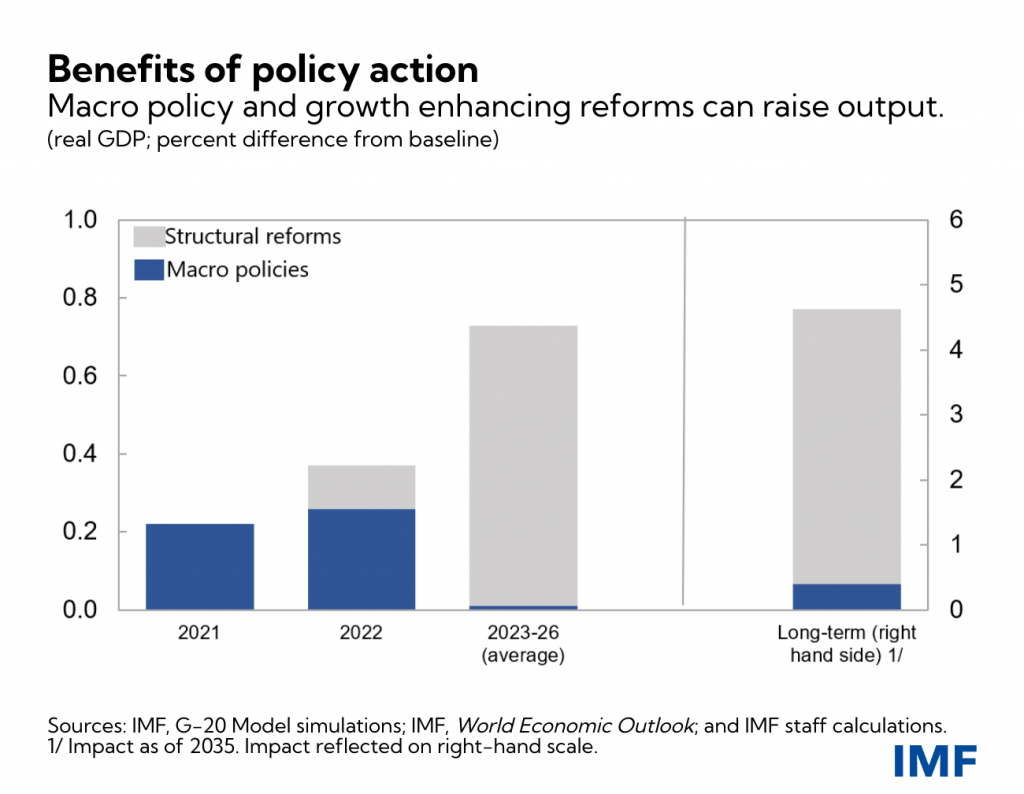
Led by G-20 economies, the world has taken extraordinary and synchronized measures, including about $16 trillion in fiscal action. Now is the time to build on these efforts with measures that are tailored to countries’ pandemic exposure and policy space.
In countries where infections are rapidly rising, it is critical that healthcare and vulnerable households and firms continue to receive support. This requires targeted fiscal measures, within credible medium-term frameworks.
Once improvements in health metrics allow for a normalization of activity, governments should gradually scale back support programs—while scaling up social spending and training programs to cushion the impact on workers. This would help heal the scars of the crisis, which hit young people, women, and the low-skilled especially hard.
Securing the recovery also requires continued monetary accommodation in most countries. This has to be coupled with closely monitoring inflation and financial stability risks. In countries where the recovery is accelerating, including the US, it will be essential to avoid overreacting to transitory increases in inflation.
In order to keep inflation expectations well anchored, major central banks have to carefully communicate their policy plans. This would also help prevent excess financial volatility at home and abroad. The key is to prevent the types of spillovers we saw earlier this year.
Third, step up support to vulnerable economies.
Poorer nations are facing a devastating double-blow: they are at risk of losing the race against the virus; and they could lose the opportunity to join a historic transformation to a new global economy built on green and digital foundations.
We estimate that low-income countries have to deploy some $200 billion over five years just to fight the pandemic. And then another $250 billion to have the fiscal space for transformative reforms, so they can return to the path of catching up to higher income levels. They can cover only a portion of that on their own. It is therefore vital that wealthier nations redouble their efforts, especially on concessional financing and dealing with debt.
The G20 Debt Service Suspension Initiative has provided fiscal breathing space. But given the need to provide permanent debt relief, we must make the new Common Framework fully operational. Chad, for example, received financing assurances from its G20 bilateral creditors, and we now need speedy commitments, on comparable terms, by private creditors.
We also strongly encourage the timely formation of the creditor committee to enable the delivery of the debt operation that Ethiopia is requesting. Success in the first Common Framework cases is critical for other countries with unsustainable debt burdens or protracted financing needs. They should also seek early action for debt resolution or reprofiling .
The IMF’s role
For its part, the IMF has stepped up in an unprecedented manner by providing $114 billion in new financing to 85 countries and debt service relief for our poorest members. We have received support to increase access limits, so we can scale up our zero-interest lending capacity. And we are exploring a new ‘vaccine window’ under our emergency financing facilities, which would support countries in financing vaccination programs if needed.
Our membership also backs a new allocation of Special Drawing Rights of $650 billion, the largest issuance in the IMF’s history. It will supplement reserves and help all our member countries, especially the most vulnerable, address their emergency needs, including vaccines. Our Executive Board recently discussed the proposal, and we expect the allocation process to be completed by the end of August.
In addition, we are working towards magnifying the impact of the new SDR allocation—by encouraging voluntary channeling of some of the SDRs, together with budget loans, to reach a total global ambition of $100 billion for the poorest and most vulnerable countries. We are exploring with our membership ways to get this done, including through our Poverty Reduction and Growth Trust (PRGT) and possibly a new Resilience and Sustainability Trust (RST).
This week’s G20 meeting is an opportunity to advance the plan for a new RST, which would support low-income nations as well as poorer and vulnerable middle-income countries ravaged by the pandemic. It would help them with structural transformation, including confronting climate-related challenges.
To further step up action on climate change, IMF staff recently proposed an international carbon price floor. Such a floor could help accelerate the transition to low-carbon growth over the course of this decade, and we intend to make a strong case for it at this week’s G20 Venice Conference on Climate.
On taxation, we strongly welcome the historic agreement reached by 130 countries in the context of the OECD/G20 Inclusive Framework. Under this accord, a minimum corporate tax rate will help ensure that highly profitable companies pay their fair share everywhere. We know from our own research that minimum tax regimes can help countries preserve their corporate tax base and mobilize revenue. This is now more important than ever.
Decades of tax competition fueled a race to the bottom—thus starving many countries of the resources needed to make vital investments in health, education, infrastructure, and social policies. Fiscal policies came under further strain during the pandemic, which makes it more difficult to invest in green and digital transformations. So, let’s seize this crucial moment to build a fairer and more effective international tax system that is fit for the 21st century.
When future generations look back on this moment, I hope they will see the unbreakable spirt of Venice in our partnership. We can end the pandemic and turn this two-track recovery into synchronized and sustainable growth—by acting decisively and acting together.
Author:

Kristalina Georgieva, Managing Director, IMF

Compliments of the IMF.
The post IMF | Urgent Action Needed to Address a Worsening ‘Two-Track’ Recovery first appeared on European American Chamber of Commerce New York [EACCNY] | Your Partner for Transatlantic Business Resources.