EACC

European Commission | A modernised cohesion policy to boost the EU’s strategic priorities

Today, the European Commission is revising the EU’s cohesion policy to better support EU competitiveness and decarbonisation, defence and security, the Eastern border regions as well as affordable housing, water resilience, and the energy transition.
The objective of this initiative is to make cohesion policy more effective, by encouraging Member States and regions to invest in the European strategic priorities, while maintaining the focus of cohesion policy on reducing economic, social and territorial disparities. Member States will be invited to reprogramme part of their 2021-2027 cohesion funds to new investments in the context of the ongoing cohesion policy’s mid-term review.
Strengthening Europe’s competitiveness and closing the innovation gap
Given the role of businesses, regardless of their size, in steering research, innovation, knowledge and technology transfer, the Commission is proposing to extend the support of the European Regional Development Fund to large companies in critical areas, such as defence, strategic technologies, and decarbonisation. In addition, the Commission encourages Member States to increase investments in strategic technologies under the Strategic Technologies for Europe Platform, to boost Europe’s competitiveness and innovation.
Backing the defence industry and supporting Eastern border regions
Today’s proposal will further enable Member States to use current cohesion funding to build resilient infrastructure to foster military mobility. It will also support productive capacities of small and large enterprises in the defence sector across all EU regions.
Moreover, cohesion programmes in the Eastern border regions, disproportionately affected by the Russian war of aggression against Ukraine, will benefit from a preferential prefinancing level, if they move at least 15% of their overall funds to the new strategic priorities.
More affordable housing
The Commission proposes, in line with the President’s political guidelines, to double the amount of cohesion policy funding dedicated to affordable housing. Member States will also be able to leverage private and public financing by using a new financial instrument set up jointly with the European Investment Bank (EIB). The instrument will combine cohesion funding with the resources of the EIB and of other international financial institutions as well as national promotional and commercial banks.
Enhancing water resilience
Member States will be able to increase investments in water resilience, including in digitisation of water infrastructure, mitigation of drought and desertification impacts.
Supporting the energy transition
Cohesion funding will support investments to promote energy interconnectors and related transmission systems, as well as the deployment of recharging infrastructure. This will be crucial to accelerate the energy transition and promote clean mobility. The proposal will also make it easier to fund decarbonisation measures.
Financial incentives under the strategic priorities
While all cohesion projects developed under the EU strategic priorities will be entitled to up to 30% of prefinancing, cohesion programmes, which will move at least 15% of their overall funds to these priorities, will enjoy an even higher level of advanced payment.
In addition, the EU funding for investments in strategic priorities will cover up to 100% of the costs in all regions.
Next steps
Today’s amendments of the cohesion policy legislations, proposed in the context of the 2025 mid-term review, will be discussed by the European Parliament and the Council.
The Commission’s objective is to conclude the reprogramming exercise of the mid-term review with Member States and regions in 2025, so that the new programmes can start being implemented in early 2026.
Background
With a budget of €392 billion in the current programming period 2021-2027, cohesion policy is the EU’s main investment policy. In line with the legal rules, the current mid-term review allows Member States to assess the implementation of their cohesion programmes and adjust them to the new political priorities in 2025.
For more information, please contact:

Maciej Berestecki, Spokesperson, EUROPEAN COMMISSION
Isabel Arriaga-E-Cunha, Press Officer, EUROPEAN COMMISSION

 
Compliments of the European CommissionThe post European Commission | A modernised cohesion policy to boost the EU’s strategic priorities first appeared on European American Chamber of Commerce New York [EACCNY] | Your Partner for Transatlantic Business Resources.

EACC

ECB | The transformative power of AI

Welcome address by Christine Lagarde, President of the ECB, at the ECB conference on “The transformative power of AI: economic implications and challenges” in Frankfurt, Germany.
It is a pleasure to welcome you to our conference on the transformative power of AI.
In the early stages of a new technological breakthrough, it is often hard to discern fact from fiction. We struggle to imagine the ways in which the new technology will be used. And even if we predict the direction of technological change correctly, we rarely get the timeline or the size of the impacts right.
Today, we sometimes hear claims that AI is improving so fast that we are only a few years away from the nature of work being radically reformed. But we also hear arguments that the same barriers that slowed down the adoption of all past technologies will also delay AI adoption.
I cannot claim to know which vision will prove to be correct. But the early evidence is promising and, in my view, we must act on the basis that we are facing an economic revolution. This attitude will be particularly important here in Europe.
On this side of the Atlantic, we are still paying the price for having been too slow to capitalise on the last major digital revolution, the internet. The tech sector explains around two-thirds of the productivity gap between the EU and the United States since the turn of the century.
And now we are faced with a technology that can improve its own performance through self-learning mechanisms and feedback loops, enabling even more rapid advances and innovations. The risks of underestimating the potential of AI, and falling behind again, are simply too great to be ignored.
What’s more, we are facing a new geopolitical environment in which we can no longer be sure that we will have frictionless access to new technologies developed overseas. This new reality strengthens the case for Europe to establish itself at the technological frontier.
There are two main areas where we should expect, and prepare for, major changes in the economy.
The first is productivity.
We can already see the productivity effects of AI in sectors like the US tech sector, where output is expanding while employment is falling.[1] But we are still in the early phase of the “productivity J-curve”, where new technologies diffuse to the wider economy and are reflected in GDP.
As such, estimates about the productivity gains of AI vary widely – but even at the lower end they would be a game changer for Europe.
One widely accepted methodology estimates that the euro area could see a boost to total factor productivity (TFP) of around 0.3 percentage points per year over the next ten years.[2] Compare that with the past decade, when annual TFP growth averaged just 0.5%.
Other estimates point to much larger gains, with productivity expected to grow 1.5 percentage points faster annually if AI is widely adopted over the next decade.[3]
Whether Europe can achieve such productivity gains will depend on whether we can improve the environment for AI innovation and diffusion.
This comes down to funding, regulation and energy.
As I have been arguing for some time, Europe’s relatively small venture capital ecosystem is a major hindrance to building foundational models in the EU.[4] Between 2018 and 2023, around €33 billion was invested in AI companies in the EU, compared with more than €120 billion in their US peers.[5]
Building and developing this technology also requires considerable investment in data centres, and the EU currently has around 4 times fewer dedicated sites than the US.[6]
At the same time, ECB research finds that regulation and a lack of institutional quality are particularly detrimental to the expansion of high-tech sectors relative to more mature technologies. Investing in radical technologies is highly risky and needs a different set of framework conditions.[7]
The adoption of AI, for example, depends on access to data pools to train models, which requires smart regulation to avoid data fragmentation while ensuring data protection. It also requires good institutions as, for instance, effective legal systems are needed to defend a non-patentable asset like a set of AI prompts.
Our research shows that if the EU’s average institutional delivery were raised to the level of best practice, AI-intensive sectors would see their share in investment rise by more than 10 percentage points.[8]
Finally, unless we see major breakthroughs in efficiency, Europe’s energy supply constraints could pose a challenge to the diffusion of AI through the economy in the future.
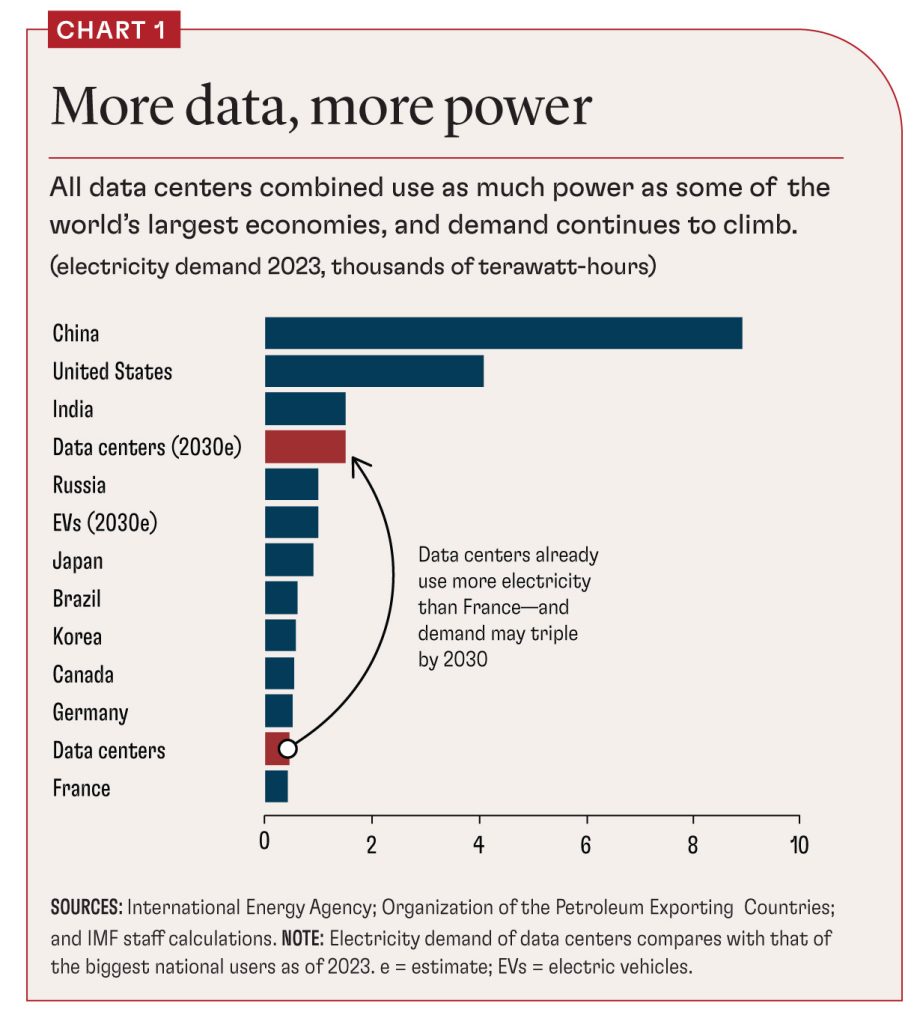
The power consumption of data centres is expected to triple in Europe by the end of the decade.[9] AI training and inference is extremely energy-intensive.[10] And this surge in demand comes at a time when the green transition is also increasing the demand for electricity, for example for charging battery electric vehicles.
There is now a clear policy agenda in Europe to address these barriers. It is widely recognised that we need to build a savings and investment union to jump-start European venture capital, that we must simplify complex digital regulations and improve permitting speeds, and that we have to massively increase investment in data centres, fibre-optic networks and electricity grids.
But for Europe to make the most of the AI revolution, how the productivity gains from AI are harnessed also matters. Labour productivity can be increased either by reducing labour inputs relative to outputs, or by raising outputs relative to inputs. The employment implications of each route are vastly different.
This brings me to the second area of major change: the effect of AI on labour markets.
According to ECB research, between 23% and 29% of workers in Europe are highly exposed to AI.[11] This does not necessarily herald a “job apocalypse”. It is reasonable to expect that AI will follow historical patterns by displacing some jobs while creating new one.[12]
But there are two new questions that this technology poses.
First, will the pace of technological change be faster than in previous transitions? This question is critical for Europe, as our social model and traditionally high levels of job protection make it hard to see how a transition that leads to massive job reallocations could avoid a major backlash.
The key factor will be whether AI leans more towards job displacement via its “automation potential”, or towards changes in the nature of work via its “augmentation potential”. In the augmentation scenario, workers will still need to adapt to changing roles and tasks, but the transition will likely be easier.
Recent research by the ILO finds that only a small share of jobs – around 5% in advanced economies – meet the criteria for high automation. But a much larger share – over 13% – meet the criteria for high augmentation.[13]
The second question is about the distribution of gains.
Early studies suggested that AI could increase the productivity of lower-skilled workers the most.[14] But newer studies looking at more complex tasks – like scientific research[15], running a business[16]and investing[17]– tell a different story. High performers benefit disproportionately and, in some cases, less productive workers see no improvements at all.
So even if AI augments more than it automates, we are likely to see an increase in labour market inequality. Demand for higher-skilled workers who can use AI most effectively will rise, while those less able to learn new skills could suffer.
All told, I do see a path for Europe to adopt AI without fracturing its social model. But it will require massive complementary investments in skills to prevent a rise in inequality.
Crucially, this will not require everyone to become coders, which would probably set the bar too high. According to the OECD, most workers who will be exposed to AI will not need specialised AI skills to get ahead in their careers.
In fact, the most sought-after skills in highly exposed jobs will be linked to management and business – skills that many people have the capacity to learn.[18]
The CEO of Anthropic, Dario Amodei, has described the potential capabilities of AI as being like “a country of geniuses in a data centre”.[19] If this proves to be correct, it is both an awesome prospect for humanity and a daunting one for individual workers.
I believe we must act today, and especially in Europe, with the mindset that this future will likely come to pass. We must remove all the barriers that will prevent us from being at the forefront of this revolution.
But we must also prepare for the human and climate impacts of this transition, and we need to start now.
I trust that this conference will generate the ideas we need to move forwards.

Allianz (2025), “Invest in your future: How to save your way out of employment vulnerability”, Allianz Research, 26 March.
Bergeaud, A. (2024), “The Past, Present and Future of European Productivity”, paper presented at the ECB Forum on Central Banking.
Briggs, J. and Kodnani, D. (2023), “The Potentially Large Effects of Artificial Intelligence on Economic Growth”, Goldman Sachs Economics Research, 26 March.
Lagarde, C. (2023), “A Kantian shift for the capital markets union”, speech at the European Banking Congress, 17 November.
European Parliamentary Research Service (2024), “AI investment: EU and global indicators”, March.
KPMG (2024), “Data centres in Europe – a strategic approach”, 23 September.
Bothner, J., Lopez-Garcia, P., Momferatou, D. and Setzer, R. (2025), “Investment in AI intensive sectors – the role of institutional factors in EU countries”, Working Paper Series, ECB, forthcoming.
ibid.
McKinsey (2024), “The role of power in unlocking the European AI revolution”, 24 October.
de Vries, A. (2023), “The growing energy footprint of artificial intelligence”, Joule, Vol. 7, No 10, 18 October.
Albanesi, S., Dias da Silva, A., Jimeno, J., Lamo, A. and Wabitsch, A. (2025), “New technologies and jobs in Europe”, Economic Policy, Vol. 40, No 121, January, pp. 71-139.
Autor, D., Chin, C., Salomons, A. and Seegmiller, B. (2022), “New Frontiers: The Origin and Content of New Work, 1940–2018”, MIT Working Papers, 14 August.
Gmyrek, P., Berg, J. and Bescond, D. (2023), “Generative AI and Jobs: A global analysis of potential effects on job quantity and quality”, ILO Working Papers, No 96, August.
Brynjolfsson, E., Li, D. and Raymond, L.R. (2023), “Generative AI at work”, NBER Working Papers, No 31161, National Bureau of Economic Research, April.
Toner-Rodgers, A. (2024), “Artificial Intelligence, Scientific Discovery, and Product Innovation”, 27 November.
Otis, N.G., Clarke, R., Delecourt, S., Holtz, D. and Koning, R. (2023), “The Uneven Impact of Generative AI on Entrepreneurial Performance”, Working Papers, No 042, Harvard Business School.
Kim, A.G., Muhn, M. and Nikolaev, V.V. (2023), “From Transcripts to Insights: Uncovering Corporate Risks Using Generative AI”, Chicago Booth Research Papers, No 23-19.
OECD (2024), “Artificial intelligence and the changing demand for skills in the labour market”, OECD Artificial Intelligence Papers, No 14, 10 April.
Amodei, D. (2024), “Machines of Loving Grace::How AI Could Transform the World for the Better”, October.

 
Compliments of the European Central BankThe post ECB | The transformative power of AI first appeared on European American Chamber of Commerce New York [EACCNY] | Your Partner for Transatlantic Business Resources.

EACC

European Council | Speech by President von der Leyen at the European Parliament Plenary debate on the conclusions of the European Council meeting of 20 March 2025

“Check against delivery”
Madam President, dear Roberta,
Mr President of the European Council, dear António,
Honourable Members,
Today, I would like to focus on the threats to global prosperity and stability and the rise of protectionism. And as our domestic agenda cannot be seen separately from global developments around us, let me start with the US tariffs.
When the dream of a united Europe began, it started with a simple idea: Let us create one Single Market. Let us break barriers and take tariffs down. This is what made us strong. Because our companies grew. And so did the ties that bind us together. And then in the same spirit, we worked with partners across the world – including America. We built connections that we believed were unbreakable. And trade brought more than prosperity. It brought the idea of a shared way of life. And with commerce, our partnership has also grown. Countless are the friendships across the Atlantic. And because of this collective experience, so many Europeans feel utterly disheartened by the announcements from the US. Let me be clear: Europe did not start this confrontation. We think it is wrong. But my message to you today is also that we have everything we need to protect our people and our prosperity. We have the largest Single Market in the world. We have the strength to negotiate. We have the power to push back. And the people of Europe should know: Together we will always promote and defend our interests and values. And we will always stand up for Europe.
So far, the US administration has announced a 25% increase of tariffs on imports of steel, aluminium, cars and car parts. The next sectors facing tariffs will be semiconductors, pharmaceuticals and timber. And tomorrow we expect another announcement – with so-called ‘reciprocal’ tariffs that will immediately apply to almost all goods and many countries in the world. Of course there are severe issues in the world of trade. Overcapacities, imbalances, unfair subsidies, denial of market access, intellectual property theft. I hear Americans, when they say some others have taken advantage of the rules. I agree. We also suffer from it. So let us work on it. But tariffs across the board make things worse, not better. Tariffs are taxes that will be paid by the people. Tariffs are taxes for the Americans on their groceries and their medication. Tariffs will just fuel inflation. Exactly the opposite of what we want to achieve. American factories will pay more for components that are produced in Europe. This will cost jobs. It will create a bureaucratic monster of new customs procedures. And today nobody needs that – neither in the US nor in Europe.
So our strategy builds on three pillars. First, we are open to negotiations. We will approach these negotiations from a position of strength. Europe holds a lot of cards. From trade to technology to the size of our market. But this strength is also built on our readiness to take firm countermeasures. All instruments are on the table. Second, we will keep diversifying our trade with other partners. Our hallmark is not only that we are the biggest market in the world but that we are reliable and predictable. We honour our commitments. And that is exactly what our partners are looking for today. And third, we will double down on our Single Market. The Single Market is the cornerstone of European integration and values. It is our powerful catalyst for growth, prosperity and solidarity. We have to tear down remaining barriers to have a Single Market to go big because scale matters. And a Single Market to go fast and go far.
To the first point: Our immediate response is unity and determination. I have already been in contact with our Heads of State and Government on the next steps. We have the parliamentary debate today. And we will assess tomorrow’s announcements carefully to calibrate our response. Our objective is a negotiated solution. But of course, if need be, we will protect our interests, our people and our companies. I want to be very clear on the aim of our response. We think that this confrontation is in no one’s interest. The flow of goods and services between us is nearly balanced. We are willing to work on the trade balance of goods as well as services. This is the largest and most prosperous trade relation worldwide. We would all be better off if we could find a constructive solution. At the same time, it also has to be clear: Europe has not started this confrontation. We do not necessarily want to retaliate, but we have a strong plan to retaliate if necessary.
The second element of our strategy is diversification. Trade goes to where the business case is. We will open doors towards fast-growing markets across the world. Europe already has trade agreements in place with 76 countries. And we are now growing this network. We just concluded trade deals with Mercosur, Mexico and Switzerland. We launched the first-ever Clean Trade and Investment Partnership with South Africa. We aim to conclude a trade agreement with India by the end of the year. We are in intense negotiations with Indonesia and Thailand. And later this week,
President Costa and I will head to Samarkand, for the first-ever summit between the European Union and Central Asia. Europe has always been a trading continent. Let us connect with the new beating hearts of the global economy. Our message is clear: Europe is reliable, predictable and open for fair business.
And the third point, Honourable Members, is: unchain the Single Market. There are too many obstacles that tie down our businesses. And we have to do our homework. Mario Draghi is right when he says: ‘High internal barriers are far more damaging for growth than any tariff.’ The Single Market was born to tear down barriers between our countries. To erase customs and duties. And to make business easy inside Europe. We must go back to that idea and fulfil it. It must be easier for SMEs to sell the same product in all Member States, instead of re-labelling it 27 times to comply with national laws. It must be easier for professionals to work across borders, instead of getting stuck with different national bureaucracies. It must be easier for tech companies to launch a new service all across Europe, instead of dealing with 27 different procedures. And it must be easier for Europeans to invest in Europe, instead of sending their savings to the other side of the world. This is the promise of our Single Market. And it must be fulfilled.
Honourable Members,
The European Parliament has always worked hard to complete the Single Market. Now we have a generational opportunity to get it done. We have a strong consensus on the Draghi and Letta reports. We have put ambitious proposals on the table, from the Savings and Investment Union, to ensure that people get a better return on their savings and the companies find the capital they need to grow, to our omnibus simplification packages, or the Union of Skills. And more will come, including the 28th legal regime for innovative companies. According to the IMF, Europe’s internal market barriers are equivalent to a tariff of 45% for manufacturing and 110% for services.
This simply cannot be. This must change now. That is why I have tasked EVP Séjourné to come up with concrete and bold proposals next month to remove some of these barriers and prevent new ones. These reforms are overdue. And now they have become more urgent than ever. In a stormy global economy, the Single Market is our safe harbour. Thirty years after Jacques Delors laid its first stone, it is time to finish the job.
Thank you, and long live Europe.
 
Compliments of the European CommissionThe post European Council | Speech by President von der Leyen at the European Parliament Plenary debate on the conclusions of the European Council meeting of 20 March 2025 first appeared on European American Chamber of Commerce New York [EACCNY] | Your Partner for Transatlantic Business Resources.
EACC

Export-Import Bank of the United States Approves More Than $350 Million in Transactions

Transactions Include Seventh Make More in America Deal, Highlighting Bank Support of Domestic Critical Minerals Supply Chain

Washington, D.C. – The Board of Directors of the Export-Import Bank of the United States (EXIM) last week approved three transactions amounting to more than $350 million in financing to support domestic exports and Bank priorities.

The first transaction of the day was an $11 million loan for IperionX Technology LLC to support the purchase and installation of industrial metals processing equipment. This transaction is the seventh under EXIM’s flagship domestic financing initiative, Make More in America (MMIA).
IperionX, a small business located in South Boston, VA, manufactures and exports titanium milled parts and titanium powder to advanced manufacturers for applications such as 3D printing. This loan will assist IperionX with its continued expansion of their processing facility to meet current demand and expected growth in key markets.
“I am pleased that the Board approved EXIM’s seventh Make More in America transaction,” said Acting President and Chairman Jim Cruse. “Today’s transaction continues to reinforce EXIM’s commitment to supporting the American worker with bolstering and reshoring critical supply chains while highlighting our dedication to advancing domestic production of critical minerals.”
The financing from this transaction allows for the advanced refining of titanium, a key critical mineral with significant geopolitical importance, further supporting EXIM’s China and Transformational Exports Program (CTEP). This transaction also supports Bank and Trump Administration priorities of strengthening American supply chains, supporting U.S. exporters, and competing with the People’s Republic of China while bolstering economic security.
The transaction is expected to support an estimated 49 local jobs.
In the second and third transactions of the day, the Board approved two final commitments for Silk Way West Airlines totaling more than $339 million to support aircraft exports. The aircraft are expected to be delivered by Spring 2026. The transactions will support an estimated 700 jobs.
ABOUT EXIM:
The Export-Import Bank of the United States (EXIM) is the nation’s official export credit agency with the mission of supporting American jobs by facilitating U.S. exports. To advance American competitiveness and assist U.S. businesses as they compete for global sales, EXIM offers financing including export credit insurance, working capital guarantees, loan guarantees, and direct loans. As an independent federal agency, EXIM contributes to U.S. economic growth by supporting tens of thousands of jobs in exporting businesses and their supply chains across the United States. Learn more at www.exim.gov.

 
Compliments of the Export-Import Bank of the United StatesThe post Export-Import Bank of the United States Approves More Than $350 Million in Transactions first appeared on European American Chamber of Commerce New York [EACCNY] | Your Partner for Transatlantic Business Resources.
EACC & Member News

Expat Management Group: Hiring Non-EU Talent in the Netherlands: EU Blue Card vs. HSM Explained

In the next five years, the Netherlands will face growing talent shortages in key sectors like skilled manual labor, digital and tech, and healthcare, with projected deficits of 450,000 workers. With domestic talent pipelines unable to meet demand, companies are increasingly looking outside the EU. However, HR teams must also navigate ever-changing salary thresholds, compliance with Dutch labor laws, and employee relocation logistics.

Read more

EACC

European Commission | Action Plan for Affordable Energy

To deliver on the Clean Industrial Deal, Europe needs affordable energy. A set of concrete short-term and structural measures will provide competitiveness, affordability, security and sustainability for citizens and businesses.
Energy is a building block and a driving force of our Union, and an area where most actions to mitigate climate change can be taken. However, high energy costs are hurting EU citizens and businesses. Energy poverty affects more than 46 million Europeans and electricity is about 3 times more expensive than gas in many European countries. For industries, retail electricity prices have almost doubled since the beginning of the energy crisis in 2021.
Affordable Energy Action Plan
As part of the Clean Industrial Deal, the Commission presented on 26 February 2025 an Affordable Energy Action Plan (COM/2025/79), which is based on 4 pillars:

Lowering energy costs for all
Completing the Energy Union
Attracting investments and ensuring delivery
Being ready for potential energy crises

The Action Plan includes 8 actions, many of which will be delivered already in 2025.
Action 1 – Making electricity bills more affordable
EU countries can already lower electricity bills, but greater ambition is needed, especially in the areas of network charges and taxation. The Commission will put forward a methodology to ensure that network charges incentivise the most efficient use of the grid, lowering energy system costs and total new grid investment needs, and will make recommendations to EU countries to lower national taxes on electricity, immediately reducing energy bills.
Action 2 – Bring down the cost of electricity supply
Costs can be better controlled by swiftly and fully applying existing EU electricity rules, and additional actions to promote the uptake of long-term electricity supply contracts, accelerate permitting procedures for key energy projects, reinforce grids and boost flexibility. An energy system underpinned by market integration, renewable generation and flexibility could result in 40% lower wholesale electricity prices on average in the EU.
Action 3 – Ensure well-functioning gas markets
EU gas wholesale prices have not fully reverted to pre-crisis levels, affecting the competitiveness of the European industry. Full regulatory oversight and close cooperation between energy and financial regulators is required. The Commission will explore how to harness the Union’s purchasing power to get a better deal for imported natural gas. Protecting EU buyers against price volatility of fossil fuels could lead to a significant short-term reduction in retail prices.
Action 4 – Energy efficiency – delivering energy savings
Energy efficiency helps avoid high energy bills. The Commission will support market actors who provide energy efficiency solutions for businesses through the European Energy Efficiency Financing Coalition and update its rules on energy labelling and ecodesign for products – which brought estimated savings of around €120 billion on energy bills in 2023, and could rise to about €162 billion in 2030.
Action 5 – Complete the Energy Union
Energy prices can differ considerably between EU countries. To enhance coordination and strengthen governance of the electricity system, the completion of a genuine Energy Union, including a fully integrated energy market and a cohesive governance framework, is key to preventing sharp increases of system costsof up to €103 billionby 2040 if no action is taken. Measures covered under this action include the launch of an Energy Union Task Force.
Action 6 – A tripartite contract to ensure affordable energy for Europe’s industry
To counteract high energy prices and market uncertainty, a broader tripartite contract for affordable energy can bring together the public sector, energy producers, and energy-consuming industries to create a favourable investment climate, facilitating a competitive EU industrial sector, while ensuring the retention and creation of quality jobs.
Action 7 – Guarantee security of supply for price stability
Ensuring secure EU energy supplies is critical for our economic resilience, continued access to affordable energy and avoiding extreme price volatility. A resilient energy system must be able to withstand potential supply disruptions resulting from geopolitical tensions, cyberattacks, deliberate attacks or extreme weather events, which threaten affordability.
Action 8 – Price crisis preparedness
Europe must be prepared to protect the affordability of energy in the event of an energy price crisis. The Commission will guide EU countries on the application of measures that incentivise consumers to reduce demand at certain times and will work with transmission system operators and national regulatory authorities to temporarily increase electricity flows in cross-border interconnectors, in certain situations.
 
Compliments of the European CommissionThe post European Commission | Action Plan for Affordable Energy first appeared on European American Chamber of Commerce New York [EACCNY] | Your Partner for Transatlantic Business Resources.

EACC

European Commission | EU to invest €1.3 billion in artificial intelligence, cybersecurity and digital skills

The Commission will allocate €1.3 billion for the deployment of critical technologies that are strategically important for the future of Europe and the continent’s tech sovereignty through the Digital Europe Programme (DIGITAL) work programme for 2025 to 2027 adopted today.
The work programme focuses on the deployment of Artificial Intelligence (AI) and its uptake by businesses and public administration, cloud and data, cyber resilience and digital skills.
More specifically, key priorities under the DIGITAL work programme include:

Improving the availability and accessibility of generative AI applications, including in the health and care sectors. Available funding will go towards testing immersive environments, known as ‘virtual worlds’, implementing the AI Act and deploying energy efficient common data spaces. These measures are key to the implementation of the AI Factories initiative to develop generative AI models for businesses and the public sector.
Supporting  the European Digital Innovation Hubs (EDIHs). This is a network of hubs that provides companies and the public sector with access to technical expertise and testing of technologies, as well as with advice, training and skills to adopt the latest technologies. It will promote the widespread take-up of AI in private and public organisations across Europe.
Building-up the award-winning Destination Earth initiative that is working to build a digital model of Earth to support climate adaptation and disaster risk management. Funding will build a more powerful model that more researchers can access.

Boosting cyber resilience. Cybersecurity solutions such as the EU Cybersecurity Reserve will improve the resilience and security of critical infrastructures including hospitals and submarine cables.
Developing EU education and training institutions’ capacity in digital skills so they may nurture and attract talent while boosting advanced skills in the European workforce.
Facilitating the new EU Digital Identity Wallet architecture and the European Trust Infrastructure, as well as promoting its adoption in Member States.
Stimulating the transformation of the public sector by developing efficient, high-quality, interoperable digital public services.

Innovation will also be accelerated by the new Strategic Technologies for Europe Platform (STEP) which awards the STEP Seal quality label to promising projects to improve their opportunity to access public and private funding.
Next Steps
The upcoming DIGITAL calls are expected to be released in April 2025, with additional calls published through the rest of the year. The EU Funding & Tenders Portal can be consulted for information on open calls.
Calls are open to businesses, public administrations, and other entities from EU Member States, EFTA/EEA countries, and countries associated to DIGITAL.
Background
DIGITAL is the first funding programme of the EU entirely focused on bringing digital technology to businesses and citizens. With a budget of €8.1 billion under the present Multiannual Financial Framework 2021-2027, it has been shaping the digital transformation of Europe’s society and economy.
Focussing specifically on deployment, DIGITAL complements investments under other EU programmes, such as Horizon Europe, EU4Health, InvestEU, the Connecting Europe Facility as well as investments under the Recovery and Resilience Facility.
For more information, please contact:

Thomas Regnier, Spokesperson, EUROPEAN COMMISSION

Patricia Poropat, Press Officer, EUROPEAN COMMISSION

 
Compliments of the European CommissionThe post European Commission | EU to invest €1.3 billion in artificial intelligence, cybersecurity and digital skills first appeared on European American Chamber of Commerce New York [EACCNY] | Your Partner for Transatlantic Business Resources.

EACC

ECB | AI can boost productivity – if firms use it

Blog post by Antonin Bergeaud, Guzmán González-Torres Fernández, Vincent Labhard and Richard Sellner
We constantly hear of exciting new ways AI tools can help to tackle economic problems and the productivity gains they bring. However, benefits can only materialize when firms actually use AI.

This post is part of a miniseries related to the ECB conference “The Transformative Power of AI”, on 1-2 April 2025, bringing together researchers, practitioners, and policymakers. Learn more here.
Though economists have attempted to quantify the potential economy-wide productivity gains that AI (artificial intelligence) could bring, there is no consensus on the impact of this technology. A central precondition for AI to thrive, is the adoption by firms. And this depends, among other things, on firms’ technological readiness, investment capacity, and regulation.
In this blog post, we first present new insights from the ECB’s corporate telephone survey (CTS) on AI adoption by firms. We then provide an overview of the multitude of other factors that will influence the impact of AI on productivity growth. Understanding these dynamics is essential for policymakers and business leaders to harness AI’s potential for sustained economic growth.
AI adoption among leading European firms
To get an idea of the pace at which AI is being adopted by European firms, the June 2024 edition of the ECB’s Corporate Telephone Survey (CTS)[1], included a module dedicated to this topic. The results for the firms participating in the survey suggest two important trends: Firstly, European firms are indeed steadily adopting AI for a variety of reasons. Secondly, however, the share of employees using AI regularly at the workplace is still small.
More specifically, the survey results show widespread yet moderate uptake so far among firms (see Chart 1). About 75% of the firms surveyed- amongst the largest in the euro area- claim to already be using AI in their daily business operations, although most of them report that less than 25% of their employees do so. The most common applications of AI relate to improving access to information or creating customised web content. Most firms state that they do not intend to reduce their headcount through the adoption of AI.
Although as shown above the use of AI tools might be relatively common among large euro area firms, a recent survey of Eurostat highlights the divide in adoption rates between large and small firms. According to this survey less than 12% of small enterprises in the EU use at least one AI technology, while more than 40% of large firms do so.[2]

Chart 1
Intensity and intents of use of AI

Chart A: Intensity of AI use
Chart B: Intention behind AI use

share of employees

percentage of respondents

Source: ECB Corporate Telephone Survey.
Note: Respondents were given the chance to provide an answer for every use listed in Chart B.

Estimating the macroeconomic productivity gains of AI adoption
Adoption is the essential precondition for AI to make an impact. However, several other factors will determine how these technologies diffuse and affect productivity growth.
First, current estimations are based on today’s state of the art in AI, assuming that AI can only be applied to a limited set of tasks in the economy. A game changer would be if AI ends up able to tackle any task, becoming so-called “artificial general intelligence”. This could have the potential to push the innovation frontier and replace tasks in a larger number of occupations. Consequently, productivity gains could multiply. Second, for firms to use AI they may need to invest in capital, notably human skills and intangible assets, which eventually would support productivity. Moreover, gains may be amplified if we accounted for productivity spillovers across sectors.[3]
How strongly these factors might affect the economy is hard to estimate. One helpful method to quantify macroeconomic productivity gains looks at the share of tasks exposed to AI and the potential gains for each task. The resulting estimates vary considerably, ranging from 0.07 percentage points (pp) to 1.5 pp per year,[4] as no consensus exists about the tasks that can be automated, to what extent they can be automated, or about the gains AI would bring to each of them.
A set of estimates in the middle of the range is shown in the blue bars in Chart 2, suggesting a productivity increase of around 0.35 pp per year on average for the euro area, 3.5 pp over ten years for the whole economy due to AI.[5] But, again, the potential gains depend on the AI adoption by firms. We use two indicators summarising how straightforward it may be for a given country to adopt AI In order to illustrate how different adoption rates across firms might interact with the general applicability of AI to different tasks in the economy,.
The dots in Chart 2 show how the original estimates for productivity gains would change if the conditions for AI adoption were less favourable as in the optimal scenario (blue bar). To that end we adjusted the estimates for productivity gains based on two indicators: First, the IMF’s preparedness index, which measures how prepared countries are for AI in terms e.g., of digital infrastructure, regulation and labour force (yellow dots). And second, the UN productive capacities index which includes 42 economic characteristics and their role for productivity, such as transport, education or quality of institutions (red dots). We also calculate how the factors captured by both indices together might reduce expected productivity gains. For the euro area, this would reduce the productivity gains to around 3.1 pp over 10 years if either one is considered, and 2.9 pp if both are (green dots).

Chart 2
Estimated productivity gains from AI

How much do the gains depend on “AI readiness” and “productive capacity”?
percentage points

Source: Authors’ calculations based on Bergeaud (2024) https://www.ecb.europa.eu/pub/pdf/sintra/ecb.forumcentbankpub2024_Bergeaud_paper.de.pdf), IMF (AI preparedness, https://www.imf.org/external/datamapper/datasets/AIPI) and UNCTAD (productive capacity, https://unctad.org/topic/least-developed-countries/productive-capacities-index).
Notes: The bars show the estimated productivity gains over a period of 10 years in percentage points; the dots show the gains that remain when taking into account for AI preparedness, productive capacity, or both.

The challenge ahead
European firms are slowly adopting AI technologies. However, the expected productivity gains remain uncertain. Whether, and to which extent, the advent of AI tools will boost firms’ output depends on several factors: the future development of the technology, its wide use across workers and tasks,[6] and the capacity of firms to benefit from the new technologies. At the moment, the conditions seem less than ideal in some EU countries. Policy makers may have two avenues to help firms reap the benefits of these new technologies. First, facilitating the availability of the necessary skills and tools for the deployment of AI. Second, implementing structural reforms that foster dynamic business environments and the construction of digital infrastructures more generally.
The views expressed in each blog entry are those of the author(s) and do not necessarily represent the views of the European Central Bank and the Eurosystem.
Check out The ECB Blog and subscribe for future posts.
For topics relating to banking supervision, why not have a look at The Supervision Blog?

The Corporate Telephone Survey is a regular firm survey conducted by the ECB. See “The ECB’s dialogue with non-financial companies”, Economic Bulletin, Issue 1, ECB, 2021.
See Eurostat (January 2025): “Use of artificial intelligence in enterprises”.
See Filippucci, F., Gal, P. and Schief, M. (2024), ‘Miracle or Myth? Assessing the Macroeconomic Productivity Gains From Artificial Intelligence’, OECD Artificial Intelligence Papers no. 29.
See Acemoglu, D. (2025), ‘The Simple Macroeconomics of AI’, Economic Policy, vol. 40, no.121, pp.13-58 and Briggs, J. and Kodnani, D. (2023) ‘The Potentially Large Effects of Artificial Intelligence on Economic Growth’, Goldman Sachs Global Economics Analyst.
This set of estimates is based on Bergeaud, ‘The Past, Present and Future of European Productivity’, paper presented at the 2024 ECB Forum on Central Banking.
See this earlier post on The ECB Blog.

 
Compliments of the European Central BankThe post ECB | AI can boost productivity – if firms use it first appeared on European American Chamber of Commerce New York [EACCNY] | Your Partner for Transatlantic Business Resources.

EACC

Delegation of the EU to the US | Top 10: Fair Trade Matters

Trade Matters
Commissioner Šefčovič held substantive talks with Secretary of Commerce Lutnick, Ambassador Greer & Director Hassett. Our priority is a fair, balanced deal instead of unjustified tariffs.
Digital Policy
At the Center for Strategic and International Studies (CSIS), Commissioner Michael McGrath addressed EU-U.S. economic relations and digital collaboration.
100 Days Defense & Competitiveness
“Our sense of urgency and common direction are clear. We are following up on our commitment to boost defense investment, with concrete steps.”

— European Commission President Ursula von der Leyen
EU on the Hill
Agricultural trade is just one facet of the $4.5 billion in EU-U.S. goods and services traded daily. EU Ambassador Jovita Neliupšienė met U.S. Senator from Arkansas John Boozman and U.S. Representative from Texas Nate Moran.
European Defense Investments 

“450 million EU citizens should not have to depend on 340 million Americans to defend ourselves against 140 million Russians who can’t defeat 38 million Ukrainians. It’s time for us to take responsibility for the defense of Europe.”
— European Commissioner for Defense and Space Andrius Kubilius
On Air
EU Ambassador Jovita Neliupšienė joined Newsmax for a discussion on trade relations and the EU’s defense capabilities.
 
Compliments of the EU External Action Service
 The post Delegation of the EU to the US | Top 10: Fair Trade Matters first appeared on European American Chamber of Commerce New York [EACCNY] | Your Partner for Transatlantic Business Resources.

EACC & Member News

Archipel Tax Advice: MiCAR 101: A New Era of Crypto Regulation in the EU

“Crypto” is no longer just a buzzword for tech geeks and financial futurists — it’s going mainstream, and fast. With this explosive growth comes the inevitable: rules. Enter the Markets in Crypto-Assets Regulation (‘MiCAR’), Europe’s new framework aimed at bringing some regulation to the European crypto space. Whether you’re in the business of offering crypto services or just dipping your toes into the world of digital assets, MiCAR is about to shake things up.

Read more