EACC

ECB | Navigating a fractured horizon: risks and policy options in a fragmenting world

Speech by Piero Cipollone, Member of the Executive Board of the ECB, at the conference on “Policy challenges in a fragmenting world: Global trade, exchange rates, and capital flow” organised by the Bank for International Settlements, the Bank of England, the ECB and the International Monetary Fund
Frankfurt am Main, 29 April 2025
I’m honoured to welcome you to this conference, jointly organised by the Bank for International Settlements (BIS), the Bank of England, the European Central Bank (ECB) and the International Monetary Fund (IMF).[1]
Today, we come together to discuss the urgent challenges posed by global fragmentation – a growing risk to our interconnected world. Earlier this month, the President of the United States announced tariff hikes, sending shockwaves through the global economy – a stark reminder that the fractures we face are no longer hypothetical, but real.
This announcement is but the latest chapter in a series of four major shocks that have been reshaping our world in recent years.
First, since 2018 the intensifying power struggle between the United States and China has led to tit-for-tat tariffs affecting nearly two-thirds of the trade between these two economic giants. Second, starting in 2020, the pandemic caused unprecedented disruptions to supply chains, which prompted a re-evaluation of the balance between global integration and resilience. Third, in 2022 Russia’s unjustified invasion of Ukraine not only triggered an energy crisis but also deepened a geopolitical divide that continues to have worldwide repercussions. And fourth, we are now facing the rising risk of economic fragmentation within the western bloc itself, as new trade barriers threaten long-standing international partnerships.
The data paint a sobering picture. Geopolitical risk levels have surged to 50% above the post-global financial crisis average, and uncertainty surrounding trade policy has risen to more than eight times its average since 2021.[2] What we are experiencing is not merely a temporary disruption – it is a profound shift in how nations interact economically, financially and diplomatically. So, it does not come as a surprise that financial markets have experienced considerable volatility in recent weeks. It remains to be seen if, for markets to find a stable equilibrium, it will be enough to step back from the current international economic disorder towards a more stable, predictable and reliable trading system – a development that appears elusive in the short term. Against this backdrop, recent moves in exchange rates, bond yields and equities, suggest that US markets have not been playing their usual role as a safe haven in this particular episode of stress. This potentially has far-reaching longer-term implications for capital flows and the international financial system.
Today I will focus on three key points. First, we are seeing increasing signs of fragmentation becoming visible across the economy and financial system. Second, the implications of this accelerating fragmentation could extend far beyond the immediate disruptions, with consequences for growth, stability and prosperity. Third, in this evolving economic landscape, central banks must adapt their approaches yet retain a steadfast focus on their core mandates, while striving to preserve international cooperation.
The emerging reality of fragmentation
Let me begin by addressing a common belief – still held by many until recently – that, despite rising geopolitical tensions, globalisation appears largely resilient. Headline figures in trade and cross-border investment, for example, do indeed appear to support this belief. In 2024 world trade expanded to a record USD 33 trillion – up 3.7% from 2023. Similarly, the global stock of foreign direct investment reached an unprecedented USD 41 trillion.[3] However, these surface-level indicators may not reflect the underlying realities, creating a misleading sense of stability when important changes are already underway. In reality, fragmentation is already happening in both the global economy and the financial system.
Fragmentation of the real economy
Fragmentation is most evident in rebalancing trade, driven by escalating geopolitical tensions. Take, for instance, the escalating US-China trade tensions that have been intensifying since 2018. Studies show the impact of geopolitical distance on trade has become notably negative. A doubling of geopolitical distance between countries – akin to moving from the position of Germany to that of India in relation to the United States – decreases bilateral trade flows by approximately 20%.[4]
The series of shocks to the global economy in recent years have also contributed to this fragmentation. According to gravity model estimates, trade between geopolitically distant blocs has significantly declined. Trade between rivals is about 4% lower than it might have been without the heightened tensions post-2017, while trade between friends is approximately 6% higher.[5] Global value chains are being reconfigured as companies respond to these new realities. In 2023 surveys already indicated that only about a quarter of leading firms operating in the euro area[6] that sourced critical inputs from countries considered subject to elevated risk had not developed strategies to reduce their exposure.[7]
However, these shifting trade patterns have not yet been reflected in overall global trade flows. Non-aligned countries have played a crucial role as intermediaries, or connectors, helping to sustain global trade levels even as direct trade between rival blocs declines.[8] But this stabilising influence is unlikely to endure as trade fragmentation deepens and geopolitical alliances continue to shift.
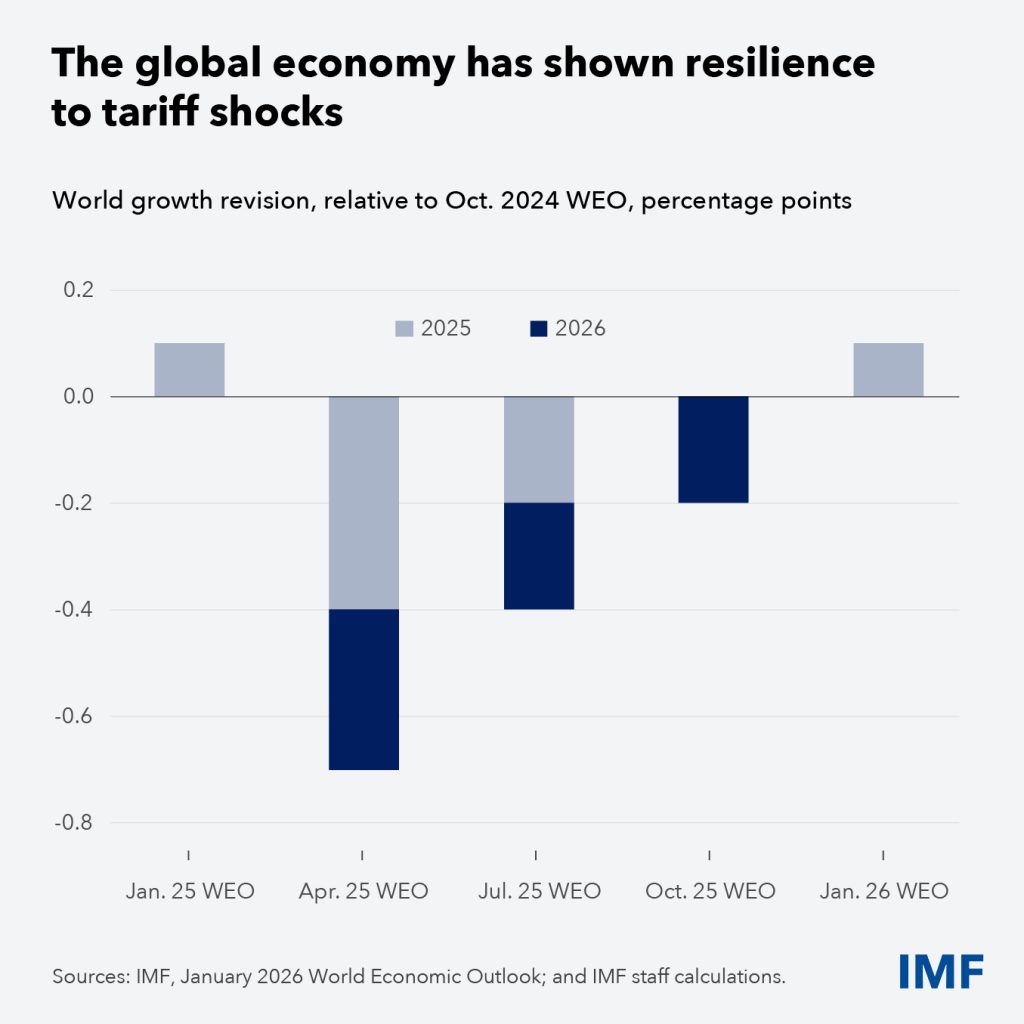
The tariffs announced by the US Administration are far-reaching and affect a substantial share of global trade flows. The effects on the real economy are likely to be material. In its World Economic Outlook, published last week, the International Monetary Fund revised down global growth projections for 2025-26 by a cumulative 0.8 percentage points and global trade by a cumulative 2.3 percentage points.[9] This notably reflects a negative hit from tariffs that ranges between 0.4% to 1% of world GDP by 2027.[10] In particular, IMF growth projections for the United States have been revised down by a cumulative 1.3 percentage points in 2025-26. The cumulative impact on euro area growth is smaller, at 0.4 percentage points.
Financial fragmentation
The fragmentation we are witnessing in global trade is mirrored in the financial sector, where geopolitical tensions are also reshaping the landscape.
In recent years, global foreign direct investment flows have increasingly aligned with geopolitical divides. Foreign direct investment in new ventures has plunged by nearly two-thirds between countries from different geopolitical blocs. However, strong intra-bloc investments have helped sustain overall foreign direct investment levels globally, masking some of the fragmentation occurring beneath the surface.[11]
But, as with trade flows, this dynamic is unlikely to persist as geopolitical tensions grow within established economic blocs. For instance, increased geopolitical distance is shown to curtail cross-border lending. A two standard deviation rise in geopolitical distance – akin to moving from the position of France to that of Pakistan in relation to Germany – leads to a reduction of 3 percentage points in cross-border bank lending.[12]
The impact of fragmentation in global financial infrastructure is perhaps even more revealing. Since 2014 correspondent banking relationships – crucial for facilitating trade flows across countries – have declined by 20%. While other factors – such as a wave of concentration in the banking industry, technological disruptions and profitability considerations – have played a role[13], the contribution of the geopolitical dimension can hardly be overstated. The repercussions of this decline can be profound. Research shows that when correspondent banking relationships are severed in a specific corridor, a firm’s likelihood of continuing to export between the two countries of that corridor falls by about 5 percentage points in the short term, and by about 20 percentage points after four years.[14]
Contributing to this trend, countries such as China, Russia and Iran have launched multiple initiatives to develop alternatives to established networks such as SWIFT, raising the possibility of a fragmented global payment system.[15] Geopolitical alignment now exerts a stronger influence than trade relationships or technical standards in connecting payment systems between countries.[16] This poses risks of regional networks becoming more unstable, increased trade costs and settlement times, and reduced risk sharing across countries.
Additionally, we are witnessing a noticeable shift away from traditional reserve currencies, with growing interest in holding gold. Central banks purchased more than 1,000 tonnes of gold in 2024, almost double the level of the previous decade, with China being the largest purchaser, at over 225 tonnes. At market valuations, the share of gold in global official reserves has increased, reaching 20% in 2024, while that of the US dollar has decreased. Survey data suggest that two-thirds of central banks invested in gold to diversify, 40% to protect against geopolitical risk and 18% because of the uncertainty over the future of the international monetary system.[17] There are further signs that geopolitical considerations increasingly influence decisions to invest in gold. The negative correlation of gold prices with real yields has broken down since 2022, a phenomenon we have also observed in recent weeks. This suggests that gold prices have been influenced by more than simply the use of gold to hedge against inflation. Moreover, countries geopolitically close to China and Russia have seen more pronounced increases in the share of gold in official foreign reserves since the last quarter of 2021.
The looming consequences of fragmentation
Accelerating fragmentation is resulting in the immediate disruptions we are now seeing, but this is likely to only be the beginning – potentially profound medium and long-term consequences for growth, stability and prosperity can be expected.
Medium-term impacts
The initial consequences of fragmentation are already evident in the form of increased uncertainty. In particular, trade policy uncertainty has led to a broader rise in global economic policy instability, which is stifling investment and dampening consumption. Our research suggests that the recent increase in trade policy uncertainty could reduce euro area business investment by 1.1% in the first year and real GDP growth by around 0.2 percentage points in 2025-26[18]. Consumer sentiment is also under strain, with the ECB’s Consumer Expectations Survey revealing that rising geopolitical risks are leading to more pessimistic expectations, higher income uncertainty and ultimately a lower willingness to spend.[19] Moreover, ECB staff estimates suggest that the observed increase in financial market volatility might imply lower GDP growth of about 0.2 percentage points in 2025.
Over the medium term, tariffs are set to have an unambiguously recessionary effect, both for countries imposing restrictions and those receiving them. The costs are particularly high when exchange rates fail to absorb tariff shocks, and some evidence suggests exchange rates have become less effective in this role.[20]
The Eurosystem’s analysis of potential fragmentation scenarios suggests that such trade disruptions could turn out to be significant. In the case of a mild decoupling between the western (United States-centric) and the eastern (China-centric) bloc, where trade between East and West reverts to the level observed in the mid-1990s, global output could drop by close to 2%.[21] In the more extreme case of a severe decoupling – essentially a halt to trade flows – between the two blocs, global output could drop by up to 9%. Trade-dependent nations would bear the brunt of these trade shocks, with China potentially suffering losses of between 5% and 20%, and the EU seeing declines ranging from 2.4% to 9.5% in the mild and severe decoupling scenarios respectively. The analysis also shows that the United States would be more significantly affected if it imposed additional trade restrictions against western and neutral economies – with real GDP losses of almost 11% in the severe decoupling scenario – whereas EU losses would increase only slightly in such a case.[22]
The inflationary effects of trade fragmentation are more uncertain. They depend mainly on the response of exchange rates, firms’ markups and wages. Moreover, they are not distributed equally. While higher import costs and the ensuing price pressures are likely to drive up inflation in the countries raising tariffs, the impact is more ambiguous in other countries as a result of the tariffs’ global recessionary effects, which push down demand and commodity prices, as well as of the possible dumping of exports from countries with overcapacity. The short to medium-term effects may even prove disinflationary for the euro area, where real rates have increased and the euro has appreciated following US tariff announcements.
In fact, a key feature of most model-based assessments is that higher US tariffs lead to a depreciation of currencies against the US dollar, moderating the inflationary effect for the United States and amplifying it for other countries. But so far we have seen the opposite: the risk-off sentiment in response to US tariff announcements and economic policy uncertainty have led to capital flows away from the United States, depreciating the dollar and putting upward pressure on US bond yields. Conversely, the euro area benefited from safe haven flows, with the euro appreciating and nominal bond yields decreasing.
Long-term structural changes
The long-term consequences of economic fragmentation are inherently difficult to predict, but by drawing on historical examples and recognising emerging trends, it’s clear that we are on the verge of significant structural changes. Two areas stand out.
The first one is structurally lower growth. On this point, international economic literature has reached an overwhelming consensus.[23] Quantitatively, point estimates might vary. For example, research of 151 countries spanning more than five decades of the 20th century reveals that higher tariffs have typically led to lower economic growth. This is largely due to key production factors – labour and capital – being redirected into less productive sectors.[24]
However, data from the late 19th and early 20th centuries, a period which tariff supporters often look back to, seem to tell a different story. At that time, trade barriers across countries were high – the US effective tariff rate, for example, reached almost 60%, twice as high as after the 2 April tariffs. And sometimes countries imposing higher trade barriers enjoyed higher growth, which may provide motivation for current policymakers’ trade tariff policies. But these episodes need to be read in historical context. Before 1913, tariffs mostly shielded manufacturing, a high-productivity sector at the time, attracting labour from other, less productive sectors, like agriculture. Therefore, their negative effects were mitigated by the expansion of industries at the frontier of technological innovation. Moreover, the interwar years offer further nuance – the Smoot-Hawley tariffs of the 1930s had relatively limited direct effects on US growth, mainly because trade accounted for just 5% of the economy.
But today’s tariffs are unlikely to replicate the positive effects seen in the 19th century. Instead, they risk creating the same inefficiencies observed in the course of the 20th century, by diverting resources from high-productivity sectors to lower-productivity ones. This contractionary effect could lead to persistently lower global growth rates. In fact, the abolition of trade barriers within the EU and the international efforts towards lower trade barriers in the second half of the 20th century were a direct response to the economic and political impact of protectionism,[25] which had played a key role in worsening and prolonging the Great Depression[26] and had contributed to the formation of competing blocs in the run-up to the Second World War.[27]
The second long-term shift driven by fragmentation might be the gradual transition from a US-dominated, global system to a more multipolar one, where multiple currencies compete for reserve status. For example, if the long-term implications of higher tariffs materialise, notably in the form of higher inflation, slower growth and higher US debt, this could undermine confidence in the US dollar’s dominant role in international trade and finance.[28] Combined with a further disengagement from global geopolitical affairs and military alliances, this could, over time, undermine the “exorbitant privilege” enjoyed by the United States, resulting in higher interest rates domestically.[29]
Moreover, as alternative payment systems gain traction, regional currencies may start to emerge as reserves within their respective blocs. This could be accompanied by the rise of competing payment systems, further fragmenting global financial flows and international trade. Such shifts would increase transaction costs and erode the capacity of countries to share risks on a global scale, making the world economy more fragmented and less efficient.
The central bank’s role in a fragmented world
So, as these tectonic shifts reshape the global economic landscape, central banks must adapt their approaches while remaining steadfast in their core mandates. The challenges posed by fragmentation require a delicate balance between confronting new realities and working to preserve the benefits of an integrated global economy. In order to navigate the present age of fragmentation, it is necessary to take action in four key areas.
First, central banks must focus on understanding and monitoring fragmentation. Traditional macroeconomic models often assume seamless global integration and may not fully capture the dynamics of a fragmenting world. Enhanced analytical frameworks that incorporate geopolitical factors and how businesses adjust to these risks will be essential for accurate forecasting and effective policy formulation. The Eurosystem is reflecting on these issues.
Second, monetary policy must adapt to the new nature of supply shocks generated by fragmentation. The effects of the greater frequency, size and more persistent nature of fragmentation-induced shocks and their incidence on prices require a careful calibration of our monetary responses. In this respect, our communication needs to acknowledge the uncertainty and trade-offs we face while giving a clear sense of how we will react depending on the incoming data. This can be done by making use of scenario analysis and providing clarity about our reaction function, as emphasised recently by President Lagarde.[30]
Third, instead of building walls, we must forge unity. Even as political winds shift, central banks should strengthen international cooperation where possible. Through forums such as those provided by the BIS and the Financial Stability Board, we can keep open channels of cooperation that transcend borders. Our work on cross-border payments stands as proof of this commitment in line with the G20 Roadmap[31]. The ECB is pioneering a cross-currency settlement service through TARGET Instant Payment Settlement (TIPS) – initially linking the euro, the Swedish krona and the Danish krone. We are exploring connections between TIPS and other fast-payment systems globally, both bilaterally and on the basis of a multilateral network such as the BIS’ Project Nexus.[32]
And fourth, central banks must enhance their capacity to address financial stability risks arising from fragmentation. The potential for sudden stops in capital flows, payment disruptions and volatility in currency markets requires robust contingency planning and crisis management frameworks. Global financial interlinkages and spillovers highlight the importance of preserving and further reinforcing the global financial safety net so that we can swiftly and effectively address financial stress, which is more likely to emerge in a fragmenting world.[33]
In fact, the lesson from the 1930s is that international coordination is key to avoiding protectionist snowball effects, where tit-for-tat trade barriers multiply as each country seeks to direct spending to merchandise produced at home rather than abroad.[34] In order to avoid this, the G20 countries committed to preserving open trade could call an international trade conference to avoid beggar-thy-neighbour policies[35] and instead agree on other measures, such as macroeconomic policies that can support the global economy in this period of uncertainty and contribute to reduce global imbalances.
Let me finally emphasise that the current situation also has important implications for the euro area. If the EU upholds its status as a reliable partner that defends trade openness, investor protection, the rule of law and central bank independence, the euro has the potential to play the role of a global public good. This requires a deep, trusted market for internationally accepted euro debt securities. That is why policy efforts to integrate and deepen European capital markets must go hand in hand with efforts to issue European safe assets.[36]
Conclusion
Let me conclude.
As we stand at this crossroads of global fragmentation, we must confront an uncomfortable truth: we are drifting toward a fractured economic and financial landscape where trust is eroded and alliances are strained.
Central banks now face a double challenge: to be an anchor of stability in turbulent economic waters while reimagining their role in a world where multiple economic blocs are forming. The question is not whether we adapt, but how we mitigate the costs of fragmentation without sacrificing the potential of global integration.
Our greatest risk lies not in the shocks we anticipate, but in the alliances we neglect, the innovations we overlook and the common ground we fail to find. The future of global prosperity hinges on our ability to use fragmentation as a catalyst to reinvent the common good.

I would like to thank Michele Ca’ Zorzi, Massimo Ferrari Minesso, Georgios Georgiadis, Cyril-Max Neuman and Jean-Francois Jamet for their help in preparing this speech, as well as Alina-Gabriela Bobasu, Laura Lebastard and Baptiste Meunier for their input.
ECB (2025), “Topic 2: The impact of a shift in US trade policies”, Introductory statement in three charts, 20 March.
Leino, T. and Gavrilovic, M. (2025), “Foreign Direct Investment Increased to a Record $41 Trillion”, IMF Blog, International Monetary Fund, 20 February.
Gopinath, G., Gourinchas, P. O., Presbitero, A. F. and Topalova, P. (2025), “Changing global linkages: A new Cold War?”, Journal of International Economics, Vol. 153, January. See also Qiu, H., Xia, D. and Yetman, J. (2025), “The role of geopolitics in international trade”, BIS Working Papers, No 1249, Bank for International Settlements, 14 March – the paper finds that year-on-year trade values between more geopolitically distant economies grew, on average, around 12 percentage points more slowly than between closer ones from 2017-23, mostly reflecting a fall in the quantity of goods traded among more geopolitically distant economies.
Bosone, C., Dautović, E., Fidora, M. and Stamato, G. (2024), “How geopolitics is changing trade”, Economic Bulletin, Issue 2, ECB. “Rivals” and “friends” refer to countries that fall into the fourth and first quartile of the distribution of geopolitical distance across country pairs respectively. Geopolitical distance is measured based on countries’ observable behaviour on foreign policy issues, such as disagreements in their voting behaviour in the UN General Assembly, in line with Bailey, M.A., Strezhnev, A. and Voeten, E. (2017), “Estimating Dynamic State Preferences from United Nations Voting Data”, Journal of Conflict Resolution, Vol. 61, No 2, pp. 430-456.
The firms surveyed are mostly multinationals with significant operations in the EU, and most also have a large share of activity outside the EU.
Almost 40% said that they were pursuing a strategy to mostly source the same inputs from other countries outside the EU, 20% that they were pursuing a strategy to mostly source the same inputs from other countries inside the EU, while 15% said that they were pursuing other strategies, such as holding more inventory, diversifying their input sources, monitoring risk more closely, changing the composition of their product(s) or closing down some production capacity. See Attinasi, M. G., Ioannou, D., Lebastard, L. and Morris, R. (2023), “Global production and supply chain risks: insights from a survey of leading companies”, Economic Bulletin, Issue 7, ECB.
Gopinath, G. et al., op. cit.
See International Monetary Fund (2025), “Chapter 1: Global Prospects and Policies”, World Economic Outlook, April.
See International Monetary Fund (2025), “The global effects of recent trade policy actions: insights from multiple models”, ibid.
Boeckelmann, L. et al. (2024), “Geopolitical fragmentation in global and euro area greenfield foreign direct investment”, Economic Bulletin, Issue 7, ECB.
Pradhan, S. K., Stebunovs, V., Takáts, E. and Temesvary, J. (2025), “Geopolitics meets monetary policy: decoding their impact on cross-border bank lending”, BIS Working Papers, No 1247, Bank for International Settlements.
Various factors might have been at play, such as fallouts from the financial crisis – which forced weaker banks to shut down or merge with stronger institutions to survive – or technological disruptions, with digital banking and fintech alternatives reducing the need for smaller, local banks as customers shifted to online platforms, bypassing physical branches, or the creation of new payment platform and digital asset exchanges. Lower profitability and revisions of banks’ strategies also contributed to the decline in banking relations as the prolonged low interest rate environment compressed profit margins for banks, especially smaller ones reliant on traditional lending, pushing some to exit or merge.
See Borchert, L., De Haas, R., Kirschenmann, K. and Schultz, A. (2024), “Broken Relationships: De-Risking by Correspondent Banks and International Trade”, CEPR Discussion Papers, No 19373, CEPR, 19 August. See also Boar, C., Rice, T. and von Peter, G. (2020), “On the global retreat of correspondent banks”, BIS Quarterly Review, Bank for International Settlements, March.
ECB (2024), The international role of the euro, June.
Ferrari Minesso, M., Mehl, A., Triay Bagur, O. and Vansteenkiste I., (2025), “Geopolitics and global interlinking of fast payment systems”, CEPR Discussion Papers, No 20105, CEPR, 4 April.
OMFIF (2024), Global Public Investor 2024.
See ECB (2025), “The impact of tariffs on the March 2025 staff projections”, ECB staff macroeconomic projections for the euro area, March.
Coibion, O., Georgarakos, D., Gorodnichenko, Y., Kenny, G. and Meyer, J. (2025), “Worrying about war: geopolitical risks weigh on consumer sentiment”, The ECB Blog, 7 April.
Barattieri, A., Cacciatore, M., & Ghironi, F. (2021). “Protectionism and the business cycle”, Journal of International Economics, 129, 103417; Eichengreen, B. (2019). “Trade policy and the macroeconomy”, IMF Economic Review, 67, 4-23; Furceri, D., Hannan, S. A., Ostry, J. D., & Rose, A. K. (2018), “Macroeconomic consequences of tariffs”, National Bureau of Economic Research Working Paper, No. 25402.
Attinasi, M. G., Mancini, M., Boeckelmann, L., Giordano, C., Meunier, B., Panon, L., Almeida, A.M., Balteanu, I., Bańbura, M., Bobeica, E., Borgogno, O., Borin, A., Caka, P., Campos, R., Carluccio, J., De Castro Martins, B., Di Casola, P., Essers, D., Gaulier, G., Gerinovics, R., Giglioli, S., Ioannou, D., Kaaresvirta, J., Khalil, M., Kutten, A., Lebastard, L., Lechthaler, W., Martínez Hernández, C., Matavulj, N., Morris, R., Nuutilainen, R., Quintana, J., Savini Zangrandi, M., Schmidt, K., Serafini, R., Smagghue, G., Strobel, F., Stumpner, S., Timini, J. and Viani, F. (2024), “Navigating a fragmenting global trading system: insights for central banks”, Occasional Paper Series, No 365, ECB. Countries are allocated to geopolitical blocs (western, eastern and neutral) according to an index of economic and political alignment. See “Annex 1: Allocation of countries to geopolitical blocs”, ibid.
To the extent that the EU faces no trade restrictions with other western economies and neutral countries.
Eichengreen, op. cit., Barbiero, O., Farhi, E., Gopinath, G. and Itskhoki, O. (2019), “The macroeconomics of border taxes”, NBER Macroeconomics Annual, Vol. 33, Issue 1, pp. 395-457.
Furceri, D., Hannan, S. A., Ostry, J. D. and Rose, A. K. (2020), “Are tariffs bad for growth? Yes, say five decades of data from 150 countries”, Journal of Policy Modeling, Vol. 42, Issue 4, pp. 850-859. They show that a one standard deviation increase in tariff rates correlates with a 0.4% decline in GDP five years later.
See also Panetta, F. (2023), “United we stand: European integration as a response to global fragmentation”, speech at an event on “Integration, multilateralism and sovereignty: building a Europe fit for new global dynamics” organised by Bruegel, Brussels, 24 April.
Eichengreen, B. and Irwin, D. A. (2010), “The Slide to Protectionism in the Great Depression: Who Succumbed and Why?”, The Journal of Economic History, Vol. 70, Issue 4, pp. 871-897.
Jacks, D. S. and Novy, D. (2019), “Trade Blocs and Trade Wars during the Interwar Period”, NBER Working Paper Series, No 25830.
Mukhin, D. (2022), “An equilibrium model of the international price system“, American Economic Review, Vol. 112, No 2, pp. 650-688; Barbiero, O. et al., op. cit.
Eichengreen, B., Mehl, A. and Chiţu, L. (2019), “Mars or Mercury? The geopolitics of international currency choice“, Economic Policy, Vol. 34, Issue 98, pp. 315-363.
See Lagarde, C. (2025), “A robust strategy for a new era”, speech at the 25th “ECB and Its Watchers” conference organised by the Institute for Monetary and Financial Stability at Goethe University, Frankfurt am Main, 12 March.
G20 (2020), G20 Riyadh SummitLeaders’ Declaration, 21 November, paragraph 16; Financial Stability Board (2020), Enhancing Cross-border Payments – Stage 1 report to the G20, 9 April; Committee on Payments and Market Infrastructures (2020), Enhancing cross-border payments: building blocks of a global roadmap – Stage 2 report to the G20, Bank for International Settlements,13 July; and Financial Stability Board (2020), Enhancing Cross-border Payments – Stage 3 roadmap, 13 October.
See Cipollone, P. (2025), “Enhancing cross-border payments in Europe and beyond”, speech at the Regional Governors’ Meeting in Osijek, 1 April.
As noted in Aiyar, S. et al. (2023), “Geoeconomic Fragmentation and the Future of Multilateralism”, IMF Staff Discussion Notes, 15 January, the global financial safety net plays an important role in safeguarding the stability of the global economy, but its coverage is uneven and global liquidity provision is limited. The global financial safety net consists of central banks’ foreign exchange reserves, central banks’ bilateral swap arrangements, regional financing arrangements and the IMF. See also IMF (2025), Global Financial Stability Report, April.
Eichengreen, B. and Irwin, D. A., op. cit.
See also Sapir, A. (2025), “The European Union should form an international open trade coalition in response to Trump’s tariffs”, First Glance, Bruegel.
Cipollone, P. (2024), “Why Europe must safeguard its global currency status”, Financial Times, 12 June, and Panetta, F. (2023), “Europe needs to think bigger to build its capital markets union”, Politico, 30 August.

 
Compliments of the European Central BankThe post ECB | Navigating a fractured horizon: risks and policy options in a fragmenting world first appeared on European American Chamber of Commerce New York [EACCNY] | Your Partner for Transatlantic Business Resources.

EACC

ECB | The first year of the Eurosystem’s new operational framework

Blog post by By Benjamin Hartung, Tobias Linzert, Imène Rahmouni-Rousseau, Yannik Schneider and Marta Skrzypińska | One year after its announcement, the new operational framework is working as intended. Euro area banks have adapted to declining central bank reserves as the Eurosystem’s balance sheet is normalising. The ECB Blog assesses how banks and money markets cope with the new environment.

The normalisation of monetary policy over recent years has also meant declining amounts of central bank reserves in the hands of commercial banks. In March 2024, the Eurosystem announced changes to its operational framework to ensure that it remains appropriate as the central bank balance sheet continues to decline. The new framework foresees that the ECB continues to steer the monetary policy stance through the deposit facility rate (DFR). Moreover, standard refinancing operations (SROs) will play a central role in providing liquidity to banks as needed.[2]Banks can now borrow reserves, i.e. liquidity, through SROs at a rate of 15 basis points above the DFR – compared to 50 basis points previously – with full allotment against a broad set of collateral.
How has central bank liquidity changed?
Excess liquidity has declined by more than €2 trillion from its peak in November 2022. It now stands at €2.8 trillion (Chart 1, panel a).[3] Reserves are still abundant in the banking system overall. Yet, their distribution is uneven. This means that it is important to assess whether reserves are sufficient at the individual bank level.
Banks are adapting to an environment with less ample liquidity in the context of the new operational framework and the fully phased-in liquidity regulation introduced after the global financial crisis.[4]Therefore, it is essential to look beyond banks’ conventional reserve demand as a medium for settling payments and for precautionary purposes; we also need to consider the regulatory value of central bank reserves.
We have conducted a confidential survey of bank treasurers to inquire about the sources of liquidity demand. The survey reveals that a large majority of banks still hold abundant reserves relative to their desired reserve targets. However, 40% of them are already operating close to their internal liquidity coverage ratio (LCR) and net stable funding ratio (NSFR) targets (Chart 1, panel b).[5] Supervisors and banks prioritise managing these ratios via their high-quality liquid assets (HQLA) portfolio and stable term-liquidity funding. This is increasingly shaping money markets.

Chart 1
Liquidity position of euro area banks

a) Path of excess liquidity

b) Share of banks split by liquidity positions

(EUR billions)

(percentage)

Sources For panel a), ECB calculations. For panel b), ECB (market operations database, Common Reporting Framework/Financial Reporting Framework, Eurosystem survey of bank treasurers), ECB calculations.
Notes For panel a) the Eurosystem excess liquidity projection is based on Survey of Monetary Analysts median expectation of the Eurosystem balance sheet evolution. Panel b) takes bank-level answers to the survey of bank treasurers about their preferred internal targets for reserves, LCR and NSFR, and it compares these against regulatory ratios reported in the third quarter of 2024 and level of reserves held in the fourth quarter of 2024. Where bank answers to the survey are not available, internal targets are extrapolated. Banks are identified as close to LCR/NSFR targets if they hold reported regulatory ratios less than 10 percentage points above the target. Banks are classified as close to reserve targets if their distance to the internal reserve target is in the bottom 25th percentile of the distribution, equivalent to 1.1% of total assets surplus reserves.

Money market rates are well anchored around the policy rate
Central banks like to see that money market interest rates, the rates commercial banks pay to borrow and lend among themselves, align well with monetary policy interest rates. So far, this is the case. As the Eurosystem’s balance sheet normalises, short-term money market rates are well anchored around the DFR. The euro short-term rate (€STR), which is the benchmark rate for unsecured borrowing, has slightly narrowed its spread to the DFR (Chart 2, panel a). And secured money market (repo) rates have gradually moved closer to the DFR.[6]
This development marks a shift from collateral scarcity to collateral abundance owing to the declining Eurosystem balance sheet and rising net government bond issuance.[7] At the same time, the share of repo transactions conducted at rates above the DFR is slowly increasing. It now accounts for about 15% of the traded volume. However, this does not indicate scarcity in reserves, as banks near their reserve target account for only a small fraction of trades above the DFR (Chart 2, panel b – yellow bar). Rather, the higher rates are more likely the result of reserve-rich dealer banks facing increased demand to intermediate government bond transactions from non-banks.

Chart 2
Repo rates anchored at the DFR with no signs of reserve scarcity

a) Short-term rates-DFR spread

b) Share of repo trading above the DFR

(basis points)

(percentage)

Sources: For panel a) Money Market Statistical Reporting (MMSR) data. For panel b) MMSR data, Securities Financing Transaction Data (SFTD), Bloomberg, ECB calculations.
Notes: Panel a) shows weekly moving averages excluding the month-ends. Repo rate captures MMSR based weighted-average repo rate against government collateral with one day maturity, trimmed. Downward spikes represent prolonged downward pressure owing to collateral scarcity that extended beyond month-ends. Panel b) shows the share of the one-day repo trading volume by rate bucket and which counterparties trade above the DFR. Euro area banks borrowing in repo are classified based on their liquidity positions, foreign banks or entities without access to Eurosystem operations are represented by the grey part in the bar.

Market funding remains attractive to meet liquidity needs
Banks have responded to the decrease in reserves by increasingly managing their liquidity through market activities, with the repo market being the main channel for redistributing reserves.[8] Banks close to their reserve targets borrow in the repo market to keep reserves above their desired levels. However, the portion of repo market activity that is motivated by reserve needs is still limited. Most of the €1 trillion of trading volume comes from banks with reserves well above their internal desired reserve levels.
Borrowing reserves in the market is generally more attractive than using Eurosystem refinancing operations (Chart 3, panel a). Banks can borrow reserves at rates below the DFR in both the repo and the unsecured markets. This explains why their appetite to borrow reserves from the Eurosystem remains low for the time being.
Looking ahead, demand for these operations is expected to increase (Chart 3, panel b). For now, market rates close to the DFR and muted SRO participation indicate that reserves are still ample. Moreover, market funding continues to be comparatively attractive, even after the cost of borrowing from the Eurosystem was reduced to 15 basis points under the new operational framework.

Chart 3
Banks tap markets to satisfy liquidity demand as market funding is economically attractive

a) Relative market pricing of borrowing in money markets vs the expected DFR

b) Use of Eurosystem standard refinancing operations

(basis points above expected DFR)

(EUR billions)

Sources: For panel a) STEP, Bloomberg, MMSR data, SFTD. For panel b) ECB calculations and Survey of Monetary Analysts (SMA) from March 2025 .
Notes: In panel a) the one-day rates spread to DFR is captured by the yellow dots. The three-month (3M) rates are adjusted for the 3M €STR OIS and the €STR-DFR spread to show the relative yield over the market-implied DFR over the next three months. The “non-HQLA repo” category is based on an estimation which includes all trades with maturity of one to three months similarly corrected for the market implied DFR. The central estimate is captured by a blue -diamond with 90% confidence intervals depicted by the whiskers. Remaining rates show average since 1 Jul 2024- 27 March 2025. For panel b), the projection of the SROs going forward is based on the March 2025 Survey of Monetary Analysts.

Regulatory liquidity demand on the rise
As excess liquidity declines, banks are increasingly focusing on their regulatory liquidity buffers. This has led to increased holdings of government bonds and non-retained covered bonds to offset the reduction in reserves within their HQLA portfolios. To manage their liquidity targets and compensate for TLTRO repayments, banks have also increased their borrowing in term markets. This represents a normalisation in how banks source liquidity and diversify their funding structure.

Chart 4
Banks resort to market funding for HQLA

a) Outstanding term commercial papers

b) Redistribution and generation of HQLA via the term-repo market

(Index=100 in 2021, first quarter)

(EUR billions)

Sources For panel a), CMD, ECB calculations. For panel b), SFTD, ECB (MOPDB) and ECB calculations.
Notes For panel a) the average outstanding amount of commercial papers (CP) and certificates of deposits (CD) per quarter by euro area domiciled banks in any currency with original maturity above six months. Panel b) shows outstanding volumes of HQLA generated for the borrower, accounting for HQLA-status of the underlying collateral. Open-term repo or evergreen transactions are excluded.

For example, banks have increased their borrowing via term commercial paper by €100 billion, mainly driven by those banks approaching their LCR and NSFR targets (Chart 4, panel a).[9] Term-repos, which boost the LCR, have emerged as a key source that allows banks to generate and redistribute HQLA.[10] In recent years, banks’ borrowing of HQLA through the term repo market has grown tenfold to nearly €350 billion (Chart 4, panel b). This new market segment now accounts for 14% of total outstanding repo transactions. Meanwhile, the prices for term funding have started to rise above those in other money market segments with fewer regulatory benefits. This highlights the importance banks place on market funding with LCR advantages.
Conclusion
One year after its announcement, the new operational framework is working as intended.
Banks have been adapting very well amid an unprecedented decline in excess liquidity. Money market rates are well controlled. And, so far, banks have almost exclusively met their liquidity needs through market sources, rather than by borrowing from the Eurosystem.
Banks use repo markets to redistribute reserves to where they are needed, although their prime focus is on term liquidity to optimise their regulatory liquidity ratios. However, most banks’ desired reserve levels have not yet been tested. As reserves are set to decline further, it will be crucial to ensure that money markets continue to function smoothly and that banks are prepared to use the Eurosystem’s operations in their day-to-day liquidity management.[11]
The views expressed in each blog entry are those of the author(s) and do not necessarily represent the views of the European Central Bank and the Eurosystem.

We are very grateful to Rita Vitorino Besugo for her contribution to the this article.
See the ECB Blog “Managing liquidity in a changing environment”, by Claudia Buch and Isabel Schnabel.
Excess liquidity is defined as reserves held with the central bank above the minimum reserve requirements. Read the ECB’s explainer on excess liquidity for more detail.
In January 2018 the LCR was fully phased in. The NSFR has been applicable in the EU at a minimum of 100% since 28 June 2021. The regulation puts emphasis on the stability of term funding sources. For compliance with the LCR, banks are encouraged to secure funding beyond one month maturity, and for the NSFR the funding should be above 12 months (or six months counting at 50% discount).
Banks’ preference to hold reserves beyond minimum required reserves relates to settlement needs including intraday liquidity, the wish to signal a strong liquidity position to investors, prudent internal liquidity management rules to account for sudden market volatility or margin calls, and based on supervisory guidance. Banks also set internal targets for the LCR and the NSFR above the 100% minimum regulatory requirement for prudential reasons for example in the internal liquidity adequacy assessment process. The targets represent a reference point for banks’ internal liquidity risk management processes.
Repo refers to repurchase transactions, a type of short-term loan where one party sells a financial asset with a simultaneous commitment to repurchase that asset at a future date. The repo market is therefore also called the secured money market, as borrowing of liquidity (reserves) is secured by collateral (typically government bonds) which the cash lender keeps as insurance should the borrower not repay the loan. Before the global financial crisis, reserves were mainly redistributed via unsecured borrowing and bank lending.
Please also see Isabel Schnabel’s speech on the ECB’s balance sheet reduction.
Please see The ECB Blog ‘Repo markets: Understanding the effects of a declining Eurosystem market footprint’ for more detail. Before the global financial crisis, reserves were mainly redistributed via unsecured overnight deposits. Currently, the unsecured overnight deposits market is mostly channelling deposits of non-banks to banks that can, in turn, place the liquidity with the central bank as reserves. See the ECB’s webpage on the €STR for more details. In addition, see Isabel Schnabel’s speech on the ECB’s balance sheet reduction.
See The ECB Blog ‘how banks deal with declining excess liquidity’.
The LCR ensures that banks have an adequate stock of unencumbered HQLA that can be converted easily and immediately in private markets into reserves to meet their liquidity needs for a 30-calendar day liquidity stress scenario. Borrowing in the term (maturities above 30 days) repo market secured by non-HQLA collateral has a positive impact on banks’ reported LCRs. In these term-repo transactions, the borrowing bank increases the HQLA numerator as it exchanges non-HQLA collateral for HQLA reserves, while the outflow denominator only starts to be affected as the maturity of the repo falls below 30 days. For maturities that are longer than six months, the transaction would additionally carry NSFR benefits.
See The ECB Blog ‘Managing liquidity in a changing environment’, by Claudia Buch and Isabel Schnabel.

 
Compliments of the European Central BankThe post ECB | The first year of the Eurosystem’s new operational framework first appeared on European American Chamber of Commerce New York [EACCNY] | Your Partner for Transatlantic Business Resources.

EACC & Member News

AKD: Alternative Investment Funds Industry Quarterly Update Q1 2025

The European AIF market is one of the fastest growing in the financial sector. For this reason, your AKD counsels keep up to date with developments in this dynamic industry. To help financial market participants to stay on top of current trends in the AIF space, the AKD Quarterly Update provides information on selected Luxembourg and Dutch legal, tax and regulatory matters within the AIF industry.
EACC & Member News

Loyens & Loeff: Indirect Cost Compensation subsidy for Dutch industry to return

The Netherlands has a subsidy scheme to compensate certain industrial sectors for indirect emission costs relating to the EU Emission Trading System (EU ETS), which subsidy scheme follows directly from EU law. These indirect emission costs are generally passed on in electricity prices and therefore have a bigger effect on energy-intensive industries.

Read more

EACC

IMF | Rising Global Debt Requires Countries to Put their Fiscal House in Order

Amid heightened uncertainty, policymakers will need to deal with complex trade-offs between debt, slower growth, and new spending pressures
Major policy shifts underway have heightened global uncertainty. The series of recent tariff announcements by the United States, and countermeasures by other countries have increased financial market volatility, weakened growth prospects, and increased risks. They come in the context of rising debt levels in many countries and already strained public finances, which in many cases will also need to accommodate new and permanent increases in spending, such as defense. Rising yields in major economies and widening spreads in emerging markets further complicate the fiscal landscape.
We project global public debt to increase by 2.8 percentage points this year—more than twice the estimates for 2024—pushing debt levels above 95 percent of gross domestic product. This upward trend is likely to continue, with public debt nearing 100 percent of GDP by the end of the decade, surpassing pandemic levels. These numbers are based on the World Economic Outlook reference projections, reflecting tariff announcements made between Feb. 1 and April 4. Amid substantial policy uncertainty and a shifting economic landscape, debt levels could rise even further.

In this environment, fiscal policy faces critical trade-offs: balancing debt reduction, building buffers against uncertainties, and meeting urgent spending needs amid weaker growth prospects and higher financing costs. Navigating these complexities will be essential for fostering stability and growth.
Risk of higher debt
Debt risks were already elevated. According to the Fiscal Monitor’s debt-at-risk, which utilizes data up to December 2024, in a severely adverse scenario global public debt could reach 117 percent of GDP by 2027. This would represent the highest level since World War II, exceeding reference projections by almost 20 percentage points.
Risks to the fiscal outlook have further intensified. Debt levels may rise even further than the debt-at-risk estimates if revenues and economic output decline more significantly than current forecasts due to increased tariffs and weakened growth prospects. Additionally, escalating geoeconomic uncertainties could heighten debt risks, driving up public debt through increased expenditures, particularly in defense. Demands for fiscal support could also rise for those vulnerable to severe disruptions from trade shocks, pushing up spending. The Fiscal Monitor estimates that a significant rise in geoeconomic uncertainty could lead to a public debt increase of approximately 4.5 percent of GDP in the medium term.

Tighter and more volatile financial conditions in the United States may have ripple effects on emerging markets and developing economies, leading to higher financing costs. This significantly impacts commodity prices, resulting in lower prices and heightened price volatility. Limited fiscal improvements may further heighten risks from rising interest rates, especially as many countries have substantial financing needs. High interest rates could limit essential spending on social programs and public investments. Additionally, reduced foreign aid, due to shifting priorities among advanced economies complicates financing for low-income countries.
Complex policy tradeoffs
In an uncertain and rapidly changing world, countries will need to first and foremost put their own fiscal house in order. This means implementing prudent policies within robust fiscal frameworks to build public confidence and help reduce uncertainty.
Fiscal policy should prioritize reducing public debt and establishing and widening buffers to address spending pressures and economic shocks. This means finding the right balance between adjustment and supporting economic growth, tailored to each country’s unique situation, available resources, and overall economic conditions.
Countries with limited room in government budgets should implement gradual and credible consolidation plans and allow automatic stabilizers, like unemployment benefits, to work effectively. Any new spending needs should be offset by spending cuts elsewhere or new revenues. For countries with greater fiscal flexibility, it is important to utilize available resources judiciously within well-defined medium-term plans. Fiscal support for businesses and communities impacted by severe trade dislocations should be both temporary and targeted, with a strong emphasis on transparency and effective cost management.
More generally, advanced economies should tackle issues related to aging populations by reprioritizing spending, advancing pension and healthcare reforms, and broadening the tax base. In emerging and developing economies, enhancing the tax system is crucial due to historically low revenues. Low-income developing countries should stay the course on fiscal adjustments given financing challenges. Timely and orderly debt restructuring alongside such adjustments is essential for countries facing debt distress.
Additionally, fiscal policy, alongside other structural policies, should focus on enhancing potential growth. This can help ease challenging tradeoffs between growth and debt sustainability. For instance, well-designed pensions and energy subsidy reforms can generate savings that can be used to support social programs and infrastructure investments.
As significant policy changes and heightened uncertainty reshape the global economic landscape, the fiscal outlook has worsened. To effectively navigate these challenges, governments should focus on building public trust, ensuring fair taxation, and managing resources wisely. By doing so, they can foster resilience and promote sustainable growth in uncertain times.
—This blog is based on Chapter 1 of the April 2025 Fiscal Monitor, “Fiscal Policy under Uncertainty.”
 
Compliments of the International Monetary FundThe post IMF | Rising Global Debt Requires Countries to Put their Fiscal House in Order first appeared on European American Chamber of Commerce New York [EACCNY] | Your Partner for Transatlantic Business Resources.
EACC

Financial Stability Board | FSB Chair’s letter to G20 Finance Ministers and Central Bank Governors: April 2025

The global risk outlook has become more challenging amid increased trade and economic policy uncertainty.
This letter was submitted to G20 Finance Ministers and Central Bank Governors (FMCBG) ahead of the G20’s meeting on 23-24 April.
As his term as FSB Chair nears its conclusion on 1 July 2025, Klaas Knot reflects on the progress made in addressing global challenges to financial stability and outlines priorities for the future. The letter notes the challenging global risk outlook, with increased trade and economic policy uncertainty reflected in large price swings and heightened volatility in global financial markets. The letter calls on market participants and financial supervisors and regulators to remain vigilant.
Recent episodes of financial market turmoil, rapid technological advancements, and the growing threat of climate change, all underscore the need for vigilance and international cooperation.
The FSB has played a critical role in enhancing the resilience of the financial system.
The letter emphasises the importance of implementing reforms and highlights the need for sustained global coordination to address emerging risks and ensure a resilient financial system.
 
Compliments of the Financial Stability Board – a global economic advisory boardThe post Financial Stability Board | FSB Chair’s letter to G20 Finance Ministers and Central Bank Governors: April 2025 first appeared on European American Chamber of Commerce New York [EACCNY] | Your Partner for Transatlantic Business Resources.

EACC & Member News

Loyens & Loeff: Cross-border bribery and corruption: How changes in FCPA enforcement under President Trump could challenge Dutch criminal enforcement actions

Recent discussions suggest that policy changes implemented during President Trump’s administration may significantly impact the enforcement of anti-corruption and anti-bribery laws by U.S. authorities. In this blog, we explore the potential risks these changes may pose for the foregoing may have for corruption investigations involving the Netherlands.

Read more

EACC

IMF | World Economic Outlook, April 2025: A Critical Juncture amid Policy Shifts

Global growth is expected to decline and downside risks to intensify as major policy shifts unfold
Executive Summary:
Following an unprecedented series of shocks in the preceding years, global growth was stable yet underwhelming through 2024 and was projected to remain so in the January 2025 World Economic Outlook (WEO) Update. However, the landscape has changed as governments around the world reorder policy priorities. Since the release of the January 2025 WEO Update, a series of new tariff measures by the United States and countermeasures by its trading partners have been announced and implemented, ending up in near-universal US tariffs on April 2 and bringing effective tariff rates to levels not seen in a century (Figure ES.1). This on its own is a major negative shock to growth. The unpredictability with which these measures have been unfolding also has a negative impact on economic activity and the outlook and, at the same time, makes it more difficult than usual to make assumptions that would constitute a basis for an internally consistent and timely set of projections.
Given the complexity and fluidity of the current moment, this report presents a “reference forecast” based on information available as of April 4, 2025 (including the April 2 tariffs and initial responses), in lieu of the usual baseline. This is complemented with a range of global growth forecasts, primarily under different trade policy assumptions.
The swift escalation of trade tensions and extremely high levels of policy uncertainty are expected to have a significant impact on global economic activity. Under the reference forecast that incorporates information as of April 4, global growth is projected to drop to 2.8 percent in 2025 and 3 percent in 2026—down from 3.3 percent for both years in the January 2025 WEO Update, corresponding to a cumulative downgrade of 0.8 percentage point, and much below the historical (2000–19) average of 3.7 percent.
In the reference forecast, growth in advanced economies is projected to be 1.4 percent in 2025. Growth in the United States is expected to slow to 1.8 percent, a pace that is 0.9 percentage point lower relative to the projection in the January 2025 WEO Update, on account of greater policy uncertainty, trade tensions, and softer demand momentum, whereas growth in the euro area at 0.8 percent is expected to slow by 0.2 percentage point. In emerging market and developing economies, growth is expected to slow down to 3.7 percent in 2025 and 3.9 percent in 2026, with significant downgrades for countries affected most by recent trade measures, such as China. Global headline inflation is expected to decline at a pace that is slightly slower than what was expected in January, reaching 4.3 percent in 2025 and 3.6 percent in 2026, with notable upward revisions for advanced economies and slight downward revisions for emerging market and developing economies in 2025.
Intensifying downside risks dominate the outlook. Ratcheting up a trade war, along with even more elevated trade policy uncertainty, could further reduce near- and long-term growth, while eroded policy buffers weaken resilience to future shocks. Divergent and rapidly shifting policy stances or deteriorating sentiment could trigger additional repricing of assets beyond what took place after the announcement of sweeping US tariffs on April 2 and sharp adjustments in foreign exchange rates and capital flows, especially for economies already facing debt distress. Broader financial instability may ensue, including damage to the international monetary system. Demographic shifts and a shrinking foreign labor force may curb potential growth and threaten fiscal sustainability. The lingering effects of the recent cost-of-living crisis, coupled with depleted policy space and dim medium-term growth prospects, could reignite social unrest. The resilience shown by many large emerging market economies may be tested as servicing high debt levels becomes more challenging in unfavorable global financial conditions. More limited international development assistance may increase the pressure on low-income countries, pushing them deeper into debt or necessitating significant fiscal adjustments, with immediate consequences for growth and living standards. On the upside, a deescalation from current tariff rates and new agreements providing clarity and stability in trade policies could lift global growth.
The path forward demands clarity and coordination. Countries should work constructively to promote a stable and predictable trade environment, facilitate debt restructuring, and address shared challenges. At the same time, they should address domestic policy and structural imbalances, thereby ensuring their internal economic stability. This will help rebalance growthinflation trade-offs, rebuild buffers, and reinvigorate medium-term growth prospects, as well as reduce global imbalances. The priority for central banks remains fine-tuning monetary policy stances to achieve their mandates and ensure price and financial stability in an environment with even more difficult trade-offs. Mitigating disruptive foreign exchange volatility may require targeted interventions, as outlined in the IMF’s Integrated Policy Framework. Macroprudential tools should be activated as needed to contain the buildup of vulnerabilities and to provide support in case of stress events. Restoring fiscal space and putting public debt on a sustainable path remain an important priority, while meeting critical spending needs to ensure national and economic security. This requires credible medium-term fiscal consolidation plans. Structural reforms in labor, product, and financial markets would complement efforts to reduce debt and narrow cross-country disparities. As Chapter 2 explains, countries’ age structures are evolving at different rates, with important consequences for medium-term growth and external imbalances. In addition, as Chapter 3 documents, migration policy shifts in destination countries have sizable spillover effects, disproportionately affecting emerging market and developing economies.
Read full outlook here.
 
Compliments of the International Monetary FundThe post IMF | World Economic Outlook, April 2025: A Critical Juncture amid Policy Shifts first appeared on European American Chamber of Commerce New York [EACCNY] | Your Partner for Transatlantic Business Resources.

EACC

IMF | The Global Economy Enters a New Era

Amid trade tensions and high policy uncertainty, the path forward will be determined by how challenges are confronted and opportunities embraced
Blog post by Pierre-Olivier Gourinchas | The global economic system under which most countries have operated for the last 80 years is being reset, ushering the world into a new era. Existing rules are challenged while new ones are yet to emerge. Since late January, a flurry of tariff announcements by the United States, which started with Canada, China, Mexico and critical sectors, culminated with near universal levies on April 2. The US effective tariff rate surged past levels reached during the Great Depression while counter-responses from major trading partners significantly pushed up the global rate.

The resulting epistemic uncertainty and policy unpredictability is a major driver of the economic outlook. If sustained, this abrupt increase in tariffs and attendant uncertainty will significantly slow global growth. Reflecting the complexity and fluidity of the moment, our report presents a range of forecasts for the global economy.

Our World Economic Outlook’s reference forecast includes tariff announcements between February 1 and April 4 by the US and countermeasures by other countries. This reduces our global growth forecast to 2.8 percent and 3 percent this year and next, a cumulative downgrade of about 0.8 percentage point relative to our January 2025 WEO update. We also present a global forecast excluding the April tariffs (pre-April 2 forecast). Under this alternative path, global growth would have seen only a modest cumulative downgrade of 0.2 percentage point, to 3.2 percent for 2025 and 2026.
Finally, we include a model-based forecast incorporating announcements made after April 4. Over that period, the United States temporarily halted most tariffs while raising those on China to prohibitive levels. This pause, even if extended indefinitely, does not materially change the global outlook compared to the reference forecast. This is because the overall effective tariff rate of the United States and China remains elevated even if some initially highly tariffed countries will now benefit, while policy-induced uncertainty has not declined.
Despite the slowdown, global growth remains well above recession levels. Global inflation is revised up by about 0.1 percentage point for each year, yet the disinflation momentum continues. Global trade was quite resilient until now, partly because businesses were able to re-route trade flows when needed. This may become more difficult this time around. We project that global trade growth will dip more than output, to 1.7 percent in 2025—a significant downward revision since our January 2025 WEO Update.

However, the global estimate masks substantial variation across countries. Tariffs constitute a negative supply shock for the implementing jurisdiction, as resources are reallocated towards the production of less-competitive items with a resulting loss of aggregate productivity and higher production prices. In the medium term, we can expect tariffs to decrease competition and innovation and increase rent-seeking, further weighing on the outlook.
In the United States, demand was already softening before the recent policy announcements, reflecting greater policy uncertainty. Under our April 2 reference forecast, we have lowered our US growth estimate for this year to 1.8 percent. That’s 0.9 percentage point lower than January, and tariffs account for 0.4 percentage point of that reduction. We also raised our US inflation forecast by about 1 percentage point, up from 2 percent.
For trading partners, tariffs are mostly a negative demand shock, driving foreign customers away from their products, even if some countries can benefit from the trade diversion. Consistent with this deflationary impulse, we have lowered our China growth forecast for this year to 4 percent, a 0.6 percentage point reduction, and inflation is revised down by about 0.8 percentage point.

Growth in the euro area, which is subject to relatively lower effective tariffs, is revised down by 0.2 percentage point, to 0.8 percent. Both in the euro area and China, stronger fiscal stimulus will provide some support this year and next. Many emerging market economies could face significant slowdowns depending on where tariffs settle. We have lowered our growth forecast for the group by 0.5 percentage point, to 3.7 percent.
Dense global supply chains can magnify the effects of tariffs and uncertainty. Most traded goods are intermediate inputs that cross borders multiple times before being turned into final products. Disruptions can propagate up and down the global input-output network with potentially large multiplier effects, as we saw during the pandemic. Companies facing uncertain market access will likely pause in the near term, reduce investment and cut spending. Likewise, financial institutions will reassess borrowers’ exposure. The increased uncertainty and tightening of financial conditions could well dominate the short term, weighing on economic activity, as reflected in the sharp decline in oil prices.
The effect of tariffs on exchange rates is complex. The United States, as the tariffing country, may see its currency appreciate as in previous episodes. However, greater policy uncertainty, dimmer US growth prospects, and an adjustment in the global demand for dollar assets—that has so far been orderly—can weigh down on the dollar, as we saw since the tariff announcements. In the medium term, the dollar may depreciate in real terms if the tariffs translate into lower productivity in the US tradable goods sector, relative to its trading partners.
Risks to the global economy have increased, and worsening trade tensions could further depress growth. Financial conditions could tighten further as markets react negatively to the diminished growth prospects and increased uncertainty. While banks remain well capitalized overall, financial markets may face more severe tests.
Growth prospects could, however, immediately improve if countries ease their current trade policy stance and forge new trade agreements. Addressing domestic imbalances can, over a period of years, offset economic risks and raise global output while contributing significantly to closing external imbalances.  For Europe, this means spending more on infrastructure to accelerate productivity growth. It also means boosting support for domestic demand in China, and stepping up fiscal consolidation in the United States.

Our policy recommendations call for prudence and improved collaboration. The first priority should be to restore trade policy stability and forge mutually beneficial arrangements. The global economy needs a clear and predictable trading system addressing longstanding gaps in international trading rules, including the pervasive use of non-tariff barriers or other trade-distorting measures. This will require improved cooperation.
Monetary policy will also need to remain agile. Some countries may confront steeper trade-offs between inflation and output. In others, inflation expectations may become less-well anchored, with a new inflation shock following closely after the prior one. Countries that encounter resurgent price pressures will require forceful monetary tightening. For others, the negative demand shock will warrant lower policy rates. Monetary policy credibility will be important in all cases, and central bank independence remains a cornerstone.
The increased external volatility from tariff adjustments and a possibly prolonged risk-off environment, may be difficult to navigate for emerging markets. Our Integrated Policy Framework emphasizes that it is important to let currencies adjust when driven by fundamental forces, as is the case now, and spells out the specific conditions where it is advisable for countries to intervene.
Fiscal authorities face starker trade-offs with high debt, low growth and rising financial costs. Most countries still have too little fiscal space and need to implement gradual and credible consolidation plans, while some of the poorest countries, also hit with reduced official aid, could experience debt distress.
New spending needs are further weighing on fiscal fragilities. Calls for support will increase for those at risk of severe dislocation from the shocks. Such support should remain narrowly targeted and incorporate automatic sunset clauses. The experience of the last four years suggests that it is easier to open the tap of fiscal support than to close it.
Some countries, especially in Europe, face new and permanent increases in
defense-related spending. How should these be financed? For countries with sufficient fiscal space, only the temporary part of the additional spending—that is, temporary support to help adapt to the new environment or the initial bulge in spending to rebuild defense capabilities—should be financed by debt. For all other countries, new spending needs should be offset by spending cuts elsewhere or new revenues.
We should not lose sight of the need for stronger growth. Governments should continue to engage in fiscal and structural reforms that help mobilize private resources and reduce resource misallocation. They should also invest in the digital infrastructure and training necessary to benefit from new technologies such as artificial intelligence.
Finally, we should ask ourselves why our global system warrants remapping—and recognize that decades of deepening trade ties fostered rapid but uneven economic growth. In many advanced economies, there is an acute perception that globalization unfairly displaced many domestic manufacturing jobs. There is some merit to these grievances, even if the share of manufacturing employment in advanced economies has been in a secular decline in countries running trade surpluses, like Germany, or deficits, like the United States.
The deeper force behind this decline is technological progress and automation, not globalization: in both countries the output share of manufacturing has remained stable. Both forces are ultimately beneficial but can be very disruptive to individuals and communities. It is a collective responsibility to ensure the right balance between the pace of progress or globalization and addressing the associated dislocations.

This requires that policymakers think well beyond the reductive lens of compensating transfers between ”winners” and ”losers,” be it of technological revolutions or globalization. In this, unfortunately not enough has been done, pushing many to embrace a zero-sum worldview whereby the gains of some only come at the expense of others. Instead, it is important to better understand these root causes so that we can build an improved trading system that delivers more opportunities. This objective is enshrined in our Articles of Agreement, which ask us “to facilitate the expansion and balanced growth of international trade, and to contribute thereby to the promotion and maintenance of high levels of employment and real income.”
Global integration is not an objective in and of itself. It is a means to an end, important insofar as it supports improved living standards for all.
—This blog is based on Chapter 1 of the April 2025 World Economic Outlook, “Policy Uncertainty Tests Global Resilience.”
 
Compliments of the International Monetary FundThe post IMF | The Global Economy Enters a New Era first appeared on European American Chamber of Commerce New York [EACCNY] | Your Partner for Transatlantic Business Resources.